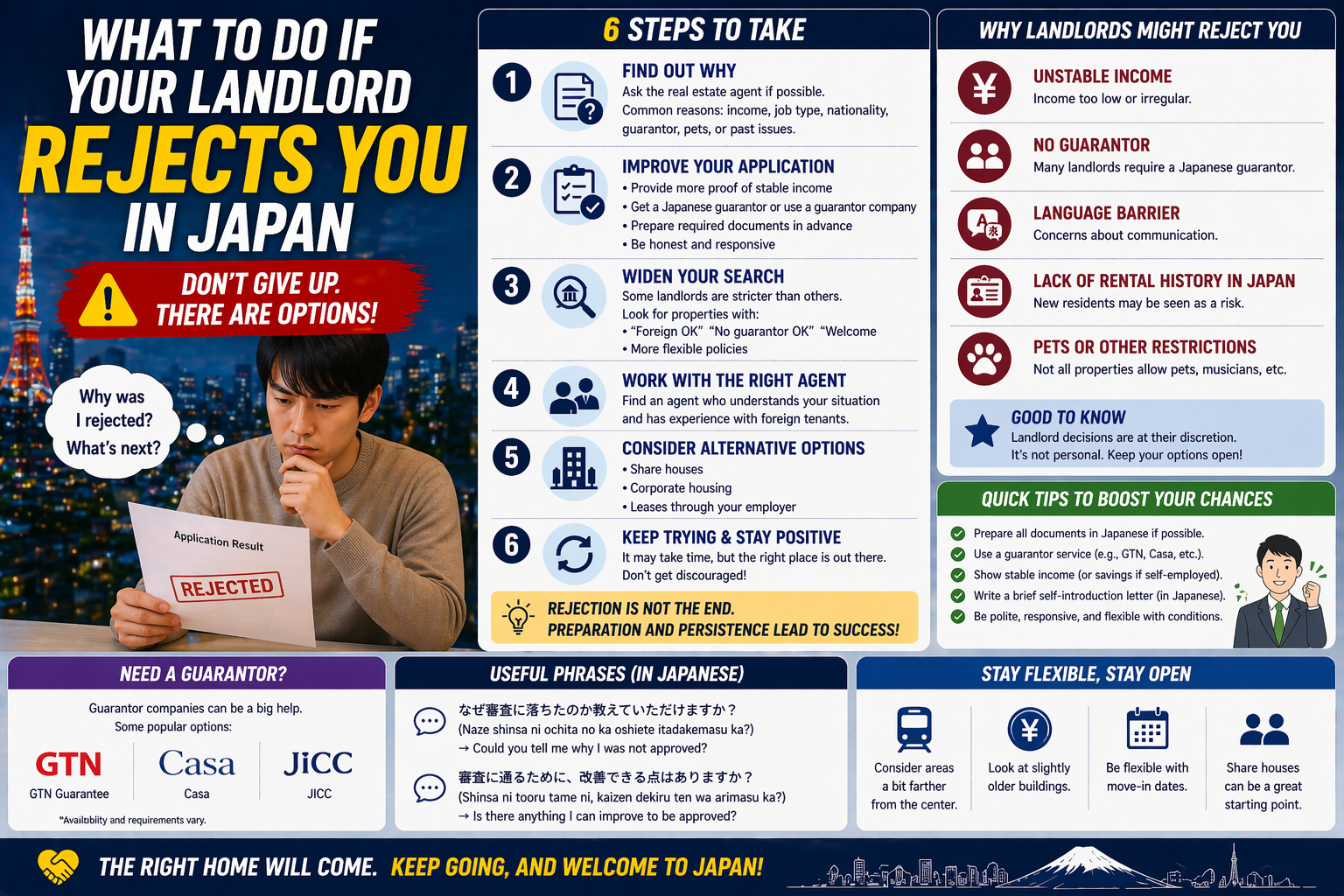
What to Do If Your Landlord Rejects You in Japan
If a landlord rejects your application in Japan, do not wait and hope the same listing comes back. Ask where the rejection happened, fix the weak point in your application, and switch quickly to properties, agents, or housing systems that are easier for foreign residents to pass.
In many cases, the problem is not only the landlord. The rejection may come from the management company, a rent guarantee company, or a document issue during screening. That matters, because your next step depends on who said no and why.
- First move: ask the agent whether the rejection came from the landlord, management company, or guarantee company.
- Most useful fix: strengthen your documents before applying again, especially income proof, visa period, emergency contact, and guarantor or guarantee-company readiness.
- Best fallback: look at foreigner-friendly listings, Safety Net Housing, or UR rental housing if you meet the conditions.
- If nationality was the reason: keep records and contact the Ministry of Justice human rights counseling service.
Who This Guide Is For
This guide is for foreign residents, students, workers, and people moving to Japan for the first time.
It matters when you have already been turned down for a private rental apartment, or when an agent hints that screening will be difficult because of income, language, visa length, family size, or guarantor issues.
Why Rejections Happen
A rejection in Japan is often called a failed screening result rather than a detailed refusal notice. The official MLIT apartment guide shows what agents usually check: your occupation, income, co-occupants, Japanese ability, reason for moving, ID, and whether you have a guarantor. That gives a good picture of what screening is really about.
Common practical reasons
- Your income looks too low for the rent.
- Your visa period is short compared with the lease term.
- You cannot provide the documents the agent or guarantee company wants.
- You have no guarantor, or the guarantee company does not approve you.
- The landlord is worried about communication after move-in.
- The property has restrictions on children, extra occupants, pets, or business use.
A point many renters miss
The landlord may not be the only decision-maker. In Japan, a rent guarantee company is often required at application stage. MLIT’s guide says a guarantor or a rental guarantee company is often needed, and the guarantee fee is commonly around half a month’s rent for a two-year guarantee, though actual fees vary.
So when you hear “the landlord rejected you,” ask one more question: was it really the owner, or was it the guarantee screening?
What To Do Right After a Rejection
Take the next steps in order. Speed matters because good listings disappear fast.
1. Ask where the rejection happened
Send a short message or call the agent and ask:
- Was the decision made by the landlord, the management company, or the guarantee company?
- Was there a document problem?
- Can I reapply if I change the guarantor or guarantee company?
- Are there similar units in the same building with easier screening?
You may not get a full answer. Some agents will only say that screening did not pass. Even then, knowing whether the issue was owner-side or guarantee-side helps you avoid wasting time on the same problem again.
2. Rebuild your application file
Prepare the documents that usually matter most:
- Residence card or passport
- Employment certificate or student certificate
- Recent payslips or other proof of earnings
- Bank balance proof if income is new or irregular
- Emergency contact in Japan
- Clear explanation of who will live there and for how long
If your job changed recently, or you are a new arrival, add a short explanation in simple Japanese or English. A messy application file can lose against a similar applicant with cleaner documents.
3. Adjust your search conditions
If one apartment rejected you, do not keep applying only to the same type of listing.
Change at least one of these points:
- Lower the rent target
- Widen the area by one or two stations
- Use an older building instead of a new one
- Accept a smaller room or longer commute
- Focus on properties already known to accept foreign tenants
This is often more effective than arguing about one rejected unit.
ここがポイント: In Japan, housing screening is usually a package decision about rent risk, paperwork, and communication. Treat a rejection as a signal to change your application strategy, not only to try harder with the same apartment.
Alternatives That Can Work Better
If private rentals keep failing, switch to channels that are structurally easier.
UR rental housing
UR is a major fallback because its official materials say it has no key money, no brokerage fee, no renewal fee, and no guarantor. The move-in cost is also lighter than many private rentals because the standard upfront payment is mainly a two-month deposit plus prorated rent and common-area fees.
That does not mean automatic approval. UR still has income and eligibility conditions, and not every property is available everywhere. But if your main problem is guarantor trouble or heavy upfront costs, UR is one of the first places to check.
Safety Net Housing
MLIT’s English apartment guide points foreign renters to the Safety Net Housing search site for units that accept foreigners. The site itself is mainly in Japanese, so it may be easier to use with an agent, school office, employer, or support center.
This route is especially useful if your applications keep failing for broad screening reasons rather than one specific building.
School, employer, or relocation support
Students should ask their school’s international office or student support section. Workers should ask HR or relocation staff whether the company has a partner agency, company lease scheme, or preferred guarantee company.
A landlord may feel more comfortable when the application comes through an institution they recognize.
If You Suspect Discrimination
Be realistic and precise here.
Japan does not usually give applicants a detailed written explanation for rental rejection. But the Ministry of Justice is clear that being refused apartment tenancy because of nationality is a human rights issue it handles through counseling and remedy procedures.
If an agent or landlord directly says you were refused because you are foreign, do this:
- Save screenshots, emails, listing pages, and chat logs
- Write down the date, office name, property name, and exact words used
- Ask once, calmly, whether another reason was given
- Contact the Ministry of Justice’s human rights counseling service for foreigners
The remedy system is not the same as getting a court order on the spot. But it is an official channel, it is free, and it can be the right next step when the reason given was plainly nationality.
Common Mistakes After Rejection
A failed application often gets worse because people react too narrowly.
Applying again without changing anything
If the first file failed because of income, guarantor, or visa length, a second application with the same weak points will likely fail too.
Hiding information
Do not hide extra occupants, pets, remote work plans, or short visa status. A smoother approval now can become a contract problem later.
Using only English in a difficult case
You do not need perfect Japanese. But for borderline screening cases, a short Japanese support note from your employer, school, spouse, or agent can make the application easier to trust.
Focusing only on central-city listings
Popular foreign-friendly neighborhoods in Tokyo, Osaka, and Kyoto often have tighter competition. One or two extra train stops can change the screening environment a lot.
Current Status to Know in 2026
As of April 23, 2026, the national MLIT housing support page for foreign renters is active, and its English apartment guide is still one of the clearest official summaries of how screening, guarantors, fees, and move-in steps work.
A useful practical update is MLIT’s current list of registered rent guarantee companies that provide language support for foreigners. The ministry’s page lists 52 companies as of December 31, 2025. If your rejection came from guarantee screening, asking your agent whether another registered company with foreign-language support can be used is a concrete next move.
Regional support also differs. For example, Tokyo Metropolitan Government continues to run consultation services for foreign residents, including general advisory and legal consultation channels. Other prefectures and cities may have their own multilingual support desks, but the range of languages and housing help is not the same everywhere.
Practical Next Checkpoints
If you were just rejected, check these before your next application:
- Can you prove stable income for the rent level you want?
- Is your visa period long enough to make the application look stable?
- Do you know whether the last rejection came from the owner or the guarantee company?
- Can your school, employer, or relocation service back the application?
- Have you widened the area or switched to UR or Safety Net Housing?
- If nationality was mentioned, have you saved the evidence and contacted a support desk?
One rejection does not mean you cannot rent in Japan. It usually means you need a different route, better paperwork, or a housing system designed to reduce the same screening barriers.
References / 参照リンク
- MLIT: Support for Foreign Nationals in Looking for Rental Housing
- MLIT Apartment Search Guidebook (English PDF)
- MLIT: List of registered rent guarantee companies that provide language support for foreigners
- UR Rental Housing: Information for Non-Japanese
- UR Rental Housing application guide (English PDF)
- Ministry of Justice Human Rights Bureau: What We Do
- Ministry of Justice Human Rights Bureau: Human Rights Counseling for Foreigners
- Tokyo Metropolitan Government: Consultation Service for Foreign Residents