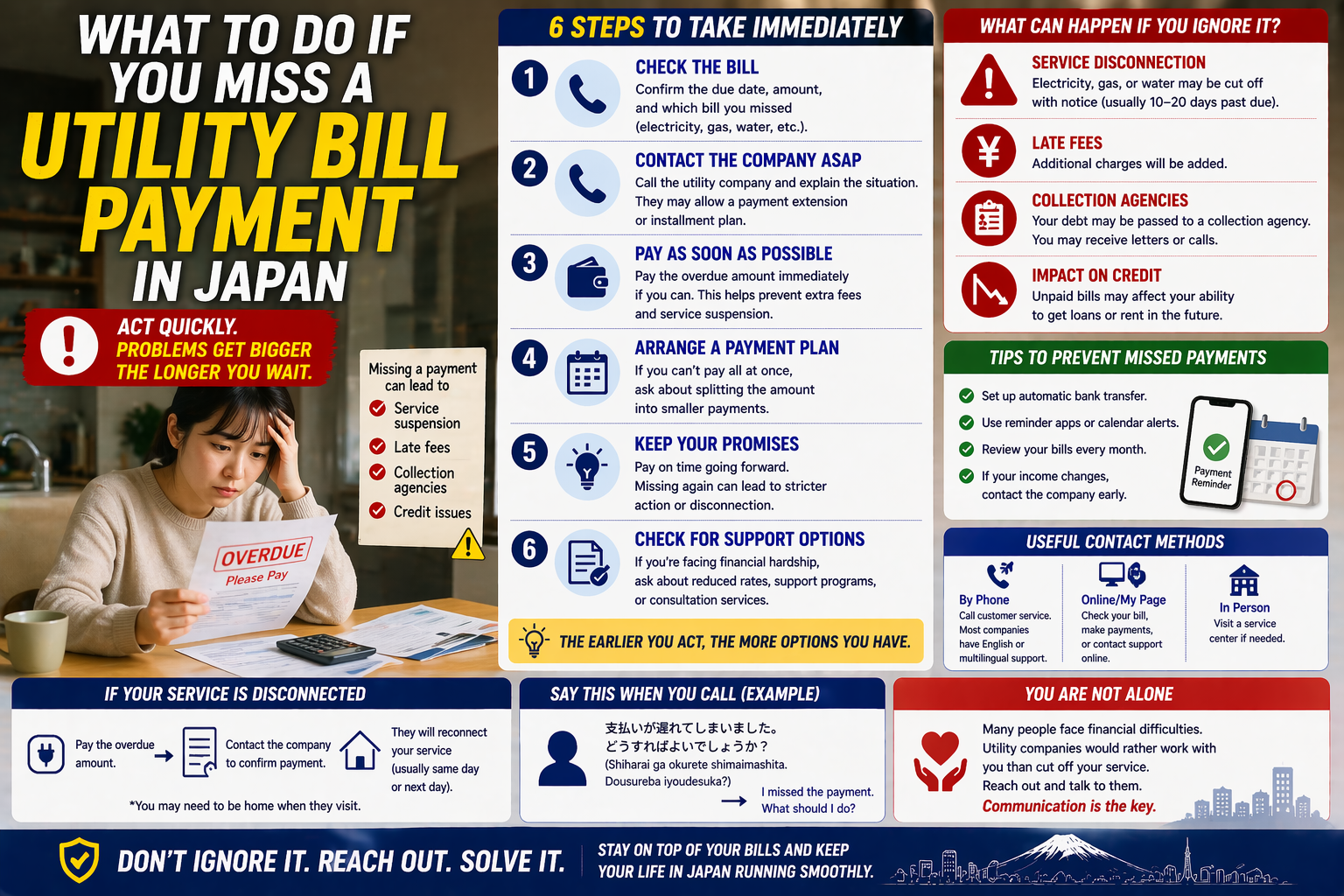
What to Do If You Miss a Utility Bill Payment in Japan
If you miss a utility bill in Japan, act quickly instead of waiting for the next notice. In many cases, electricity, gas, or water will not stop the same day your payment is late, but providers can add late charges, send warning postcards, suspend service, or cancel the contract if non-payment continues.
For most readers, the practical answer is simple: pay as soon as possible, keep proof of payment, and contact your provider right away if the slip is lost, expired, or the service has already been stopped.
- Best first move: check which utility is unpaid and whether the bill was supposed to be paid by paper slip, bank withdrawal, credit card, or app
- Do not assume the shutoff is immediate: timing differs by provider and by utility
- Do not ignore warning postcards or SMS: some are real, but scams also use fake overdue-payment messages
- Water rules are local: electricity and gas depend on your retailer, while water usually depends on your municipality
Who this guide is for
This guide is for foreign residents, students, workers, and beginners in Japan who pay their own electricity, gas, or water bills.
It matters most if:
- you pay with a paper slip from the convenience store
- your bank account did not have enough money on the withdrawal date
- you moved recently and missed a final bill
- you received a shutoff warning and are not sure whether it is real
- your gas or water has already stopped
What usually happens after a missed payment
The exact process depends on the company or municipality, but the pattern is usually the same: due date passes, reminder comes, then stronger action follows if you still do not pay.
Tokyo Gas explains this clearly in its English guide. It says the due date for gas and electricity is generally 30 days after the day following the meter reading date or electricity billing date. It also says late-payment interest can apply, and gas service may be shut off after prior notice if charges remain unpaid long enough. For electricity, it says the contract may be canceled after prior notice if payment remains overdue.
That matters because many newcomers assume a missed bill only creates a small fee. In practice, the bigger problem is often service interruption or a contract issue, not just the extra yen.
ここがポイント: In Japan, one missed bill does not always mean immediate shutoff, but ignoring the first warning can turn a small payment problem into a same-day living problem.
What to do right away
1. Confirm which bill is unpaid
Check the bill, app, web portal, email, or postcard notice.
You need to identify:
- the utility type: electricity, gas, or water
- the provider or municipality
- the customer number or contract number
- the due date
- whether there is already a shutoff date or suspension notice
If your payment method was automatic bank withdrawal, check whether the withdrawal failed because of low balance. If you recently moved, confirm that this is not a final bill from your old address.
2. Pay first if the bill is still payable
With some providers, late payment is still possible using the original paper invoice. TEPCO says customers can still pay with the paper invoice after the payment deadline has passed at a nearby convenience store, although a late fee may apply and the payment deadline itself cannot be extended.
That is useful in real life because many people panic when they see an overdue date and assume the slip is already useless. It may still work, but you should not delay.
3. Keep proof of payment
After payment, keep the receipt, app confirmation, or payment screen.
This matters most if:
- you paid close to the suspension date
- you paid at a bank or post office, where confirmation may take longer
- you need your electricity or gas turned back on
TEPCO says convenience-store payments are usually confirmed without further contact, but if you paid right before the scheduled termination date, or if you paid through a bank or post office, you should contact customer service and have your receipt ready.
4. Call if the bill is lost, expired, or the service is already off
Do not wait for a new slip automatically.
Call the provider or municipal water bureau if:
- you no longer have the bill
- the barcode or payment method no longer works
- the notice says a separate restart procedure is required
- your electricity, gas, or water is already stopped
If the line is in Japanese, prepare your customer number, address, name on the contract, and the date you paid.
If your electricity or gas has already been stopped
At that stage, the issue is no longer just “late payment.” You usually need both full payment and a restart process.
TEPCO’s English FAQ says that if electricity or gas was shut off because bills were not paid, all past-due bills must be paid before service can be resumed, and customers should contact the customer service center after payment.
Tokyo Gas says the same basic rule applies to gas service stopped for overdue payment: all overdue charges must be paid before service resumes. It also notes that, depending on how and when you paid, a separate application for resumption may be needed and reconnection can take time.
Gas has an extra point: check whether it is a safety stop, not a payment stop
Osaka Gas Network explains that gas can stop for different reasons. If payment could not be confirmed, the company posts a notice of supply stop and asks the customer to pay and contact the number shown on the notice. But gas may also stop because the meter’s safety function activated.
So if your gas suddenly stops:
- check for a posted notice about unpaid charges
- check whether the meter is showing a safety shutoff signal
- do not assume every gas stoppage is a billing problem
That can save you hours, especially if the real issue is meter reset rather than unpaid bills.
Water bills work differently because they are local
Water is not handled the same way nationwide. In most cases, the water bill is managed by a city or metropolitan water bureau, not by a retail company like electricity.
Tokyo Metropolitan Government guidance says water service can be stopped after repeated demands for payment. It also says that once water has been stopped, the full unpaid amount must be paid before service is reopened. If the service is already suspended, customers are told to call the department listed on the notice or the customer center.
This is why readers should not copy electricity advice directly onto water bills.
Why local differences matter
Regional differences can affect:
- how many reminder notices are sent
- whether multilingual support exists
- what office you must call
- whether online payment or app payment is available
- how fast payment is reflected in the system
For example, Yokohama has multilingual information pages explaining overdue-payment details. That does not mean every city offers the same level of language support.
Common mistakes that make the problem worse
Assuming your landlord pays the bill
In some rentals, water may be included in rent or building fees, but electricity and gas usually are not. Check your lease and your utility contract before ignoring a bill.
Ignoring a postcard because you already paid once before
TEPCO says postcards may be sent before payment is fully confirmed. That means a warning card is not always proof you still owe money. But it is also not something to throw away without checking.
Waiting for the next month to combine payments
This is risky. Water bureaus and utilities often want the overdue amount cleared first. If the service is already suspended, waiting for the next bill can delay reconnection.
Trusting a random SMS or robocall
The National Consumer Affairs Center of Japan warns about scams using automated calls that claim unpaid charges under the name of real companies. TEPCO and Tokyo Gas also warn customers about phishing messages pretending to be official overdue-payment notices.
Be careful if a message:
- pressures you to pay immediately through a strange link
- asks for prepaid card payment
- comes from an unfamiliar sender
- claims legal action before you have received any normal bill or notice
If you are unsure, open the provider’s official website yourself and contact customer support from there. Do not use the phone number or link inside a suspicious message.
When you should contact the provider before paying
Sometimes paying first is not the best first step.
Contact the provider or water bureau first if:
- you think the bill is wrong
- you moved out and the dates do not match your actual usage
- the contract is in another person’s name
- you are not sure whether the notice is from the retailer, the network company, or the municipality
- you need same-day reconnection information
This is especially important for electricity because Japan’s retail market is liberalized. The Agency for Natural Resources and Energy explains that households can choose among retail electricity providers, so the company sending your bill may not be the same company you assume from the region.
Current practical status as of April 23, 2026
As of April 23, 2026, the basic rule has not changed: missed utility payments in Japan are handled provider by provider, and water remains municipality based.
The current official guidance that matters most for readers is:
- Tokyo Gas still states due dates, late-payment interest, and overdue-payment shutoff rules on its English support page
- TEPCO still says late paper-invoice payment may be possible and that full overdue payment is required for resumption after shutoff
- Tokyo water guidance still says service may be suspended after repeated demands and that full payment is required after suspension
- Consumer agencies still warn about fake unpaid-charge calls and messages using real company names
So the most useful habit is not memorizing one national deadline. It is checking the exact operator on your bill every time.
Practical takeaway
If you miss a utility payment in Japan, do these three things in order:
- Check the real provider and the real due date.
- Pay immediately if the bill is still valid.
- Call the provider or municipality if the service is stopped, the bill is missing, or the message looks suspicious.
The part to watch most closely is the move from “late” to “stopped.” Once that happens, full payment and a separate restart step may be required, and the time without electricity, gas, or water can be much longer than the time it would have taken to deal with the first notice.
参照リンク
- Tokyo Gas: Procedures for Starting, Stopping, or Modifying Gas/Electricity Service
- Tokyo Gas: How to pay your gas and electricity bills
- TEPCO: Frequently Asked Questions
- TEPCO: Be suspicious of emails, calls, or messages pretending to be the TEPCO Group
- Tokyo Metropolitan Government Waterworks Bureau: Water service has been stopped
- Yokohama City: Water services (procedures and charges)
- Yokohama City: Multilingual explanation of overdue payment details
- Osaka Gas Network: FAQ on gas smell and gas stoppage
- Agency for Natural Resources and Energy: What does liberalization of the electricity market mean?
- National Consumer Affairs Center of Japan: Beware of scams claiming unpaid charges through automated calls