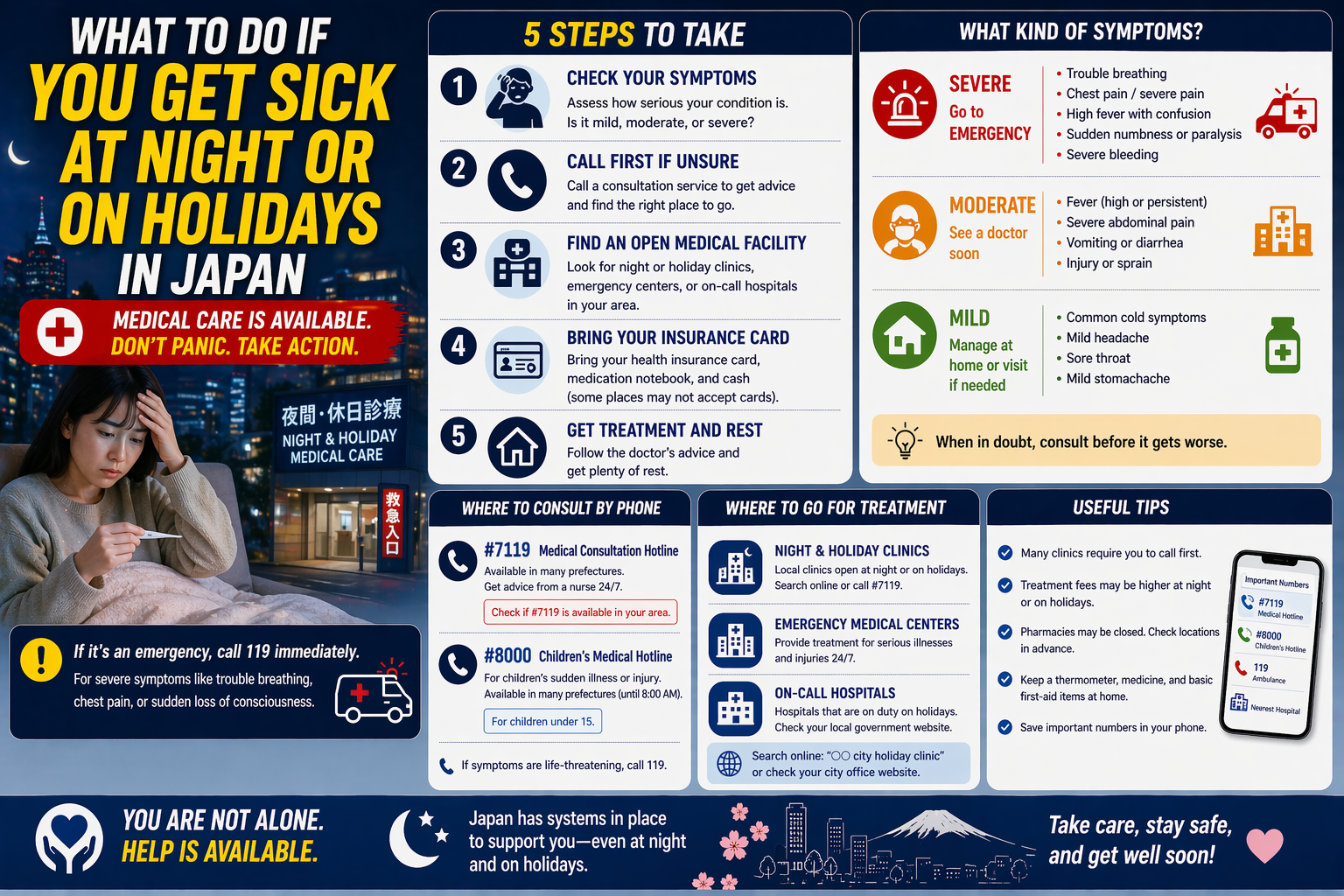
What to Do If You Get Sick at Night or on Holidays in Japan
If you get sick in Japan when your usual clinic is closed, the practical answer is simple: call 119 for a clear emergency, call #7119 if you are not sure and your area supports it, and use #8000 for a sick child at night or on holidays. If it is urgent but not life-threatening, look for a night or holiday clinic before you leave home, because hours and coverage vary by city and prefecture.
This guide is for tourists, students, workers, and long-term residents who need a clear plan when illness or injury happens outside normal clinic hours.
- Life-threatening signs: call
119now. - Not sure how urgent it is: try
#7119in areas that offer it. - Child under 15 with sudden symptoms: call
#8000for pediatric advice. - Need a clinic or pharmacy open now: search on Japan’s official Medical Information Net.
Start With the Fast Decision
At night or on national holidays, many regular clinics are closed. That does not mean you should wait until morning.
Use this order:
- If the person is unconscious, has severe trouble breathing, heavy bleeding, signs of stroke, a seizure that does not stop, or strong chest pain, call
119. - If the person looks sick but you are unsure whether to call an ambulance, use
#7119where available. - If the patient is a child and the problem is not clearly an ambulance case, call
#8000. - If you need a doctor soon but it does not look like an ambulance case, search for a holiday or night clinic and call before going.
ここがポイント: In Japan, the hardest part after-hours is often not the treatment itself. It is choosing the right route quickly.
119,#7119,#8000, and the local night-duty clinic each solve a different problem.
When You Should Call 119 Right Away
Japan’s emergency number for ambulance service is 119.
Call without delay if you see symptoms such as:
- sudden trouble breathing
- strong chest pain or pressure
- sudden speech trouble, facial drooping, or weakness on one side
- unconsciousness or confusion
- severe bleeding
- repeated seizures or a seizure with no recovery of consciousness
- major burns, a serious fall, or a traffic accident
The Tokyo Fire Department’s English EMS guide also links to the national ambulance warning signs list. The point is not to diagnose yourself. It is to avoid losing time in a real emergency.
If you need help from people nearby, this sentence is useful:
救急車を呼んでください。 (Please call an ambulance.)
When to Use #7119
#7119 is a phone consultation line for sudden illness or injury when you are unsure whether you need an ambulance or immediate medical care. Depending on the area, doctors, nurses, or trained staff listen to the symptoms and tell you whether to:
- call an ambulance
- go to a hospital right away
- wait and see
- use a nearby medical institution instead
This matters because #7119 is not nationwide in one uniform way yet. The Fire and Disaster Management Agency says on its current implementation page, accessed on April 23, 2026, that the service operates in 41 regions. Some places use #7119, while others use a different local consultation number.
So do not assume it will work everywhere in Japan. Check your prefecture, city, or fire department page if you have time. If you are in Tokyo, the Tokyo Fire Department states that #7119 is available 24 hours a day.
When to Use #8000 for a Child
If a child becomes sick at night or on a holiday and you are unsure whether to go to the hospital immediately, call #8000.
This line connects you to pediatric emergency advice in your prefecture. Staff can explain:
- whether the symptoms sound urgent
- whether home care is reasonable for the moment
- whether you should go to a clinic or hospital now
The Ministry of Health, Labour and Welfare’s latest status page available on April 23, 2026 shows that #8000 was in place in all 47 prefectures as of October 1, 2025, and every prefecture offered service past midnight. Even so, the exact hours still differ by prefecture, so local details matter.
How to Find a Night or Holiday Clinic
If the problem is urgent enough for same-day care but not a clear ambulance case, look for an after-hours clinic before you leave.
Your best official tool is Medical Information Net (医療情報ネット). It is run by the Ministry of Health, Labour and Welfare and prefectures. You can search for:
- clinics and hospitals open now
- holiday and night-duty medical institutions
- pharmacies
- language support
- nearby facilities based on location
This is the most practical national search tool because it is built for exactly this problem: finding care when normal clinics are closed.
For Tokyo, the Tokyo Fire Department also offers an English web-based EMS guide and nearby medical institution search.
Before you go
Do these three things first:
- Call the clinic or hospital if possible. Official guides warn that hours, language support, and acceptance can change.
- Confirm the department you need, such as internal medicine, pediatrics, surgery, or ENT.
- Check what payment methods they accept. Large hospitals often take cards, but smaller clinics may still prefer cash.
What This Means for Foreign Residents and Visitors
The biggest problem for many foreigners is not the phone number. It is the system difference.
In Japan, after-hours care is split between several routes:
- ambulance transport for emergencies
- consultation lines for deciding urgency
- local night-duty or holiday clinics for non-ambulance urgent care
- pharmacies and drugstores for mild symptoms
That structure is efficient once you know it, but confusing if you expect one national after-hours clinic chain.
If you are a short-term visitor and need multilingual support, JNTO’s Japan Visitor Hotline is available 24/7. It can help foreign visitors find medical support information, but it does not replace 119 in an emergency.
Costs and Insurance: What to Expect
A late-night or holiday visit can still lead to multiple charges:
- consultation or examination fees
- tests
- medicine
- separate pharmacy payment if you receive an outside prescription
For short-term visitors without Japanese health insurance, the bill can be high. JNTO warns that people without travel insurance may be charged the full amount, and it gives examples where serious cases can cost millions of yen.
For residents enrolled in Japanese public health insurance, the out-of-pocket burden is usually much lower than the full bill, but you still need to pay your share at the hospital or clinic.
The practical takeaway is simple:
- If you live in Japan, carry your health insurance card or My Number health card setup.
- If you are visiting, carry travel insurance details.
- In either case, keep some way to pay on the spot.
Regional Differences Matter More Than Many People Expect
This is not a system where one answer fits all of Japan.
Regional differences include:
- whether
#7119is available - the non-
#7119consultation number in some areas - which hospital or clinic is on night or holiday duty
- whether pediatric care is easy to find after hours
- how much English support is available
That is why the safest habit is to save local emergency links for the place where you actually live or stay, not just general Japan-wide advice.
Common Mistakes to Avoid
Waiting too long because the clinic is closed
Closed does not mean there is no care. Japan has emergency routes outside normal hours, but you may need a different phone number or a duty clinic.
Going straight to a random hospital without checking
Some hospitals cannot accept walk-ins for your case, your language, or that time slot. Call first when you can.
Assuming #7119 works everywhere
It does not. Coverage is expanding, but it is still regional.
Forgetting that children have a separate advice line
For a sick child at night, #8000 can save time and help you avoid the wrong level of care.
Focusing only on language and forgetting urgency
If the person has severe symptoms, call 119 first. Translation problems are secondary in a real emergency.
Current Status to Know in 2026
As of April 23, 2026, the useful current points are:
- The Fire and Disaster Management Agency’s current page says
#7119operates in 41 regions, so access is broader than before but still not universal. - The Ministry of Health, Labour and Welfare’s latest
#8000status page available that day shows all 47 prefectures participating as of October 1, 2025. - Medical Information Net is live nationwide and includes search functions for holiday/night care and foreign-language support.
Those three points matter more in practice than broad summaries. They tell you whether you can phone for triage, whether a child-specific line exists, and where to find an open clinic fast.
Final Practical Takeaway
If you live in Japan or are staying for more than a few days, save these before you need them:
119- your prefecture or city emergency medical page
#7119or your local emergency consultation number#8000- Medical Information Net
The real watchpoint is regional variation. The national tools are getting better, but when you get sick at 11 p.m. on a holiday, the result still depends on where you are and whether you can reach the right local service quickly.
参照リンク
- Ministry of Health, Labour and Welfare: What to do with adult symptoms – #7119
- Fire and Disaster Management Agency: What is #7119? Current implementation areas
- Fire and Disaster Management Agency: 2024 White Paper on Fire and Disaster Management
- Ministry of Health, Labour and Welfare: Child medical telephone consultation service #8000
- Ministry of Health, Labour and Welfare: What to do with children’s symptoms – #8000
- Medical Information Net
- Ministry of Health, Labour and Welfare: About the Medical Information Provision System
- Tokyo Fire Department: Tokyo EMS Guide
- Tokyo Fire Department: Situations in which you should call an ambulance without hesitation (Adult)
- Japan National Tourism Organization: Guide for when you are feeling ill