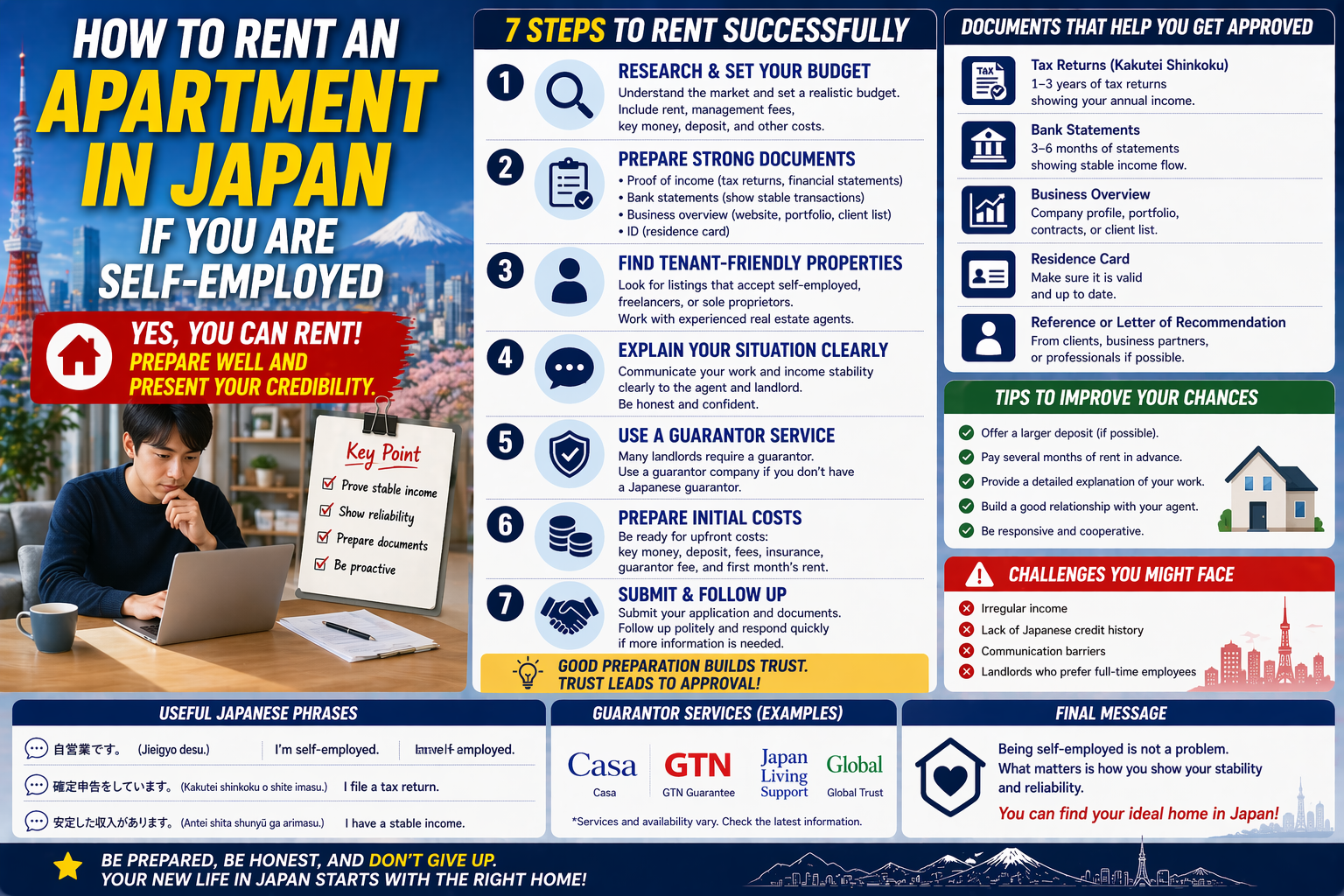
How to Rent an Apartment in Japan If You Are Self-Employed
Yes, you can rent an apartment in Japan if you are self-employed. The hard part is not your visa label or your job title by itself. The hard part is proving stable income in a format the landlord, agent, and guarantor company can screen quickly.
If you do not have a normal employment certificate, prepare a stronger file instead: your latest tax return, ID, proof of address, bank records, and a clear explanation of your work. That is what usually moves a self-employed application forward.
- Short answer: Self-employed renters are accepted in Japan, but screening is usually stricter than for salaried employees.
- What matters most: Recent income proof, a valid residence card, and whether a guarantor company will approve you.
- Typical upfront cost: MLIT says initial contract payments are often about 4 to 7 months of rent, plus a guarantee fee in many cases.
- Best strategy: Tell the agent at the start that you are self-employed and ask what documents their guarantor company wants before you apply.
Who This Guide Is For
This guide is for freelancers, sole proprietors, remote workers with independent contracts, and small business owners living in Japan.
It matters most if you are:
- renting your first long-term apartment in Japan
- moving after leaving a salaried job
- renewing your housing search with a short income history in Japan
- trying to rent as a foreign resident without a standard Japanese employer letter
Why Self-Employed Applicants Face More Screening
Japan’s rental process already asks many tenants for a guarantor or a rent guarantee company. MLIT’s apartment search guide says a guarantor or rent guarantee company is often required, and the standard document list includes a passport or residence card plus proof of earnings and other supporting papers.
For a salaried employee, that proof is often straightforward. For a self-employed person, it is less standardized. The landlord or guarantee company may worry about irregular monthly income, late tax filing, or difficulty contacting your business.
That does not mean automatic rejection. It means you need to replace the missing “company employee” paperwork with documents that show three things clearly:
- who you are
- how you earn money
- whether you can keep paying rent for the full contract term
ここがポイント: If you are self-employed, your application is usually strongest when you submit a tax return and supporting financial records early, instead of waiting for the agent to ask later.
The Documents That Usually Matter Most
Start with the documents that almost every application will need.
Basic identity and address documents
Prepare these first:
- passport
- residence card
- current address record if requested
- phone number and email that you can answer quickly
A residence record, often called juminhyo, is the municipal document used to certify your registered address in Japan. Some agents or guarantee companies may ask for it when they want stronger address proof than the residence card alone.
Income proof for self-employed renters
This is the core issue.
MLIT’s guidebook lists proof of earnings as a typical rental application document. For self-employed applicants, the closest standard substitute for an employment certificate is usually:
- your latest final tax return (
kakutei shinkoku) - recent bank statements showing business or personal income flow
- invoices or contracts with ongoing clients, if requested
- municipal income or tax-payment certificates, if you already have them
The key document is usually the final tax return. The National Tax Agency explains that the final tax return is the annual filing for income earned from January 1 to December 31. For a landlord or guarantor company, that matters because it is official evidence that your income was declared, not just estimated.
If your latest return shows low income because you recently started your business, add context instead of hiding it. A short written note in simple Japanese or English can help if it explains:
- when your business started
- what type of work you do
- how often you are paid
- whether you have retained clients or ongoing contracts
Guarantor or guarantee company documents
Many rentals in Japan still require either:
- a personal guarantor
- a rent guarantee company
- both, in some cases
MLIT also publishes a list of registered rent guarantee companies that provide language support for foreigners. As of December 31, 2025, that list had 52 businesses. This matters because a self-employed foreign renter often passes or fails at the guarantee-company stage before the landlord makes a final decision.
What It Usually Costs Up Front
Before you sign, ask for a full written breakdown.
According to MLIT’s apartment search guide, payments at contract signing often include:
- security deposit
- key money
- agency fee
- damage insurance premium
- one month of rent in advance
- common service fee
- guarantee fee if you use a rent guarantee company
MLIT’s rule-of-thumb range is about 4 to 7 months of rent in total at the start. The same guide says the guarantee fee is often around half a month’s rent for a two-year guarantee, though actual terms vary.
That range is why self-employed renters should budget for screening costs and move-in costs at the same time. Even if your income is good, a weak cash position can still hurt your application.
A Practical Step-by-Step Approach
Use a narrower, more deliberate process. It saves time.
1. Filter properties before you apply
Ask these questions before you visit too many places:
- Does the property accept foreign tenants?
- Is a guarantee company required?
- Has the guarantee company approved self-employed applicants before?
- What income documents are required for freelancers or company owners?
If you need more options, MLIT’s guide points to the Safety Net Housing search system, which includes housing intended to be easier for groups that often face barriers in the rental market.
2. Tell the agent you are self-employed from the first message
Do not wait until the application form.
In the standard MLIT sample application, “self-employed” is a separate occupation category. Hiding it wastes time and can make later checks look suspicious. State it early and frame it clearly: what work you do, how long you have done it, and what your average monthly income looks like.
3. Submit a complete file at once
A thin application file slows everything down.
Your first submission should ideally include:
- ID documents
- latest tax return
- recent bank statements
- emergency contact information
- short business explanation
- any extra document the guarantee company specifically asks for
If you can show savings that cover several months of rent, include that too when appropriate.
4. Read the contract terms carefully
Before signing, MLIT says you should confirm:
- whether the contract is a regular lease or a fixed-term lease
- how much deposit and key money you must pay
- whether there is a renewal fee
- whether pets, extra occupants, or business use are restricted
- what restoration costs may apply when you move out
For self-employed people, the business-use question matters more than many renters expect. A normal residential lease may still restrict client visits, storage, signage, or visible business activity from the unit.
Common Mistakes Self-Employed Renters Make
Applying before the paperwork is ready
If your tax filing is late or your bank records are messy, screening gets harder fast. Prepare the file first, then apply.
Focusing only on monthly rent
A unit that looks affordable at 90,000 yen a month can still require several hundred thousand yen upfront. Check the full move-in total, not just the advertised rent.
Assuming every guarantee company uses the same rules
They do not. One company may accept freelance income with a tax return and savings balance. Another may want a longer Japan income history or reject applicants with short residence periods.
Ignoring your residence status timeline
Landlords and guarantee companies pay attention to how long your current period of stay lasts. If your renewal date is close, expect more questions.
Current Status and 2026 Watchpoints
As of April 23, 2026, there is no special national rental contract category just for self-employed foreign residents. Screening still depends mainly on the landlord, management company, and guarantor company.
Two current points are worth watching:
- MLIT continues to maintain multilingual rental guides, contract samples, and the list of registered guarantee companies with foreign-language support.
- The Immigration Services Agency says new-format residence cards will be introduced from June 14, 2026. If you rent around that period, agents may see both existing and new card designs, so make sure your address and other registered details are current.
What To Do If You Keep Getting Rejected
If two or three applications fail, change the process, not just the property.
Try these moves:
- ask the agent which part failed: income proof, guarantee screening, residence period, or communication concerns
- look for properties that already use foreigner-friendly guarantee companies
- search the MLIT-linked Safety Net Housing system
- widen your area or lower your rent ceiling
- offer a stronger document set instead of repeating the same application
The practical goal is not to prove that your work is legitimate in theory. It is to make your income look easy to verify.
Final Takeaway
If you are self-employed, renting in Japan is usually a documentation problem before it is a nationality problem.
Bring a complete income file, confirm the guarantee-company rules before applying, and budget for the full move-in cost. If you do that, you stop looking like an exception and start looking like a tenant the screening team can process.
Before you send your next application, check these three points:
- Do I have my latest tax return ready?
- Do I know exactly what the guarantee company wants?
- Can I cover the full upfront cost, not just the monthly rent?
If the answer to all three is yes, your chances improve sharply.
参照リンク
- MLIT: Support for Foreign Nationals in Looking for Rental Housing
- MLIT PDF: Apartment Search Guidebook
- MLIT: Registered Rent Guarantee Company System
- MLIT: List of Registered Rent Guarantee Companies Providing Language Support for Foreigners
- National Tax Agency: Final tax return
- Immigration Services Agency: What is a residence card?
- Shinjuku City: Residence Records (Juminhyo)
- Safety Net Housing search system