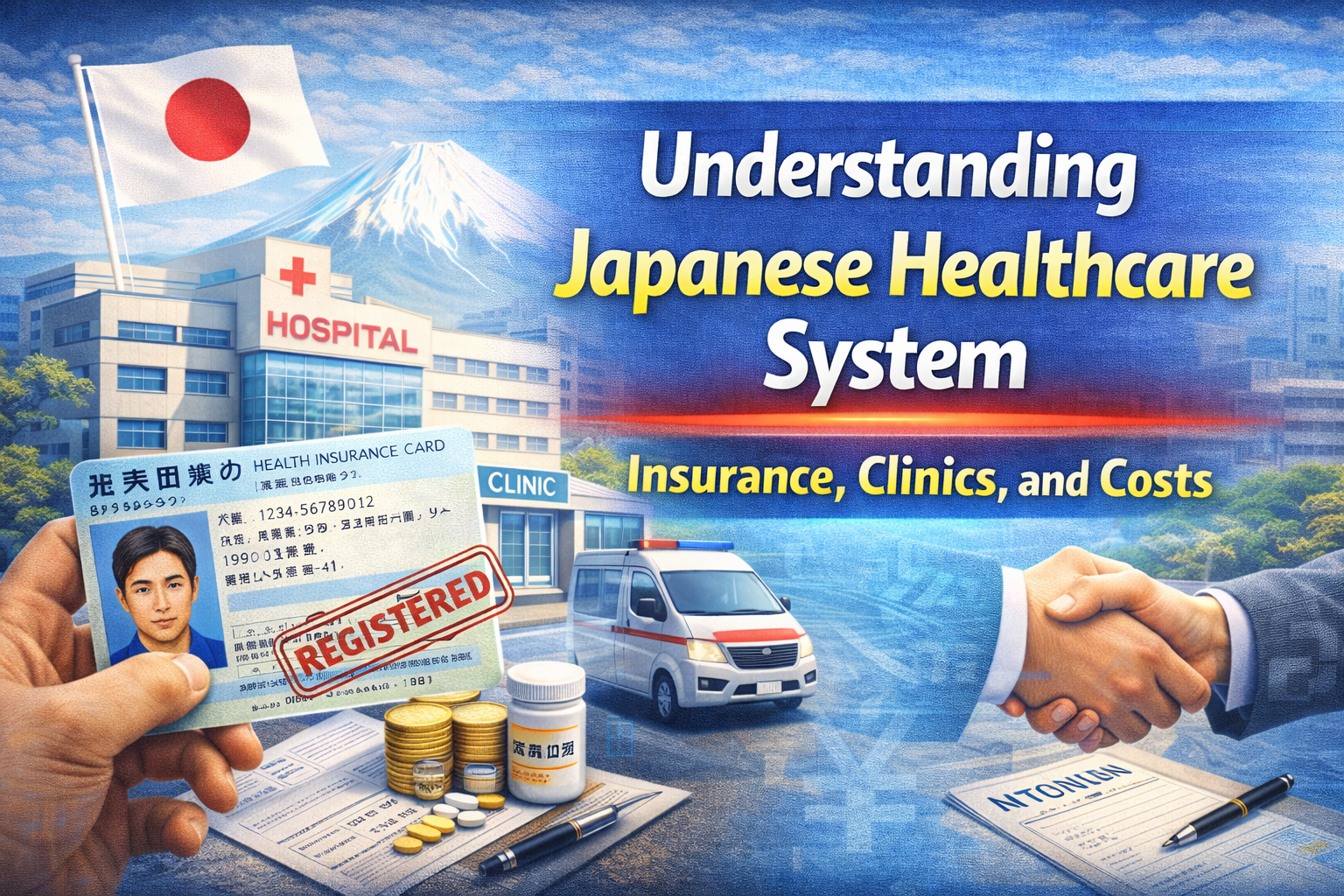
Understanding Japanese Healthcare System: Insurance, Clinics, and Costs
If you live in Japan for more than a short visit, the basic rule is simple: you are expected to be in Japan’s public health insurance system, and you usually pay only a set share of covered medical costs at the counter. For many working-age residents, that counter payment is 30% for insured treatment.
The part that confuses many foreign residents is not the quality of care. It is the route: which insurance applies, whether to start at a clinic or hospital, what to bring, and why the bill can change when you walk into a large hospital without a referral.
Quick orientation:
- Long-term residents usually join either employer-based health insurance or National Health Insurance.
- Tourists and short-term visitors are different. They should not assume Japan’s public insurance will cover them.
- For ordinary illness, a local clinic is often the right first stop.
- Since the paper health insurance card transition ended, My Number health insurance use or an eligibility certificate matters at reception.
Who This Guide Is For
This guide is for foreign residents, students, workers, long-term stayers, and travelers who may need medical care in Japan.
It matters when you:
- move to Japan and register your address;
- start or leave a job;
- get sick and need a first appointment;
- visit a large hospital without knowing the referral system;
- travel in Japan without Japanese public insurance;
- need to understand why your bill is not the same as another person’s bill.
This is practical guidance, not personal medical, legal, or immigration advice. For enrollment, premium, and document rules, check your employer, your city or ward office, and the official sources linked at the end.
The Main Rule: Residents Need Public Health Insurance
Japan’s health system is built around universal public insurance. The system does not work like private-only healthcare, and residents normally do not choose freely among many competing insurance plans.
Japan Health Policy NOW explains that people who permanently reside in Japan for three months or more, including non-Japanese citizens, are covered by the mandatory public insurance framework. In daily life, most foreign residents fall into one of these two routes:
- Employer-based health insurance: usually for company employees who meet the work and enrollment conditions.
- National Health Insurance: usually for students, self-employed people, freelancers, unemployed residents, and people not covered through an employer.
Municipal pages make the local part clear. For example, Shinjuku City says foreign residents living in Japan must be enrolled in public health insurance, and Saitama City explains that foreign nationals registered as residents may need to join National Health Insurance if they are not in workplace insurance or another public program.
Enrollment Is Local for National Health Insurance
National Health Insurance is handled by your municipality. That means the counter is usually your city hall, ward office, or town office.
Common timing rules include:
- file the procedure within 14 days when you become eligible;
- file when you move into a municipality;
- file when you leave employer-based insurance;
- file withdrawal procedures when you move out, leave Japan, or join another public insurance plan.
Shinjuku City notes an important point: eligibility does not begin only from the day you file. It begins from the day you should have enrolled. In plain English, registering late may not erase past premiums.
What You Usually Pay at Clinics and Hospitals
For insured treatment, the price is not invented by each clinic. Japan uses a national medical fee schedule. Japan Health Policy NOW explains that medical service fees are set by points, and one point equals 10 yen.
For many foreign residents under 70, the practical result is easy to remember:
- the public insurance side covers most insured treatment;
- the patient pays the required co-payment at reception;
- for many working-age residents, that co-payment is 30%.
Co-payment rates differ by age and income. Children, older residents, and higher-income older residents may fall under different rates. Local child medical subsidies can also reduce children’s out-of-pocket costs, but these are municipal or prefectural programs, not a single national rule that works the same everywhere.
Typical Costs You Should Expect
The exact bill depends on the treatment, tests, medicine, facility, time of visit, and whether the service is covered by insurance.
A simple clinic visit for a covered issue is usually far less expensive than paying the full uninsured cost, but you may still pay separately for:
- consultation;
- tests such as blood tests, X-rays, or ultrasound;
- prescription medicine at a pharmacy;
- medical certificates or documents;
- after-hours or holiday surcharges;
- non-covered services such as some vaccinations, cosmetic treatment, or optional health checks.
ここがポイント: In Japan, the biggest cost difference is often not “clinic versus hospital” alone. It is whether the treatment is covered by public insurance, whether you have valid proof of eligibility, and whether you entered a large hospital through the referral route.
High Medical Bills Have a Cap System
Japan also has a high-cost medical expense benefit system for insured residents. This can reduce the burden when monthly covered medical costs become very high.
The threshold depends on age and income. MHLW materials show that, for a general working-age income bracket, the monthly limit can be calculated using a formula such as 80,100 yen plus 1% of the amount above a set medical-cost level. The details are technical, so do not rely on a rough internet example for a serious bill. Ask your insurer or municipal office before planned hospitalization if possible.
Clinics First, Hospitals When Needed
For non-emergency symptoms, Japan often works best when you start with a local clinic.
Clinics are usually organized by department, such as internal medicine, dermatology, pediatrics, orthopedics, ophthalmology, or ENT. If the clinic doctor thinks you need specialist tests, surgery, hospitalization, or advanced treatment, they can write a referral letter to a hospital.
This matters because large hospitals may charge an extra fee if you arrive without a referral.
Why a Large Hospital Can Cost More Without a Referral
Some large hospitals charge a selected medical care fee, often called sentei ryoyohi, for patients who visit without a referral letter.
Hospital pages show how this works in practice. Shonan Kamakura General Hospital says patients without a referral are charged an additional 7,000 yen for medical treatment or 5,000 yen for dental treatment. The National Center for Global Health and Medicine lists an 11,000 yen first-visit additional fee for patients without referrals.
The lesson is straightforward:
- go to a local clinic first for ordinary symptoms;
- ask for a referral if hospital care is needed;
- check the hospital’s website before going;
- expect different hospitals to list different additional amounts.
Emergencies are different. Do not delay urgent care just to avoid a referral fee.
What to Bring When You See a Doctor
Reception can be quick if you bring the right items. It can become slow or expensive if you cannot prove insurance eligibility.
Bring:
- My Number Card registered as a health insurance certificate, or your eligibility certificate;
- residence card, if you are a foreign resident;
- passport, especially for visitors;
- cash and a payment card, because payment methods vary;
- a list of medicines you take;
- allergy information;
- referral letter, if you have one;
- Japanese notes about symptoms, if your Japanese is limited.
Yamaguchi International Exchange Association gives practical advice that still applies broadly: confirm language support before visiting, bring your insurance information and ID, and do not assume the foreign-language-speaking doctor or receptionist is always on duty.
The 2026 Reception Change: My Number Health Insurance Use
As of 2026, this is one of the most important practical changes at medical reception.
The Digital Agency explains that existing health insurance cards were no longer available on and after December 2, 2025. The system has shifted to My Number Card use as the health insurance certificate, while people who do not have or have not registered a My Number Card can use an eligibility confirmation document issued by their insurer.
For foreign residents, this means:
- do not assume an old paper health insurance card will work;
- register your My Number Card for health insurance use if you plan to use it;
- if you do not use a My Number Card, check that you have the correct eligibility certificate;
- when changing jobs, moving cities, or changing insurance, confirm that your eligibility information is updated.
This is not only a technology issue. If reception cannot confirm your insurance status, you may be asked to pay more upfront and settle the difference later.
Tourists and Short-Term Visitors: Do Not Rely on Resident Insurance
Tourists are in a different position from residents. If you are visiting Japan temporarily, you usually cannot depend on Japanese public health insurance.
The Ministry of Health, Labour and Welfare strongly recommends that international visitors buy private medical insurance with enough coverage before or during their stay. JNTO also warns that medical costs during a trip can become high, especially when surgery, hospitalization, or medical transport is involved.
For visitors, the practical checklist is:
- buy travel medical insurance before arrival if possible;
- confirm whether it covers hospitalization, emergency surgery, pregnancy-related care, and transport;
- keep the insurer’s emergency contact number accessible;
- use JNTO’s medical institution search when you need foreign-language support;
- ask the clinic or hospital about payment before non-urgent treatment.
JNTO’s guide also notes that some travel insurance services include interpretation, medical institution referral, and cashless payment arrangements. Those details depend on the policy, not on Japan’s public system.
Emergencies: Call 119
For serious illness or injury, call 119 for an ambulance. This is the fire and ambulance emergency number in Japan.
The Fire and Disaster Management Agency’s English ambulance guide says to call 119 when you need ambulance service. Tokyo’s medical information site for foreign tourists and residents explains that the dispatcher will ask for the emergency type, address, symptoms, age, name, and contact information.
Use 119 for situations such as:
- loss of consciousness;
- severe breathing trouble;
- chest pain;
- major injury;
- heavy bleeding;
- suspected stroke;
- serious burns;
- sudden severe symptoms that cannot wait for a clinic.
If you are in Tokyo, the Tokyo site says three-way interpretation is available for emergency calls from foreigners in English, Chinese, Korean, Portuguese, and Spanish. Other regions may differ, so speak slowly, give your location first, and ask nearby Japanese speakers for help if available.
Common Mistakes Foreign Residents Make
Small mistakes can create large bills or delays.
Avoid these:
- Waiting to enroll after moving to Japan or leaving a job.
- Assuming employer insurance and National Health Insurance are the same counter.
- Going straight to a large hospital for a minor symptom without checking referral rules.
- Forgetting that dental care is covered in many ordinary cases, but not every dental or cosmetic procedure is covered.
- Assuming English support is available every day at every clinic.
- Losing track of insurance changes when moving from one city to another.
- Forgetting to bring valid eligibility proof to the clinic or pharmacy.
One more point: public insurance premiums are not the same everywhere. National Health Insurance premiums are calculated by municipalities based on factors such as income and household situation. A student in one ward and a freelancer in another city may not pay the same amount.
Practical First Steps After Moving to Japan
If you are a new resident, handle healthcare before you need it.
- Register your address at your city or ward office.
- Confirm whether your employer enrolls you in employer-based health insurance.
- If not, ask the municipal office about National Health Insurance.
- Check whether you need to complete procedures within 14 days.
- Set up your My Number Card health insurance use, or confirm how you will receive an eligibility certificate.
- Find nearby clinics for internal medicine, dental care, and any regular specialty you need.
- Save 119, your insurer’s contact, and a local medical consultation number if your area offers one.
For families, also ask the city office about child medical subsidies, vaccination schedules, pregnancy support, and local emergency pediatric services. These local programs can make a real difference, and they are not identical across Japan.
What to Watch in 2026
Three points are worth checking this year.
- Medical fee revisions: Japan reviews medical service fees regularly. Japan Health Policy NOW explains that the fee schedule is reviewed every two years, and 2026 is a revision year. Small changes can affect consultation fees, drug prices, and facility billing.
- My Number insurance reception: From December 2025 onward, the old paper-card transition is over. Make sure your current proof of eligibility works before you are sick.
- Municipal premium notices: National Health Insurance premiums can change after your previous year’s income is reflected. If the number looks wrong, ask your city or ward office early instead of ignoring the notice.
The practical takeaway is simple: for ordinary illness, start with a clinic, bring valid insurance eligibility proof, and check local rules when you move or change jobs. The system is manageable once those three habits are in place.
参照リンク
- Japan Health Policy NOW: Health Insurance System
- Japan Health Policy NOW: Japan’s Health Insurance System
- Japan Health Policy NOW: The Medical Service Fee System
- Japan Health Policy NOW: Cost Control
- Ministry of Health, Labour and Welfare: Health Insurance
- MHLW: Health and Medical Services PDF
- MHLW: For International Visitors to Japan, Private Health Insurance Recommendation
- Digital Agency: Use of Health Insurance Card in My Number Card
- Digital Agency: FAQ on My Number Card as Health Insurance Certificate
- Digital Agency: Eligibility Confirmation
- Shinjuku City: Health Insurance System
- Shinjuku City: National Health Insurance Procedures
- Saitama City: National Health Insurance System
- Yamaguchi International Exchange Association: Medical Care
- JNTO: Guide for When You Are Feeling Ill
- JNTO: Travel Insurance Information
- Fire and Disaster Management Agency: Guide for Ambulance Services PDF
- Tokyo Medical Information Site: How to Call an Ambulance
- Shonan Kamakura General Hospital: Outpatient Services
- National Center for Global Health and Medicine: Outpatient Services
- The Japan Times: Japan Health Panel Adopts Medical Fee Changes