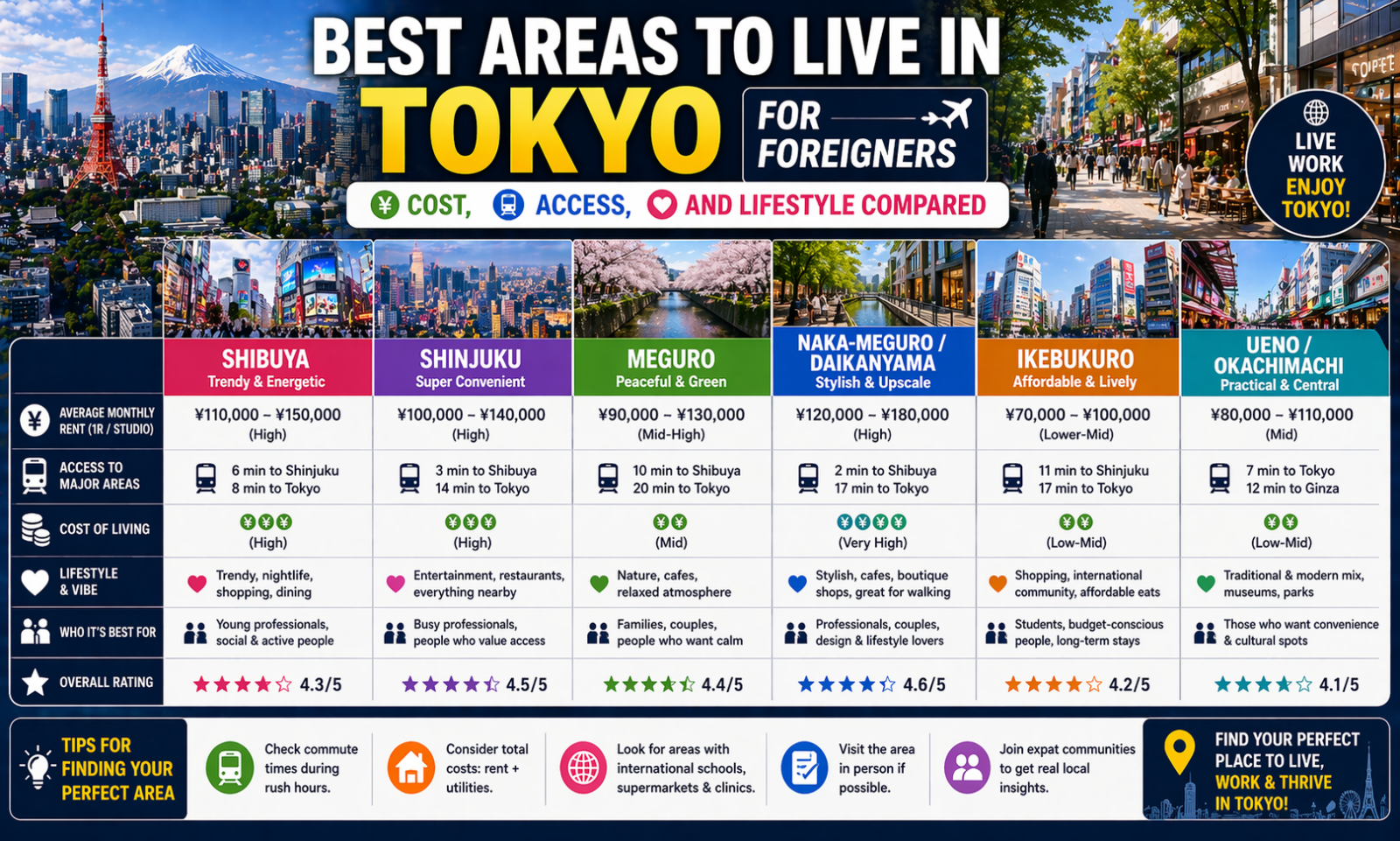
Best Areas to Live in Tokyo for Foreigners: Cost, Access, and Lifestyle Compared
If you want one short answer, Setagaya, Koto, and Toshima are the safest starting points for most foreigners. They usually give you a better balance of rent, train access, and daily-life convenience than Minato or central Shinjuku.
If your budget is high and you want the easiest premium central base, Minato is the strongest option. If you care most about transfers, city-office support, and getting around quickly, Shinjuku is hard to beat. But for many workers, students, and long-term residents, the better move is to live one step outside the most expensive core.
- Best overall balance: Setagaya
- Best for modern bayside living: Koto
- Best for value near a major hub: Toshima
- Best for pure convenience: Shinjuku
- Best for high-budget international living: Minato
This guide is for foreigners choosing a first Tokyo apartment, changing areas after a short stay, or comparing neighborhoods before a work or school move. Rent examples below use current ward-level 1K averages published in March 2026, and actual listings will vary by station distance, building age, and room size.
The Short Comparison
| Area | Typical 1K rent | Best for | Main strength | Main tradeoff |
|---|---|---|---|---|
| Setagaya | ¥90,000 to ¥120,000 | Workers, couples, long-term residents | Strong balance of price and livability | Commute depends heavily on your station |
| Koto | ¥85,000 to ¥110,000 | Remote workers, couples, families | Newer housing stock and practical city support | Some areas feel less central at night |
| Toshima | ¥85,000 to ¥110,000 | Students, first-time residents, commuters | Big-station access without top-tier rent | Busy around Ikebukuro itself |
| Shinjuku | ¥110,000 to ¥150,000 | People who want maximum convenience | Transit and multilingual support | Noise, crowds, higher rent |
| Minato | ¥130,000 to ¥180,000 | High earners, company-paid housing | Premium central location and foreign-language services | The highest rents in this group |
ここがポイント: If your budget for a solo 1K is below about ¥120,000, start with Setagaya, Koto, or Toshima. Look at Minato only if your budget is clearly higher or your employer is covering part of the rent.
How to Read Tokyo Housing Choices
Tokyo is not just “central vs suburban.” What matters more is the combination of these four points:
- your rent ceiling
- your train line, not only your ward
- how much city-office and language support you may need
- whether you want a quiet residential rhythm or a fast hub area
A cheaper apartment can become expensive in practice if it adds two transfers every day. The reverse is also true: paying central-Tokyo rent only makes sense if you will actually use that location advantage.
1. Setagaya: The Best All-Round Pick for Many Foreign Residents
Setagaya is often the most practical middle ground. Ward-level average 1K rent is currently ¥90,000 to ¥120,000, which is lower than Minato, Shinjuku, or Meguro while still keeping you close to major west-side work and study areas.
Why it works
Areas such as Sangenjaya and Shimokitazawa stay popular because they do not feel isolated. Sangenjaya sits on the Tokyu Den-en-toshi Line and Setagaya Line, giving direct movement toward Shibuya and local connections inside the ward. Shimokitazawa sits on the Odakyu line and connects easily toward Shinjuku and the wider west side.
Setagaya City also publishes a foreign-resident guide and multilingual living handbook, which matters more than many new arrivals expect. When you need help with moving procedures, insurance, garbage rules, or local services, having a ward that already organizes information for non-Japanese residents saves time.
Best fit
- workers commuting to Shibuya or west Tokyo
- couples who want a more residential feel
- people planning to stay longer than one year
Watch out for
- station choice changes everything inside Setagaya
- a low-rent listing can still mean a long walk or a slower local train
- fashionable pockets can rise toward central-Tokyo pricing fast
2. Koto: Strong Value if You Want Newer Buildings and Practical Daily Life
Koto is one of the most useful choices for foreigners who want cleaner trade-offs and fewer extremes. Current ward-level 1K averages are around ¥85,000 to ¥110,000.
That matters because Koto often gives you a newer-feeling apartment stock than similarly priced older units on the west side. It also has a foreign-resident guide that clearly groups daily-life information such as utilities, garbage, transport, taxes, insurance, and ward procedures in one place.
Why it works
Toyosu is a good example of the area’s appeal. Toyosu Station connects to the Tokyo Metro Yurakucho Line and transfers to the Yurikamome line, so access is better than many people assume. It is also a very busy station in the Tokyo Metro system, which tells you this is not a fringe location.
For foreigners who want a modern apartment, easier supermarket runs, and a calmer home base than Shinjuku or Ikebukuro, Koto is often a smart compromise.
Best fit
- remote workers who still need city access
- couples and families
- people who prefer newer apartments over older central units
Watch out for
- not every part of Koto feels equally central
- bay-area convenience can come with a less traditional neighborhood feel
- commute quality depends on whether your office is east-side, central, or west-side
3. Toshima: Best Value Around a Huge Transport Hub
Toshima is easy to overlook because Ikebukuro gets framed as hectic. That misses the practical point. Current ward-level 1K averages are about ¥85,000 to ¥110,000, and that is why Toshima deserves serious attention.
Ikebukuro Station is one of Tokyo Metro’s busiest stations and connects to the Marunouchi, Yurakucho, and Fukutoshin lines, with transfers to JR, Tobu, and Seibu. In plain terms, it is one of the easiest places in Tokyo for reaching many parts of the city without living at Minato-level prices.
Toshima also offers a city consultation counter for foreign residents with support in 22 languages through video interpretation. That is a concrete advantage for first-time residents dealing with paperwork, contracts, and everyday problems.
Best fit
- students
- first-time foreign residents
- commuters who need wide rail coverage
Watch out for
- living right around Ikebukuro Station can feel too busy for some people
- better value usually appears one or two stops away, not at the station front
4. Shinjuku: Best for Convenience, Not for Saving Money
Shinjuku is the easiest answer if you want to reduce friction in everyday life. Current ward-level 1K averages are around ¥110,000 to ¥150,000. You are paying for that convenience.
The big advantage is not only transport. Shinjuku City runs a Foreign Resident Advisory Corner with consultation in English, Chinese, and Korean, plus additional support through the Multicultural Plaza. For a newcomer who may need help with housing questions, taxes, insurance, or local rules, that support is real infrastructure, not a small extra.
Why it works
Shinjuku Station itself connects Tokyo Metro with JR, Keio, Odakyu, and Toei services. That makes the ward useful for people whose work or school location may change, or for people who are still learning how Tokyo fits together.
Best fit
- short-to-medium-term workers
- people who prioritize transfers over apartment size
- newcomers who want the easiest administrative support
Watch out for
- rent rises quickly near the strongest stations
- nightlife and crowd density are not a small issue here
- the most convenient address is rarely the best value address
5. Minato: Best if Budget Is Secondary
Minato is the premium answer. Current ward-level 1K averages are around ¥130,000 to ¥180,000, the highest range in this comparison.
If you can afford it, Minato is simple: central location, polished housing stock, and strong official support for foreign residents. Minato City’s consultation services cover everyday-life and city-government questions in a wide range of languages, including English, Chinese, Korean, Portuguese, Spanish, Thai, Russian, Tagalog, Nepali, Vietnamese, Indonesian, Hindi, and French.
Why it works
This is the ward for people who want to spend less time compromising. Areas linked to Azabu, Hiroo, and nearby stations are widely known for convenience and an international residential feel. If your company pays part of the rent, Minato becomes much more realistic.
Best fit
- corporate transfers
- higher-income households
- people who want central Tokyo and official language support together
Watch out for
- you pay a major premium for the address
- for the same budget, you may get more space in Setagaya, Koto, or Toshima
Which Area Is Best for Your Situation?
If you are a student
Start with Toshima or selected parts of Setagaya.
Why:
- better odds of keeping rent below central-core levels
- strong station access
- easier daily budgeting
If you are a worker in central Tokyo
Start with Setagaya if you want balance, or Shinjuku if time matters more than rent.
Why:
- Setagaya keeps lifestyle quality higher for the money
- Shinjuku reduces commute friction when your schedule is heavy
If you are moving with a partner or family
Start with Koto or Setagaya.
Why:
- more realistic path to larger layouts
- calmer residential pattern than major hubs
- official ward information is easy to find for everyday procedures
If your employer covers housing
Look at Minato first.
Why:
- the rent penalty hurts less
- central access and foreign-language support are both strong
Common Mistakes When Choosing a Tokyo Neighborhood
Mistake 1: Choosing only by ward name
A ward is too large to tell you enough. In Setagaya, station choice can change your commute and daily rhythm completely.
Mistake 2: Looking only at monthly rent
A slightly cheaper apartment can cost more in time, transfers, and taxi use after missed last trains. Tokyo punishes bad line choices.
Mistake 3: Underestimating city-office support
If your Japanese is limited, ward-level support matters. Shinjuku, Toshima, Koto, Minato, and Setagaya all make foreign-resident information visible, but the style and language coverage differ.
Mistake 4: Renting at the biggest station itself
The best-value move is often one or two stops away from the famous station. You keep most of the access and lose part of the rent premium.
Current Status to Check Before You Sign
As of April 21, 2026, the practical picture is this:
- March 2026 rent averages still show a wide gap between premium central wards and the mid-priced wards that many foreigners actually choose
- official ward support pages remain a useful filter, especially for first-time residents
- major stations such as Ikebukuro and Toyosu continue to show strong passenger volume, which supports their role as realistic everyday bases rather than niche locations
Before signing any apartment, confirm these points on the actual listing and with the agent:
- exact station walk time
- train line and transfer count to your workplace or school
- building age and insulation
- move-in fees and guarantor conditions
- whether the landlord accepts non-Japanese applicants
- which ward office services you are likely to use soon
Final Takeaway
For most foreigners, the best area in Tokyo is not the most famous one. It is the place where rent, line access, and daily admin all stay manageable at the same time.
That is why Setagaya, Koto, and Toshima are the strongest starting points for many people. Shinjuku is the convenience pick. Minato is the premium pick. Your next check should be simple: open listings near your likely station, not just your preferred ward name, and see what your budget buys one or two stops further out.
参照リンク
- Sumai Souba Navi: How Much Is Rent in Tokyo? 2026 Averages by Ward
- Setagaya City: For foreign residents
- Setagaya City: Life in Setagaya 2025
- Koto City: Guide to Living for foreigners
- Tokyo Metro: Toyosu Station
- Tokyo Metro: Ikebukuro Station
- Toshima City: Foreigner Support
- Tokyo Metro: Shinjuku Station
- Shinjuku City: Foreign Resident Advisory Corner
- Minato City Living Guide
- Minato City: Consultation Desks for Foreigners
- Tokyu: Sangen-jaya Station
- Odakyu Railway Transport Guide