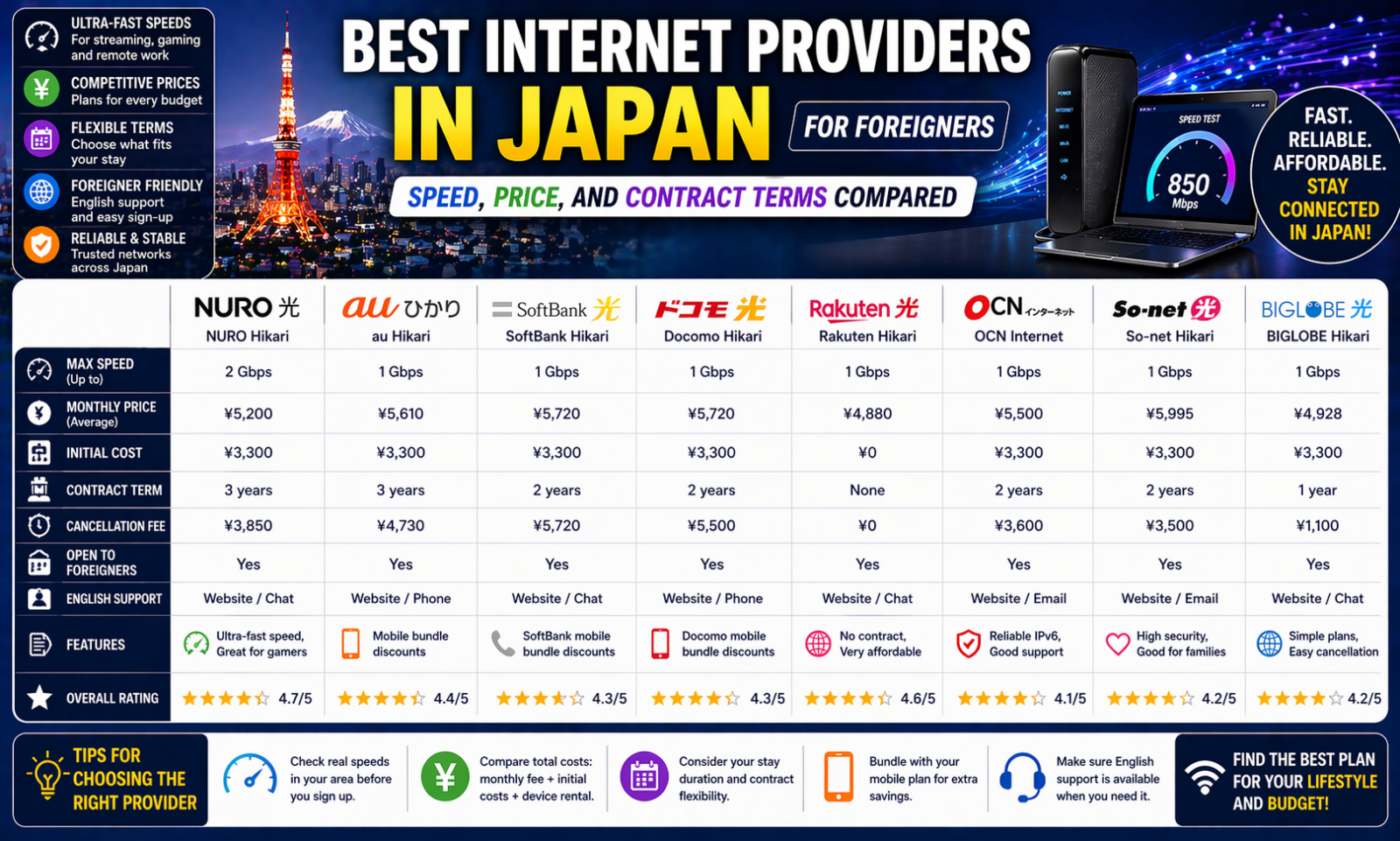
Best Internet Providers in Japan: Speed, Price, and Contract Terms Compared
If you want the short answer, NURO Hikari is usually the strongest pick for raw speed, SoftBank Hikari and docomo Hikari are the safest picks for wide coverage, and au Hikari is a strong option for detached houses and au or UQ mobile users. The best choice in Japan is rarely about one brand being universally better. It depends on your building, your mobile carrier, how long you will stay, and whether 10Gbps is actually available at your address.
For most foreigners moving into a normal apartment, the practical decision is simple: check whether your building already supports an NTT-based line first, then compare SoftBank Hikari and docomo Hikari. If you live in a house or a low-rise building with more options, NURO Hikari and au Hikari become much more attractive.
- Best for speed: NURO Hikari if your address is supported and you can wait for installation
- Best for broad availability: SoftBank Hikari or docomo Hikari
- Best for mobile bundle savings: SoftBank Hikari for SoftBank or Y!mobile users, au Hikari for au or UQ users, docomo Hikari for docomo users
- Best for short stays or uncertain moves: a no-contract plan or your building’s included internet may be safer than a long cashback-based contract
Who this guide is for
This guide is for students, workers, couples, and long-term residents in Japan who need home internet, not just a SIM card.
It matters most when you are:
- moving into a new apartment or house
- choosing between 1Gbps and 10Gbps plans
- trying to avoid early cancellation fees
- deciding whether a mobile bundle discount is worth a longer contract
ここがポイント: In Japan, the “best” provider is often the one your building can install quickly at a reasonable price. Coverage and contract terms matter almost as much as speed.
Quick comparison
Start with the table below, then check the notes after it. Prices and terms were checked on April 21, 2026, and campaign discounts can change.
| Provider | Typical speed tiers | Typical monthly price | Contract term | Main strength | Main caution |
|---|---|---|---|---|---|
| NURO Hikari | 2Gbps, 10Gbps | ¥5,200 for 2G, ¥5,700 for 10G, or ¥8,300 for 10G without a term | Usually 3 years | Very strong speed and low latency | Coverage is limited and installation can take 1 to 3 months |
| SoftBank Hikari | 1Gbps, 10Gbps | ¥4,180 apartment, ¥5,720 house, ¥6,930 for 10G | Usually 2 years | Wide NTT-based coverage and simple bundled service | 10G is not nationwide and some discounts need options |
| docomo Hikari | 1Gbps, 10Gbps | ¥4,400 apartment, ¥5,720 house, ¥6,380 for 10G Type A | Usually 2 years | Good fit if your building already uses NTT lines | Price depends on provider type, and 10G area still depends on NTT expansion |
| au Hikari | 1Gbps, 5Gbps, 10Gbps | Home 1G starts around ¥6,160 with phone on a 3-year plan, 10G starts around ¥7,018 with phone on a 3-year plan | 2 years, 3 years, or no contract | Strong performance and good au or UQ bundle value | Area limits are stricter than NTT-based services |
What the speed numbers really mean
Advertised speed is the maximum under technical standards, not the speed you will always get at home. That matters in Japan because many people compare 1Gbps, 2Gbps, and 10Gbps marketing numbers without checking building wiring, router support, or evening congestion.
User-reported April 2026 averages collected by MyNavi from Minna no Net Kaissen Sokudo show a clear pattern:
- NURO Hikari is near the top among major national choices
- au Hikari is usually the next strongest major option
- SoftBank Hikari and docomo Hikari are slower on average, but still fast enough for streaming, video calls, and normal remote work
For most homes, stable 300 to 500Mbps is already more than enough. Paying extra for 10Gbps only makes sense if you actually have compatible equipment, heavy simultaneous use, or specific gaming and upload needs.
Which provider is best for each kind of user?
The fastest way to choose is to match the provider to your situation.
If you want the best chance of an easy apartment setup
Choose SoftBank Hikari or docomo Hikari first.
Why this matters:
- both use NTT-based infrastructure, so coverage is generally wider
- many apartment buildings are already set up around NTT lines
- SoftBank says some applications can be opened in as little as six business days
- SoftBank also offers free temporary rental internet while you wait for the line to open
If your building manager says “FLET’S is already in the building,” this is usually where you should start.
If you care most about speed and gaming
Choose NURO Hikari if your address is supported.
NURO’s official pricing is aggressive for the speed class: ¥5,200 for 2G and ¥5,700 for 10G on 3-year plans. The trade-off is coverage and setup time. NURO’s official guidance says installation is usually about 1 to 2 months for houses and 1 to 3 months for apartments, with some regions taking longer.
That makes NURO excellent for people who will stay put and want better real-world performance, but a weaker fit if you just moved and need internet next week.
If you use docomo, SoftBank, Y!mobile, au, or UQ mobile
Bundle savings can matter more than a small price difference in the internet plan itself.
The practical rule is simple:
- docomo phone users: start with docomo Hikari
- SoftBank or Y!mobile users: start with SoftBank Hikari
- au or UQ users: start with au Hikari
That does not mean the bundle always wins. If your building only supports one line cleanly, or if you may leave Japan within a year, the cheapest long-term bundle on paper can still become the more expensive choice.
If you live in a detached house
You usually have more room to choose.
That is where au Hikari and NURO Hikari become more competitive, because they can offer stronger performance than many standard NTT-based 1G plans. au Hikari is especially worth checking for detached homes, but the area map matters. Its 1G home service excludes several prefectures in Kansai, Tokai, and Okinawa, and its 10G home service is still limited to parts of Tokyo, Kanagawa, Saitama, and Chiba.
Price and contract terms that catch people out
Monthly fee is only part of the bill. In Japan, the real cost often changes because of installation fees, option requirements, and how cashback is structured.
Early cancellation is cheaper than it used to be, but not free
As checked on April 21, 2026, official pages show cancellation charges such as:
- SoftBank Hikari 10G 2-year auto-renewal: ¥6,380 outside the renewal window
- NURO Hikari 10G 3-year plan: ¥4,400
- au Hikari Home 1G 3-year plan: ¥4,730
- au Hikari Home 10G 2-year plan: ¥4,460, and 3-year plan: ¥4,730
- docomo Hikari 1G: typically ¥4,180 to ¥5,500 depending on housing type and plan
- docomo Hikari 10G: typically ¥5,500 on fixed-term plans
These fees are smaller than older Japanese contracts, but they still matter if you may move, change jobs, or leave Japan early.
Installation fees can still hurt if you cancel too early
A common pattern is “installation effectively free” through monthly discounts. If you cancel before the installment period ends, you may have to pay the remaining installation balance.
Examples from official pages include:
- NURO Hikari: basic installation fee listed as ¥44,000, effectively discounted over time on eligible plans
- SoftBank Hikari 10G: installation fee examples up to ¥31,680 with discount conditions
- au Hikari Home: initial cost listed at ¥41,250 or ¥48,950 depending on plan page, then reduced by ongoing discounts
This is why a big signup campaign can be misleading. The safe question is not “How much is month one?” but “What do I pay if I cancel in month ten?”
10Gbps often needs extra hardware
SoftBank’s official 10G page says you need 10Gbps-capable equipment and a Cat6A or better LAN cable for comfortable 10G use. That is true across providers in practice.
Before paying for 10G, check:
- whether your router supports 10G or only 1G
- whether your PC has a 10G-capable port or adapter
- whether your building wiring and room setup can actually use the faster line
- whether you really need more than a solid 1G plan
Regional differences you should check before applying
This is one of the biggest sources of confusion for foreign residents.
NTT-based providers are usually easier nationwide
SoftBank Hikari uses the same area base as NTT East and NTT West FLET’S Hikari Next, and its 10G service follows FLET’S Hikari Cross coverage. docomo Hikari 10G also depends on NTT East or West 10G service areas.
That means these two are usually easier to find across Japan than au Hikari or NURO, especially outside large metro areas.
au Hikari is not a true nationwide default
au Hikari Home 1G is officially available nationwide only with major exceptions. The official page excludes Osaka, Kyoto, Wakayama, Nara, Shiga, Hyogo, Mie, Aichi, Shizuoka, Gifu, and Okinawa. Its 10G plan is even narrower, limited to parts of Tokyo, Kanagawa, Saitama, and Chiba.
If you are moving to Kansai or Tokai, do not assume au Hikari will be available just because it is a major brand.
NURO is expanding, but address-level checks still matter
NURO’s area guide says service is available in parts of Hokkaido, Tohoku, Kanto, Tokai, Kansai, Chugoku, and Kyushu, but not every city or building qualifies. The same page notes that in Tohoku, 10G is the available plan.
For a foreign resident choosing a new apartment, this means you should check the exact address before signing the lease if home internet quality matters to your work or study.
Common mistakes foreigners make
These are the mistakes that cause the most frustration after moving in.
1. Signing before checking the building
Some apartments already include internet, some only allow certain lines, and some need landlord approval for new work.
Check:
- whether internet is already included in rent
- whether the building has NTT, NURO, or au equipment already installed
- whether outside work or drilling approval is needed
2. Comparing only promotional prices
The cheapest ad is often a temporary discount.
Compare:
- normal monthly fee after the campaign ends
- contract length
- installation repayment period
- option fees for router rental, phone, or bundle eligibility
3. Choosing 10G when 1G is enough
If you mostly stream Netflix, use Zoom, browse the web, and play casual games, a good 1G line is already enough. The upgrade is usually worth it only for heavy upload work, serious gaming setups, multiple power users, or households with many connected devices.
4. Ignoring language support
Mainstream providers are often cheapest, but the signup flow, support calls, and installation coordination may be mostly in Japanese.
If English support matters more than a small monthly saving, check providers such as Asahi Net, which has English pages and support material for fiber services. It may not always be the cheapest route, but it can be the easier route.
Latest watchpoints in 2026
The market is still shifting in ways that matter for new contracts.
- 10G coverage is growing, but unevenly. docomo’s 10G area page, checked on April 21, 2026, still points users to NTT East and West area search tools and lists March 2026 additions including Shimane, Tottori, and Yamaguchi.
- No-contract plans exist, but they cost more. NURO’s 10G no-term plan is ¥8,300, much higher than its 3-year plan, but it can still be the smarter choice for uncertain stays.
- Installation speed is now a real decision factor. SoftBank highlights faster activation paths and temporary rental options, while NURO officially warns that opening can take much longer.
Bottom line
If you need a practical default, start with SoftBank Hikari or docomo Hikari for apartments, NURO Hikari for speed-first users who can wait, and au Hikari for detached houses and au or UQ bundle users in supported areas.
Before you apply, check four things in this order:
- your building’s supported line types
- your real monthly price after discounts end
- your cancellation and remaining installation cost if you move early
- whether 10G is actually useful with your devices
That last point is the one many people skip. In Japan, the better contract is often not the fastest one on the ad. It is the one that still looks reasonable after your first move, your first support call, and your first full bill.
参照リンク
- SoftBank Hikari English overview
- SoftBank Hikari pricing
- SoftBank Hikari 10G details
- SoftBank FAQ: coverage
- SoftBank FAQ: fastest opening timing
- SoftBank FAQ: temporary rental before opening
- NTT docomo: docomo Hikari pricing
- NTT docomo: docomo Hikari 10G area page
- au: au Hikari Home 1G pricing
- au: au Hikari Home 1G 3-year plan details
- au: au Hikari Home 10G pricing
- au: au Hikari Home 10G 3-year plan details
- au: au Hikari Home 10G no-contract plan
- NURO Hikari pricing
- NURO Hikari installation timeline
- NURO Hikari area guide
- Asahi Net English fiber services
- Asahi Net FTTH English pricing
- MyNavi Hikari speed comparison, citing Minna no Net Kaissen Sokudo, April 2026