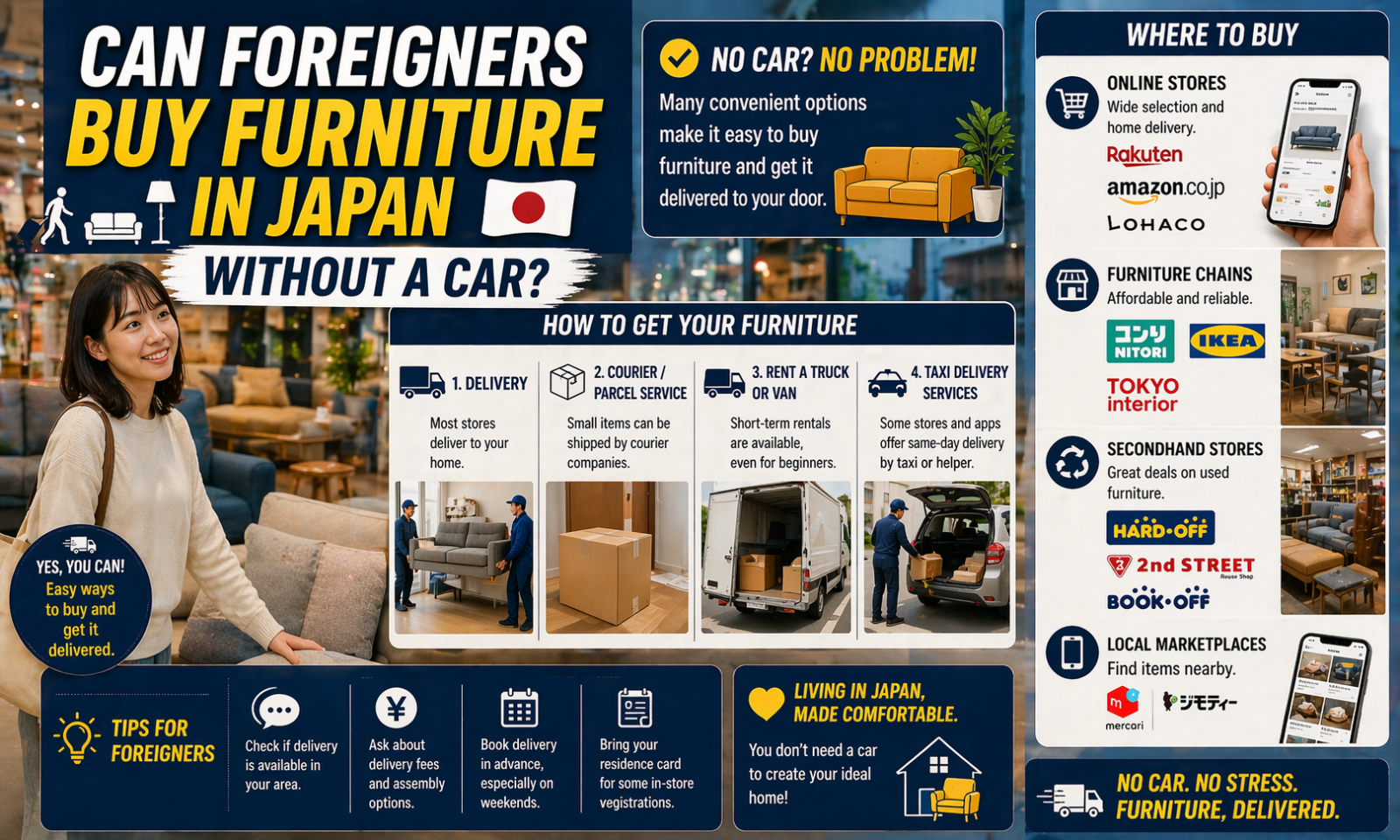
Can Foreigners Buy Furniture in Japan Without a Car?
Yes. You do not need a car to buy furniture in Japan. For most foreign residents, the real question is not whether a store will sell to you, but how the item will be delivered, whether your building can receive it, and whether you can handle the old furniture afterward.
If you are a student, new worker, or long-term resident setting up a room in Japan, this matters as soon as you move in. Beds, desks, shelves, and sofas are easy to buy, but delivery fees, stair access, redelivery rules, and garbage disposal can change the total cost fast.
- Short answer: Major chains in Japan offer delivery, and some also offer assembly or pickup options.
- Best no-car option for large items: Pay for home delivery instead of trying to carry furniture on trains.
- Best option for small items: Flat-pack or boxed items can sometimes be carried or sent by parcel.
- Main mistake to avoid: Buying first and checking your doorway, delivery slot, or disposal plan later.
Who This Is For
This guide is for:
- Foreign students moving into a small apartment or dorm-like room
- Workers furnishing a rental after arriving in Japan
- Long-term residents replacing furniture without owning a car
- People living in cities where parking is expensive or difficult
It is most useful if you live in Tokyo, Osaka, Yokohama, Kyoto, or another urban area where many people rely on trains and delivery instead of private cars.
The Main Rule: Buying Is Easy, Transport Is the Hard Part
Major furniture chains in Japan already assume that many customers will not drive home with a bed or wardrobe.
For example:
- IKEA Japan offers parcel delivery for small items and truck delivery for larger ones.
- NITORI offers drop-off delivery, in-home assembly and setup for some items, and even collection of old furniture in some cases.
That is why the practical answer is simple: foreigners can buy furniture without a car, but you should plan the delivery method before you pay.
What Your No-Car Options Look Like
1. Store delivery
This is the safest option for beds, sofas, wardrobes, dining tables, and large shelves.
As of April 23, 2026:
- IKEA Japan lists parcel delivery for smaller orders and truck delivery for larger ones.
- In IKEA’s main delivery area, truck delivery starts from
4,500 yento the door or5,500 yento the room for smaller purchases, with discounts for eligible members on higher-value orders. - NITORI lists assembly-furniture delivery at
3,300 yenon weekdays for drop-off or6,600 yenfor assemble-and-set-up service, with higher fees on weekends and holidays. - NITORI also says self-assembly items and other products start from
1,100 yen, with fees changing by purchase amount and size.
Why this matters: the delivery charge may be much cheaper than renting a car, paying parking, and struggling with stairs or elevators.
2. Parcel or courier shipping
This works for chairs, lamps, storage boxes, small tables, and some flat-pack pieces.
Yamato Transport says standard TA-Q-BIN handles parcels up to a combined 200 cm and 30 kg. That gives you a rough ceiling if you are buying a smaller used item from a local seller and arranging shipping separately.
In practical terms:
- A compact shelf or flat-pack side table may be realistic
- A mattress, sofa, or large desk usually is not
3. Carrying it yourself on the train
This is possible only for smaller furniture.
JR East allows up to two carry-on items per passenger, each up to 250 cm total dimensions and 30 kg. On the Tokaido, Sanyo, Kyushu, and West Kyushu Shinkansen, luggage between 161 cm and 250 cm requires a seat reservation with oversized baggage space, and items over 250 cm cannot be brought on board.
That means:
- A boxed chair, small rack, or narrow flat-pack item may be possible
- A bed frame, wardrobe, or sofa is usually unrealistic
- Even if the rules allow it, rush-hour trains are a bad time to try
4. Car sharing for same-day pickup
Some stores now treat this as a no-car workaround. IKEA Japan, for example, advertises a car-sharing option through Times Mobility for customers who want to take purchases home the same day.
This can help if:
- You want the item today
- Delivery slots are too slow
- The item is too large for trains but still manageable in a shared car
It is less useful if you need staff to carry furniture upstairs or assemble it.
Costs You Should Check Before You Buy
The sticker price is only part of the bill.
Delivery fee
This is the most obvious extra cost.
- IKEA delivery depends on box size, area, volume, and whether the order is parcel or truck delivery
- NITORI delivery depends on product type, purchase amount, size, date, and whether you want assembly
Carry-in or upper-floor charges
This is where people get surprised.
IKEA warns that extra work such as carrying items up higher floors can trigger additional charges. NITORI also offers a paid lifting service when delivery into the building is difficult.
If you live in a walk-up apartment, a narrow building, or a place with a small elevator, ask first.
Redelivery cost or missed-delivery trouble
NITORI says it contacts customers by phone or SMS about delivery timing and notes that missing the delivery can lead to a redelivery fee.
If you do not yet have a stable Japanese phone number, or if you work long shifts, this matters more than many first-time buyers expect.
ここがポイント: In Japan, buying furniture without a car is normal. The expensive part is usually not the purchase itself, but failed delivery planning.
Common Problems Foreign Residents Run Into
Your building entrance is too small
IKEA explicitly tells customers to check the package size and the route to the room, including elevators, stairs, corridors, and doors.
Check these before you order:
- Front door width and height
- Hallway turns
- Elevator depth and width
- Stair landings
- Space inside the room where assembly will happen
Your area has limited delivery coverage
Regional differences matter.
- IKEA says delivery is unavailable in some areas such as remote islands.
- NITORI says some locations may require extra fees, and some products may not be deliverable.
So a delivery plan that works in central Tokyo may not work the same way in Okinawa, Hokkaido, mountain areas, or island locations.
You forget the old furniture
Replacing furniture is not only about getting the new item in. It is also about getting the old one out.
Shinjuku City’s multilingual waste guidance says normal household collection is generally free, but large-sized waste collection is charged. Its moving guide also explains that furniture over 30 cm on one side counts as oversized garbage and requires a reservation and fee.
This is not a national rule with one price for all Japan. Municipal rules differ. But the pattern is common: large furniture usually cannot just be left at the regular trash point.
You buy from a secondhand seller without discussing shipping
Used furniture can save a lot of money, but private sellers and recycle shops do not all handle delivery the same way.
Before paying, confirm:
- Whether the price includes delivery
- Whether the item is disassembled
- Who carries it upstairs
- Whether cash is required on delivery
- What happens if it does not fit through the entrance
The Best No-Car Strategy by Item Size
Small furniture
Examples: bedside tables, simple chairs, lamps, small storage racks.
Best approach:
- Carry it yourself if boxed and light enough
- Use parcel delivery if available
- Buy online if the store shows a clear shipping fee
Medium flat-pack furniture
Examples: compact desks, bookshelves, TV stands.
Best approach:
- Choose store delivery unless you are certain it fits train rules and your route is easy
- Check weight, not just box length
Large or assembled furniture
Examples: sofas, wardrobes, bed frames, mattresses, dining tables.
Best approach:
- Use home delivery
- Add assembly if offered
- Measure doors, elevator, and room path first
- Confirm whether old-furniture collection is available
Common Mistakes to Avoid
- Buying a large piece on impulse because the store is near a station
- Checking product size but not package size
- Assuming all areas in Japan have the same delivery fees
- Missing the delivery call or SMS window
- Forgetting that oversized garbage disposal may need a booking and fee
- Trying to force a large item onto a train because it is technically under a size limit
Latest Practical Takeaway
As of April 23, 2026, the practical answer is still yes: foreigners in Japan can buy furniture without a car, and the system around delivery is built for that.
What still separates a smooth purchase from a stressful one is not nationality. It is whether you checked four things before paying:
- delivery fee
- building access
- delivery coverage in your area
- disposal of the old item
If those four points are clear, living without a car is not a barrier to furnishing a home in Japan. If they are not, even a cheap chair can turn into an expensive problem.
参照リンク
- IKEA Japan: Delivery and collect
- NITORI: Delivery and Assembly Services
- JR East: Oversized Luggage Guide
- JR Central: Luggage information for oversized baggage
- Yamato Transport: What is the maximum size for TA-Q-BIN?
- Shinjuku City: How to Dispose of Recyclable Resources and Garbage
- Shinjuku City moving guide PDF