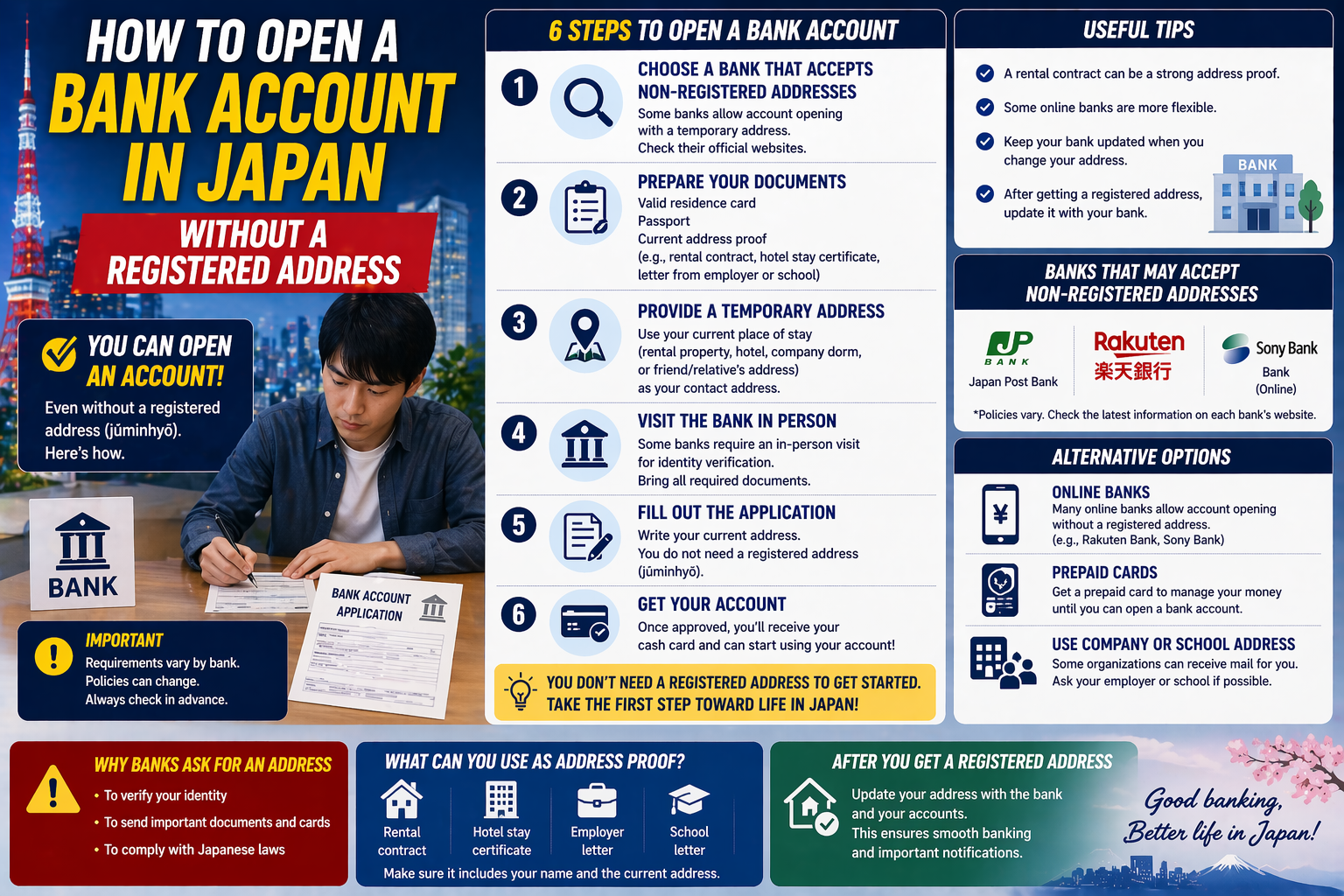
How to Open a Bank Account in Japan Without a Registered Address
Short answer: usually you cannot open a normal personal bank account in Japan until you have a registered address. Banks are required to verify your identity and address, and major banks commonly ask for ID that shows your current Japanese address. If you have just arrived and are still staying in a hotel, short-term rental, or other place that is not yet your registered residence, the practical path is to finish address registration first and then apply.
This guide is for new foreign residents, students, and workers who need a bank account soon after arriving in Japan and are wondering whether they can do it before resident registration is complete.
- Most ordinary banks want your current Japanese address on your ID.
- Foreign residents staying mid- to long-term must register their address with the municipality within 14 days after it is decided.
- A few banks mention limited exceptions or extra forms, but that is not a reliable workaround for a normal first account.
- If you need an account fast, getting your address registered is usually the step that unlocks everything else.
Why the address matters so much
Banks in Japan do not ask for an address just because of internal policy. Industry guidance based on anti-money-laundering rules says banks confirm a customer’s name, address, and date of birth when opening an account.
For foreign residents, that connects directly to the resident registration system.
If you are a mid- to long-term foreign resident, you must register your address with your city or ward office within 14 days after your residence is decided. Once you do that, your resident record is created, and your address can be reflected in the documents banks usually ask for.
That is why the timing matters. Before your address is registered, you may still have legal status to stay in Japan, but you often do not yet have the address proof that banks want.
ここがポイント: In most real cases, the problem is not your nationality. The problem is that the bank cannot complete address verification in the form it requires.
Can any bank open an account without a registered address?
For a standard personal account, do not assume yes.
Mitsubishi UFJ Bank says account-opening ID must show your current address. Its app-based opening route also excludes non-Japanese nationals in ordinary cases, sending them to in-branch procedures instead. That tells you two things:
- address matching is central
- foreigners often face a stricter or more manual review path
Japan Post Bank is the main case that looks a little different on paper. Its FAQ says a foreign national can open an account if they have a place of stay in Japan, and that people treated as non-residents under tax or foreign exchange rules may need to submit a separate form.
But that does not mean “no address needed.” On Japan Post Bank’s own account-opening pages, the bank still says identity documents for account opening must show your current address, and it may send the passbook or other materials to your home after review. It also warns that account opening can be refused after screening.
So the practical conclusion is this:
- If you have no registered address yet, a normal retail bank account is unlikely.
- If a bank mentions a place of stay or non-resident handling, treat that as a narrow exception, not the standard rule.
- If you are a tourist or short-term visitor, this is even harder. Municipal resident registration itself does not apply to short-term visitors.
What to do instead
Start with the address, not the bank.
1. Make sure you actually have a residence you can register
A hotel, hostel, or short tourist stay usually does not solve this problem. You need a real residential address that your municipality accepts for resident registration.
If you are entering Japan for school or work, this is the stage where these options matter most:
- company dormitory
- school dormitory
- long-term share house
- leased apartment
- family home in Japan if you will actually live there
2. Register your address at the local city or ward office
Once your residential address is decided, register it within 14 days. After that, your resident record is created. In many municipalities, the address is also printed on the back of your residence card.
This step matters because banks often want one or more of these:
- residence card showing the current address
- My Number card with the current address
- certificate of residence (
juminhyo) - another official document tied to the same address
3. Apply only after your documents match your real address
This is where many first-time applicants lose time.
Do not apply while these still do not match:
- the address on your residence card
- the address on your application form
- the address where you can receive mail
SBI Shinsei Bank says the address on the ID must match the present address, and it sends the cash card by mail. If the bank cannot confirm delivery to that address, the process can fail.
4. Prepare for extra checks if you are new to Japan
Even after address registration, some banks have additional conditions.
For example, SBI Shinsei Bank says applicants must be residents of Japan, must have a personal Japanese phone number, and may be ineligible if they have been in Japan for less than six months and are not working in Japan. Japan Post Bank says students and technical intern trainees may be asked for student or employee ID.
That means a registered address is necessary, but sometimes not sufficient on its own.
Who is most affected
This issue usually hits the same groups first:
- students who arrive before dorm check-in is fully processed
- workers staying in temporary accommodation before moving into company housing
- people waiting for a lease start date
- newcomers trying to set up salary payment, phone service, or utility contracts in their first weeks
If that is your situation, the bank account problem is usually part of a larger first-month setup chain. In Japan, address registration often sits near the center of that chain.
Common mistakes to avoid
Applying too early
A common mistake is applying as soon as you land because you already have a residence card. That card alone may not help if the current address is not yet registered.
Using a temporary stay address that cannot receive bank mail
Banks may send passbooks, PIN notices, or cash cards by post. If the address is unstable or your name is not properly registered there, delivery can fail.
Assuming an employer or school letter will replace address proof
Supporting letters can help in some cases, especially for students or trainees, but they usually do not replace the bank’s need to verify your current address.
Forgetting that app procedures may be narrower than branch procedures
Some banks advertise fast smartphone account opening, but the app route may exclude foreign nationals or require a smaller set of documents than you have.
Current status as of April 23, 2026
As checked on April 23, 2026, the official pages reviewed for this article still point in the same direction:
- banks continue to frame account opening around identity and address verification
- major banks still require ID showing the current address for ordinary account opening
- foreign applicants may face extra screening, extra documents, or in-person procedures
- I did not find a major retail bank publicly offering a standard personal account designed for someone with no registered Japanese address at all
That last point is an inference from the official materials above, not a quote from one single authority. But for practical planning, it is the safest reading.
The practical takeaway
If you do not yet have a registered address in Japan, treat bank account opening as the step after resident registration, not before it.
For most new arrivals, the fastest order is:
- move into a residence you can register
- complete resident registration at the municipality
- update or confirm your address documents
- apply at a bank that fits your status, language needs, and timeline
If your salary, scholarship, or tuition timing is tight, ask your employer or school what temporary payment arrangement they accept until your address registration and bank setup are complete. That is usually a more realistic solution than trying to force an early bank application.
参照リンク
- Japanese Bankers Association: What are identity verification documents?
- Toshima City: Resident Registration / Residence Card
- MUFG: Identification documents required when opening an account
- Japan Post Bank FAQ: Can foreign nationals open an account?
- Japan Post Bank: For foreign nationals opening an account
- Japan Post Bank: Identification documents for account opening
- SBI Shinsei Bank: Open an account at our branch
- SBI Shinsei Bank: Required identification documents for opening a bank account
- SBI Shinsei Bank FAQ: Can I open an account if the address on my identification document is different from my present address?
- SBI Shinsei Bank FAQ: How long does it take to open an account by post?