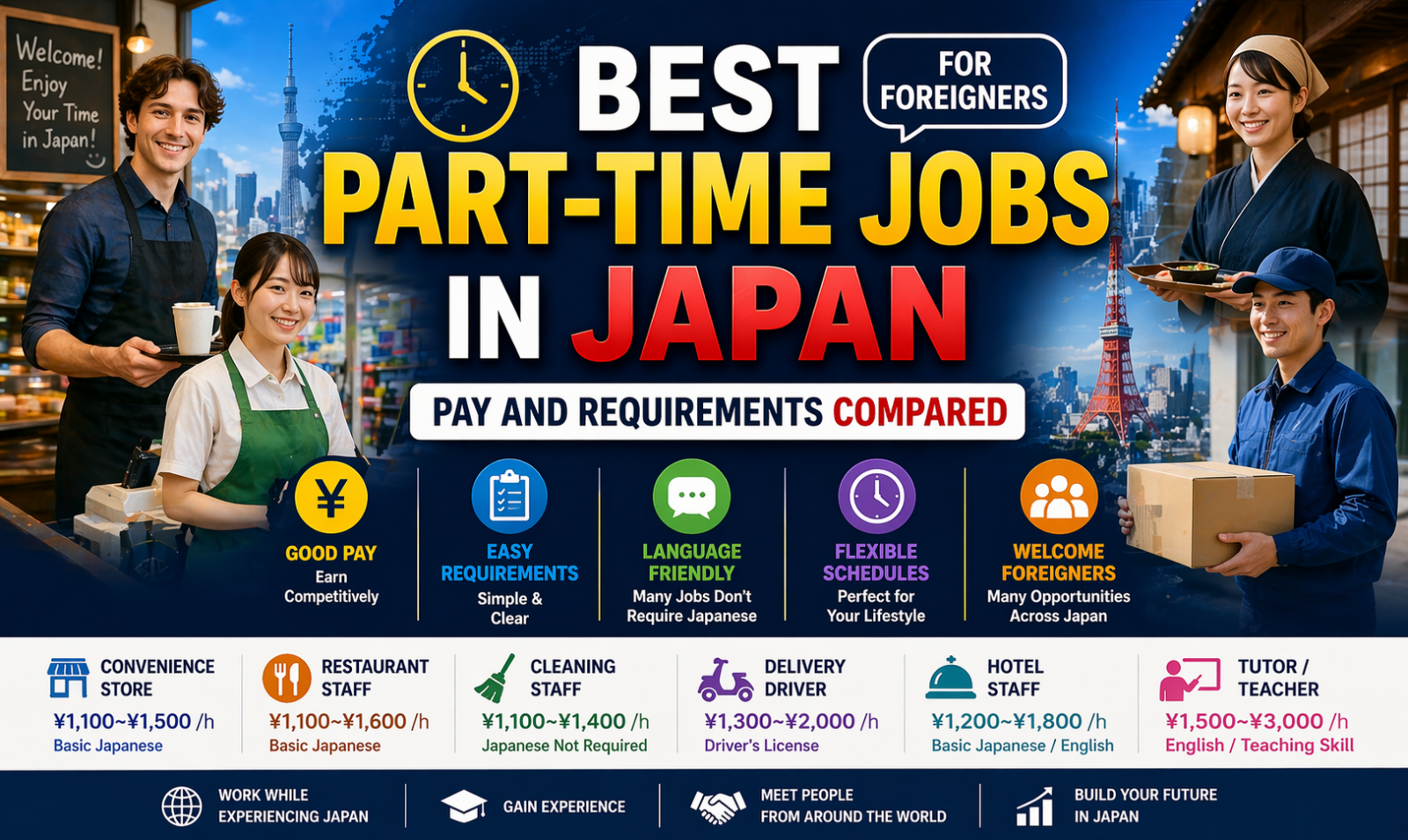
Best Part-Time Jobs in Japan for Foreigners: Pay and Requirements Compared
If you want a short answer, the best part-time job depends on your Japanese level and visa status more than the headline hourly pay.
For most foreigners in Japan, warehouse work and hotel cleaning are the easiest entry points when Japanese is limited, restaurant and convenience store jobs are the easiest to find, and English teaching is usually the highest-paid part-time option if you already have strong English and can handle lesson work.
As of April 21, 2026, that choice matters even more because pay floors changed with the latest prefectural minimum wages, and work permissions still depend heavily on your residence status.
- Best for limited Japanese: warehouse sorting, cleaning, back-of-house kitchen work
- Best for easy availability: restaurants, cafes, convenience stores, supermarkets
- Best for higher hourly pay: English teaching, some bilingual support jobs, late-night shifts
- Best first check before applying: your visa rules, weekly hour limits, and the local minimum wage
Who this guide is for
This guide is for foreign students, working holiday visitors, and foreign residents already in Japan who want a realistic part-time job plan.
It matters most when you are deciding between jobs that look similar on a job app but are very different in practice: one may pay more because it is overnight, one may require customer-service Japanese, and another may fit your visa but not your school schedule.
First check: can you legally do part-time work?
Before comparing jobs, check your residence status.
Students
If you are on a Student status of residence, you cannot work automatically. The official Study in Japan guidance says you need permission to engage in activity outside your status of residence.
Once that permission is granted, the main rules are:
- Up to 28 hours per week during the school term
- Up to 8 hours per day during long school holidays
- The job must not interfere with your studies
- Work in adult entertainment businesses is prohibited
This is not a small detail. The same official guidance warns that students who overwork and let attendance fall can have trouble extending their stay.
Working holiday participants
If you are in Japan on a working holiday visa, the Ministry of Foreign Affairs says work is allowed as an incidental activity to support your stay.
But there are still limits:
- Adult-entertainment related workplaces are prohibited
- Country-specific eligibility rules still apply
- Your program conditions depend on your nationality and the latest bilateral arrangement
Other residence statuses
If you are not a student or working holiday participant, do not assume part-time work is always allowed just because the job is labeled “baito.”
Some statuses allow broad work, some allow only specific fields, and some require separate confirmation. If you are unsure, check with the Immigration Services Agency or a foreigner-support Hello Work office before you sign anything.
ここがポイント: A job is only “good pay” if you are legally allowed to do it, can keep the schedule, and the hourly rate is above your prefecture’s minimum wage.
What foreign students actually do in Japan
Official Study in Japan data based on the 2023 JASSO lifestyle survey gives a useful reality check.
Among privately financed international students, the most common part-time jobs are:
- Restaurant work: 39.2%
- Sales: 28.4%
- Factory assembly work: 6.0%
- Teaching or research assistant work: 5.6%
- Hotel staff: 4.2%
- Language teacher or janitorial work: 3.4%
- General administration: 3.1%
- Warehouse work or translation/interpreting: 2.9%
The same source says about half of student part-time workers fall in the 1,000 to 1,200 yen per hour range, while the average hourly wage is roughly 1,300 yen.
That matters because it cuts through a common misunderstanding: the highest numbers in job ads are not the normal result for most student jobs.
Best part-time jobs compared
Below is a practical comparison based on official wage floors and recent foreigner-friendly job listings in Japan.
| Job type | Typical pay seen in recent listings | Japanese needed | Good fit for | Main watchpoint |
|---|---|---|---|---|
| Warehouse / sorting | About ¥1,220 to ¥1,750 in Tokyo-area examples | Low to basic | People who want simple tasks and less customer contact | Night shifts can be long, and some listings target only unrestricted visa holders |
| Restaurant / kitchen / hall | About ¥1,100 to ¥1,500 depending on area and shift | Basic to intermediate | Students who want flexible shifts and lots of openings | Late finishes can hurt attendance and commute costs add up |
| Convenience store / retail | About ¥1,200 to ¥1,600 in major-city examples | Intermediate customer-service Japanese | People who want stable urban openings and language practice | Cash register, stock work, and customer talk happen at the same time |
| Hotel cleaning / housekeeping | About ¥1,140 to ¥1,300 in current examples | Low to basic | People with limited Japanese who can work physically | Short shifts can look convenient but cap total monthly income |
| Hotel front desk | About ¥1,140 to ¥1,425 in recent examples | Intermediate to advanced, often plus English | Bilingual applicants in tourist areas | Service standards are higher and schedule changes are common |
| English teaching / tutoring | Roughly ¥1,500 to ¥2,500+ in current listings | English ability matters more than Japanese in some roles | Native or near-native English speakers | Fewer openings, uneven hours, and some jobs pay only for lesson time |
Which jobs are usually best, and for whom?
A long list is less useful than a clear ranking. For most readers, the real choice is not between ten jobs. It is between three or four lanes.
1. Warehouse and sorting jobs
Best overall if your Japanese is still weak.
Current foreigner-friendly listings show why. A Tokyo warehouse listing on WORK JAPAN showed ¥1,226 to ¥1,750 per hour, noted that Japanese use is limited, and highlighted night shifts. Similar listings on the same platform clustered around the low- to mid-¥1,200s and higher for overnight work.
Why this matters:
- You can enter faster than in customer-facing jobs
- The work is usually repetitive and easier to learn
- Night shifts often lift pay, sometimes sharply
But there is a catch. Some warehouse listings accept only people with broader work rights, such as permanent resident or spouse-type statuses. That is a visa filter, not just a hiring preference.
2. Restaurant jobs
Best for availability, not always for pay.
Restaurant work stays the largest student category in official data. That makes sense: cafes, ramen shops, family restaurants, fast-food chains, and izakaya constantly need staff.
Recent listings show a wide spread:
- Around ¥1,100 to ¥1,250 in regional examples
- Around ¥1,230 to ¥1,350 in many Tokyo examples
- Around ¥1,500 in some specialized kitchen roles
Restaurant jobs are a good fit if you want:
- Shifts after class
- Fast hiring
- A place to improve spoken Japanese
They are a worse fit if you need quiet work, steady weekends off, or a schedule that never runs late.
3. Convenience store and retail jobs
Best if you want daily Japanese practice and city-center access.
These jobs look simple from the outside, but they usually require more Japanese than warehouse or cleaning work. You may need to handle the register, stocking, package pickup, and customer questions in one shift.
Recent examples show:
- Kyoto-area Lawson dispatch work at about ¥1,220
- Osaka FamilyMart listings at ¥1,200 to ¥1,600 depending on shift
- Tokyo convenience-store examples around ¥1,300 and up in some locations
This route can be excellent for language growth. It is less forgiving if you are still struggling with numbers, polite expressions, or fast customer interaction.
4. Hotel cleaning and housekeeping
Best low-language option in tourist areas.
Hotel cleaning jobs often ask for less spoken Japanese than front-desk work. Current listings show many jobs in the ¥1,150 to ¥1,300 range, with some weekend premiums or short daytime shifts.
This is attractive if you want:
- Daytime hours
- Less customer talk
- Work in major tourist cities
The tradeoff is income ceiling. A short 10:00 to 15:00 shift can be easier to manage, but total monthly earnings may stay lower than a longer warehouse or restaurant schedule.
5. English teaching and tutoring
Best pay if you can actually qualify.
This is the option many newcomers imagine first, and it can indeed pay more. Recent foreigner-facing listings show part-time English teaching examples around ¥1,500 to ¥2,000, with some cases above ¥2,250.
Still, this lane is smaller than many expect.
You usually need some mix of:
- Strong spoken English
- Confidence leading children or adult learners
- Reliable weekly availability
- A presentation style employers can trust with customers or parents
So yes, it often pays best. No, it is not automatically the easiest job to get.
What minimum wage means for your job search in 2026
The latest official regional minimum wage list for FY2025 matters because those rates are the legal floor employers must meet.
Examples from the latest published list include:
- Tokyo: ¥1,226
- Kanagawa: ¥1,225
- Osaka: ¥1,177
- National weighted average: ¥1,121
That changes how you should read job ads.
A low-looking offer may be normal in one prefecture and illegal in another
A job at ¥1,150 an hour would be above the floor in many areas, but below the floor in Tokyo and Kanagawa.
Big-city headline pay is not the whole story
Tokyo often pays more, but rent and transport can erase the advantage quickly. A slightly lower hourly rate in a cheaper city can still leave you with more money at the end of the month.
Night pay can make average jobs look better than they are
Late-night jobs often advertise a stronger rate because premium pay applies. That does not mean the base wage is unusually high.
Common mistakes foreigners make when choosing a part-time job
Chasing the highest number in the ad
A listing may show a top rate that only applies after 10 p.m., only on weekends, or only after training. Always check the normal base rate first.
Ignoring the visa filter
A warehouse or retail ad may look perfect until you read the preferred visa types. That line decides whether the job is realistic for you.
Underestimating customer-service Japanese
A convenience store is not just “simple cashier work” in Japan. The speed, fixed phrases, and customer expectations are higher than many beginners expect.
Taking a job that hurts your main status purpose
For students, this is the biggest risk. Official guidance is clear that work must not damage study attendance or school performance.
Not checking written working conditions
The Ministry of Health, Labour and Welfare provides multilingual guidance for foreign workers because wage, schedule, overtime, and dismissal problems still happen. If the terms are vague before you start, that is already useful information.
Latest update that matters now
Two current changes are especially worth noting.
Prefectural wage floors are higher than many old blog posts show
A lot of old guides still cite Tokyo at ¥1,113 or ¥1,163 as if that were the current number. As of April 21, 2026, the latest published Tokyo regional minimum wage is ¥1,226, based on the FY2025 list.
The working holiday program is broader in 2026
The Ministry of Foreign Affairs says Japan’s working holiday program covers 32 countries and regions as of April 1, 2026. It also notes recent repeat-participation changes for some partners, including Taiwan from February 1, 2026 and South Korea from October 1, 2025.
That matters because some readers who assumed they were limited to one stay may now need to recheck their country rules.
So what should most foreigners choose?
If you want the most practical answer, use this order.
- Choose warehouse or cleaning work if your Japanese is limited and you need a realistic first job.
- Choose restaurant work if you want the widest pool of openings and can handle busy shifts.
- Choose convenience store or retail work if your Japanese is already functional and you want faster language improvement.
- Choose English teaching only if you already have the communication level to compete for it.
The next thing to check is simple:
- Your residence status
- Your weekly hour limit
- Your prefecture’s minimum wage
- Whether the listed pay is base pay or includes a night premium
- Whether the commute still makes sense after transport time and cost
A part-time job in Japan is not just about getting hired. The better question is whether the job still looks good after you strip away the flashy rate, check the legal limits, and imagine doing that shift every week.
参照リンク
- Study in Japan: Part-Time Work
- Study in Japan: Status of Residence
- Ministry of Foreign Affairs of Japan: The Working Holiday Programmes in Japan
- MHLW: Labour Standards
- MHLW: For Foreign Workers in Japan
- MHLW regional minimum wage list FY2025 (English PDF)
- MHLW pamphlet: Are Your Working Conditions Fair? For Foreign Workers in Japan (PDF)
- Tokyo Metropolitan Foundation TIPS: Job Search
- Tokyo Employment Service Center for Foreigners
- Shinjuku City multilingual guide: Public Employment Security Offices (Hello Work)
- WORK JAPAN warehouse listing example
- WORK JAPAN English teacher listing example
- WORK JAPAN English teacher listing example 2
- Nihon Arubaito part-time jobs for foreigners
- Tokyo World Japanese Language School: Part-time job