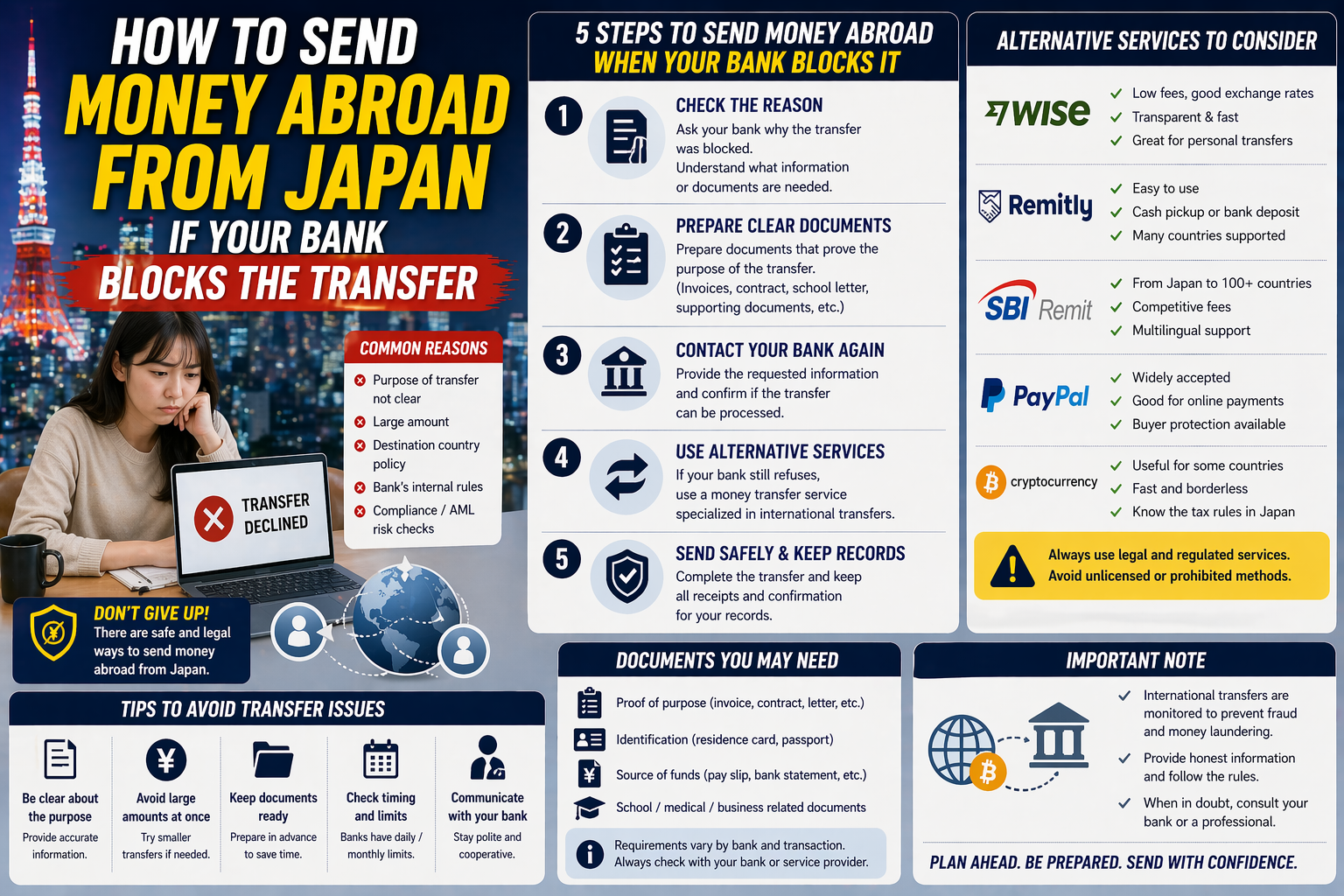
How to Send Money Abroad From Japan If Your Bank Blocks the Transfer
If your bank in Japan blocks an overseas transfer, the practical fix is usually to identify the exact compliance problem first, then switch route if needed. In many cases the issue is not that international remittance is impossible. It is that the bank needs more information, your My Number is not registered, your address or residency status is outdated, the transfer purpose does not fit the bank’s rules, or the destination is restricted.
For many foreign residents, the safest order is simple: ask the bank why the transfer stopped, prepare the missing documents, and if the bank still cannot process it, move to another service that accepts your country, purpose, and payment method.
- Best first step: ask for the exact reason for the block, not a general explanation
- Common fix: update My Number, address, residence status, or transfer purpose
- If the bank still says no: compare another bank, Japan Post Bank’s current online remittance service, or a remittance provider such as Wise or Seven Bank/Western Union
- Watch the total cost: transfer fee, exchange rate, intermediary bank fees, and return fees can all matter
Who this guide is for
This guide is for students, workers, and long-term residents in Japan who need to send money to family, pay tuition, move savings, or make another personal overseas transfer.
It matters most when:
- your app or branch says the transfer cannot be processed
- the bank asks for extra documents and you are not sure what to prepare
- you recently moved, changed visa status, or arrived in Japan not long ago
- you need to send money soon and want a backup option
Why banks in Japan block overseas transfers
A blocked transfer is usually about rules, not just technology.
1. Identity or tax information is incomplete
Many institutions in Japan require My Number for overseas remittances. Japan Post Bank says its international remittance service can only be used from accounts that have passed transaction confirmation and already have My Number registered. SBI Shinsei Bank and SMBC Trust Bank also state that My Number registration is required for overseas remittance transactions. Wise Japan requires identity verification and a My Number document before you can use the service from Japan.
If you moved and your bank still has your old address, that can also stop the process.
2. The transfer purpose does not fit the bank’s rules
Banks now ask more detailed questions about why you are sending money. SMBC Trust Bank says it may check your occupation, your relationship with the recipient, and documents supporting the remittance. It also tightened its online remittance rules in March 2024 so that a registered payee must match the registered remittance purpose.
That matters in real life. A transfer marked as family support may not be handled the same way as tuition payment or reimbursement.
3. The destination or recipient is restricted
Some services suspend transfers to certain countries or apply extra screening under sanctions and anti-money-laundering rules. Seven Bank says some countries and regions are suspended, and it may request additional details before allowing a transfer.
4. Your residency status may trigger extra handling
Japan Post Bank explains that some foreign nationals are treated as non-residents under the Foreign Exchange and Foreign Trade Act if they have been in Japan for less than six months and are not working at a business office in Japan. In that case, some transfers are handled differently, and after you become a resident under the law, you need to ask the bank to change your account setting.
ここがポイント: A blocked transfer often means “the bank cannot approve this transaction as entered,” not “you can never send money abroad from Japan.”
What to do first when the transfer is blocked
Start with the bank you already use. That is often faster than opening a new service blindly.
Ask these questions clearly
- What is the exact reason the transfer was blocked?
- Is the problem My Number, address, residency status, recipient details, country restrictions, or transfer purpose?
- Can I fix it online, or do I need to visit a branch or send documents?
- If the transfer was rejected after submission, will there be a return fee or intermediary bank fee?
Prepare the documents most banks ask for
The exact list depends on the provider, but these are the documents that commonly matter:
- residence card or other photo ID
- My Number card, notification slip, or a residence certificate showing My Number
- proof of your current address if the bank record is old
- documents showing the purpose of the transfer
- documents showing source of funds for larger or unusual transfers
For example, purpose documents may include:
- tuition invoice or school notice
- family support explanation and recipient details
- invoice or statement for a permitted personal payment
- bank details that exactly match the recipient name
If your bank still will not send it, your realistic alternatives
1. Try another bank or bank-linked remittance route
This works best if your transfer is legitimate but your current bank’s process is too strict for your case.
Japan Post Bank is one example worth checking because its system changed recently. Its branch-counter and Yucho Direct international remittance service ended on August 29, 2025, but the bank launched a newer online service in July 2025. The current service is for individual customers and has these stated limits:
- less than 1,000,000 yen per transfer
- up to 2,000,000 yen per day
- up to 5,000,000 yen per month
- stated application fee: 3,000 yen per transfer
This will not always be the cheapest route, but it is useful if you already bank with Japan Post and want a bank-based option rather than a separate remittance app.
2. Use a remittance provider that accepts Japan-based customers
If the issue is your bank’s channel rather than the transfer itself, a specialist remittance service may be easier.
Wise Japan is one common example. Its Japan verification page says you need a valid Japanese photo ID and a My Number document, and the details must match your profile exactly. Wise also says JPY transfers must be funded from a bank within Japan, and it does not accept cash deposits or third-party payments.
That last point matters. If your bank blocked the transfer and you plan to ask a friend or employer to pay into your remittance for you, Wise says that will be rejected.
3. Use Seven Bank’s international money transfer service if the route fits
Seven Bank is useful for people who want English-friendly setup, ATM access, or Western Union cash pickup options. Its application page says foreign nationals need a residence card and My Number when applying.
But read the restrictions before you rely on it.
Seven Bank says:
- personal transfers must fit its allowed purposes
- business payments and import-bill payments are not allowed
- the standard limits are 1,000,000 yen per transfer/day/month and 3,000,000 yen per year
- some countries and regions are suspended
If your use case is family support, small personal remittance, or a fast cash pickup route, this can be practical. If you need to pay an overseas company, it may not work.
Costs to compare before you switch
Do not compare only the headline transfer fee.
A blocked or returned transfer can become expensive because four separate costs may apply:
- sender fee charged by your bank or remittance provider
- exchange-rate margin
- intermediary bank charges
- return or investigation fees if the payment fails
SMBC Trust Bank says rejected transfers may incur additional return charges from beneficiary or intermediary banks. Japan Post Bank also notes that intermediary charges may be deducted.
If you are comparing options, check these items in order:
- Total yen you will pay
- Exact amount the recipient will receive
- Whether the route is bank deposit or cash pickup
- Whether the destination country is currently supported
- Whether the service accepts your transfer purpose
Common mistakes that delay remittances
These are the errors that waste the most time:
- Using old personal information. A moved address, expired card, or unregistered My Number can stop the process.
- Choosing the wrong purpose. A provider may allow family support but reject business-related payments.
- Entering a recipient name that does not match the bank record. Even a small mismatch can trigger review or return.
- Trying to pay from someone else’s account. Wise says third-party payments are rejected.
- Leaving the transfer to the last day. A compliance review can add days, and sometimes longer.
Current changes that matter as of April 23, 2026
Three recent points are especially important for foreign residents in Japan:
- Japan Post Bank changed its remittance system. Counter and Yucho Direct international remittance ended on August 29, 2025, and the newer online service became the main route.
- Purpose checks are stricter at some banks. SMBC Trust Bank’s online remittance process ties payees to remittance purpose more tightly than before.
- Country restrictions can change. Seven Bank announced additional suspended countries and regions on September 11, 2025, so availability is not fixed forever.
Practical takeaway
If your bank blocks an overseas transfer from Japan, do not start by guessing. Ask for the exact reason, fix the missing compliance item if possible, and only then choose a backup route.
For many residents, the decision is straightforward:
- use your bank if the issue is just missing verification
- use a specialist remittance service if speed and convenience matter more
- use a bank route again if you need higher trust, a formal record, or a transfer purpose that app-based services will not accept
Before you send, check one last thing: whether your destination country, transfer purpose, and identity documents still match the provider’s current rules on the day you apply. That is often the difference between a transfer that goes through and one that gets sent back.
参照リンク
- Japan Post Bank English: International Remittances
- Japan Post Bank: New international remittance service
- Japan Post Bank: Domestic remittances involving non-residents
- Japan Post Bank: International remittance fees
- Wise Help Centre: Getting verified in Japan
- Wise Help Centre: Guide to JPY transfers
- Seven Bank: Regulation of remittance under the Foreign Exchange and Foreign Trade Act
- Seven Bank: International Money Transfer FAQ
- Seven Bank: Application method for international money transfer service
- Seven Bank: International Money Transfer Service
- SMBC Trust Bank: Overseas Fund Transfer
- SMBC Trust Bank: Purpose of Remittance notice
- SBI Shinsei Bank: Individual Number (My Number)