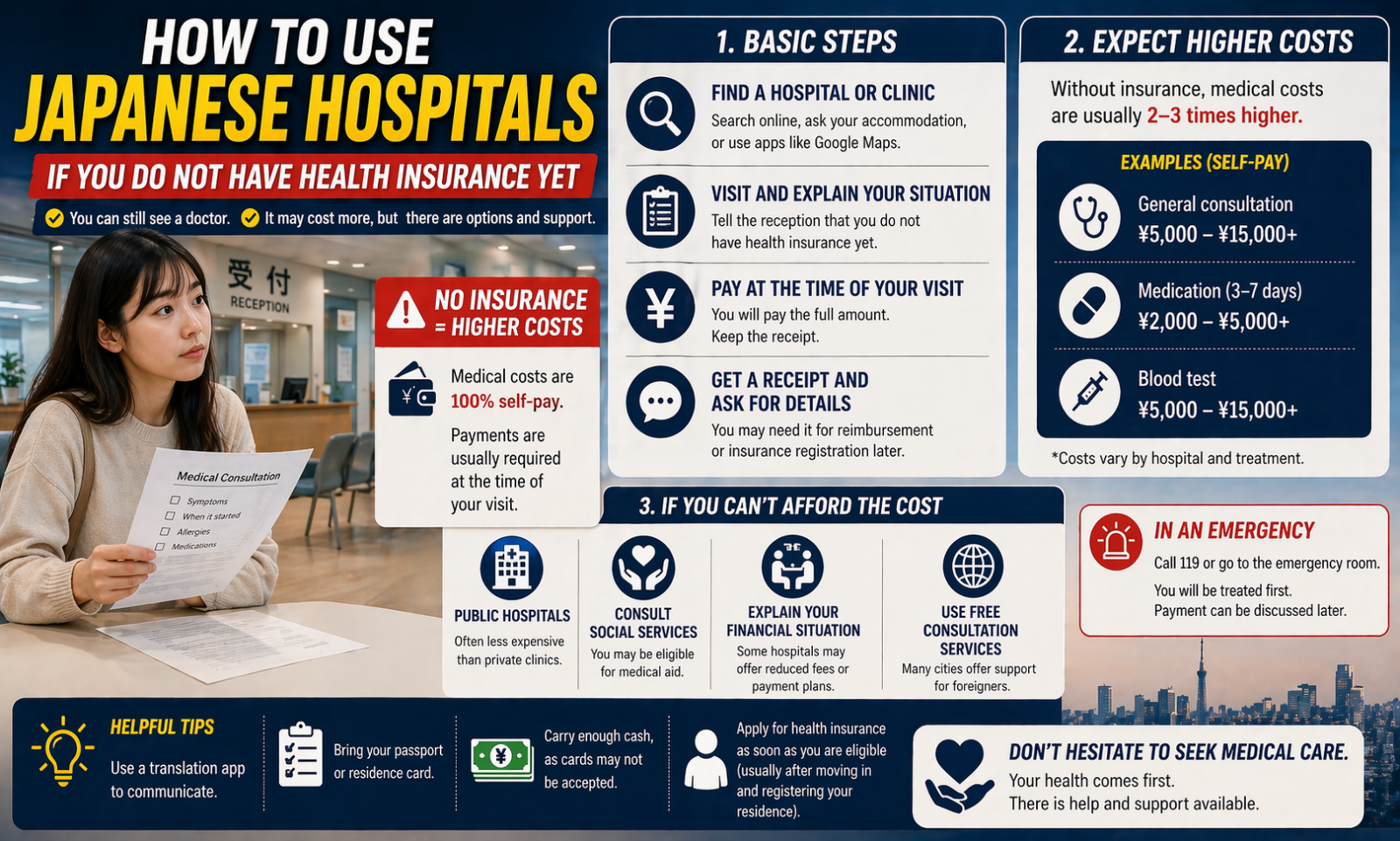
How to Use Japanese Hospitals If You Do Not Have Health Insurance Yet
You can still go to a Japanese clinic or hospital even if your health insurance is not active yet. The main difference is simple: if you cannot prove coverage, you may be asked to pay the full bill on the day.
If you are a new resident, a student, or a worker who should be joining Japan’s public insurance, do not wait until the next problem. Get treatment when you need it, then fix your insurance status as quickly as possible with your city office or employer.
- You can receive treatment without showing insurance, but payment is usually much higher.
- If you are eligible for public insurance, enrollment deadlines matter and late procedures can become expensive.
- In Tokyo, HIMAWARI and AMDA can help you find medical institutions with foreign-language support.
- In an emergency, call 119 for an ambulance.
Who this guide is for
This guide is mainly for:
- new foreign residents who have just moved to Japan
- students whose insurance paperwork is still in progress
- workers who recently changed jobs or lost employer insurance
- long-term residents who are between plans and suddenly need care
If you are a short-term visitor, the hospital process is similar, but the insurance answer is different. You will usually rely on travel insurance or pay first and claim later under your private policy.
What happens if you go to a hospital before insurance is ready
Japanese hospitals do not require you to be fully set up in advance before you can be seen. If you are sick or injured, you can still visit a clinic or hospital.
What changes is the billing.
According to the Ministry of Health, Labour and Welfare, people who can verify public insurance eligibility usually pay only part of the bill at the medical institution. For many patients aged 6 to 69, that standard share is 30%. If you cannot verify eligibility, the medical institution may treat you as a self-pay patient and charge the full amount.
Where to go
- For routine problems during the day, start with a clinic.
- For more serious symptoms, use a hospital.
- For urgent night or holiday care, use after-hours services in your area.
- For severe symptoms, serious injury, or anything life-threatening, call 119.
JNTO’s emergency guide for foreign visitors explains this basic split clearly: clinic or general hospital during regular hours, after-hours reception outside those times, and emergency hospitals for urgent cases.
What to bring
Bring whatever helps the hospital identify you and understand your case.
- passport or residence card
- phone number and address in Japan
- any insurance document you do have
- My Number Card, if you already have one
- medication list or photos of prescriptions
- cash or a payment card, because self-pay charges may be due immediately
If your insurance is being processed, bring proof of that too. It may not reduce the bill on the spot, but it helps staff understand your situation.
ここがポイント: Needing treatment and finishing insurance enrollment are two separate problems. Do not delay urgent care just because your paperwork is incomplete.
How much you may need to pay
The biggest shock for new arrivals is not access. It is cost.
If you already have valid public insurance proof, Japan’s system usually reduces what you pay at the counter. If you do not, you may be billed at the uninsured rate for that visit.
When you can prove coverage
MHLW’s current guidance says patients can verify eligibility mainly with:
- a My Number Card registered for health insurance use
- a Health Insurance Eligibility Certificate
When that verification works, many people aged 6 to 69 pay 30% of total covered medical expenses, while other age groups may pay 10%, 20%, or 30% depending on age and income rules.
When you cannot prove coverage yet
Expect these practical outcomes:
- the clinic may ask for the full consultation and treatment cost that day
- tests, imaging, and medicines can raise the bill quickly
- a hospital may ask about your payment method before treatment unless it is an emergency
- the final amount varies by treatment, facility, time of day, and whether the care is covered by public insurance at all
Tokyo’s HIMAWARI service specifically lists questions such as “How much would the medical fee be if I have no medical insurance?” That matters because there is no single uninsured price for every case.
If you should be in Japan’s public insurance, fix that first
For many foreign residents, the real issue is not that they are outside the system forever. It is that they have not completed the right procedure yet.
If you are not on employer insurance
If you live in Japan as a registered resident and are not enrolled in another public health plan, you will usually need National Health Insurance (NHI) through your municipality.
Toshima City’s foreign-resident guidance says foreign residents registered as residents must enroll in NHI if they will not enroll in another public health insurance program. Its Japanese guidance also says enrollment procedures should be done within 14 days after moving in or after losing other public insurance.
That deadline matters for two reasons:
- premiums start from the month you became eligible, not only from the day you finally apply
- if your notification is late, some municipalities can charge premiums retroactively, and Toshima states this can go back up to 2 years
Toshima also warns that before you complete the procedure, medical costs can be fully self-paid. Other municipalities may explain the process in slightly different words, but the practical lesson is the same: do not leave NHI enrollment for later.
If you recently started or changed a job
Your employer may place you in employee health insurance instead of NHI. If you just started work, confirm these points immediately:
- the date your coverage starts
- whether dependents are included
- what document you can use before your digital or paper proof is available
- whom to contact if the hospital says your eligibility cannot be verified
A gap of even a few days matters when you suddenly need a doctor.
Language help and hospital search tools
If the hardest part is finding a hospital that can communicate with you, use official or public support services instead of guessing.
Tokyo: HIMAWARI
Tokyo’s medical information service for foreign patients can help you find medical institutions with foreign-language support and explain the Japanese medical system.
Key points:
- phone: 03-5285-8181
- languages: English, Chinese, Korean, Thai, and Spanish
- hours: 9 a.m. to 8 p.m., every day
This is especially useful if you need to compare clinics before you go and want to ask how uninsured billing may work.
Nationwide practical support: AMDA
AMDA International Medical Information Center offers multilingual medical consultation and remote interpretation support.
Its English page lists:
- medical consultation phone support
- remote interpretation support for medical visits
- weekday service hours for English support
AMDA is useful when the hospital visit itself becomes difficult because of language, not just because of insurance.
Visitors: JNTO
If you are visiting Japan rather than living here, JNTO’s emergency medical guide and hotline can help you find care and understand where to go.
Important exceptions
Not every medical bill should be handled through the same insurance route.
Work-related injuries
If you were injured at work or while commuting, that may be a workers’ compensation issue rather than ordinary health insurance. MHLW publishes a foreign-worker brochure on industrial accident compensation insurance. If the injury is job-related, tell the hospital and your employer immediately.
Municipality differences
National insurance rules are national in structure, but the paperwork is handled locally. That means:
- deadlines and required documents are checked at your city or ward office
- premium amounts vary by municipality and household situation
- local offices may differ in what they can issue immediately while your status is being updated
Visitors and people without resident registration
If you do not have resident registration in Japan, you may not be able to join NHI at all. In that case, the realistic path is usually private insurance, travel insurance, or self-pay.
Common mistakes to avoid
People usually run into trouble for the same reasons.
- Waiting to enroll because you are healthy now. The risk appears the day you need a doctor, not before.
- Assuming the hospital can solve your insurance status for you. It usually cannot.
- Thinking “I will join later” means you avoid earlier premiums. Municipalities can bill retroactively.
- Bringing no ID, no address, and no payment method.
- Forgetting to mention that an injury happened at work or during commuting.
- Assuming an old health insurance card format is still the normal path in 2026.
Current status as of April 23, 2026
This area has changed recently enough that older advice online is easy to get wrong.
As of April 23, 2026:
- MHLW says eligibility at medical institutions is now checked mainly through a My Number Card used as a health insurance card or through a Health Insurance Eligibility Certificate.
- The eligibility certificate system started on December 2, 2024.
- If you are newly sorting out coverage, ask your municipality or insurer what proof they can issue now, not what older blogs say used to be normal.
That last point matters in real life. A hospital receptionist is not deciding your legal status. They are deciding whether your coverage can be verified today.
Practical takeaway
If you need care before your insurance is ready, the safest order is:
- Go to the right clinic or hospital without waiting for perfect paperwork.
- Expect possible full self-pay if you cannot prove coverage.
- Contact your city office or employer the same day or next business day to fix enrollment.
- Keep all receipts and ask your insurer or municipality what can and cannot be processed afterward.
That sequence will usually save you more trouble than trying to solve everything at the reception desk while you are sick.
参照リンク
- Ministry of Health, Labour and Welfare: Overview of health insurance policy in Japan (English PDF)
- MHLW: My Number Card as your Health Insurance Certificate (Foreign Language Brochures)
- Toshima City: National Health Insurance (English)
- Toshima City: National Health Insurance (Japanese)
- Japan National Tourism Organization: For safe travels in Japan – Guide for when you are feeling ill
- Tokyo Metropolitan Government: Medical information service for foreign patients
- AMDA International Medical Information Center: English
- MHLW: Brochure about Industrial Accident Compensation Insurance for foreign workers