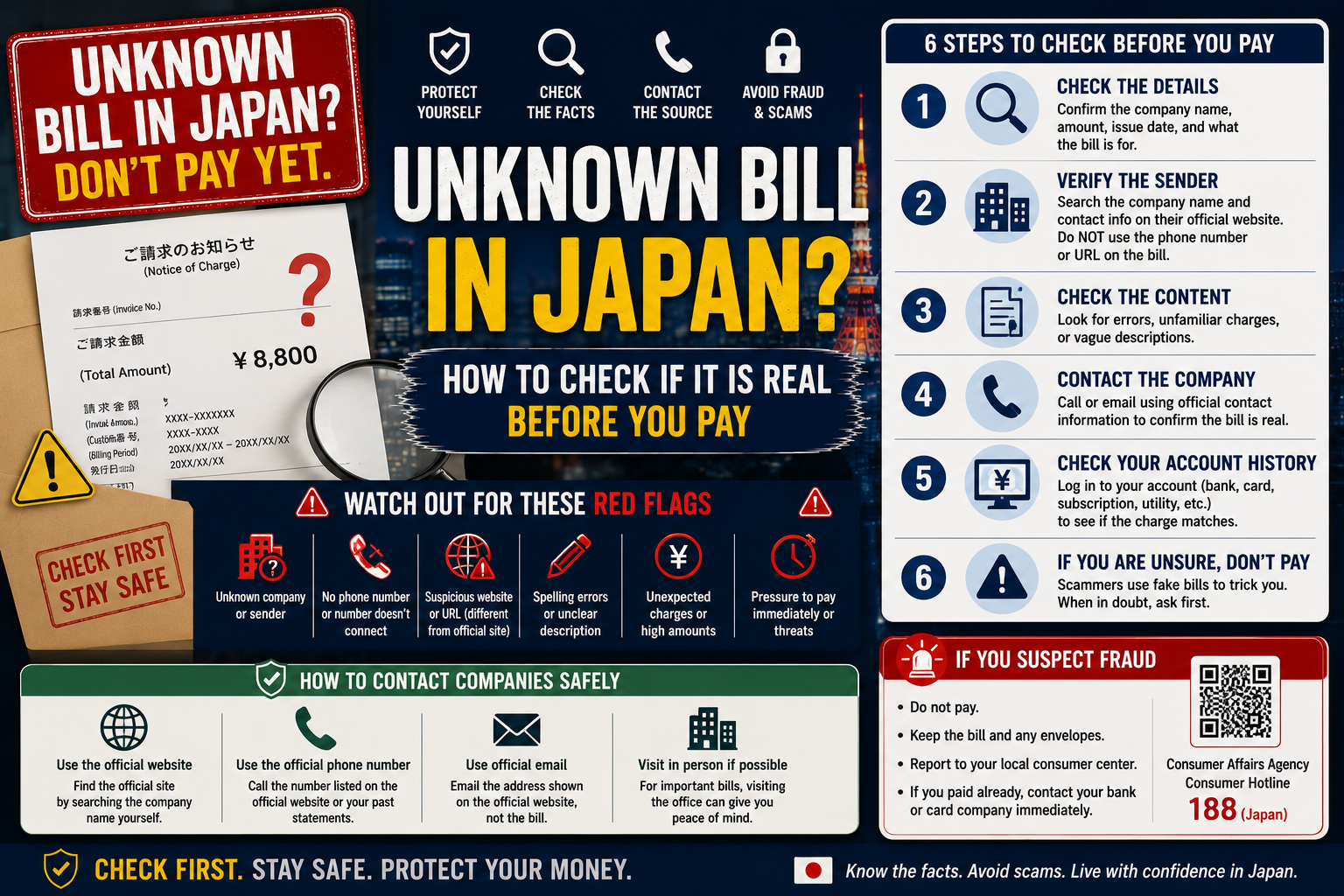
Unknown Bill in Japan? How to Check if It Is Real Before You Pay
If you get a bill in Japan that you do not recognize, do not pay it first and ask questions later. The safe approach is simple: check who sent it, confirm whether you actually use that service or owe that tax, and contact the issuer through an official website or official phone number you find yourself.
This matters for foreign residents, students, workers, and beginners who may receive payment slips, SMS messages, emails, or postcards in Japanese. Some are real. Some are scams. Others are real bills that look unfamiliar because Japan’s tax, insurance, and utility systems are handled by different offices and can change when you move, change jobs, or leave Japan.
- Do not use the phone number or link printed in a suspicious message until you verify it elsewhere.
- A real court notice in Japan is not sent by email. Important court documents are generally sent by special postal service.
- A real bill can still surprise you after moving, changing insurance, or leaving Japan after January 1.
- If you are unsure, call Consumer Hotline 188 or your local city office before paying.
Who this guide is for
This guide is for people in Japan who receive:
- a payment slip in the mail
- an SMS or email asking for payment
- a demand from someone claiming to be a court, police officer, lawyer, utility company, phone company, or government office
- a bill for tax, health insurance, pension, utilities, or another service they do not remember signing up for
It is especially useful if you cannot read all of the Japanese on the notice or if the notice arrived soon after you moved, changed visa or job status, or left one city for another.
First answer: what should you do right away?
Start with these steps in order:
- Do not pay on the spot.
- Do not click links in SMS or email.
- Check the sender name, service name, amount, and due date.
- Compare it with your own records such as rent, utilities, phone contract, tax notices, and insurance enrollment.
- Contact the organization through its official website, not through the message itself.
- If it sounds like a lawsuit or court order, verify it immediately with the court or legal office using official contact details.
- If you think it is fraud, contact 188, your local police station, or the police consultation line.
ここがポイント: In Japan, the most expensive mistake is often not the strange-looking bill itself. It is paying, calling, or clicking before you verify the sender independently.
How to tell whether the bill may be real
A bill is more likely to be real if it matches a situation you already know about.
Common real bills that surprise foreign residents
Resident tax
Resident tax often confuses newcomers because it is based on the previous year’s income, and billing usually starts later. If you lived in a city on January 1, you may still owe local resident tax there even if you move later. Kyoto City’s current guidance also notes that people who leave Japan before the notice is sent may need a tax representative in Japan.
Why this matters: people often think, “I already moved, so this cannot be mine.” In some cases, it still can be.
National Health Insurance
National Health Insurance bills can also feel unfamiliar. In many municipalities, the payment notice is sent to the head of household, even if another family member is the one enrolled or using care. Tokyo also notes that payment method and number of installments vary by municipality.
Why this matters: the bill may be real even if the name layout or payment timing is not what you expected.
Utilities, mobile phone, internet, and rent-related charges
These are often billed by operator, landlord, management company, or guarantor company. If you recently started or ended a contract, you may receive:
- a final monthly bill
- late payment charges
- a restoration or reconnection fee
- a guarantor-related claim connected to rent
Why this matters: a real claim should connect to an actual contract, address, or account number you can verify.
Signs that the bill may be a scam
Be more careful if the demand arrives by SMS, email, postcard, or phone call and includes pressure tactics.
Common warning signs:
- urgent phrases like “pay today or your account will be frozen”
- demands for gift cards, prepaid e-money, crypto, or instant bank transfer
- a link in SMS asking you to log in or enter card details
- a caller who says they are from the police, court, or government office and wants payment immediately
- a message that tells you not to contact anyone else
- a callback number that you cannot confirm on an official website
Japan’s National Police Agency says phishing messages often impersonate mobile carriers, delivery companies, banks, and public bodies, and advises users not to click links in email or SMS. The Tokyo Metropolitan Police also warned on April 15, 2026 that spoofed caller ID is being used in impersonation scams, including calls that look like real police numbers.
Court notices: the exception you should not ignore
Many fake bills in Japan use legal language to scare people. Some mention lawsuits, unpaid fees, seizure of wages, or final demand deadlines.
Here is the important split:
- Fake court scams are common and courts have warned about fake postcards, fake calls, and fake emails.
- Real court documents should not be ignored.
The Ministry of Justice says real court payment demands and small-claims summons are sent by special service mail and are not sent by email. Courts in Japan also warn that courts do not call people to demand bank transfers.
What to do if the notice mentions a court
- Check whether it arrived as a formal mailed document rather than email.
- Look for the court name and verify it on the official Courts in Japan website.
- Do not call the number printed on a suspicious postcard or letter until you confirm the court independently.
- If it appears to be a real court document, act quickly. Ignoring a real one can create a much bigger problem than the original claim.
A safe verification checklist
Use this when you are holding a paper bill or looking at a message on your phone.
1. Check the sender
Ask yourself:
- Do I know this company, city office, school, landlord, or insurer?
- Did I ever sign a contract with them?
- Is the address connected to a place where I lived or used a service?
2. Check the payment method
A suspicious demand is riskier if it asks for:
- gift cards or electronic money codes
- payment through a random URL
- personal information over the phone
- immediate transfer to a personal bank account
3. Check the contact route
Open the official website yourself and compare:
- phone number
- branch or office name
- account number or customer ID format
- notice style and service description
4. Check your life events
Unexpected bills are often linked to:
- moving to a new city
- leaving a job and changing health insurance
- leaving Japan after January 1
- ending a phone or internet contract
- missing earlier mail because of an address change
What not to do
These mistakes make small problems expensive fast:
- paying first just to “be safe”
- calling the number in a suspicious SMS or postcard without checking it
- clicking a payment link in a text message
- sending your residence card, My Number, bank details, or card details before verification
- ignoring a possible real court notice because you assume all strange bills are scams
- throwing away a paper notice without checking the sender and subject
If you already paid or shared information
Act the same day if possible.
- Contact your bank or card issuer immediately.
- Change passwords if you entered them on a suspicious site.
- Report phishing or fraud to police.
- Contact Consumer Hotline 188 for advice on the next step.
- If the case involves a city office, insurer, or utility, call the official customer support line and explain what happened.
The Consumer Affairs Agency says people who do not know where to ask for help should use 188, which connects them to a local consumer affairs consultation office.
Regional differences to expect
This topic is Japan-wide, but the details are not always the same.
- Resident tax notices are handled by your municipality.
- National Health Insurance billing style and installment timing vary by city, ward, town, or village.
- Utility and rent-related claims depend on the operator, landlord, and guarantor company.
- Some cities provide more English support than others.
So the right question is not only “Is this real?” but also “Which office actually handles this kind of bill where I live?”
Current watchpoints in 2026
Several official warnings make this issue more urgent now.
- The Consumer Affairs Agency published a warning on January 9, 2026 about suspicious calls impersonating agency staff.
- The Tokyo Metropolitan Police updated its warning on April 15, 2026 about caller ID spoofing in impersonation scams.
- Courts in Japan continue to warn about fake legal notices, fake court calls, and fake court emails.
The practical takeaway is clear: even when the message looks official, the contact route may still be fake.
Final takeaway
If you get a bill in Japan that you do not recognize, pause first. A real bill can usually be tied to a contract, a tax year, a household insurance setup, or a formal court process that you can verify through an official channel. A scam usually tries to stop you from checking.
Before you pay anything, confirm three points:
- who sent it
- what contract or legal basis it refers to
- which official website or office confirms it
If those three points do not line up, do not treat it as a normal bill.
参照リンク
- Consumer Affairs Agency: Consumer Hotline 188
- Consumer Affairs Agency: Inquiry and damage consultation information
- Consumer Affairs Agency: Warning about suspicious calls impersonating agency staff (January 9, 2026)
- National Consumer Affairs Center of Japan: Fake postcards impersonating NCAC and the Consumer Affairs Agency
- National Police Agency: Phishing countermeasures
- Tokyo Metropolitan Police: Warning about impersonation scams using spoofed caller ID (updated April 15, 2026)
- Courts in Japan: Suspicious phone calls claiming to be court clerks or court staff
- Courts in Japan: Warning about mail claiming to be from a district court civil division
- Courts in Japan: Warning about suspicious postcards titled final notice of unpaid charges lawsuit
- Courts in Japan: Warning about suspicious emails claiming to be from the Supreme Court clerk
- Ministry of Justice: Q&A on payment orders and small claims, including how real court notices are sent
- Ministry of Justice: Warning about fictitious billing using the Ministry’s name
- Tokyo Metropolitan Government: How National Health Insurance premium or tax notices work
- Tokyo Metropolitan Government: National Health Insurance premium or tax amounts and municipal differences
- Kyoto City: Procedures for municipal resident tax when leaving Japan