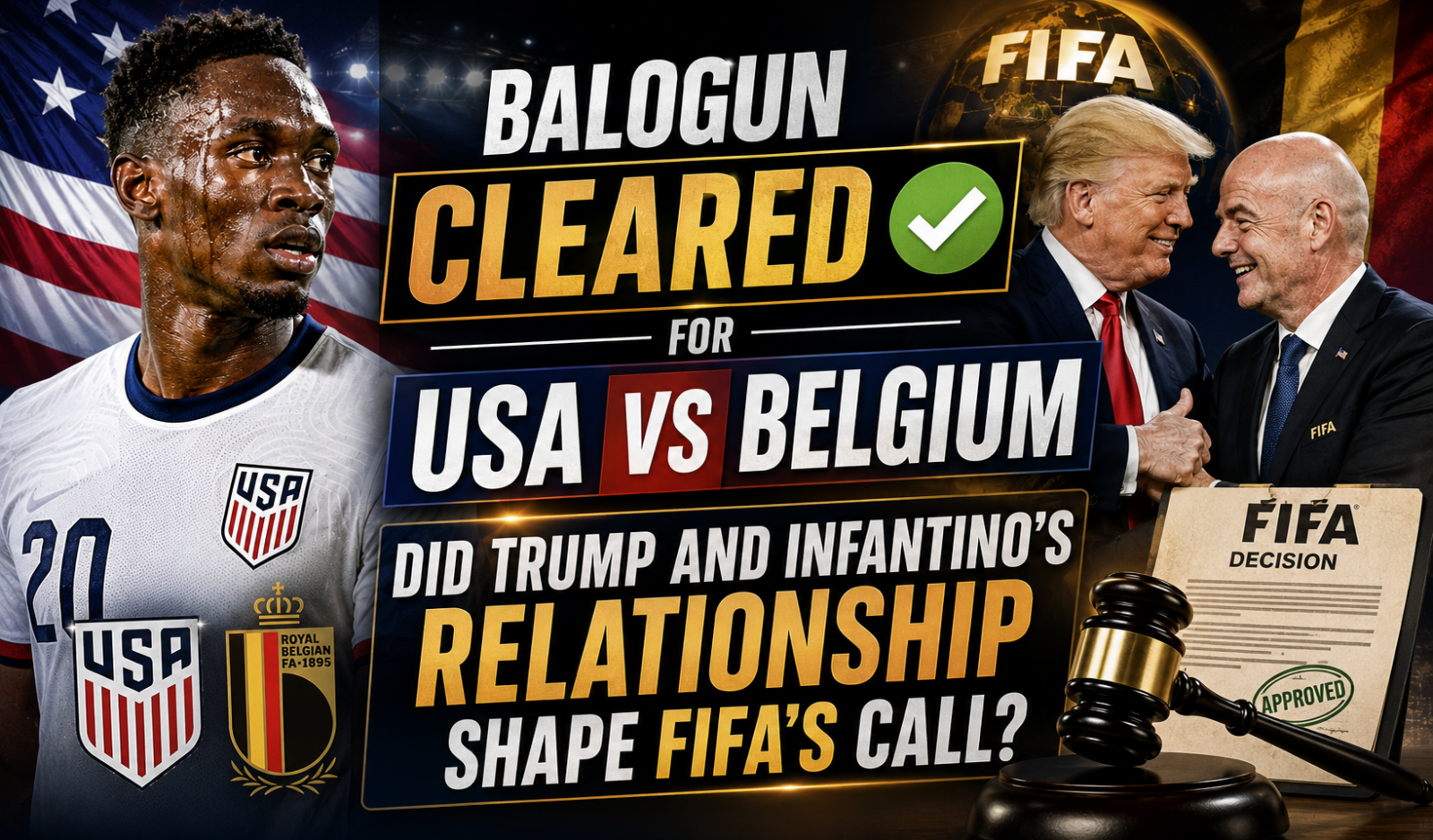
Balogun Cleared for USA vs Belgium: Did Trump and Infantino’s Relationship Shape FIFA’s Call?
Folarin Balogun can play for the United States against Belgium because FIFA suspended his one-match ban under Article 27 of its disciplinary code. The clearest answer to the political question is more cautious: there is no public proof that Donald Trump’s relationship with FIFA president Gianni Infantino changed the ruling, but Trump’s reported lobbying and FIFA’s late reversal have made the decision look unusually political.
That matters beyond one knockout match. For viewers in Japan, the case is a reminder that World Cup officiating controversies no longer end with the referee or VAR screen. They can move into legal arguments, federation pressure, and questions about whether powerful hosts receive a different hearing.
- Balogun had been set to miss USA vs Belgium after a red card against Bosnia and Herzegovina.
- FIFA later suspended the ban for a one-year probationary period.
- Trump reportedly contacted Infantino before the reversal and then publicly thanked FIFA.
- Belgium objected strongly, arguing that the decision undermined the automatic nature of red-card suspensions.
- The key issue is not only whether Balogun deserved to play, but whether FIFA can explain the process clearly enough for other countries to trust it.
What FIFA Actually Changed
Balogun’s red card was not simply erased. FIFA’s disciplinary committee used Article 27 to suspend the implementation of the one-match ban, meaning he remains eligible for the Belgium match while living under a probationary condition.
If he commits another similar infringement during that period, the suspended sanction can be enforced, with any new punishment added on top.
That distinction is important. FIFA did not say the incident never happened. It effectively said the punishment would not be served immediately.
Why Article 27 matters
Article 27 allows FIFA’s judicial bodies to suspend a disciplinary measure fully or partly. Supporters of the decision point to that rule and argue that FIFA had a legal route available.
Critics focus on timing and consistency:
- Balogun’s availability changed close to a knockout match.
- Belgium had prepared for a game in which the U.S. striker was expected to be absent.
- FIFA’s explanation did not remove the impression that pressure from powerful actors mattered.
A similar Article 27 precedent involving Cristiano Ronaldo has also been cited in coverage of the case. That precedent helps FIFA’s legal argument, but it does not answer the fairness question on its own. A rule can be valid and still be applied in a way that invites suspicion.
ここがポイント: The controversy is not only about whether the foul deserved a red card. It is about whether FIFA’s disciplinary process looks equally accessible to every team.
Where Trump and Infantino Enter the Story
The political layer comes from Trump’s reported contact with Infantino. Multiple reports say Trump lobbied FIFA over Balogun’s suspension, and Trump later thanked FIFA publicly for reversing what he called an injustice.
For the United States, Balogun is not a marginal player. He entered the Belgium match as a central attacking figure and one of the team’s most important scoring options. His absence would have changed the U.S. lineup, Belgium’s defensive planning, and the emotional temperature around a home-country World Cup campaign.
That is why the phone call matters. Even if FIFA’s disciplinary committee acted within the rules, a personal intervention by the U.S. president creates a visible chain:
- a U.S. star is suspended;
- the U.S. side challenges the decision;
- Trump contacts FIFA’s president;
- FIFA suspends the ban;
- Trump celebrates the outcome.
None of those steps proves improper influence. Together, they create the appearance problem FIFA now has to manage.
Relationship is not evidence, but it is context
Trump and Infantino have had a visible public relationship around the 2026 World Cup, which the United States is co-hosting with Canada and Mexico. In a normal disciplinary case, that relationship might be background noise. In this case, it sits beside a decision that directly benefits the U.S. team before a knockout match.
That is why Belgium’s reaction has been so forceful. Belgium does not need to prove a backroom deal to argue that the process looked unfair. In tournament football, perception can become part of the dispute because teams prepare based on expected suspensions, squad availability, and the usual reading of disciplinary rules.
Belgium’s Complaint Is About Competitive Trust
Belgium’s anger is easy to understand even for readers who think Balogun’s original red card was harsh. A knockout match is not an ordinary league fixture. One player’s availability can change pressing plans, centre-back assignments, and set-piece preparation.
Belgium’s reported objections focus on a simple sporting principle: a red card normally brings an automatic next-match suspension. When that expectation changes late, the opposing team can reasonably ask why.
The Belgian side has three practical concerns:
- Preparation: Belgium had to account for a player who was expected to be unavailable.
- Consistency: Other teams will ask whether they could receive the same hearing in a similar case.
- Transparency: FIFA must show whether this was a normal disciplinary application or an exceptional intervention.
This is where the issue connects with Japanese football audiences. Japan has often been on the side of needing disciplined preparation, clear rules, and small margins to compete with larger football powers. A late procedural shift involving a host nation naturally raises the question: would the same path be open if the affected player belonged to Japan, South Korea, Morocco, or Croatia?
That question may be uncomfortable, but it is the right one.
Why Japanese Readers Should Watch the Process, Not Just the Player
From Japan, the temptation is to read the story as another dramatic World Cup controversy involving the United States. But the more useful angle is institutional.
Japan’s national team has built much of its recent reputation on structure: clear roles, collective pressing, game plans tailored to stronger opponents, and careful tournament management. In that kind of football culture, trust in the rulebook matters. If disciplinary decisions appear negotiable, the burden shifts from preparation to politics.
That does not mean Japan should treat every controversial ruling as corruption. It means football federations and fans should pay attention to the procedure:
- Was the rule available before the tournament started?
- Has it been applied to comparable cases?
- Did the opposing team receive a clear explanation?
- Was the timing reasonable?
- Can smaller federations realistically pursue the same route?
These are not abstract governance questions. They decide who is on the pitch when a World Cup match begins.
The VAR angle is still important
The original red card also matters because modern football increasingly turns on video review. Slow-motion replays can make accidental contact look more deliberate, while real-time speed can show a different picture.
If the U.S. argument was that VAR or disciplinary review overstated Balogun’s intent, that is a football argument many neutral fans can understand. Japanese fans have seen enough VAR-heavy matches to know that the technology does not remove interpretation. It simply moves interpretation into another room.
The problem is that the VAR debate has now been mixed with presidential lobbying. That makes it harder for FIFA to persuade everyone that the outcome was only about the tackle.
Did Trump’s Influence Decide It?
The responsible answer is: we do not know. Public reporting shows that Trump became involved and that FIFA later made a decision favorable to the United States. Public reporting does not, by itself, prove that Infantino or FIFA’s disciplinary committee changed course because Trump asked.
Still, influence in sport does not always need to look like a direct order. It can work through urgency, access, and attention. A request from the president of a co-host nation is not the same as a routine federation email. It signals that the case matters at the highest political level.
That is why FIFA’s burden is now higher. The organization can point to Article 27, but it also needs to show that Article 27 was applied in a predictable way.
A convincing explanation would address at least three points:
- why Balogun’s case qualified for suspended implementation;
- how the decision compares with similar red-card cases;
- whether political contact had any role in the timing or review.
Without that, FIFA may have a legally defensible decision that still damages confidence.
What Comes Next
For the United States, the immediate result is simple: Balogun is available against Belgium. That strengthens the U.S. attack and gives the host nation a major player back at the most important moment of its tournament.
For Belgium, the issue is not over. Even if the match goes ahead, the federation’s objection will remain part of the story, especially if Balogun affects the result.
For Japan and other countries watching from outside the dispute, the lesson is practical. Teams must prepare not only for opponents and referees, but also for the disciplinary machinery around the tournament.
The next things to watch are concrete:
- whether FIFA releases a fuller explanation of the Balogun decision;
- whether Belgium pursues legal or procedural action;
- whether Article 27 is used again during the tournament;
- whether smaller federations receive the same access and speed in future cases.
Balogun’s eligibility may decide a match. FIFA’s explanation may decide something larger: whether the World Cup rulebook feels like a shared standard or a document that bends most easily for those with the strongest phone numbers.