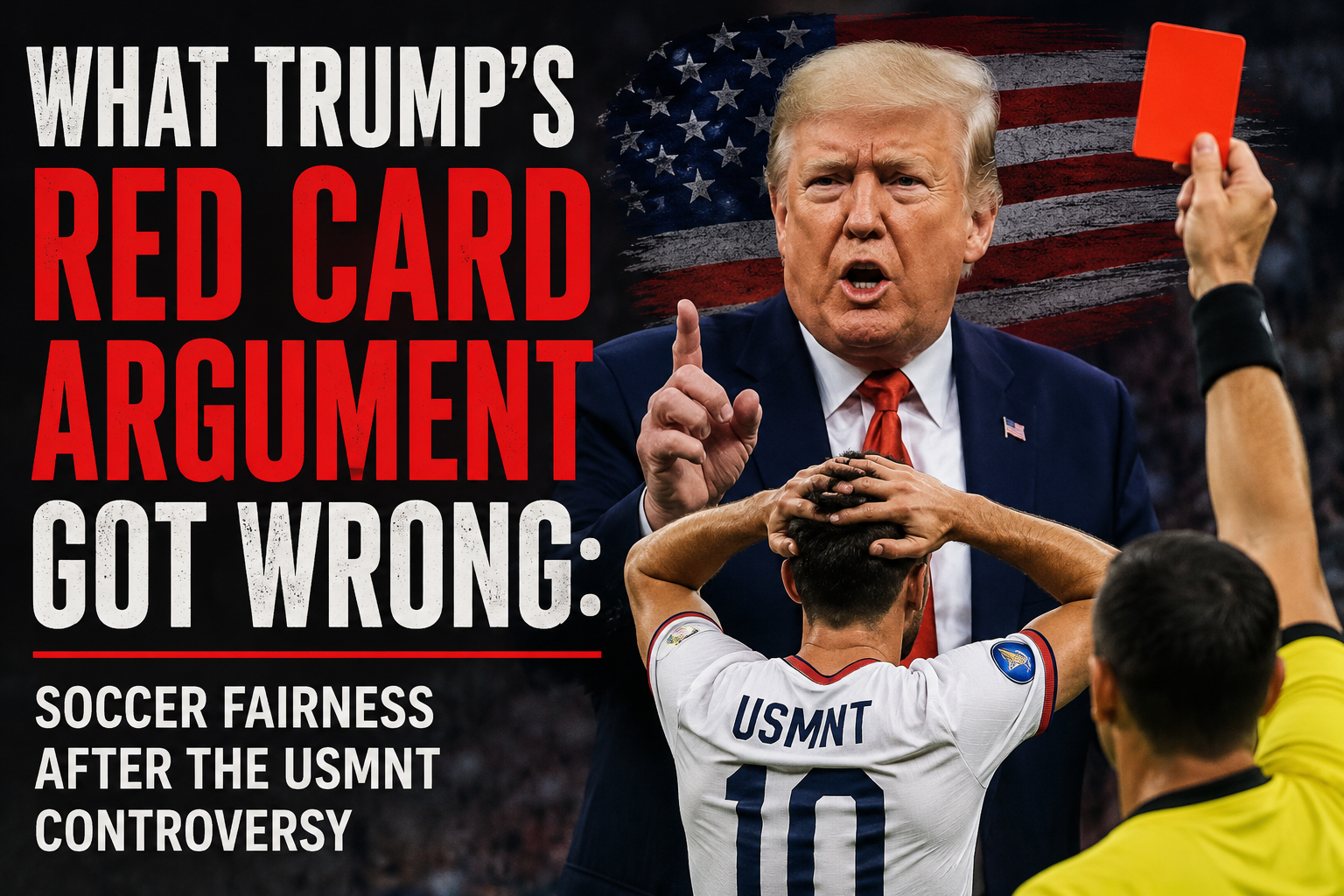
What Trump’s Red Card Argument Got Wrong: Soccer Fairness After the USMNT Controversy
In soccer, a red card is not a symbolic punishment that can be adjusted to protect television drama. It changes the match because the Laws of the Game say the player is sent off, and the team continues with one fewer player.
That is the central problem with Donald Trump’s claim that the United States men’s national team should not have been forced to play short-handed after a red card. The complaint may sound intuitive to people used to American sports, where ejections and substitutions are often separate questions. But in soccer, the disadvantage is the point. It is part of the competitive cost of serious misconduct.
- A red card removes the player from the match and the team cannot replace him.
- That rule is not a FIFA “choice” made case by case for one national team.
- Letting a team replace a sent-off player would reward the very side that committed the offense.
- The debate matters because the 2026 World Cup will bring many casual U.S. viewers into a sport whose fairness logic is different from familiar American leagues.
The Rule Trump Seemed To Miss
The issue is not whether a match becomes less balanced after a red card. Of course it does. That imbalance is built into the sanction.
Under the International Football Association Board’s Laws of the Game, a player who receives a red card is sent off. Once sent off, that player takes no further part in the match, and the team plays with fewer players. FIFA competitions apply those laws; they do not rewrite them because the affected team is the host country, a television draw, or a politically convenient case.
This is where Trump’s argument went off track. The fairness question in soccer is not, “Should both teams always have the same number of players?” It is, “Should the team that committed a serious offense avoid the sporting consequence of that offense?”
Soccer answers that second question clearly: no.
Why Playing Short Is Part Of The Punishment
A red card usually follows one of the game’s most serious categories of misconduct: violent conduct, serious foul play, denying an obvious goal-scoring opportunity, or a second caution. The exact incident matters in each match, but the structure of the punishment is the same.
The team loses more than one player’s skill. It loses shape.
A coach may have to:
- pull off an attacker to add a defender;
- ask wide players to cover longer distances;
- drop the defensive line and give up territory;
- abandon a pressing plan that required all 11 players;
- use substitutions to repair the formation instead of improving it.
That is why a red card can change the entire rhythm of a match. The opponent gains space, the punished team becomes more conservative, and every later tactical choice is made under pressure.
If soccer allowed a replacement after a sending-off, the punishment would shrink dramatically. The offender would leave, but the team structure would remain intact. In practical terms, that would turn one of soccer’s strongest sanctions into something closer to a personnel swap.
The American Sports Comparison Is Misleading
For many U.S. viewers, the confusion is understandable. In baseball, basketball, American football, and hockey, an ejected player is normally replaced in some way, though the details differ by sport and league. The contest continues with the same basic number of participants.
Soccer is built differently.
The sport has limited substitutions, continuous play, and a low-scoring environment where one positional gap can decide the match. A team playing with 10 players is not just “missing a starter.” It must solve a new problem every minute:
- who covers the empty zone;
- whether to keep attacking or protect the score;
- which player’s role becomes narrower;
- how much energy remains after defending with fewer bodies.
That burden is visible to players and coaches immediately. It is also visible to the opponent, which can move the ball toward the weak side, stretch the field, and force repeated defensive decisions.
ここがポイント: Soccer’s red card rule is not designed to preserve numerical symmetry. It is designed to make serious misconduct costly to the team that committed it.
Why This Matters Before The 2026 World Cup
The United States will co-host the 2026 FIFA World Cup with Canada and Mexico. That will bring a large American audience into matches where soccer’s disciplinary logic may collide with expectations formed by other sports.
This is not only a rules lesson. It is a broadcasting, commentary, and fan-literacy issue.
When a red card happens in a World Cup match, the key explanation should come quickly and plainly:
- the player is sent off;
- the team cannot replace him;
- the tactical balance has changed because the law requires it;
- the referee’s decision can be debated, but the consequence of a valid red card is not optional.
That distinction matters. Fans can argue over whether a foul deserved a red card. They can question VAR, referee positioning, or consistency. But once the red card is correctly given, playing short-handed is not an extra punishment invented by officials. It is the rule.
The Fairness Is In The Incentive
The deeper point is that fairness in soccer is not always visual balance. Two teams may not have equal possession, equal rest, equal crowd support, or equal tactical comfort. The laws try to protect the contest by setting consequences that shape behavior.
A red card tells players that some actions carry a team-level cost. That matters because soccer is full of moments where an individual can stop danger through illegal means: pulling down a runner, lunging into a dangerous challenge, or handling the ball to prevent a goal.
If the team could simply replace the player, the calculation changes. A defender might still be removed, but the team would keep 11 players and preserve its structure. In late-game situations, that could make cynical fouls more attractive, not less.
The current rule is harsh because it needs to be harsh. It protects the opponent from a team benefiting too easily from serious misconduct.
What To Watch Next
The controversy is a preview of a bigger communication challenge around major soccer events in North America. The rule itself is not likely to bend for political criticism or television discomfort. The more realistic question is whether commentators, federations, and tournament organizers explain it well enough when the next high-profile red card arrives.
For readers watching international soccer, the practical takeaway is simple:
- debate the referee’s decision if the incident is questionable;
- separate that debate from the automatic consequence of a red card;
- watch how the punished team changes shape afterward;
- notice whether the opponent uses the extra player patiently or rushes the advantage.
That is where the match often turns. Not in the outrage after the card, but in the tactical choices that follow with 10 against 11.
Reference

Full text regarding the red card
QUESTION: I wanted to ask you, can you describe your phone call with Gianni Infantino about the red card? And Belgium is appealing the decision. What’s your reaction to that?
DONALD TRUMP: You’re asking me about the whole soccer thing? So yeah, I did. I spoke to Gianni, who’s highly respected, who’s produced the most successful World Cup in history, by, they say, four times. This isn’t just a success. I actually said, Gianni, we’ve got all these games. Each one is turning out to be a Super Bowl.
And we have all these games. You know, when you think of it, every game is like a Super Bowl. Yes, I watched last night, what a game that was, with Mexico and England. I mean two countries, I don’t know the players, although I think Kane is a great player. See, I played golf with him and I like him a lot.
He’s a good golfer too, but he’s — he’s really great. But I watched and no reason for me to watch, and you couldn’t take your eyes off the game. Because I said, Gianni, you know, you have all these games, because they added games, in a country where really we don’t — it’s not our main sport, to put it mildly, and this has been four times more successful.
He told me last night, the numbers are four times greater. They think 50 or 60 million people are going to be watching the game tonight and, you know, this is getting to be Super Bowl numbers. But you have a game tonight and I think — they’re projecting a minimum of 50 million people watching a game. We call it soccer.
It’s called football, I guess, but we can’t really call football because it gets a little — there’s a little confusion. So yeah, you call it soccer. We’re the only ones that do that but we have football and football is great. But I’ve never seen anything like it. So I saw the play and I’m a person that loves sports and was a good athlete.
And I understand sports really well, really well, and that wasn’t a foul. That wasn’t even an infraction. That was two guys running full speed that happened to crash into each other. You can’t take your foot and properly place it on somebody else’s foot when you’re going. No, these were two great athletes that got tangled up and this referee, who is a little bit suspect, if you check his past.
I don’t want to say that because I don’t like to create controversy, but very suspect. Uh, if you’d like, I’ll provide you with the past. He made a call that nobody could believe. You know, even people on the other side, they say, oh, we got lucky, wow, that’s — and it’s very interesting, they say they don’t show them in slow motion.
And I never realized that. I never heard of that before, that they’re not allowed to review in slow motion because it’s so different, because you’ll take one little quarter of a second and you’ll see that a hand is touching a neck or you see something. Whereas when you see it in fast motion, it will look like two guys collided, which is really what happened.
They got sort of entangled. He didn’t do anything wrong, and he’s our best player, or one of our best players, a very vital player, and he gave him a red card. I didn’t know what that meant. I didn’t think it meant much. Then I started hearing that that means he can’t play in the next game, at least in the next game.
I said, boy, that’s a big — you know, if it happened to another player, it would have been unfair, but when they take your best player or just about, they have some great players, but — and they say you can’t play, that’s very unfair. That’s — you know, it’s one thing to penalize somebody for the game, but how do you penalize them for a game that hasn’t been played yet?
It’s very unfair. You can’t do that. So yes, I asked for a review by FIFA. I spoke to a man who’s highly respected. And, by the way, who’s level of respect has gone up tenfold, and he was good before this started. But, you know, he really pushed it in this country. I’m the one that got them to do it. It was not Biden; Biden was asleep.
I got him to do it. In fact, it was very sad because I got him to do it and, if the progression was normal, I would have been retired now. The Democrats are saying, man, we should have just let him have his way, we would have had him gone.
But I said the saddest thing is I got the Olympics and I got the World Cup. I tried to claim 250 years too, but that didn’t work. They said that one is what it is. No, I tried, but it didn’t work. But wait, wait — so, I got him, I was so proud of it. And then I realized I wouldn’t be president during that because I would have been out of office by that time, I felt badly.
The beautiful thing about what I did is I ran, I never thought of it, and then all of a sudden, I realized I just got the Olympics, and I totally got that myself, and I just got FIFA. I got that myself. We gave a little piece to Canada, gave a little piece to Mexico. I got that myself. And a lot of people helped like that man right there, Kevin.
A lot of people — you know that; we worked hard on that and we got it. But what we didn’t know is how successful it was going to be. I thought — I didn’t know. I said Gianni, is anyone going to show up? Because we’re not — again, we’re not really — I think soccer is doing much better, but I couldn’t imagine.
If you would have said to any very smart of these, like people like this, that the numbers they’re doing now would be happening — they’ve never seen anything like it. Think of it, take the most successful Olympics or the most successful FIFA, and you look at what’s happened, you look at the numbers for this in the United States.
Just compare it to FIFA. And it’s numerous times more, it’s not like 10 percent more, 2 percent more, 5 percent more, which is more expected. It’s like 4 times more successful than anything they’ve ever done. In fact, I said to Gianni, let’s do it again next time. And he said that would be hard. I said, no, no, you do it again, but at the same time, you give it to somebody else for the next one.
I don’t know, it’s a little crazy idea. But all I did, all I did, I asked for a review because I didn’t think it was a foul. And, you know, again, I’m good at this stuff. I didn’t think it was a foul. I thought it was two great athletes that crashed into each other and got entangled. That was not a guy punching somebody in the face or anything that would be different.
And I think it’s — I think it’s a terrible — if they wouldn’t allow a top player, maybe the best, maybe among the best players on the team to play, I think it would have had a big stain. And I related just that feeling. I didn’t tell him what to do — I can’t tell him what to do. But — and I don’t believe he made the decision; I think it was a committee that made the decision.
And they made the right decision because, number one, it wasn’t a foul. And you want to see a game with your best players; you don’t want to say, how would you feel if I took — we take Messi out, he ran into somebody? Or we took Rinaldo. Rinaldo, you bumped into somebody, we’re going to take you out of a game, he’s great.
Or Harry Kane? Harry Kane — we’re going to take you out of the game, Harry, because you happened to hit somebody a little bit harder than — you can’t do that. If you would have taken him out, I think it would have really stained this incredible champion. We got to have our best players and they’ve got — Belgium’s got a great team, by the way.
We have our best players, and they have to have their best. And if we win or we lose, it’s fair. Otherwise, let’s say we lost him and we lost the game. It would be a terrible thing. So, I think they made a really brilliant decision. I think the referee’s call was horrible and nobody talks about that. They talk about the red card like it’s fine.
Nobody talks — the referee’s decision to red card. I didn’t know what the hell a red card was. When I found out I said, you’ve got to be kidding. This guy just hands up, OK, your best player is not going to play next week or in the next game. I said, wow, that’s a lot of power, that’s terrible. But then I looked at his past and it wasn’t so great. OK.
QUESTION: Mr. President, are you going to talk to the Belgian prime minister before the game?
DONALD TRUMP: I didn’t think of it, but I would. He’s a good man. I will tell you this, the people in Belgium, if they win the game, they can be very proud. If they would win the game with a player missing, it would have been a different feeling. You can’t do that and I’m very glad — all I did was ask for a review. I didn’t say you have to do this.
This man is a smart, tough man, Gianni Infantino, he’s a smart, tough man. And his stock has gone through the roof because the job he’s done has been great. And I feel we have to have all the best players on the field. You can’t take the best players. Yeah, please, in the back, go ahead.