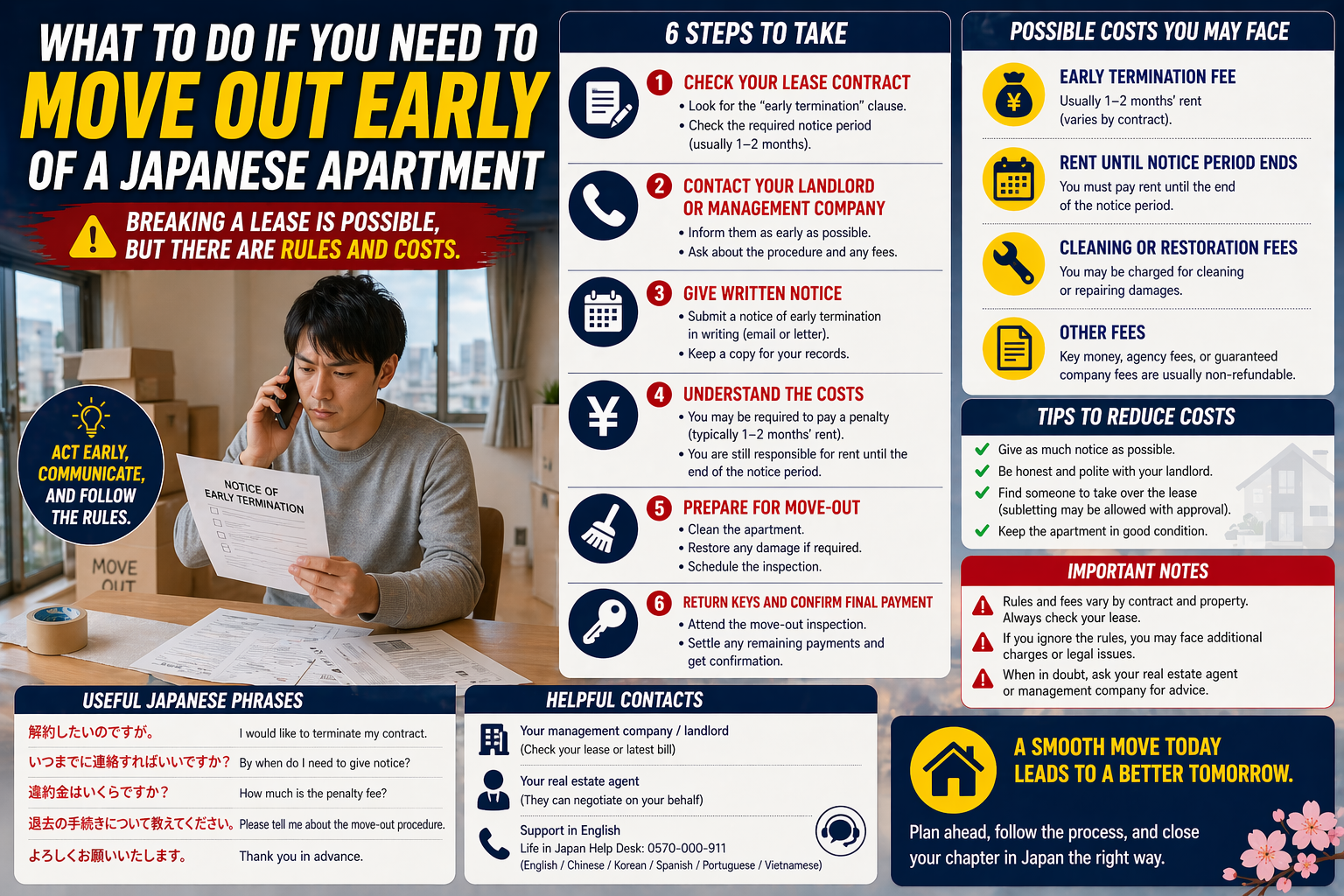
What to Do If You Need to Move Out of a Japanese Apartment Early
If you need to leave a Japanese apartment before the contract end date, the first move is usually simple: check your lease, then give formal notice to the landlord or management company right away. In many standard residential leases in Japan, the model rule is about one month’s notice. If you leave with less notice, you may still owe about one month of rent or rent-equivalent charges.
That does not mean every contract works the same way. A regular lease, a fixed-term lease, and a company or student housing contract can have different exit rules. The safest approach is to treat early move-out as a short project: confirm the contract, send notice in the required way, stop utilities, attend the move-out inspection, and keep records until your deposit is settled.
- Check whether your contract is a regular lease or a fixed-term lease
- Confirm the notice period and how notice must be submitted
- Expect to pay rent through the notice period even if you leave earlier
- Do not assume your full deposit will come back; check cleaning and damage clauses
Who This Guide Is For
This guide is for foreign residents in Japan who rent a private apartment and need to move out early because of a job change, school plans, budget pressure, family reasons, or a move to another city or overseas.
It matters most if:
- you are still inside the original lease term
- you are leaving Japan soon
- you signed a lease in Japanese and are not sure what the cancellation clause means
- your landlord or management company is asking for extra fees you did not expect
Start With the Contract, Not With the Moving Truck
Before you book movers, find the clause for cancellation, usually labeled with words like 解約, 中途解約, or notice period.
For ordinary residential leases, Japan’s Ministry of Land, Infrastructure, Transport and Tourism (MLIT) model contract still uses a practical baseline: the tenant can cancel by giving at least one month’s notice, and if the notice is shorter, the tenant can still end the lease by paying one month of rent or rent-equivalent charges. That is not a law that automatically overrides every lease, but it is a strong reference point for what many landlords and agents use in practice.
ここがポイント: In Japan, early move-out is usually less about a dramatic “penalty” and more about notice period, unpaid rent through that period, and move-out charges written in the contract.
Regular lease vs fixed-term lease
This difference matters.
Regular lease
In a regular lease, early cancellation by the tenant is commonly allowed if the contract says how to do it. The usual issue is not whether you can leave, but how much notice you must give and whether the contract requires written notice, an online form, or a call to the management company.
Fixed-term lease
A fixed-term lease is more restrictive. MLIT’s public guidance for fixed-term model contracts still shows that early termination depends heavily on the contract terms, although the law gives tenants a route in certain cases when they can no longer use the home as their living base because of unavoidable reasons such as transfer, medical treatment, or caregiving. In other words, with a fixed-term lease, do not assume the one-month rule automatically solves everything.
If you are unsure which type you signed, ask the agent or management company to identify the contract type in writing.
What You Usually Have to Pay
The main cost is often not a special break-lease penalty. It is the money that stays alive until the contract is properly closed.
Common costs
- Rent through the notice period
- Common service fees or management fees through the end date
- Utility bills up to the stop date
- Cleaning fees if your contract clearly puts them on the tenant
- Damage charges for things beyond normal wear and tear
- Internet or phone cancellation fees if you signed separate service contracts
What is often misunderstood
- Deposit does not mean automatic full refund. It is usually returned after deducting valid unpaid rent and approved move-out charges.
- Cleaning fees are not always illegal and not always automatic. They depend on the contract wording and local practice.
- Normal aging is not the same as tenant damage. MLIT’s move-out guidance for foreign renters says ordinary aging and normal wear are generally not part of the tenant’s restoration burden.
MLIT’s English leaflet is useful here because it gives concrete examples. Marks from furniture on the floor, refrigerator darkening on wallpaper, and equipment failure from age are generally treated differently from negligence, poor cleaning, pet damage, smoking stains, or unauthorized changes.
The 7 Practical Steps to Move Out Early
A rushed move-out goes wrong when people do these in the wrong order. Use this sequence instead.
1. Give notice immediately
Send the cancellation notice as soon as you know your likely move date, even if your next housing is not finalized.
Ask these questions in one email or message:
- What is the required notice period?
- What date will rent liability end?
- Is there a cancellation form?
- What date is the room inspection?
- When and how will the deposit settlement be issued?
If the office accepts phone notice, still follow up in writing so you have a timestamp.
2. Ask for the exact final payment logic
Do not settle for a vague answer like “you may need to pay one more month.” Ask them to calculate:
- final rent date
- daily rent if applicable
- common fees
- expected cleaning fee, if any
- key replacement or other special charges written in the lease
This matters because some contracts prorate, while others do not handle every fee the same way.
3. Book utility stop dates separately
Your lease ending does not automatically stop electricity, gas, water, or internet.
Shinjuku City’s English guidance for residents moving out says you must notify the electricity company, gas company, water bureau, NTT, and the post office. TEPCO’s current English FAQ says electricity cancellation should be requested before the last day of use, while gas should be requested by the day before, and you may need to be present depending on meter access.
For Tokyo water service, the Bureau of Waterworks currently allows start and cancellation procedures in English mode through its app and web tools. Outside Tokyo, the utility operator and procedure differ.
4. Handle your address and insurance records
If you are moving to another city, or leaving Japan, your ward or city office procedures matter too.
Shinjuku City’s foreign resident guidance says address-change notifications should be completed within 14 days of the change. Municipal rules and counters vary, but the bigger point is the same across Japan: your apartment move-out and your resident record are related but separate procedures.
If you are enrolled in National Health Insurance or have local tax paperwork coming, do not leave this until after the move.
5. Set up mail forwarding
Japan Post’s e-Tenkyo service is the online change-of-address request for mail forwarding. Current Japan Post guidance says forwarding starts in about 3 to 7 business days after the procedure is completed, so do not wait until your last night.
6. Clean and document the room before inspection
Take dated photos and short videos of:
- walls, floors, ceiling
- kitchen and bathroom
- air conditioner area
- keys, mailbox, and fixtures
- any old damage that existed before you moved in
MLIT also provides an English move-out checklist for confirming room condition. That matters if there is a later dispute over what was new damage and what was already there.
7. Attend the inspection and ask for a written breakdown
Move-out inspections are commonly done with the tenant and landlord or manager present. If they point to damage, ask:
- Is this normal wear or tenant-caused damage?
- What clause in the contract applies?
- Is there a written estimate?
- Will this come out of the deposit, or be billed separately?
If the explanation is weak, do not argue only by feeling. Ask for the contract clause and the itemized statement.
Cases Where the Rule Changes
Not every early move-out follows the same pattern.
Company housing or university housing
Employer-arranged or school-arranged housing may have separate internal notice rules. Those can be stricter on paperwork timing even when the physical room is the same kind of apartment.
Share houses and serviced apartments
These often use different contracts, shorter terms, or operator-specific exit fees. The one-month private-lease model is a reference, not a guarantee.
Leaving Japan entirely
If you are departing Japan, apartment notice, utility stop dates, resident record changes, insurance, taxes, and bank or phone contracts can collide in the same week. Start earlier than you think you need to.
Common Mistakes That Cost Money
Waiting until the move date to notify the landlord
This is the most expensive mistake. You may leave the room physically, but rent can continue through the notice period.
Confusing deposit with the last month’s rent
Unless the landlord explicitly agrees, do not assume your deposit can simply cover your final rent.
Repairing things yourself without approval
MLIT’s English guidance warns that arranging repairs on your own can create more trouble if the landlord uses a designated contractor or disputes the work.
Ignoring special clauses
A standard rule of thumb is useful, but the signed contract still matters most for cleaning charges, key replacement, pets, smoking, or short-notice cancellation.
Forgetting separate contracts
Internet, phone, parking, bicycle parking, and home insurance may all have their own cancellation steps.
What to Do If the Charges Look Unfair
Start by asking for three documents:
- the cancellation clause
- the move-out settlement breakdown
- any repair estimate or invoice
Then compare the charge with MLIT’s restoration guidance. If the dispute does not settle, contact your local consumer affairs center. The national consumer hotline number in Japan is 188, which routes callers to a nearby consultation point.
This is not a court judgment, but it is often the fastest way to get practical guidance on whether a charge looks standard or worth challenging.
Current Status as of April 23, 2026
As of April 23, 2026, Japan does not have a new nationwide rule that lets tenants leave early with no notice just because plans changed.
What the current official material still shows is:
- MLIT’s public model contract framework still centers on about one month’s notice for ordinary leases
- if the notice is shorter, paying about one month of rent or rent-equivalent charges remains a common model approach
- fixed-term leases still need closer contract reading, because early cancellation can be narrower
- recent official updates on MLIT’s contract pages are about form revisions and related notes, not a new nationwide cap on move-out charges
That means the practical question is still the same in 2026: what exactly does your contract say, and when did you notify the landlord?
Bottom Line
If you need to move out of a Japanese apartment early, act fast and keep it orderly.
- Give notice first
- Confirm the final rent date in writing
- Stop utilities and update your address records separately
- Photograph the room before inspection
- Ask for an itemized settlement before accepting deductions
The difference between a smooth exit and an expensive one is usually not the move itself. It is whether you handled the notice period, documents, and inspection before the deadline caught up with you.
参照リンク
- MLIT: Standard Rental Housing Contract
- MLIT: Standard Contract PDF
- MLIT: Support for Foreign Nationals in Looking for Rental Housing
- MLIT: Points for Restoring Rental Housing to Its Original Condition When You Move Out (English PDF)
- MLIT: Move-Out Condition Checklist (English PDF)
- MLIT: Fixed-Term Rental Housing Standard Contract
- MLIT: Fixed-Term Rental Contract Commentary PDF
- Shinjuku City: Procedures When Moving Out
- Shinjuku City: Notification Procedures for a Change of Address
- TEPCO English FAQ for Moving In and Out
- Tokyo Metropolitan Bureau of Waterworks: Start or Cancel Water Contracts in English
- Japan Post / Yu ID: What Kind of Service Is e-Tenkyo?
- Japan Post / Yu ID: What Is the Procedure for Requesting e-Tenkyo?
- National Consumer Affairs Center of Japan: Consumer Hotline 188