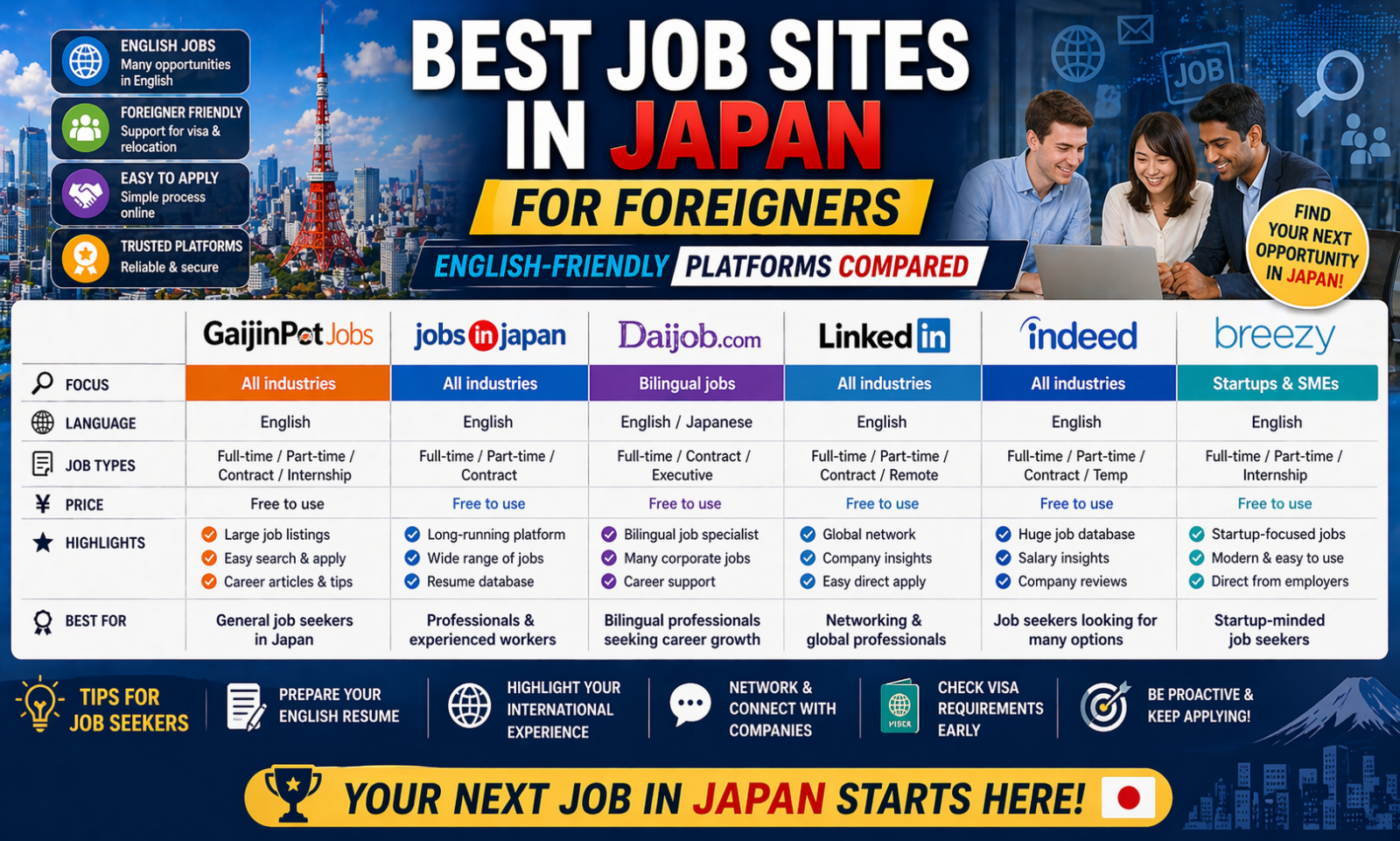
Best Job Sites in Japan for Foreigners: English-Friendly Platforms Compared
If you want the short answer, there is no single best job site for every foreign job seeker in Japan.
For broad English-friendly searching, Jobs in Japan is one of the easiest starting points. For bilingual office and professional roles, CareerCross and Daijob are usually stronger. For teaching, hospitality, and other foreigner-focused listings, GaijinPot Jobs is still useful. For part-time, service, factory, and beginner-friendly searches, WORK JAPAN and YOLO JAPAN are often easier to use. And if you already live in Japan and need official guidance, Hello Work’s foreigner support centers matter more than any private platform.
This guide is for students, workers, first-time job seekers, and long-term residents who want a practical way to choose where to search first, not just a long list of websites.
- Best overall starting point: Jobs in Japan
- Best for bilingual corporate jobs: CareerCross, Daijob
- Best for English-heavy entry roles: GaijinPot Jobs
- Best for part-time and beginner-friendly work: WORK JAPAN, YOLO JAPAN
- Best official support: Hello Work foreigner support centers
How to choose the right site first
The fastest way to save time is to match the platform to your actual situation.
Use Jobs in Japan if you want a broad search in English
Jobs in Japan is strong because its search page lets you filter by:
- location
- job category
- English level
- Japanese level
- employer type
- overseas applicants welcome
That matters if you are still outside Japan or you need to avoid listings that quietly assume advanced Japanese.
It is a practical first stop for people looking at teaching, hospitality, sales, support, some IT, and mixed-skill roles across different prefectures.
Use CareerCross if you want bilingual corporate work
CareerCross is better when your goal is not simply “a job in Japan” but a professional role in an international or bilingual workplace.
Its official site highlights bilingual jobs, native English jobs, multilingual IT jobs, translation roles, and companies with remote work available. That makes it a stronger fit for people targeting:
- IT and product roles
- finance and consulting
- sales and business development
- HR, legal, and back office roles
- translation and localization
If you already have experience and can work in both English and Japanese, CareerCross should be near the top of your list.
Use Daijob if language skill is your main selling point
Daijob positions itself as a job site for multilingual professionals and says its database has more than 10,000 job listings.
That is useful for applicants whose value is not only their work history but also their language mix, such as:
- English plus Japanese
- Chinese plus Japanese
- Korean plus Japanese
- other multilingual business profiles
Daijob is usually a better fit for mid-career candidates than for people looking for a first casual job after arrival.
Use GaijinPot Jobs if you want foreigner-focused listings in plain English
GaijinPot Jobs remains one of the easiest sites to read if you are new to the Japan job market.
It is especially common for:
- English teaching
- education support
- hospitality
- tourism
- customer support
- some startup and international office roles
Its biggest advantage is not sophistication. It is readability. Many listings are written for foreign applicants and show requirements like Japanese level, location, salary range, and whether visa support is available.
That makes it a good site for beginners, even if you later move to more specialized platforms.
Use WORK JAPAN if you need part-time or everyday work options
WORK JAPAN is aimed at foreign job seekers directly and says it is available in multiple languages. Its homepage also highlights categories like No Nihongo OK and Dormitory Provided.
That makes it especially useful for:
- part-time job seekers
- people looking for restaurant or hotel work
- factory and light work applicants
- specified skilled worker candidates
- people who need housing-related filters
If your priority is to start earning soon rather than build a white-collar career path immediately, WORK JAPAN can be more practical than a corporate-focused site.
Use YOLO JAPAN if you are already in Japan and need a simple start
YOLO JAPAN says it supports users in 6 languages, does not require Japanese from registration to interview, and even says no resume is needed for its easy work search flow.
That is a very specific strength.
YOLO JAPAN is worth checking if you:
- already live in Japan
- want part-time, temporary, or one-time work
- do not yet have a Japanese-style resume ready
- want a lower-friction way to start applying
It is not the best site for a long-term professional career search. It is better as a quick-entry platform.
The best site by situation
ここがポイント: The best platform depends more on your Japanese level, visa status, and target job type than on your nationality.
Here is the simplest way to think about it.
Best for first-time searching
- Jobs in Japan
- GaijinPot Jobs
These are easier to understand quickly and better for seeing what the market looks like.
Best for corporate and bilingual careers
- CareerCross
- Daijob
These are stronger when you already have a profession and want a better match, not just any opening.
Best for part-time, service, factory, or beginner-friendly work
- WORK JAPAN
- YOLO JAPAN
These are more useful when speed, language support, and practical filters matter more than corporate branding.
Best official backup when you need human help
- Hello Work foreigner support centers
The Tokyo Employment Service Center for Foreigners is a public employment office run by the Ministry of Health, Labour and Welfare. It supports non-Japanese students and foreign specialists already in Japan, and interpreters are available in English and Chinese by appointment. The Kabukicho center also handles part-time job seekers such as students, dependents, and working holiday holders.
That matters if online platforms are not enough, or if your status of residence changes what kind of work you can legally do.
A mistake many foreigners make
A lot of people choose a site based only on language.
That is understandable, but it misses the real filter: Can you legally do that job under your status of residence, and does the employer actually hire from your situation?
Japan’s official visa categories for work include, among others:
- Engineer / Specialist in Humanities / International Services
- Instructor
- Skilled Labor
- Intra-company Transferee
- Specified Skilled Worker
So before you spend hours applying, check three things:
- whether the listing accepts overseas applicants or only domestic applicants
- whether visa sponsorship is available, possible, or not offered
- whether your current or planned status of residence matches the job type
A site can be English-friendly and still be the wrong site for you.
Common mistakes and how to avoid them
Applying on the wrong platform for your level
If you have little Japanese and no office experience in Japan, starting on CareerCross may feel discouraging. You may get better traction on Jobs in Japan, GaijinPot Jobs, WORK JAPAN, or YOLO JAPAN first.
Ignoring domestic-only restrictions
Some listings clearly say domestic applicants only. Others welcome overseas applicants. That difference changes your odds immediately.
Treating “visa support” as a guarantee
On job sites, visa support can mean different things:
- full initial sponsorship
- renewal support only
- support only for candidates already in Japan
- future possibility, not a firm promise
Read that line carefully.
Assuming Tokyo-centered results represent all Japan
Tokyo dominates many English job boards, but foreigner-friendly hiring also appears in Osaka, Fukuoka, Aichi, Okinawa, Hokkaido, and regional teaching or hospitality markets.
If you only search central Tokyo, you may miss jobs with lower competition or housing support.
Latest update that changes old recommendation lists
One practical update matters here: WeXpats Jobs officially terminated service on April 15, 2026 (JST).
That means older blog posts and YouTube lists that still recommend it as an active job board are already out of date. If you see it in older rankings, check the service status before using the advice.
Final recommendation
If you want the simplest order, use this one:
- Start with Jobs in Japan to map the market.
- Add CareerCross or Daijob if you are aiming for bilingual professional work.
- Add GaijinPot Jobs if you want foreigner-focused English listings.
- Use WORK JAPAN or YOLO JAPAN if you need part-time, service, factory, or quick-entry work.
- Use Hello Work foreigner support if your visa status, eligibility, or application process is unclear.
The next thing to check is not another list of websites. It is whether the jobs you are saving actually match your Japanese level, location flexibility, and residence status.
参照リンク
- JOBS IN JAPAN – Search Jobs
- JOBS IN JAPAN – About Us
- CareerCross
- Daijob.com
- GaijinPot Jobs
- WORK JAPAN
- YOLO JAPAN About
- Tokyo Employment Service Center for Foreigners – About Us
- Tokyo Employment Service Center for Foreigners – To Use Our Service
- Ministry of Foreign Affairs of Japan – Work or Long-term stay
- WeXpats Jobs service termination notice page