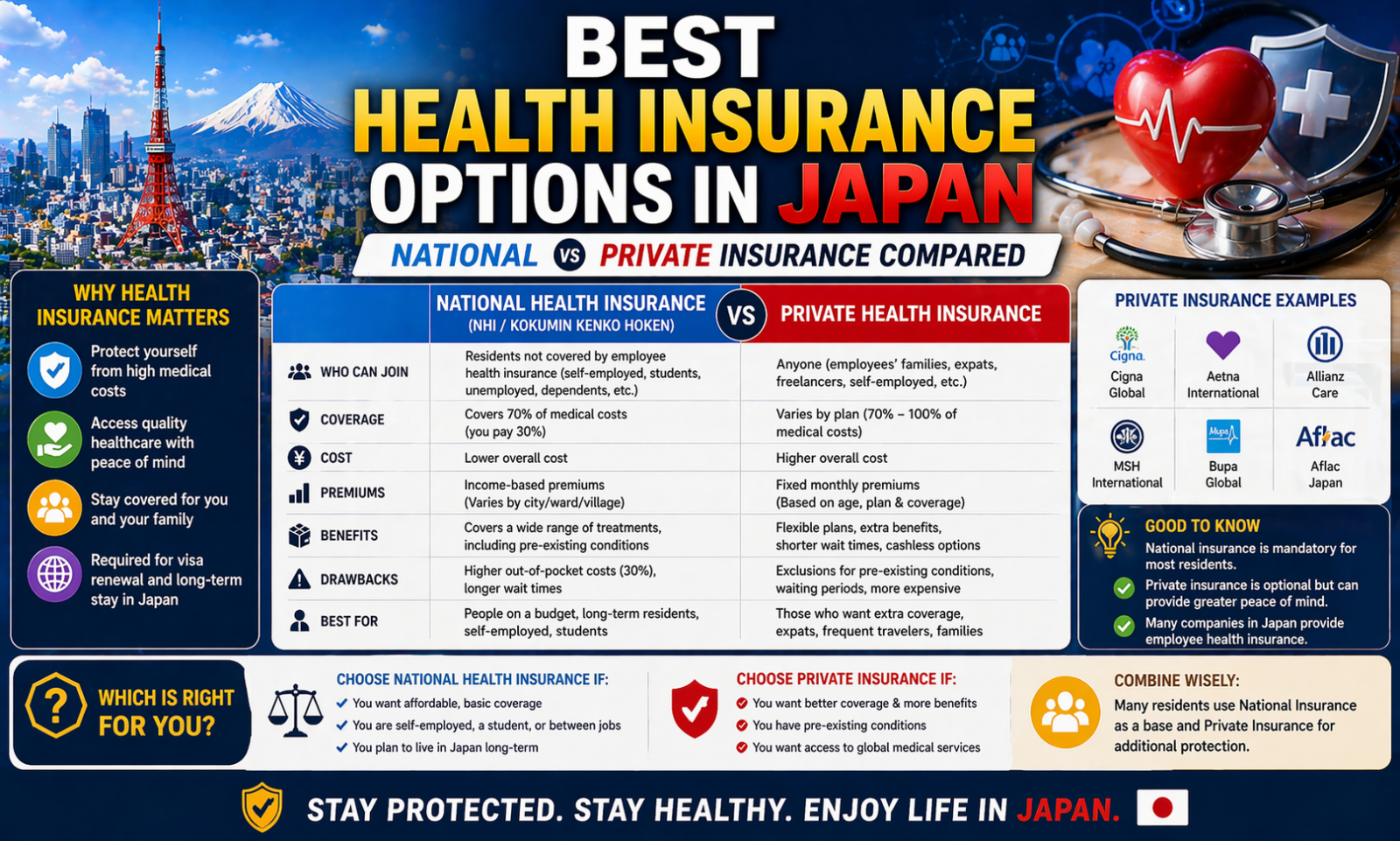
Best Health Insurance Options in Japan: National vs Private Insurance Compared
Short answer: for most foreign residents in Japan, the best base coverage is not private insurance. It is Japan’s public health insurance system. If you work for a covered employer, you usually must join Employees’ Health Insurance. If you do not have employer coverage, you usually join National Health Insurance through your city or ward office. Private insurance is usually worth considering only as an extra layer for cash benefits, advanced treatment, or gaps that matter to your situation.
That point matters because many newcomers search for the “best insurance” as if Japan works like a fully private market. It does not. In practice, your first decision is often already set by your work status and residence status. The useful comparison is which public plan applies to you, and whether a private plan adds enough value to justify the extra premium.
- Public insurance is the core system for long-term residents.
- Employees’ Health Insurance usually beats National Health Insurance on family coverage and employer cost sharing.
- National Health Insurance is the usual fallback if you are self-employed, freelance, studying, or otherwise not in an employee plan.
- Private insurance in Japan is usually a supplement, not a substitute, for public coverage.
Who this guide is for
This guide is for:
- workers starting a job in Japan
- students and researchers registering as residents
- freelancers, business owners, and dependents changing status
- long-term residents comparing whether private medical insurance is worth paying for
It matters most when you:
- move into Japan and complete resident registration
- start or leave a job
- switch from employee coverage to city insurance, or the other way around
- want extra protection for hospitalization, surgery, or treatment that public insurance does not fully cover
The basic rule: public insurance comes first
Japan requires residents to join a public health insurance system unless they fall into a limited exception.
If you are employed at a covered company, your employer enrolls you in Employees’ Health Insurance. Japan Pension Service states that covered workplaces must enroll eligible workers regardless of nationality, and that employers and workers share salary-based contributions by law.
If you are not covered by an employee plan, you usually join National Health Insurance through your municipality. City guidance for foreign residents in Osaka and Kyoto says residents are, in principle, required to enroll unless they are already in an employee insurance plan or fall under a specific exclusion.
This means most long-term foreign residents are not choosing between public and private as equal alternatives. They are choosing whether to add private insurance on top of the public plan that applies to them.
Public insurance in Japan: what you are actually comparing
A lot of articles say “national insurance” when they really mean all public insurance. In daily life, there are two main paths.
Employees’ Health Insurance
This is usually the stronger option if you qualify through work.
Why it is often better:
- premiums are salary-based and shared with your employer
- enrollment is handled through the workplace
- qualifying dependents can be covered under the employee plan
- it is generally easier for full-time workers who want stable monthly administration
It is usually the best fit for:
- full-time employees
- many part-timers who meet coverage rules
- workers at incorporated companies or covered workplaces
Japan Pension Service also notes that some part-time workers must be enrolled if they meet conditions such as 20 or more weekly hours, an expected employment term of two months or longer, monthly wages of JPY 88,000 or more, not being a student, and working at a specific covered workplace.
National Health Insurance
This is the usual public option if you are not in an employee plan.
It is usually the best fit for:
- self-employed residents
- freelancers
- many students
- people between jobs
- people whose employer plan does not apply to them
What matters in practice:
- premiums are set by your municipality, so they vary by city or ward
- the amount is often linked to your previous year’s Japan income
- each household member is assessed under the local system, so family cost can feel heavier than under Employees’ Health Insurance
Kyoto City’s foreign-resident guidance says premiums are based on total income earned in Japan in the previous year, while Osaka City’s guidance shows that local eligibility and exclusions are handled at municipal level. That is why two people with similar situations can face different paperwork or premium amounts depending on where they live.
National vs private insurance: the real comparison
Below is the practical difference most residents need to understand.
| Point | Public insurance in Japan | Private insurance in Japan |
|---|---|---|
| Main role | Core medical coverage for residents | Extra protection on top of public coverage |
| Who joins | Usually mandatory if eligible | Optional |
| How you pay | Salary-based or municipality-based contributions | Policy premium based on insurer rules, age, benefits, and health underwriting |
| Typical coverage | Insured medical treatment with patient copayment | Fixed cash benefits for hospitalization, surgery, cancer, advanced treatment, or riders |
| Best use | Essential everyday healthcare access | Reducing out-of-pocket shock and adding comfort or specific protection |
Private medical insurance products in Japan commonly pay benefits for hospitalization, surgery, or specific conditions. Guidance from the Life Insurance Cultural Center explains that medical insurance and riders often pay set benefits for hospital stays, surgery, radiation treatment, or advanced medical treatment. That structure is different from public insurance, which is the main system that reduces what you pay at the clinic or hospital counter.
ここがポイント: If you live in Japan long term, private insurance is usually a second decision. First confirm which public plan you must join. Then decide whether private coverage solves a problem you actually have.
What public insurance usually covers, and where the gaps remain
Public insurance is strong, but it does not mean everything is free.
Typical everyday effect:
- you usually pay 30% of covered medical costs at the point of care
- you can use the system for normal doctor visits, prescriptions, and many hospital treatments
- if your monthly covered medical bill becomes very high, the high-cost medical expense system can cap what you pay for eligible costs
The high-cost medical expense benefit matters more than many newcomers realize. The Ministry of Health, Labour and Welfare explains that people with public health insurance can apply so their monthly payment is limited to a ceiling amount, but the refund does not cover things such as private room charges, pajama rental, hospital meals, or uninsured treatment.
That last part is the key reason some residents buy private insurance.
Common gaps that make people consider private insurance
- income loss during hospitalization if your employer support is limited
- private room charges at hospitals
- cash needs for family support, transport, or time off work
- cancer-specific lump sums or repeated treatment support
- advanced medical treatment riders
- peace of mind for people with dependents and little savings
If those risks do not matter much to you, paying for a private policy may add little value.
When Employees’ Health Insurance is usually the best option
For many workers, this is the strongest overall setup.
It is usually the better choice when:
- your employer must enroll you
- you want the employer to share the contribution cost
- you have qualifying dependents who can join under your coverage
- you prefer payroll deductions instead of municipal billing
This is especially important for couples or families. A single worker comparing only their own monthly contribution may miss the bigger point: family treatment under employee coverage can be much more efficient than paying National Health Insurance at household level.
You also do not get to opt out just because a private plan looks cheaper on paper. If your workplace is covered and you are eligible, public enrollment is a legal requirement.
When National Health Insurance is the right choice
National Health Insurance is not a “worse” system. It is the normal route for many residents outside standard employment.
It often makes sense for:
- students
- language school attendees with resident registration
- freelancers and sole proprietors
- new arrivals still setting up work
- people who left a job and need coverage before the next one starts
The weak point is usually cost predictability. Municipal premiums can jump when your prior-year Japan income rises. That catches people after their first full year of work, or after moving from student status into paid work.
A second weak point is paperwork. You need to handle enrollment, address changes, and payment with your municipality, and the exact documents can vary.
When private insurance is worth considering
Private insurance is most useful when it solves a concrete money problem, not when it simply sounds reassuring.
It may be worth it if:
- you have limited emergency savings
- you want cash benefits during hospitalization
- your family budget would strain under repeated treatment or cancer care
- you specifically want an advanced medical treatment rider
- you are worried about costs that public insurance does not reimburse
It may be less useful if:
- you are young, healthy, and have solid savings
- you already have strong employer benefits
- you are buying because you misunderstand public insurance and think you need private cover to access normal care
- the policy exclusions, waiting periods, or claim rules do not match your real risks
For short-term visitors, the answer is different. The Ministry of Health, Labour and Welfare strongly recommends private health insurance for international visitors to prepare for treatment during a stay in Japan. That advice is aimed at visitors, not long-term residents who should be in the resident public system.
Common mistakes foreigners make
Treating private insurance as a replacement for public insurance
This is the biggest mistake. A private policy may pay cash after hospitalization or surgery, but that does not mean it replaces mandatory resident coverage.
Assuming “national insurance” always means National Health Insurance
For employees, the relevant public plan is often Employees’ Health Insurance. That can be the better and legally required route.
Looking only at the monthly premium
A lower headline premium can be misleading.
What you should compare instead:
- employer contribution or no employer contribution
- dependent coverage rules
- hospital copayment exposure
- premium increases after your income rises
- exclusions and claim conditions in private policies
Ignoring local differences
National rules set the framework, but municipal administration still matters. Premium notices, payment methods, and local procedures can vary by city or ward.
Missing the card change
Many people still expect the old health insurance card system to work the same way.
Latest update that matters in 2026
As of April 21, 2026, the practical update to watch is how you prove eligibility at the clinic. The Ministry of Health, Labour and Welfare says people should now use either:
- a My Number Card registered for health insurance use, or
- a qualification confirmation certificate if they do not use the My Number Card route
MHLW also states that the old health insurance card validity ended no later than December 1, 2025, and from December 2, 2025 people present either a My Number health insurance card setup or a qualification confirmation certificate.
This is not just an administrative detail. If you are new to Japan, changed jobs, or recently moved, make sure you know which document you actually need before your next clinic visit.
So, which option is best?
For most foreign residents, the answer is straightforward.
- Best overall for eligible workers: Employees’ Health Insurance
- Best public option if you are not in an employee plan: National Health Insurance
- Best role for private insurance: optional top-up protection for specific gaps, not your main coverage
If you are single, healthy, and have savings, you may decide public insurance alone is enough.
If you support a family, want lump-sum support during hospitalization, or are worried about non-covered costs, a carefully chosen private plan can make sense. But it should come after you understand your public plan, not before.
What to check next before you sign up
- confirm whether your employer must enroll you in Employees’ Health Insurance
- if not, ask your city or ward office how National Health Insurance premiums are calculated where you live
- check whether your spouse or children can qualify as dependents under employee coverage
- if you shop for private insurance, compare exclusions, waiting periods, payout conditions, and advanced-treatment riders rather than only the monthly premium
- confirm whether you will use a My Number Card for health insurance or need a qualification confirmation certificate
The practical takeaway is simple: public insurance is the foundation in Japan. The smartest choice is usually not “public or private.” It is “which public plan applies to me, and do I need private cover for anything public insurance clearly does not pay for?”
参照リンク
- Japan Pension Service: Enrollment in Employees’ Pension Insurance and Employees’ Health Insurance
- City of Osaka: Introduction to National Health Insurance
- Kyoto City Sakyo Ward: Guide to National Health Insurance
- MHLW: High-Cost Medical Expense Benefit
- MHLW: My Number Card as your Health Insurance Certificate
- MHLW: How to prove health insurance eligibility
- MHLW: Qualification confirmation certificate
- MHLW: Private health insurance recommended for international visitors to Japan
- Japan Health Insurance Association: Who qualifies as a dependent
- Life Insurance Cultural Center: Medical insurance
- Life Insurance Cultural Center: General medical rider
- Life Insurance Cultural Center: Advanced medical treatment rider