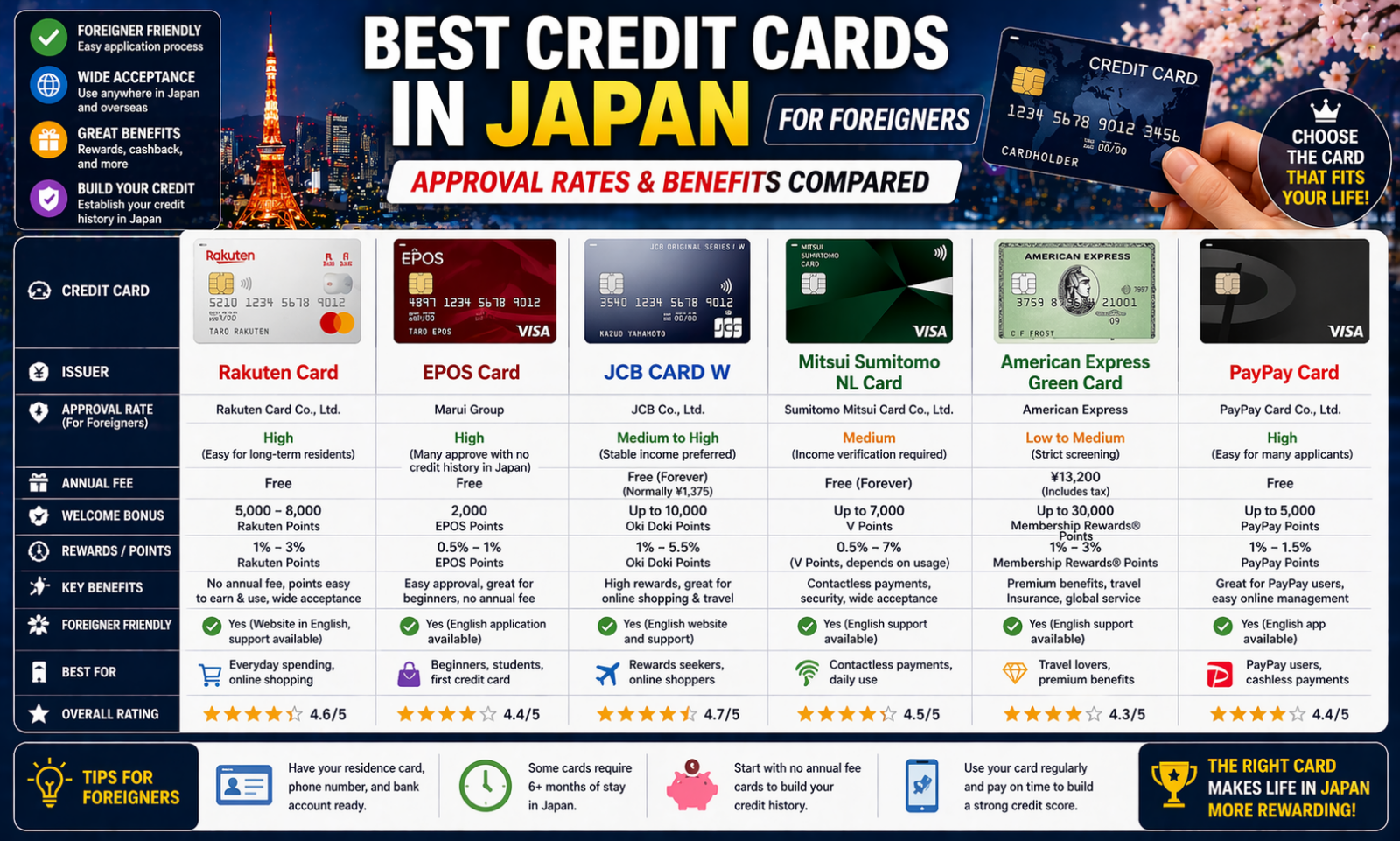
Best Credit Cards in Japan for Foreigners: Approval Rates and Benefits Compared
If you want a realistic answer first, here it is: no major Japanese card issuer in this comparison publishes official approval rates. For foreigners in Japan, the better way to compare cards is to look at what issuers do publish: residence requirements, income wording, ID rules, app flow, bank-account setup, and whether the card is easy to use from day one.
For many new residents, EPOS Card and Rakuten Card are usually the most practical first places to start. If you already use PayPay a lot and have steady income, PayPay Card becomes more attractive. If most of your spending is at Aeon, MaxValu, or related stores, an AEON Card can make more sense than a general-purpose rewards card.
- Best first application for many newcomers: EPOS Card
- Best all-round points card: Rakuten Card
- Best for PayPay users with steady income: PayPay Card
- Best for supermarket-heavy households: AEON Card
How to read “approval rates” in Japan
Japanese card companies usually do not publish public pass rates for ordinary consumer cards. They also keep screening criteria private. PayPay Card says directly that screening results may lead to rejection and that the screening details are not disclosed. CIC, Japan’s designated credit bureau, explains that card companies use credit information as part of their credit decisions.
That matters for foreigners because a weak or short credit file in Japan can be a real disadvantage, even if your salary is fine.
So in this article, the “approval” comparison is an inference, not a leaked percentage table. I am comparing cards by the signals that matter in practice:
- Do you need to live in Japan already?
- Is a Japanese mobile number required?
- Does the issuer ask for stable income, or allow students and spouses too?
- Can you use a residence card for identity checks?
- Can you finish the setup quickly with a Japanese bank account?
ここがポイント: If a website claims exact approval percentages for Japanese cards, treat them as estimates unless the issuer itself publishes the number. For most applicants, your address history, phone number, bank account, and early Japanese credit record matter more than any unofficial “rate.”
Who this guide is for
This comparison is for:
- new foreign residents setting up life in Japan
- students and workers applying for their first Japanese credit card
- long-term residents who want a better daily-use card
- people who already have a bank account and Japanese phone number, but do not know which card is easiest to start with
If you just landed and still do not have a stable address, a bank account, or a phone number in your own name, you may want to wait a little. In Japan, applications tend to go more smoothly once those basics are in place.
Quick comparison
| Card | Annual fee | Base rewards | Published application wording | Practical approval view | Best for |
|---|---|---|---|---|---|
| EPOS Card | Free | 0.5% equivalent (1 point per 200 yen) | Age 18+, living in Japan | Good first-card candidate | New residents, light spenders, fast setup |
| Rakuten Card | Free | 1% (1 point per 100 yen) | Age 18+; mobile number and bank account setup are built into the flow | Strong general option | Online shopping, daily use, Rakuten ecosystem |
| PayPay Card | Free | 1.0%; higher in some PayPay-linked cases | Age 18+, living in Japan, stable continuing income or spouse income, authenticated mobile phone | More selective on paper | Heavy PayPay users with steady income |
| AEON Card | Usually free | 0.5% equivalent (1 point per 200 yen), 2x at Aeon Group stores | Age 18+, living in Japan, reachable by phone; students and full-time homemakers can apply | Solid if your spending fits the chain | Families, supermarket shoppers, suburb living |
1. EPOS Card: the most practical first card for many foreigners
EPOS Card is not the richest rewards card on this list, but it is often the easiest one to justify as a first application.
The official application page says it is for people aged 18 or older, excluding high school students, who live in Japan. EPOS also allows web application, app-based setup, and in some cases same-day pickup at Marui. Its app-based “smart card” flow accepts a residence card as photo ID and asks for a bank account that can be set up online.
Why that matters
For a foreign resident, the biggest early hurdle is often not rewards. It is getting approved for a normal card at all. EPOS looks relatively approachable because:
- the published eligibility wording is simple
- annual fee is free
- the issuer clearly supports residence-card-based identity checks
- the card can be set up quickly compared with slower postal flows
The trade-off
The base reward rate is lower than Rakuten or PayPay. EPOS gives 1 point per 200 yen, which is effectively 0.5% in normal spending.
EPOS also has one foreigner-specific caution that many comparison posts skip: the company has a page asking some customers who used a residence card at application to keep submitting updated residence-card information. If that status is not updated, card use can be suspended.
Bottom line: if your main goal is getting a usable Japanese credit card without chasing the highest headline rewards, EPOS is a strong first choice.
2. Rakuten Card: best overall value if you want a daily-use card
Rakuten Card stays popular for a simple reason: the base earning rate is easy to understand. You earn 1 point per 100 yen, and the card has no annual fee.
For foreigners, the practical advantage is that Rakuten’s application flow is very standard and transparent. The issuer explains that you need:
- identity documents
- a Rakuten ID
- bank account information for withdrawals
- your own mobile phone number
Rakuten also accepts a residence card in its identity-check process when required.
Why it ranks high
Rakuten Card is a good fit when you want one card that works across daily life in Japan, not just inside one store group. It is especially useful if you already use Rakuten services for shopping, travel, or mobile.
The official site also says cards are generally delivered in about one week to ten days, so it is not instant, but it is predictable.
Where it is weaker
Rakuten’s consumer-facing pages in this review do not publish a foreigner-specific “easy approval” promise, and they do not publish approval percentages. That means you still need the same basics as elsewhere: a stable address, a phone number in your name, and clean application details.
Bottom line: if you are settled enough to complete a standard application, Rakuten Card is the best all-rounder here.
3. PayPay Card: good rewards, but the published screening wording is stricter
PayPay Card looks attractive because the base earning rate is 1.0%, and the official points page says the rate can go higher in PayPay-linked use cases. The application flow is also fast on paper, with screening described as as fast as a few minutes in some cases.
But the official application conditions are noticeably more specific than EPOS or Rakuten. PayPay Card says applicants must be:
- 18 or older
- living in Japan
- have stable continuing income, or a spouse with stable continuing income
- have a mobile phone capable of identity authentication
That wording makes a difference.
Who should choose it
PayPay Card makes sense if:
- you already use PayPay often
- your income situation is straightforward
- you want tighter integration with the PayPay app ecosystem
Who should be careful
If you are a brand-new arrival, still changing addresses, or you do not have a clear income picture yet, the published requirements make this look less forgiving than EPOS.
There is also a dated but important update on the issuer site: benefit changes are scheduled for June 2, 2026 on some PayPay-linked earning conditions. That does not make the card bad, but it means you should check the latest terms before applying just for a rewards headline.
Bottom line: strong card for established users, not my first pick for the most uncertain newcomer profile.
4. AEON Card: underrated if your real life is supermarkets, malls, and family spending
AEON Card is easy to underestimate if you only compare general rewards rates. The normal earning rate is 1 WAON POINT per 200 yen, but Aeon says card spending at Aeon Group stores earns double points, and many cards in the lineup have no annual fee.
For foreigners, AEON’s FAQ is useful because it states its application condition more plainly than many issuers: applicants should be 18 or older, living in Japan, and reachable by phone. It also says students and full-time homemakers can apply even without their own income.
Why that matters
That wording can make AEON more realistic than people expect for:
- students
- households relying on one spouse’s income
- people living in suburbs where Aeon, MaxValu, and Aeon Mall are part of normal weekly life
The limitation
If you rarely shop in the Aeon ecosystem, the card is less compelling than Rakuten. The rewards story is much better when your groceries and household spending already flow through Aeon Group stores.
Bottom line: not the best universal card, but one of the better lifestyle-specific cards if your spending pattern matches it.
Which card has the best approval odds for foreigners?
If we stay strict and use only what issuers publicly show, this is the most honest ranking:
Best practical odds for a first application
- EPOS Card
- Rakuten Card
- AEON Card
- PayPay Card
This is an inference from published requirements and application flow, not an issuer-supplied approval table.
Why EPOS comes first
- simple eligibility wording
- strong support for app-based ID checks
- residence card clearly supported
- no published income requirement on the main application page
Why PayPay falls back
- stable continuing income is written into the application condition
- mobile authentication is required
- benefits are changing soon, so the reward case needs a fresh check
Common mistakes foreigners make when applying
Applying too early
Many rejections happen because the applicant is still in setup mode.
Typical weak points are:
- no bank account ready for withdrawals
- no mobile number in your own name
- address mismatch between your application and your ID
- applying right after arrival with no Japanese credit history at all
Sending inconsistent name information
Japan is strict about exact name matching. If your residence card, bank account, and application use different spacing, order, or character forms, the process can stall.
Applying for several cards at once
CIC says card applications themselves become part of your credit information. If you send many applications in a short period, that can work against you.
What to check before you apply
Use this short checklist first:
- Your residence card and current address match your application
- You have a Japanese mobile number you can actually receive calls or SMS on
- You already have a Japanese bank account for auto-debit setup
- Your employer, school, or spouse-income details are ready if asked
- You are applying for the card that matches your real spending, not just the highest ad headline
Final take
For most foreigners living in Japan, the best first card is the one you can realistically get approved for and keep using smoothly. On that standard, EPOS Card is the safest starting point, Rakuten Card is the best all-round step up, PayPay Card suits stable earners already inside the PayPay ecosystem, and AEON Card is strongest when your weekly life already runs through Aeon stores.
Before you submit, check one more thing: not just the reward rate, but the issuer’s latest application wording and ID rules on the day you apply. In Japan, that small detail can matter more than the points chart.
参照リンク
- EPOS Card application information
- EPOS point earning guide
- EPOS smart card application method
- EPOS residence card notice
- Rakuten Card basic information
- Rakuten Card application flow
- Rakuten Card points guide
- Rakuten Card identity verification
- PayPay Card application conditions
- PayPay Card application flow
- PayPay Card fees
- PayPay Card point benefits
- AEON Card application conditions FAQ
- AEON Card beginner application guide
- WAON POINT guide
- CIC: What is Credit Information Disclosure?
- CIC: How credit information is used