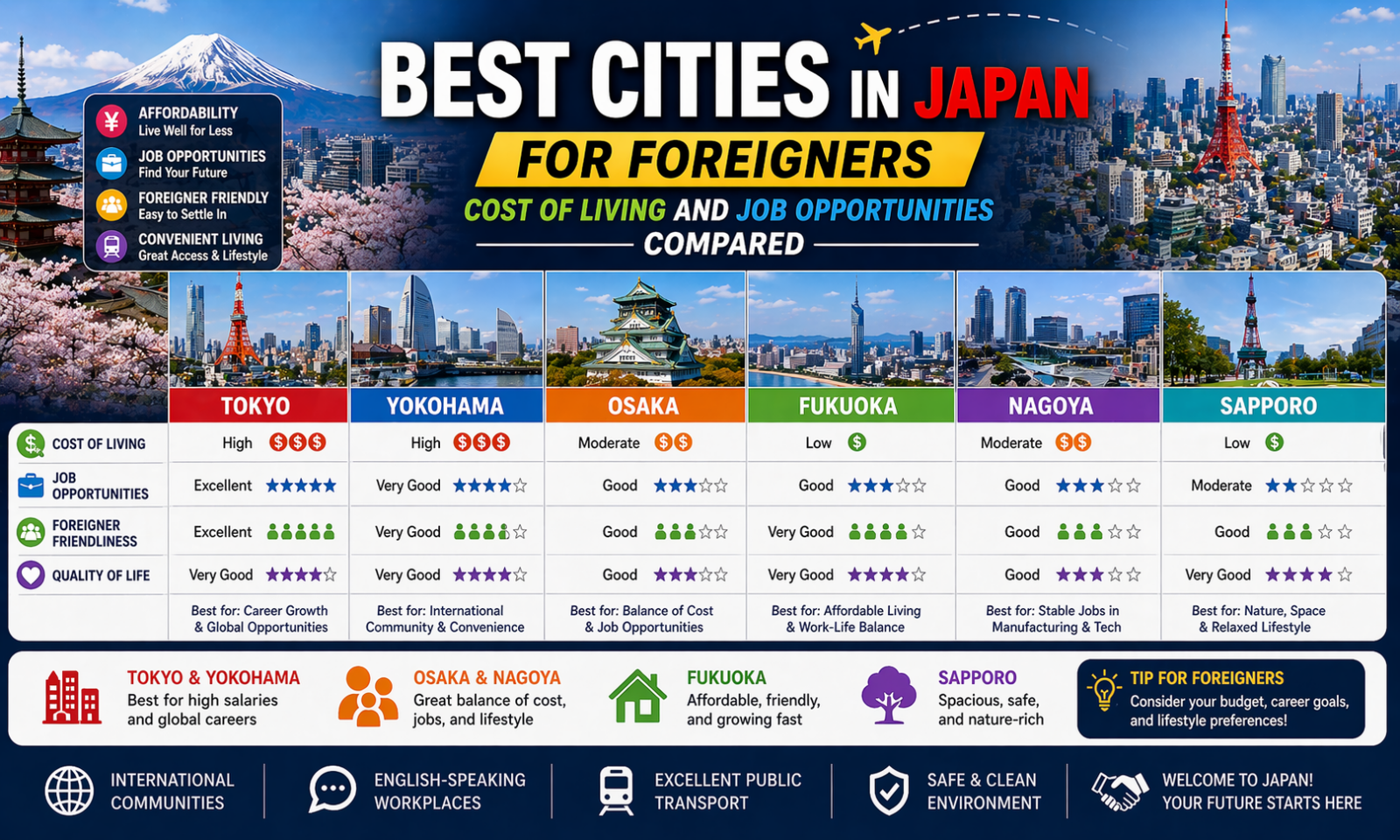
Best Cities in Japan for Foreigners: Cost of Living and Job Opportunities Compared
If you want the short answer first, Tokyo still has the widest job market, but it is the hardest city on your budget. For many foreigners who need a better balance between rent and work options, Fukuoka and Osaka are often the strongest picks. If your field is manufacturing or engineering, Nagoya deserves more attention than it usually gets. If low rent matters most and you can work in IT, BPO, tourism, or remote-friendly roles, Sapporo is worth a serious look.
This guide is for workers, students close to graduation, and long-term residents who are deciding where to base themselves in Japan in 2026. It matters most if you are comparing rent, local job types, and how much practical support exists for foreign residents after you arrive.
- Best for maximum job choice: Tokyo
- Best balance of cost and opportunity: Fukuoka
- Best alternative to Tokyo for broad city life: Osaka
- Best for manufacturing and engineering: Nagoya
- Best for lower rent and a calmer pace: Sapporo
Japan’s labor market is still active, but not equally active everywhere. The Ministry of Health, Labour and Welfare said Japan’s seasonally adjusted effective job-offers-to-applicants ratio was 1.18 in January 2026, down from the previous month. That means there were still more jobs than applicants nationally, but the market has cooled from earlier highs. At the same time, the Statistics Bureau said Japan’s 2025 CPI rose 3.2% year on year, with food up 6.8%, so city choice matters more than it did a few years ago.
How to read this comparison
A city is not “best” just because rent is low or salaries look high on paper. Foreign residents usually need four things at the same time:
- enough jobs in the right industry
- rent that does not swallow half their income
- public information or consultation support in languages they can use
- transport and daily-life systems that are manageable without advanced Japanese from day one
ここがポイント: The best city for foreigners is usually the city where your industry is strongest after rent, commuting time, and support services are counted together.
Quick city comparison
| City | Rent snapshot | Job strengths | What it means in practice |
|---|---|---|---|
| Tokyo | About ¥84,000 for a one-room in Shinjuku ward on SUUMO | Tech, finance, consulting, global sales, hospitality, education | Best for job volume, worst for rent pressure |
| Osaka | About ¥55,000 in Osaka Kita ward | Services, tourism, trade, life sciences, manufacturing support | Large market with lower housing pressure than Tokyo |
| Fukuoka | About ¥54,000 in Hakata ward | Startups, IT, logistics, services, Kyushu business hub roles | Strong cost-to-opportunity balance |
| Nagoya | Roughly mid-¥60,000 range in central wards such as Naka | Automotive, aerospace, machinery, industrial tech | Best if your skills fit manufacturing-heavy employers |
| Sapporo | About ¥38,000 in Chuo ward | IT, game development, BPO, tourism, back-office work | Cheaper rent, narrower job market |
These rent figures are not citywide official averages. They are recent listing-based examples from central areas on SUUMO, useful as a reality check when you compare neighborhoods foreigners often consider first.
Tokyo: still the top job market, but you pay for it
Tokyo remains the safest answer if your first priority is access to jobs. JETRO’s Tokyo profile shows the scale clearly: population of about 14.0 million, labor force of 6.19 million, and more than 810,000 establishments. That scale matters because it increases your chances of finding work in English-speaking teams, foreign-affiliated firms, specialized recruiting, and part-time jobs while you are still improving your Japanese.
Why Tokyo works
- the broadest range of industries in Japan
- the highest concentration of foreign companies and headquarters functions
- the deepest market for bilingual office work and international tech roles
- the most transition support for highly skilled foreign professionals and founders
Tokyo is also trying to make arrival easier. The Tokyo Metropolitan Government’s International Residents Support Center TOKYO says it helps with administrative procedures, housing and utility setup, and bank account opening.
Where Tokyo gets difficult
The problem is not only rent. It is the total package.
- rent is highest among the cities in this list
- deposits, agency fees, guarantor costs, and moving costs scale up quickly
- commuting can become expensive in time even when transport is efficient
- some support services are aimed more at entrepreneurs and highly skilled workers than at every newcomer
Choose Tokyo if job access matters more than short-term savings. For software, finance, consulting, research, international sales, or English-heavy corporate work, it is still hard to beat.
Fukuoka: the best balance for many newcomers
If you want a major city without Tokyo-level housing pressure, Fukuoka is the most convincing option in this comparison.
JETRO describes Fukuoka as the economic center of western Japan and a gateway to Asia. The prefecture also promotes business setup, and Fukuoka City continues to highlight its startup programs and foreign-resident support in English. For day-to-day life, the city’s official English portal and the Fukuoka City International Foundation both provide multilingual consultation.
Why Fukuoka stands out
- central-city rent is still much lower than Tokyo
- Hakata and Tenjin give you a compact urban core that is easy to learn
- startup and small-company hiring is more visible than in many regional cities
- foreign residents can use one-stop consultation support for visas, work, medical care, and daily life through FCIF
This combination matters. A city can be cheap but still difficult if jobs are thin or paperwork support is weak. Fukuoka avoids much of that problem.
Best fit
Fukuoka is especially strong for:
- early-career workers who need a livable first base in Japan
- startup-minded professionals
- people working in services, logistics, IT, or regional business roles
- foreigners who want a big city but not the daily cost and commute intensity of Tokyo
For many readers, Fukuoka is the best all-rounder.
Osaka: broad opportunity without Tokyo prices
Osaka is the other city that makes the strongest practical case for foreigners. JETRO’s Osaka profile shows a large base: population of about 2.75 million, labor force of 1.13 million, and more than 228,000 establishments in the city. It explicitly notes an advantage over Tokyo in lower business costs such as land prices, office rents, store rents, and wages.
For foreign residents, Osaka International House runs an information counter with consultation in several languages and also offers legal and visa consultation.
Why Osaka works
- large urban labor market with more breathing room on housing
- strong Kansai transport connections to Kyoto, Kobe, and the wider region
- active service, tourism, trade, and health-related sectors
- easier cost structure than Tokyo for people starting from zero
Trade-offs
- fewer English-first white-collar jobs than Tokyo
- some industries still expect stronger Japanese than newcomers assume
- central wards are no longer especially cheap
Osaka is often the best choice if you want a major city with real job depth but do not want Tokyo’s price level. It is the safest “second-biggest market” option.
Nagoya: underrated if you work in manufacturing or engineering
Nagoya is easy to miss if you search only in English, but it can be one of the smartest choices for the right worker.
JETRO describes Nagoya as one of Japan’s three major economic regions and stresses the concentration of automobile, aerospace, machine tools, ceramics, and other high-tech manufacturing. That is not a small detail. It means Nagoya is not just “cheaper than Tokyo.” It has a specific industrial identity, and that identity creates real demand.
Nagoya is a strong choice when:
- your experience is in manufacturing, mechanical engineering, industrial systems, procurement, or quality control
- you want a central location between Tokyo and Osaka
- you prefer a city where daily costs are usually easier than Tokyo but the economy is still large
Nagoya is weaker when:
- you need a large English-first white-collar job market
- your plan depends on a dense expat scene from day one
- you want a startup-heavy environment like Fukuoka or Tokyo
Aichi also offers practical help. The Aichi Foreign Talent Support Center provides job-search and employment consultations for foreigners, and the Aichi Multicultural Coexistence Center offers multilingual life support.
Nagoya is not the best city for every foreigner. It may be the best city for the foreigner whose job actually matches the region.
Sapporo: lower rent, easier pace, narrower hiring base
Sapporo makes sense for a different reason: affordability and livability.
JETRO says Sapporo attracts IT companies, game companies, call centers, and BPO centers because of its human resources and lower business costs, including office rent. On the housing side, the central one-room examples are much cheaper than Tokyo, Osaka, or Nagoya. Sapporo also has a visible support structure for foreign residents through the Sapporo International Communication Plaza Foundation, which runs the SAPPORO HELP DESK for Foreign Residents.
Sapporo is best for
- remote workers who do not need Tokyo-level job density
- students or early-career residents who need to control rent tightly
- people targeting IT support, games, tourism, BPO, or education roles
- foreigners who prefer a calmer daily rhythm
What to watch
- winter costs and snow management are real quality-of-life factors
- the job market is smaller, so switching jobs can take longer
- some industries simply do not have enough openings compared with Tokyo or Osaka
Sapporo can be a very good city to live in. It is just not a city to choose on low rent alone unless your work setup is already clear.
Common mistakes when choosing a city
Looking only at headline rent
A cheaper apartment does not always mean a cheaper life if you need long train commutes, frequent intercity travel, or repeated job hunting.
Assuming “more foreigners” always means “easier life”
Support quality matters more than foreign-resident numbers by themselves. A city with a good multilingual consultation desk can feel easier than a bigger city with weaker local help.
Ignoring industry fit
This is the biggest mistake. Nagoya can outperform Fukuoka for an engineer. Fukuoka can outperform Nagoya for a startup worker. Tokyo can be worth the cost if your salary options are clearly better there.
Forgetting setup costs
Your first months in Japan usually include:
- deposit and key money in some rentals
- agency and guarantor fees
- furniture and appliances
- commuter pass costs
- resident registration, phone setup, and utility contracts
A city that saves you ¥20,000 to ¥30,000 per month on rent can make a major difference during that stage.
So which city should you choose?
If you want the simplest decision path, use this:
- Choose Tokyo if you need the widest possible job market and can handle the cost.
- Choose Fukuoka if you want the best balance of rent, city convenience, and practical support.
- Choose Osaka if you want a large metropolitan market with lower housing pressure than Tokyo.
- Choose Nagoya if your career is tied to manufacturing, engineering, or industrial business.
- Choose Sapporo if low rent and quality of life matter most and your work is already a good match.
Final takeaway
For most foreigners, there is no single best city in Japan. There is only a best match.
Right now, Tokyo is still the strongest job city, but Fukuoka is the strongest value city. Osaka stays close behind for people who want scale. Nagoya is the smart specialist pick. Sapporo is the budget-and-lifestyle pick.
Before you decide, check three things in this order: your likely salary range, your likely rent in the exact neighborhood you can actually afford, and whether the city has support in a language you can use. That is usually what separates a smooth first year in Japan from an expensive mistake.
参照リンク
- Ministry of Health, Labour and Welfare: Employment Referrals for January 2026
- Statistics Bureau of Japan: Japan 2025 Consumer Price Index
- JETRO: Tokyo Regional Information
- Tokyo Metropolitan Government: International Residents Support Center TOKYO
- Tokyo Metropolitan Government: Consultation Service for Foreign Residents
- JETRO: Osaka City Regional Information
- International House, Osaka: Information Counter for Foreign Residents
- JETRO: Fukuoka Regional Information
- Fukuoka City English Portal
- Fukuoka City International Foundation: Consultation Support Center for Foreign Residents
- JETRO: Nagoya City Regional Information
- Aichi Foreign Talent Support Center
- Aichi Multicultural Coexistence Center
- JETRO: Sapporo City Regional Information
- Sapporo International Communication Plaza Foundation: What We Do
- Sapporo International Communication Plaza Foundation: Foreign Residents in Sapporo
- SUUMO: Tokyo Rent Snapshot
- SUUMO: Osaka Rent Snapshot
- SUUMO: Fukuoka Rent Snapshot
- SUUMO: Aichi Rent Snapshot
- SUUMO: Hokkaido Rent Snapshot