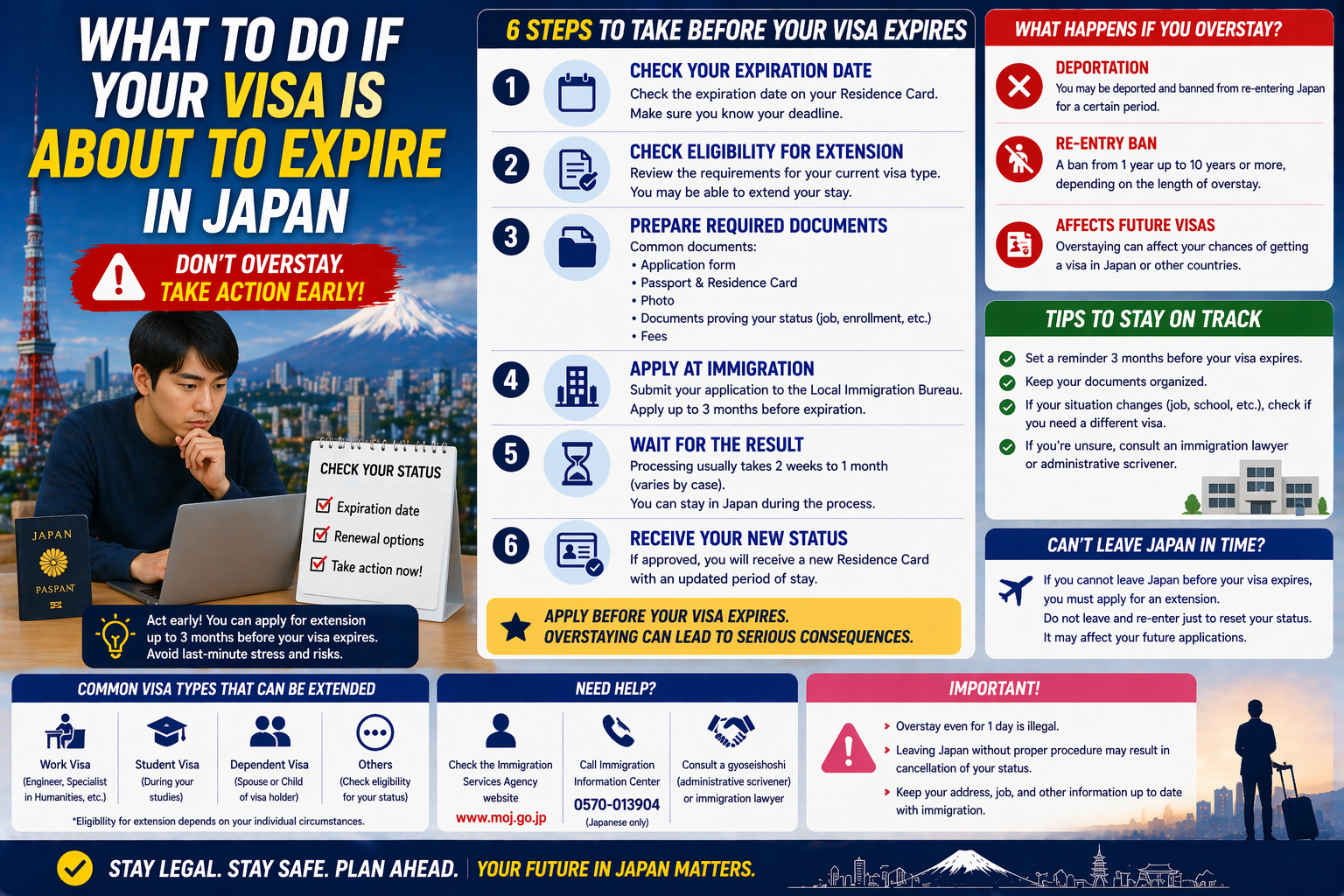
What to Do If Your Visa Is About to Expire in Japan
If your visa is about to expire in Japan, the safest move is usually simple: apply before the expiry date. In most long-term cases, that means applying for an extension of period of stay. If your work, school, or family situation has changed, you may need a change of status of residence instead.
One important detail comes first. In everyday English, people say “visa,” but inside Japan the key issue is usually your status of residence and its expiry date, not the visa sticker used to enter the country. That difference matters, because the procedure is handled by Japan’s Immigration Services Agency, not by getting a new visa inside Japan.
- Apply before the expiry date. Waiting until the last week creates unnecessary risk.
- If you file on time, you may be able to stay under a special period while the application is being processed.
- If your employer, school, or spouse situation changed, a normal renewal may not be enough.
- As of April 23, 2026, the most important recent cost change is the higher immigration fee that started on April 1, 2025.
Who This Guide Is For
This guide is for foreign residents in Japan who already have a long-term status such as work, student, dependent, spouse, or other mid to long-term residence status.
It matters most when:
- your residence card shows an expiry date coming soon
- you changed jobs or schools recently
- you stopped working or studying and are unsure what to file next
- your family situation changed, such as divorce or the death of a spouse
- you are in Japan as a short-term visitor and cannot leave on time for a serious reason
First, Check What Is Actually Expiring
Before you prepare documents, check these three things:
- the expiry date on your residence card
- your current status of residence
- whether your real-life situation still matches that status
For example, if you hold an Engineer/Specialist in Humanities/International Services status and you are still in qualifying work, you will usually look at an extension.
If you finished school and are moving into a full-time job, or if you divorced while on a spouse-based status, your case may require a change of status instead.
ここがポイント: Filing before expiry is the key line. Once you are late, the problem stops being a normal renewal and can become an overstay issue.
Your Main Options
1. Apply for an extension of period of stay
This is the standard route if you want to keep doing the same kind of activity in Japan under the same status.
The Immigration Services Agency says you can apply before the date your stay expires. If your current period of stay is six months or longer, applications are generally accepted from about three months before expiry.
That timing matters for people with busy work or school schedules. Three months gives you time to collect employer certificates, school documents, tax papers, and updated photos without gambling on the last few days.
The official standard processing period for an extension is two weeks to one month, but real cases can take longer if documents are missing or the bureau needs more review.
2. Apply for a change of status of residence
Use this if the reason you stay in Japan has changed.
Common examples include:
- student to worker
- dependent to worker
- one work category to a different category when the activity no longer matches the current status
- spouse-based status after divorce or widowhood, where a different status may now be needed
The official standard processing period for a change of status is one to two months, so leaving this until the final days is especially risky.
3. If you are a short-term visitor
Short-term stay is different. Japan does not treat this like a normal long-term renewal. The Immigration Services Agency says an extension for temporary visitor status is generally allowed only for truly unavoidable humanitarian or similarly special reasons, such as medical treatment.
If you are in Japan as a tourist or other short-term visitor, do not assume you can simply “renew your visa” from inside Japan.
What Happens If You Apply Before the Expiry Date
If you hold a residence card and submit an extension or change-of-status application before your current period of stay ends, the Immigration Services Agency provides a special period.
That means you can generally remain in Japan under your previous status until:
- a decision is made, or
- two months have passed after your original expiry date,
whichever comes first.
For in-person applications, the back of the residence card is marked to show that the application is in progress. For online applications, the process is handled differently, so keep your application records and notices carefully.
This special period is one reason filing early matters so much. It gives you a legal bridge while the application is pending. It is not a reason to delay.
What to Prepare Now
The exact checklist depends on your status, but most people should start gathering these items immediately:
- passport
- residence card
- the correct application form
- a photo if required for your application type
- documents proving your current activity in Japan
- supporting documents from your employer, school, or family relationship
- recent tax or income documents if your status category requires them
A practical rule helps here: match your documents to the life you are actually living now.
If your paperwork still shows an old employer, an old school, or an old address, immigration may ask questions that slow the review.
If Your Job, School, or Family Situation Changed
Many visa-expiry problems start earlier than people think. The deadline trouble is often only the last symptom.
Job or school changes
For several work and student statuses, the Immigration Services Agency requires a notification within 14 days when you leave an affiliated organization, join a new one, or when the organization changes certain details.
This matters if you:
- changed employers
- resigned and have not started a new job yet
- transferred schools
- withdrew or graduated and your next step is different from your old status
If you skipped that notification, fix it quickly. A late notification is better than leaving the record wrong and then trying to renew with inconsistent information.
Divorce or death of a spouse
For people on spouse-related or dependent statuses covered by the rule, divorce or the death of a spouse must also be reported within 14 days.
That does not automatically mean you must leave Japan the same day. It does mean your next immigration step may no longer be a simple extension. In many cases, you need to confirm whether a different status fits your situation.
Fees and the Latest Change That Matters
The biggest recent practical update is the fee revision that took effect on April 1, 2025.
For both extension of period of stay and change of status of residence:
- 6,000 yen if you apply at the office
- 5,500 yen if you apply online
Before that revision, the standard fee was 4,000 yen. The increase is not huge compared with rent or airfare, but it is enough to matter if you are renewing for a family or switching status after a job or school change.
There is also a more technical update: the Immigration Services Agency’s electronic notification system had a specification change from January 5, 2026. If you are filing required notifications online, make sure you are using the current system guidance.
Common Mistakes to Avoid
These are the mistakes that create the most trouble:
- waiting for your employer or school to “handle everything” without checking the deadline yourself
- assuming a visa can be renewed inside Japan the same way it was issued abroad
- filing for an extension when your real situation now requires a change of status
- forgetting the separate 14-day notification after changing employer, school, or spouse situation
- assuming a pending application means you can ignore requests for extra documents
- treating short-term visitor status like a normal resident renewal case
If Your Expiry Date Is Very Close
If the expiry date is only days away, act in this order:
- Confirm whether you need an extension or a change of status.
- Check the status-specific document list on the Immigration Services Agency site.
- Submit as soon as possible, online if eligible or at the regional immigration office that handles your area.
- If your case involves job loss, graduation, divorce, or another major change, contact immigration or a qualified immigration lawyer instead of guessing.
If the date has already passed, the situation is more serious. At that point, do not rely on internet forum advice. Contact the regional immigration office or the Foreign Residents Support Center quickly and explain the dates and facts exactly as they happened.
Practical Takeaway
When your visa is about to expire in Japan, the real question is not just “How long can I stay?” It is whether your current life still matches your current status, and whether you can file before the expiry date.
Check the date on your residence card, start about three months early if you can, and do not ignore linked duties such as employer, school, or spouse notifications. The deadline on the card is the visible part. The stronger application is the one where your documents, your status, and your actual situation all match.
References / 参照リンク
- Ministry of Foreign Affairs of Japan: VISA
- Ministry of Foreign Affairs of Japan: Validity of a Visa
- Immigration Services Agency: Permission to Extend Period of Stay
- Immigration Services Agency: Special Period After Filing Before Expiry
- Immigration Services Agency: Permission to Change Status of Residence
- Immigration Services Agency: Fee Revision for Immigration Procedures
- Immigration Services Agency: Online Procedures
- Immigration Services Agency: Notification Concerning the Organization of Affiliation
- Immigration Services Agency: Notification Concerning a Spouse
- Immigration Services Agency: Temporary Visitor Status
- Immigration Services Agency: Electronic Notification System Portal
- Immigration Services Agency: Consultation and Support Information
- Immigration Services Agency: Foreign Residents Support Center (FRESC)