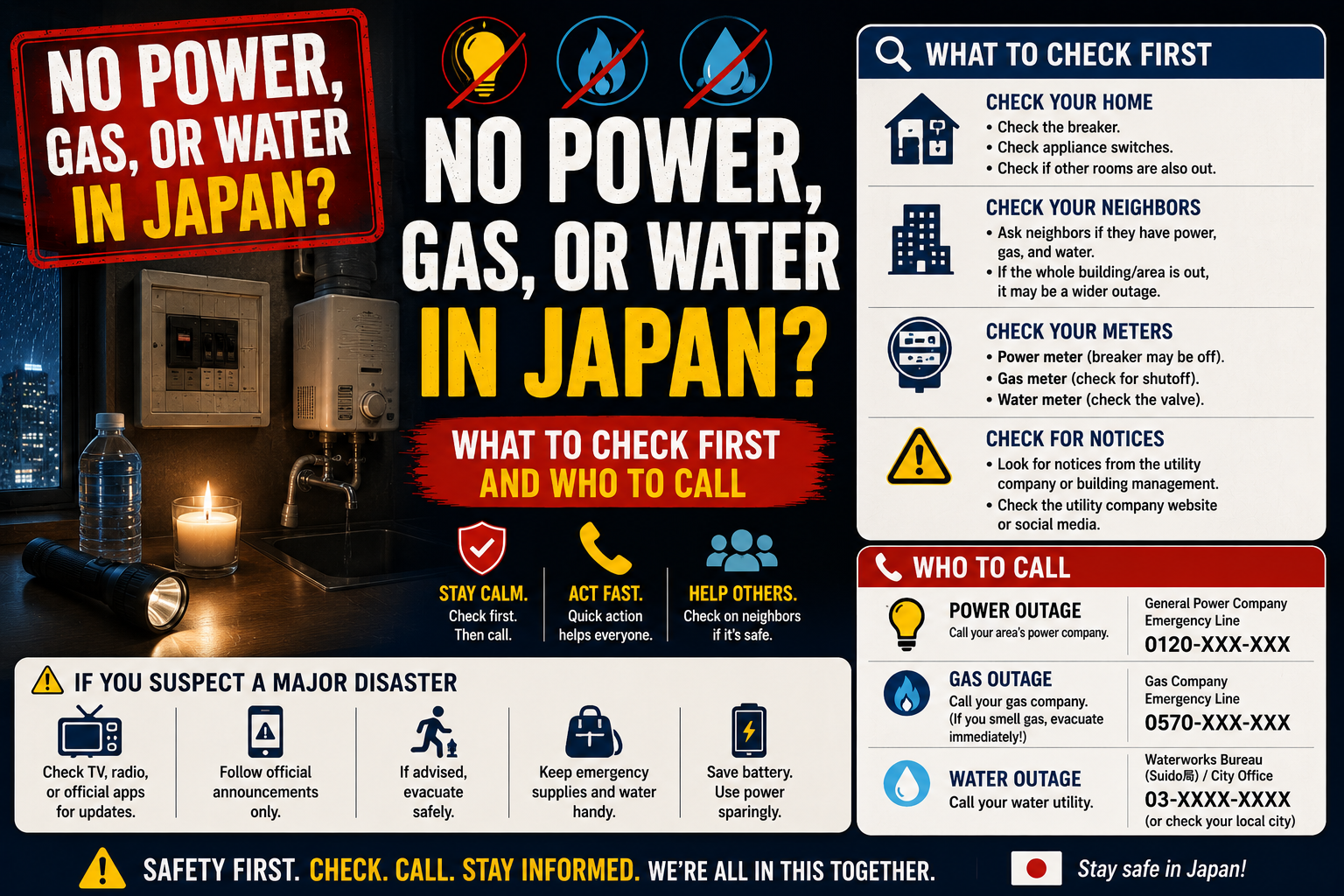
No Power, Gas, or Water in Japan? What to Check First and Who to Call
If your utility service suddenly stops in Japan, the first job is to identify what kind of stop it is: a neighborhood outage, a problem inside your room, a building-wide issue, or a contract or payment problem.
That matters because the next step changes fast. A tripped breaker can be reset at home. A gas smell is an emergency. No water in one apartment building may mean you need the building manager, not the city bureau.
- Check whether the problem is only in your room, in your whole building, or in the neighborhood.
- For gas, do not try a reset if you smell gas.
- In apartment buildings, contact the manager early if water pumps, storage tanks, auto-lock doors, or shared equipment may be involved.
- Keep your utility contract details, customer number, and emergency contacts easy to find before something stops.
Who this guide is for
This guide is for students, workers, and long-term residents in Japan who need a practical first response when electricity, gas, or water stops at home.
It matters most when you have just moved in, live in an apartment building, face a storm or earthquake, or get a sudden warning about unpaid bills.
Start here: identify the type of stop
Before you call anyone, do three quick checks:
-
Look outside your unit. If hallway lights, nearby homes, or street signals are also affected, this may be a wider outage.
-
Check your own equipment. Look at your breaker panel, gas meter, visible valves, and any notices from your building or utility.
-
Check your building setup. In Japan, some apartments rely on shared pumps, storage tanks, or building systems. That means your unit can lose service even when the city network is still running.
ここがポイント: In Japan, the fastest fix often comes from the right contact, not the first contact. A breaker issue is yours. A gas leak is an emergency line. A water stop in a tank-based apartment may be the building manager.
If the electricity stops
A power cut is often the easiest to sort out because the pattern tells you a lot.
If the whole neighborhood is dark
TEPCO’s guidance says to contact the power grid operator when the outage affects the surrounding area, and to be ready to give your address, name, phone number, and a nearby landmark.
What to do:
- Check your local utility’s outage map or outage page.
- Call the grid operator if the outage is not already shown.
- Avoid elevators, especially in apartment buildings.
- Unplug heaters, irons, and other heat-producing devices so they do not restart unsafely when power returns.
Why this matters for foreign residents: many apartment buildings in Japan use electric locks, elevators, water heaters, and internet equipment that may also stop during a power outage.
If only your home is affected
TEPCO says a full-home outage may come from using too many appliances at once or from a leakage breaker problem.
Check these points:
- If you have an amp breaker, reduce appliance use and reset it.
- If the earth leakage breaker tripped, turn off branch breakers first, then turn them back on one by one.
- If only one room lost power, unplug the suspected appliance and check the room breaker.
A common Japan-specific mistake is running a microwave, kettle, heater, and washing machine at the same time in a small apartment with a limited contract capacity.
When to call immediately
- The breaker will not reset.
- You see sparks, burning smell, or damaged cords.
- The outage returns repeatedly.
- You rely on powered medical equipment.
TEPCO’s emergency outage calls are accepted 24 hours a day, while some general inquiry hours are limited.
If the gas stops
Gas requires the most caution. If you smell gas, treat it as an emergency, not a simple stoppage.
If you smell gas
Tokyo Gas Network’s English emergency guidance is clear:
- Open windows.
- Close gas taps on appliances and pipes.
- Close the gas tap on the meter as well.
- Do not use flames.
- Do not touch light or fan switches, because a small spark can ignite gas.
- Call the gas leak emergency line right away.
This is not the moment to test appliances, relight anything, or try random buttons.
If there is no gas but no gas smell
Tokyo Gas Network tells users to check these basics first:
- Is the gas tap or appliance tap closed?
- Do other gas appliances work?
- Is the gas meter tap in the correct position?
- Is the gas meter light blinking?
If the meter light is blinking, the meter may have automatically shut off gas after abnormal usage or an earthquake. Tokyo Gas says many home gas meters stop supply automatically when they detect an issue or an earthquake of magnitude 5 or higher.
Can you reset the gas meter yourself?
Yes, often you can, but only if you do not smell gas.
For common home meters, Tokyo Gas Network’s English instructions say to:
- Turn off all gas appliances, including outdoor ones such as water heaters.
- Press the reset button as directed for your meter type.
- Wait before using gas again.
For many household meters, the wait is about three minutes. If the light stops blinking, gas use can resume. If it does not recover, contact the operator.
A common mistake after moving in
People often assume the stove or water heater is broken when the real issue is the meter shutoff, a closed gas tap, or a service-start problem after move-in. Check those before paying for a repair visit.
When repeated gas stoppages mean something else
Tokyo Gas Network notes that frequent stoppages can mean your gas meter is too small for your current usage. That matters if you added a new gas heater, water heater, or other appliance after moving in.
If the water stops
Water outages in Japan are more local than many newcomers expect. The key question is whether your building uses direct supply or a storage tank and pump system.
If only your home has no water
The Tokyo Metropolitan Government’s water bureau says to first check whether the meter valve is open.
After that:
- If your home uses direct supply and the valve is open, contact the water bureau.
- If your building uses a storage tank system, the problem may be the building pump or building-side maintenance.
- In that case, contact the building manager or landlord first.
This is especially important in older apartment buildings and some larger complexes.
If the whole area has no water
The cause may be scheduled work or an unexpected accident. Check your municipality’s water outage information page or customer center.
Tokyo’s water bureau explicitly separates these cases, and Yokohama’s English guidance also shows that repair responsibility can differ depending on whether the problem is on the road side of the meter or on the customer side.
Why building management matters more for water
With water, foreign residents often lose time by calling the city first when the actual problem is inside the building:
- empty or shut storage tank
- pump failure
- maintenance work
- a private plumbing problem after the meter
If you live in a managed building, ask whether neighbors in the same building still have water and whether the building uses a tank system.
If the stop is caused by unpaid bills or a contract problem
Not every utility stop is an outage.
A few practical checks:
- Did you recently move in and forget to start service?
- Did your card payment fail?
- Did you miss a paper bill because it was in Japanese?
- Is the contract under a roommate, employer, or previous tenant?
For water, Tokyo’s official FAQ says service can be stopped for non-payment and that reopening after a shutoff may require full payment of the unpaid amount. Exact steps depend on the notice you received and the office handling your case.
That is why you should keep photos or PDFs of:
- your latest bill
- customer number
- contract name
- shutoff notice, if any
Common mistakes to avoid
1. Calling the wrong party first
In Japan, the correct contact may be different for each utility:
- electricity: the grid operator for outages
- gas smell: the emergency gas leak line
- water in tank-based apartments: building manager first
- billing or contract issues: your retailer, bureau, or account office
2. Treating a gas stop like an appliance problem
If all gas appliances stop at once, check the meter before assuming the stove or water heater failed.
3. Ignoring building notices
Scheduled inspections and short service stops are often posted in apartment lobbies, mail areas, or elevator notices.
4. Trusting scam messages about urgent shutoff
Tokyo’s water bureau has warned about fake calls and messages claiming unpaid bills and threatening shutoff or legal action. If you get a message like that, do not click the link. Check your account through the official customer center or official website instead.
Regional differences you should expect
Utility procedures are not fully uniform across Japan.
Differences can include:
- which company handles outages versus billing
- whether English support exists
- whether your city or ward publishes live outage information
- whether your apartment uses direct water supply or a storage tank
- emergency phone availability outside normal business hours
A useful example: Yokohama’s water bureau lists Japanese phone support 24 hours a day and says English-speaking service is available from 8:00 a.m. to 8:00 p.m. Support conditions can change a lot by city.
Latest status to check in 2026
As of May 8, 2026, the practical pattern is still the same across major operators and municipalities:
- electricity operators continue to publish outage contacts and self-check steps online
- gas operators continue to publish meter reset instructions in English
- municipal water bureaus continue to split responsibility between public-side repairs and private-side or building-side problems
- scam warnings about unpaid utility bills remain active, especially for water-related messages and calls
So the most useful preparation is simple: save your operator’s outage page, your municipality’s water page, your building manager’s phone number, and photos of your latest bills.
What to keep ready before the next stoppage
- Your address in Japanese and English
- Customer number for each utility
- Building manager or landlord contact
- A flashlight and phone battery pack
- A screenshot of your local utility outage page
- A photo of your breaker panel and gas meter
If one of your utilities stops in Japan, do not guess for too long. Identify whether it is your unit, your building, or the wider area, then contact the right party quickly. That one distinction usually saves the most time.
参照リンク
- TEPCO: What to do if the power goes out
- TEPCO: Contact Information for outages
- Tokyo Gas Network: Smell Gas?
- Tokyo Gas Network: No Gas
- Tokyo Gas Network: Resetting Your Meter
- Tokyo Metropolitan Government Bureau of Waterworks: No Water
- Tokyo Metropolitan Government Bureau of Waterworks: Water service stopped for non-payment FAQ
- Tokyo Metropolitan Government Bureau of Waterworks: Warning about suspicious shutoff calls
- Yokohama City: Water services problems and contact details