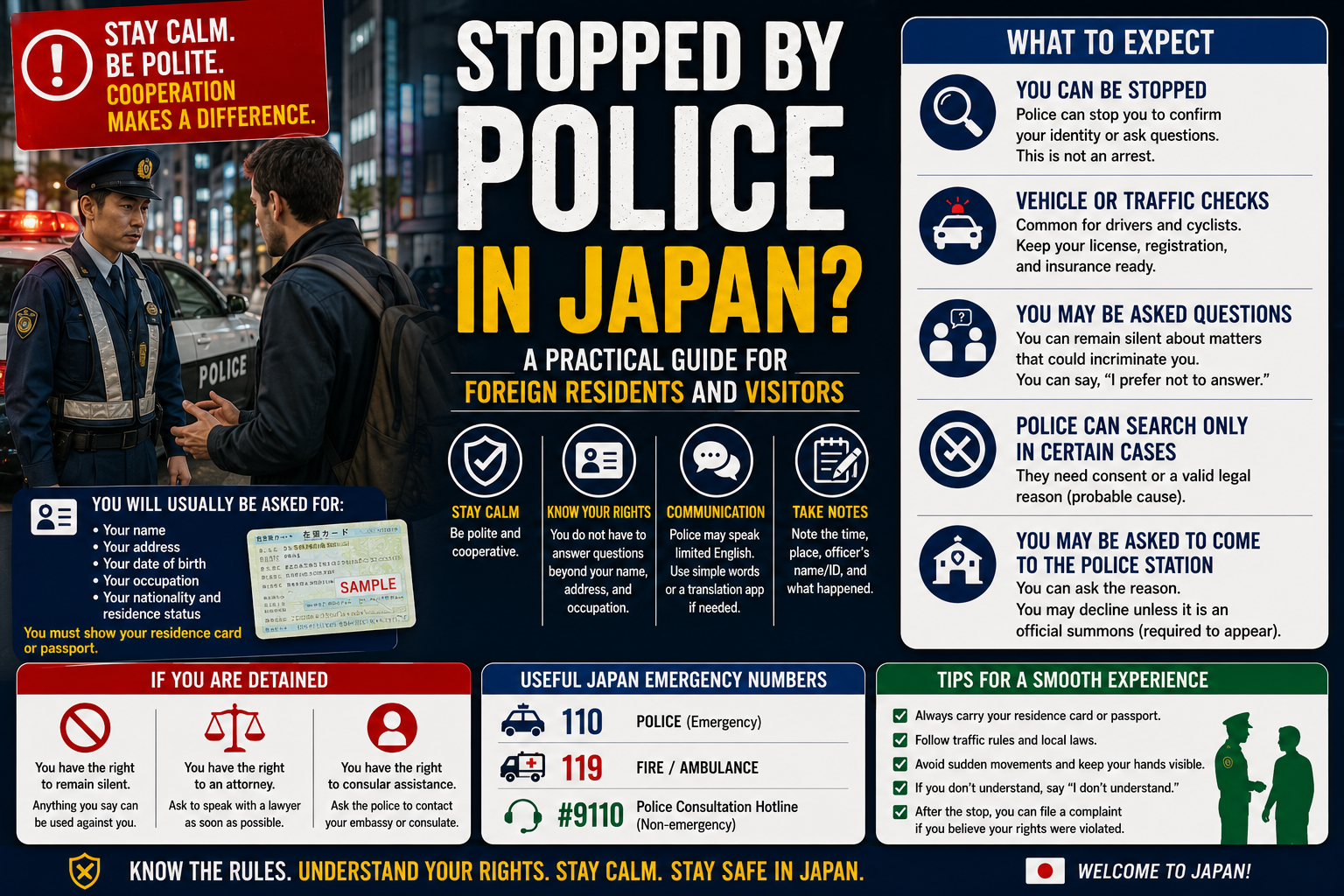
Stopped by Police in Japan? What Foreign Residents and Visitors Should Do
If police stop you in Japan, the safest first move is simple: stay calm, stop, and show the ID you are legally required to carry. For most foreign residents, that means a residence card. For short-term visitors, that usually means a passport.
In many cases, a street stop is an ID check or brief questioning, not an arrest. You should answer basic questions clearly, avoid arguing on the street, and separate urgent situations from non-urgent ones: 110 for emergencies, #9110 for police consultation.
This guide is for tourists, students, workers, and long-term residents who want to know what the rules are, what police can ask, and what to do next if the encounter becomes stressful.
- Carry the right ID: residence card for most mid-to-long-term residents, passport for short-term visitors.
- A police stop is not automatically an arrest: officers may stop and question someone under Japanese law, but that does not by itself mean detention.
- Use the right phone number:
110is for urgent police help.#9110is for non-emergency police consultation. - If language is the problem, say so early: ask for simple Japanese or an interpreter, and note that support can vary by prefecture and time of day.
Why police may stop you in Japan
Japan’s Police Duties Execution Act allows police officers to stop and question a person when they have reasonable grounds to suspect a crime or believe the person may know something about a crime.
That matters because many foreign residents assume any stop is a criminal accusation. It is not. In practice, a police stop can happen after a bicycle check, a late-night patrol, a report from someone nearby, or a routine identity check.
The same law also says police may ask a person to come to a nearby police station or police box for questioning if doing it on the spot would be inappropriate or would block traffic. But the law does not say police can force answers in every ordinary street stop.
ここがポイント: In Japan, police can stop and question you, but a street stop is not the same thing as an arrest. Your first job is to stay calm, identify yourself properly, and understand whether the situation is voluntary questioning or something more serious.
What to do in the first few minutes
Keep the first exchange simple. That lowers the risk of confusion, especially if your Japanese is limited.
- Stop walking and face the officer.
- Keep your hands visible and avoid sudden movements.
- Ask politely why you were stopped.
- Show your residence card or passport when legally required.
- Speak in short sentences. If needed, say that your Japanese is limited.
- If you do not understand, ask the officer to repeat slowly or write it down.
Useful plain phrases:
- “I have my residence card.”
- “I am a tourist. Here is my passport.”
- “Please speak slowly.”
- “I do not understand Japanese well.”
- “Am I free to leave?”
- “Am I under arrest?”
Those last two questions matter because they help you understand whether this is still voluntary questioning or whether criminal procedure has started.
Which ID you must carry
This is the part many people get wrong.
Most foreign residents
If you are a mid-to-long-term resident in Japan, the Immigration Control and Refugee Recognition Act says you must carry your residence card at all times and present it when certain officials, including police officers, lawfully request it while performing their duties.
That means students, workers, dependents, and many long-term residents should not leave home without the card, even for a short errand.
Short-term visitors
If you are in Japan as a temporary visitor, the same law says you must carry your passport or the document that applies to your landing status.
For most travelers, that means your passport is the practical answer. A passport photo on your phone is not a legal substitute.
Special permanent residents
This is one important exception. Immigration Services Agency guidance says special permanent residents do not have the same constant carry requirement for the special permanent resident certificate. But if immigration or other authorized officials ask to see it, they still need to present it.
That exception is narrow. Most foreign readers in Japan are not special permanent residents, so most people should assume they need to carry their residence card or passport.
Can you refuse questions or refuse to go to a police box?
Japanese law draws a line here.
The Police Duties Execution Act says police may stop and question a person, and may request that the person accompany them to a nearby police station or police box for questioning in some cases. But the same article also says, unless criminal procedure law applies, the person is not to be forcibly taken there or compelled to answer against their will.
What this means in real life:
- You should not refuse a lawful ID presentation request if you are required to carry that ID.
- You can stay polite while checking whether the officer is making a request or giving a legally compulsory order.
- If you are asked to move to a police box, ask whether it is voluntary and whether you are free to leave.
- If you are told you are under arrest, the situation is no longer a routine stop.
Do not turn this into a street argument. Calm questions work better than confrontation.
If the stop becomes serious or confusing
Sometimes the problem is not the stop itself. It is the language gap, stress, or not knowing whom to call next.
If you need urgent help
Call 110 if:
- you are in immediate danger
- there is violence, theft, or a traffic accident
- you believe a crime is happening right now
If it is not an emergency
Use #9110 for non-urgent police consultation. The National Police Agency directs people to #9110 or the nearest police station for worries and problems that are not emergencies.
This is useful if:
- you want to ask how to report a problem later
- you believe an officer’s conduct should be reviewed
- you need the right prefectural contact point after the stop ends
If you are a visitor and need language support
The Japan National Tourism Organization’s Japan Visitor Hotline is available 24 hours a day, 365 days a year for foreign visitors. It is not a replacement for 110, but it can help visitors who need support during an emergency or after one.
If you need consular help
If your passport is taken as evidence, you are arrested, or you cannot contact family, check your embassy or consulate details through the Ministry of Foreign Affairs list of foreign missions in Japan.
Common mistakes that make things worse
A police stop often gets harder because of avoidable mistakes, not because of one question.
- Not carrying your real ID: a photo or copy does not solve the problem.
- Arguing before understanding the situation: first find out whether this is an ID check, voluntary questioning, or an arrest.
- Speaking too much too fast: short, clear answers are better than long explanations in difficult Japanese.
- Walking away suddenly: that can escalate a basic stop.
- Calling
110for a non-urgent complaint after the fact: use#9110unless there is immediate danger. - Assuming rules are identical for everyone: tourists, residents, and special permanent residents are not treated under the same carry rules.
Regional differences and what may vary
The national legal framework is the same across Japan, but some practical details vary by prefecture.
- availability of foreign-language support
- how quickly a station can arrange interpretation
- which consultation number a local police headquarters wants you to use beyond
#9110 - whether the stop happens on the street, at a station, or at a police box
Tokyo may feel more used to foreign-language encounters than a smaller city, but you should not assume instant English support anywhere in Japan.
Current status as of May 8, 2026
As of May 8, 2026, the core nationwide rules on foreign nationals carrying and presenting ID in Japan are unchanged in the official sources cited below.
What matters right now is not a brand-new law but knowing the current contact routes:
110remains the emergency police number.#9110remains the non-emergency police consultation line.Japan Visitor Hotlineremains available for foreign visitors, and JNTO also began a separate tourist information call center on April 1, 2026.
So the practical update is this: if police stop you today, the legal basics are stable, but the fastest help still depends on whether your issue is urgent, non-urgent, or mainly a language problem.
Final takeaway
If you are stopped by police in Japan, do three things first: stay calm, show the correct ID, and work out whether this is routine questioning or something more serious.
After that, your next step becomes clearer:
110for immediate danger or a crime in progress#9110for non-emergency police consultation- embassy or consulate contact if you need consular support
- official immigration sources if the issue involves your residence card or status
The most useful preparation is boring but effective: carry the right document every day, know the difference between 110 and #9110, and do not wait until a stressful roadside stop to learn the rule.
References / 参照リンク
- Immigration Control and Refugee Recognition Act (Japanese Law Translation)
- The Police Duties Execution Act (Japanese Law Translation)
- What is a Residence Card? Immigration Services Agency of Japan
- What is a Special Permanent Resident Certificate? Immigration Services Agency of Japan
- Q&A on the Special Permanent Resident System, Immigration Services Agency of Japan
- National Police Agency: Opinions, Consultations, and Information
- Tokyo Metropolitan Police Department: Consultation Desk Information
- Japan Visitor Hotline, JNTO
- JNTO Press Release on New Tourist Information Call Center, March 13, 2026
- Foreign Missions in Japan, Ministry of Foreign Affairs of Japan