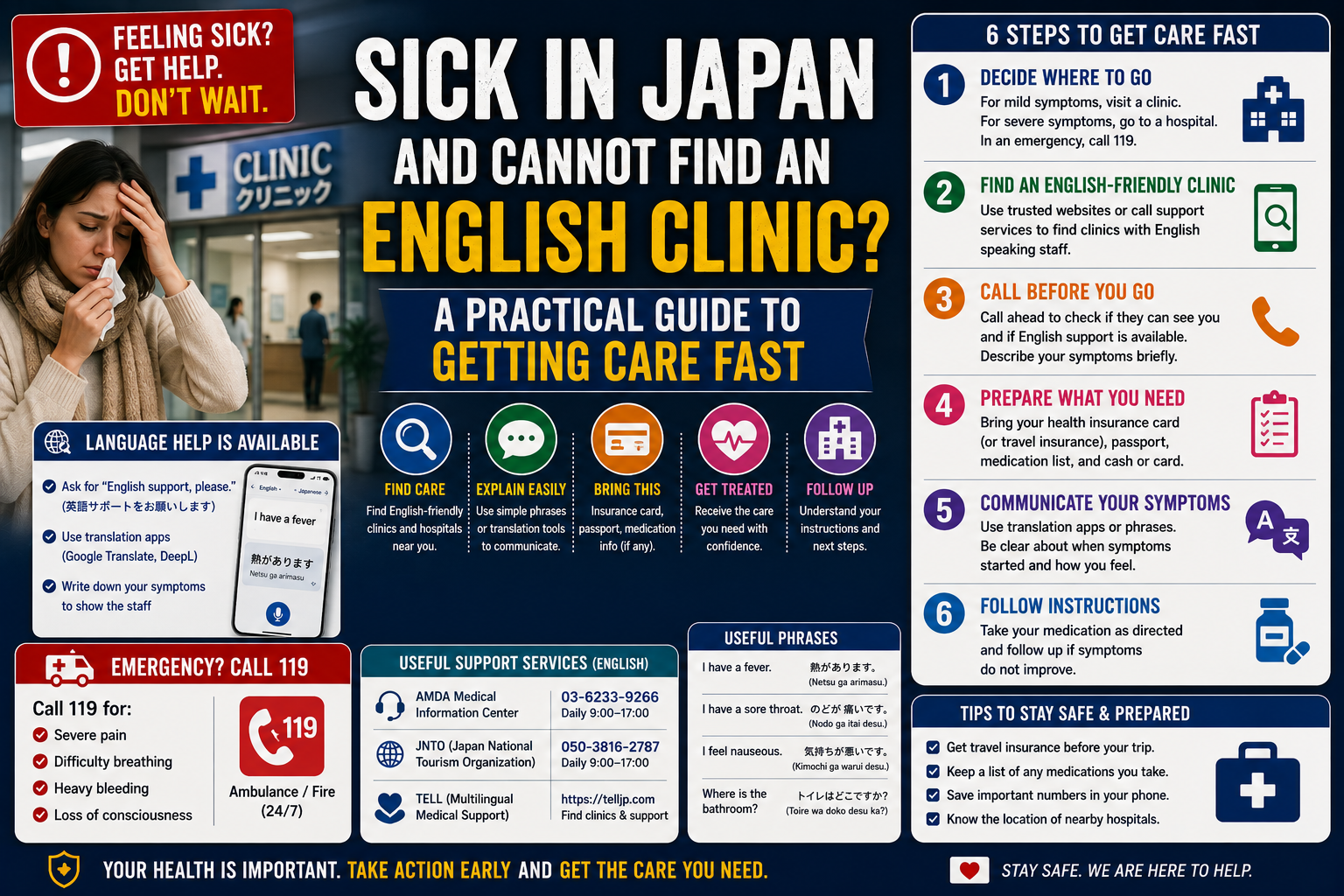
Sick in Japan and Cannot Find an English Clinic? What to Do Next
If you get sick in Japan and cannot quickly find an English-speaking clinic, do not wait and hope it gets easier later. Use an official medical search tool, a multilingual support line, or an emergency number right away, depending on how serious your symptoms are.
For most people, the fastest path is simple: search nearby clinics through JNTO or the Ministry of Health system, call a multilingual help line if you cannot explain your symptoms, and use 119 immediately for emergencies.
- Emergency now: call
119for an ambulance - Not sure if it is an emergency: check whether
#7119works in your area - Need language help: try AMDA’s multilingual medical line
- Need a clinic fast: use JNTO or Medical Information Net to filter by language, department, and location
Who this guide is for
This guide is for tourists, students, workers, and long-term residents in Japan who need medical help but cannot easily find an English-speaking clinic.
It matters most when:
- you are sick outside normal clinic hours
- you are in a smaller city where English support is limited
- you do not know which department to visit
- you have insurance, but do not know what to bring or what you may have to pay first
First, decide: emergency or not?
Start here. The right next step depends on how severe your symptoms are.
Call 119 now if you have signs of an emergency
Examples include:
- trouble breathing
- severe chest pain
- heavy bleeding
- loss of consciousness
- seizures
- serious head injury
- possible stroke symptoms such as face drooping, arm weakness, or speech trouble
JNTO’s emergency guide says ambulance requests go through 119, and it also notes that you cannot choose which hospital the ambulance takes you to.
If you are unsure, try #7119 first
In many areas, #7119 connects you to an emergency medical advice line. Fire and Disaster Management Agency information shows it is used to help people decide whether they should call an ambulance or go to a hospital, but it is not available everywhere in Japan.
Check your prefecture before you rely on it. Coverage and hours vary by area.
If the patient is a child, try #8000
For children’s sudden illness at night or on holidays, #8000 connects callers to pediatric advice in every prefecture, but the service hours differ by prefecture.
ここがポイント: If symptoms look serious, skip the language problem and act on the medical problem first. In Japan,
119is the emergency route. Translation can come after the ambulance is on the way.
How to find a clinic when English support is limited
Do not search only by “English-speaking clinic near me.” In Japan, that often misses usable options.
Instead, search by three things together:
- medical department
- area
- language support or foreign-patient support
Option 1: Use JNTO’s medical institution search
JNTO’s official medical guide lets you filter by:
- prefecture
- language
- medical department
- emergency medicine
- credit card support
- foreign-patient base medical institution categories
This is one of the easiest tools if you are a short-term visitor or a new arrival who needs an English interface.
Option 2: Use Medical Information Net (Iryo Joho Net)
The Ministry of Health’s Medical Information Net is broader. It covers medical institutions and pharmacies nationwide and can filter by:
- foreign language support
- clinics that are open now
- holiday or night care
- children’s care
- women’s care
- pharmacies
This tool matters because the nearest workable option may be a clinic with limited English, a hospital with interpreter support, or a pharmacy that is still open.
Option 3: Use the prefectural consultation pages
The Ministry of Health maintains a page linking to local consultation centers by prefecture. These are useful when rules, hours, and referral options differ locally.
That local difference matters. A useful hotline in Tokyo may not exist in the same form in rural areas, and after-hours care systems can be very different from one prefecture to another.
If you cannot explain your symptoms in Japanese
Language is often the real barrier, not the lack of doctors.
Call AMDA for multilingual support
AMDA Medical Information Center provides multilingual medical information and telephone interpretation support for foreign residents and visitors in Japan. Its published consultation number is 03-6233-9266.
AMDA’s language schedule varies by language, so check the current timetable before you call. English is listed on its service schedule, and the site states that consultations are free except for call charges.
Use symptom sheets before you arrive
JNTO provides printable sheets for:
- personal information related to treatment
- pointing to symptoms and symptom descriptions
These are useful when you can speak basic English but the clinic staff cannot, or when the doctor needs fast, concrete information.
Before you go, prepare:
- your name and date of birth
- address or hotel name
- allergies
- current medicines
- insurance card, if you have one
- passport or residence card
- emergency contact
Which place should you go to?
In Japan, the first stop depends on time and severity.
During normal daytime hours
Try a clinic first for common problems such as:
- fever
- sore throat
- stomach pain
- rash
- mild injury
At night, on weekends, or on holidays
Look for:
- after-hours reception at hospitals
- holiday or night clinics in your area
- emergency hospitals if symptoms are more serious
JNTO notes that after-hours reception varies by region. That means you should not assume the same system exists everywhere.
If you do not need a doctor immediately
A pharmacy or drugstore may be enough for mild symptoms. JNTO’s guide also points readers to an English OTC medicine search and advises asking a pharmacist or registered seller when needed.
This can help with:
- mild cold symptoms
- simple pain relief
- seasonal allergies
- minor stomach issues
It is not a substitute for urgent care when symptoms are getting worse.
What to bring and what you may pay
This is where many foreigners lose time.
If you are a resident with Japanese health insurance
Government guidance for international students explains a useful baseline: foreign residents staying three months or more generally join National Health Insurance if applicable, and with NHI 70% of covered treatment costs are paid by the insurance system, while the patient pays 30%. Non-covered care is paid in full.
For expensive care, Japan also has a high-cost medical expense system, but that does not always solve your immediate payment problem at reception.
If you are a tourist or you do not have Japanese insurance
You may need to pay a large amount first and claim it later through travel insurance. JNTO says clinics often accept cash only, while major hospitals are more likely to take credit cards.
JNTO also says:
- ask for a cost estimate at reception
- prescription charges are often separate from treatment charges
- if you do not have cashless insurance support, you may be charged the full amount on site
Bring these items if you have them
- health insurance card
- passport or residence card
- cash and a credit card
- phone charger
- list of medicines and allergies
- travel insurance details, if you are visiting Japan
Common mistakes to avoid
Waiting too long because English support looks weak
A clinic with limited English may still treat you safely if you arrive with written symptoms, translation support, or a phone interpreter.
Going to a large hospital for every minor problem
For non-emergencies, a local clinic is often faster and more practical.
Forgetting the department name
Search by symptom and department, not only by hospital name. JNTO’s guide lists common matches such as internal medicine for fever or sore throat, orthopedics for fractures or joint pain, and obstetrics/gynecology for pregnancy-related concerns.
Assuming every area has the same hotline
#7119, child advice hours, and after-hours systems vary by prefecture.
Arriving with no payment plan
Even insured patients may need to pay first. Uninsured visitors may face the full cost up front.
Latest points to know
As of May 8, 2026, a few current points matter:
- The Ministry of Health’s consolidated list of medical institutions that accept foreign patients was updated on March 31, 2026, after an earlier update on February 26, 2026.
- The official Medical Information Net remains the broadest nationwide public search tool for clinics, hospitals, and pharmacies.
- The Ministry of Health still provides prefecture-by-prefecture consultation links, which is important because local support systems are not uniform.
These updates matter because older blog posts and expired COVID-era foreigner hotlines still appear in search results. Use current official pages, not old reposts.
A practical fallback plan
If you feel sick and cannot find an English-speaking clinic within a few minutes, use this order:
- Decide whether it is an emergency. If yes, call
119. - If you are unsure, check
#7119for your area. - Search JNTO or Medical Information Net for a clinic, hospital, or pharmacy.
- Call AMDA or a local consultation line if language is blocking you.
- Bring your ID, insurance, medicines, and payment method.
The most useful habit is simple: bookmark one official search page and one multilingual support page before you need them. In Japan, the hardest part is often not treatment itself. It is getting to the right door fast enough.
参照リンク / References
- JNTO: Guide for when you are feeling ill in Japan
- MHLW: Information on Local Call Centers
- MHLW: Prefectural consultation desks
- MHLW: List of medical institutions that accept foreign patients
- MHLW: Medical Information Net system overview
- Medical Information Net (Iryo Joho Net)
- FDMA: What is #7119?
- MHLW: Pediatric phone advice #8000
- AMDA Medical Information Center
- Study in Japan: Insurance
- MHLW: High-cost medical expense benefit system