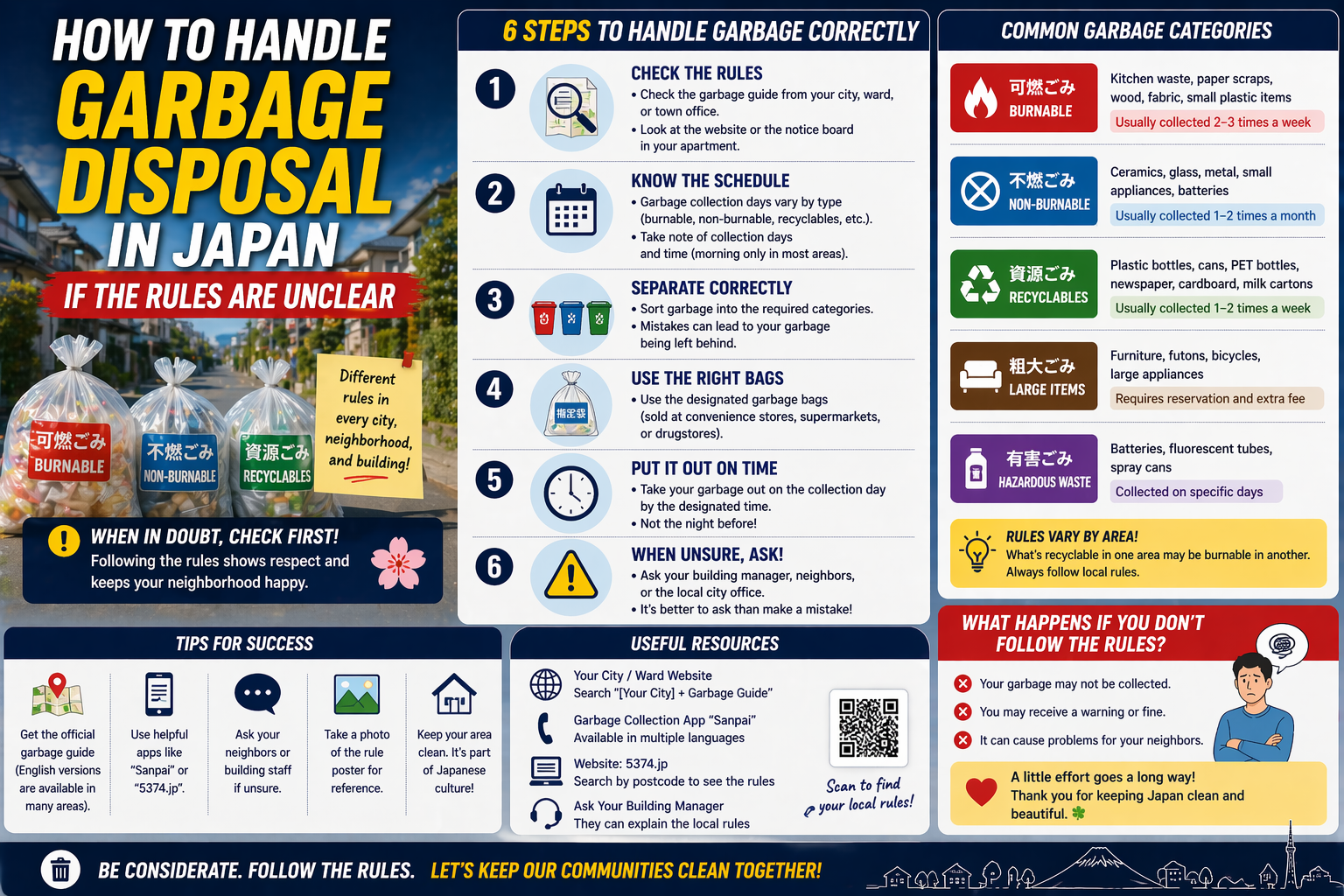
How to Handle Garbage Disposal in Japan If the Rules Are Unclear
If the garbage rules around you are unclear, do not guess and put the bag out anyway. In Japan, household garbage rules are mainly set by each municipality, and the pickup point may also depend on your building. The safe move is to check your city or ward guide first, then confirm the collection point with your building manager or landlord.
That sounds slow, but it usually saves time. A bag left out on the wrong day, in the wrong bag, or at the wrong spot may be left behind with a warning sticker. Batteries, spray cans, and large appliances can create bigger problems than that.
- Most important rule: garbage sorting and pickup rules differ by city, ward, and sometimes by building.
- Common deadline: many areas want trash out on the collection day in the morning, often by 8:00 a.m. or 8:30 a.m.
- Bag rules vary: some cities require official designated bags, while others accept transparent or semi-transparent bags.
- Do not mix risky items: rechargeable batteries, spray cans, and large home appliances often need a separate disposal route.
Who This Guide Is For
This guide is for beginners in Japan, including students, workers, and long-term residents who have just moved into a dorm, share house, or apartment and are not sure which local rule applies.
It matters most when:
- you just moved to a new city or ward
- your building has a garbage area but no clear signs
- the item does not fit obvious categories like burnable or non-burnable
- you need to throw away batteries, spray cans, or something large
The Rule Behind the Confusion
Japan does not run one single national household-garbage system. The Ministry of the Environment says municipal waste disposal is the responsibility of municipalities. That is why the correct answer in Osaka, Minato City, Nagoya, and Fukuoka can be different even for similar items.
On top of that, your apartment building may have its own pickup point or house rules. Minato City tells residents to ask the city office about sorting and pickup days, but to ask the building manager, office, or landlord about where to put the trash.
ここがポイント: If the rules are unclear, treat it as a local question, not a Japan-wide question. Check your municipality for sorting and your building for the collection spot.
What to Do First When You Are Not Sure
Start with these steps in order.
1. Check your city or ward’s official guide or search tool
This is the fastest way to avoid mistakes.
Examples from official local sources:
- Minato City provides multilingual sorting leaflets, a full guidebook, and a garbage-sorting app.
- Nagoya provides a city guide in multiple languages and a sorting app that works in eight languages.
- Fukuoka provides an official garbage site with an item search, recycle-station search, and collection-day search.
- Osaka publishes an English guide and links disposal rules to its garbage collection map.
If you are unsure about one item, search by the item name, not by a general category. A rice cooker, mobile battery, broken umbrella, or hair spray can each have a different route.
2. Confirm the pickup point with your building
Even when the city rule is clear, the pickup location may not be.
Ask:
- the building manager
- the landlord
- the real estate agency if you just moved in
- a dorm office, if you live in student housing
This matters because some buildings use a shared garbage room, while others use a neighborhood collection point on the street.
3. If you still cannot tell, ask before you throw it away
Use the municipality contact route instead of guessing.
For example:
- Fukuoka has a multilingual support line for ward offices.
- Minato and Nagoya both publish city contact points for garbage questions.
If your city office only answers in Japanese, ask a friend, school office, employer, or support center to help you make the call. That is still better than leaving uncollected garbage outside.
The Local Differences That Cause Most Mistakes
The biggest problems usually come from four local differences.
Bag rules
Do not assume every city accepts the same bag.
- In Fukuoka, burnable and non-burnable trash must go in Fukuoka City’s designated bags.
- In Nagoya, residents are told to use Nagoya City garbage bags, sold at supermarkets and convenience stores.
- In Osaka, household trash should be put out in see-through bags.
- In some Tokyo wards, the rule may be a transparent or semi-transparent bag rather than a paid city bag.
If you moved from one city to another, old habits can easily cause mistakes.
Collection day and time
Putting trash out on the wrong morning is one of the most common errors.
Official city examples show how specific this can be:
- Minato City says to put garbage out by 8:00 a.m., with some areas at 7:30 a.m.
- Nagoya says by 8:00 a.m., but in Naka Ward it is 7:00 a.m.
- Osaka says to use the collection map and, if you are unsure of the local pickup time, put it out by 8:30 a.m.
That means “morning” is not precise enough. Check the exact time for your address.
Sorting categories
The same item may move between categories depending on size, material, and city rules.
Examples:
- A small appliance may be regular garbage in one city, but a small-electronics recycling item in another.
- Plastic packaging may be recyclable if it is clean, but regular garbage if food is still stuck to it.
- PET bottle caps and labels are often separated from the bottle itself.
When the item is mixed-material, local search tools are much more useful than guessing from the main material.
Dangerous items
These are the items you should slow down for.
- Rechargeable batteries and mobile batteries: Fukuoka says small rechargeable batteries cannot be disposed of as normal garbage because they can ignite on impact. Osaka also separates lithium-ion batteries and asks residents to insulate terminals.
- Spray cans and gas canisters: Osaka says the contents must be fully used up without drilling a hole. Fukuoka warns that remaining contents may cause fires or explosions in garbage trucks.
- Sharp or broken items: cities often require wrapping them and marking them as dangerous.
Items You Usually Cannot Leave Out as Normal Household Garbage
When rules are unclear, assume these items need special handling until you confirm otherwise.
Bulky waste
Cities usually define bulky waste by size and require advance booking.
For example:
- Osaka treats items over 30 cm on the longest side or diameter, or long items over 1 meter, as bulky waste.
- Nagoya treats items over 30 cm as bulky waste and requires advance application.
This often involves a fee sticker or other prepaid process.
Major home appliances
Air conditioners, TVs, refrigerators/freezers, washing machines, and clothes dryers are not ordinary city garbage. Under Japan’s Home Appliance Recycling Act, retailers collect them and manufacturers recycle them, and consumers pay collection and recycling costs.
If you are replacing the appliance, the store is often the first place to ask.
Computers and some batteries
Some cities do not collect personal computers as normal household garbage. Rechargeable batteries, especially swollen or damaged ones, may have a dedicated collection box or staffed drop-off point.
Do not force open a device just to remove the battery unless the official instructions for your city say to do that.
Common Mistakes to Avoid
- Using the wrong bag because your previous city had different rules.
- Leaving trash at the nearest street point without checking whether your building uses another location.
- Missing the morning cutoff and assuming late morning is still fine.
- Putting a mobile battery into burnable or non-burnable trash.
- Treating a spray can like ordinary metal waste without emptying it safely.
- Leaving a large item out without a bulky-waste booking.
- Assuming a clean-looking plastic item is recyclable even when food residue is still attached.
Current Status: Why Cities Still Care So Much About Correct Sorting
As of the Ministry of the Environment’s March 27, 2026 release, Japan’s municipal solid waste volume in FY2024 fell to 38.11 million tons, but the recycling rate stayed almost flat at 19.3%.
That matters for residents because local governments are still pushing detailed sorting, proper recycling, and safer handling of risky items such as batteries. In practice, the rules are not getting simpler nationwide. Cities are instead adding more search tools, multilingual guides, and reminder apps to help residents follow local systems correctly.
Practical Takeaway
If you only remember one method, make it this:
- Check the official garbage guide for your city or ward.
- Check the collection point with your building.
- If the item is large, electrical, sharp, pressurized, or battery-powered, stop and confirm before disposal.
A garbage bag left uncollected is annoying. A wrongly discarded battery or appliance can be expensive or dangerous. When the rule is unclear, the right next step in Japan is usually not to sort harder by yourself. It is to verify the local rule for your exact address.
参照リンク
- Ministry of the Environment: Waste Disposal and Recycling Measures
- Ministry of the Environment: Municipal solid waste generation and disposal in FY2024
- METI: Act on Recycling of Specified Home Appliances
- Minato City: Garbage rules and recycling
- City of Osaka: Waste and Recycling Collection
- City of Nagoya: Garbage separation guide in easy Japanese
- City of Nagoya: Garbage separation app
- Fukuoka City: Rules on how to dispose of household garbage
- Fukuoka City garbage site: Burnable garbage
- Fukuoka City garbage site: Non-burnable garbage
- Fukuoka City garbage site: Garbage not collected by the city