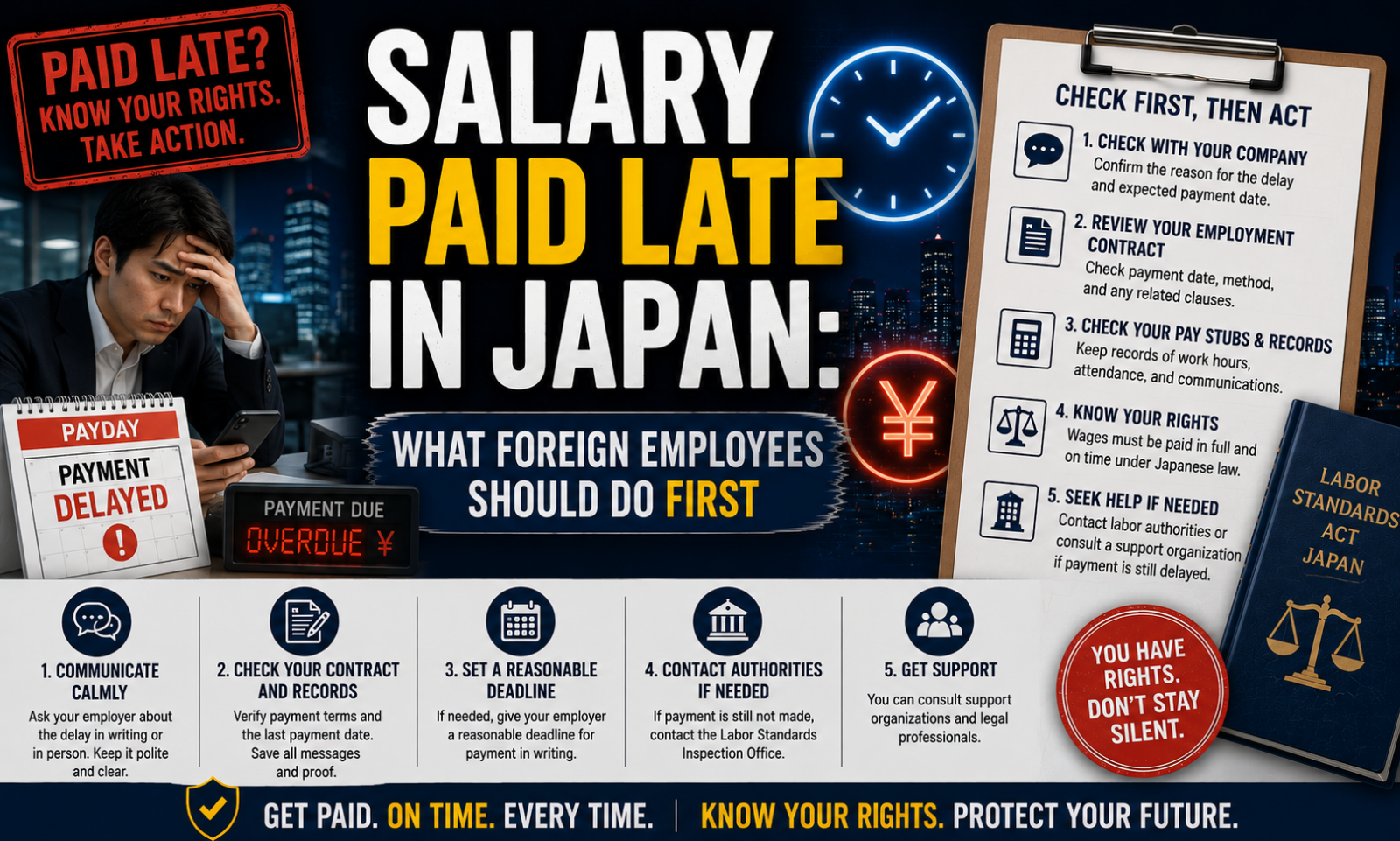
Salary Paid Late in Japan: What Foreign Employees Should Do First
If your salary is late in Japan, do not treat it as normal. Start by checking your contract and payday rule, then ask your employer in writing for the payment date. If the money still does not arrive, you can contact a Labour Standards Inspection Office or a Ministry of Health, Labour and Welfare consultation service.
Under Japan’s Labor Standards Act, wages must be paid in full, directly to the worker, at least once a month, on a fixed date. That is the basic rule. For foreign employees, the practical issue is speed: the longer you wait, the harder it becomes to sort out records, rent payments, and tax or insurance deductions.
- A late salary after the stated payday is a labor problem, not just bad office communication.
- Employees in Japan are broadly protected by labor rules regardless of nationality.
- Your first job is to save evidence: contract, payslips, timesheets, bank records, and messages.
- As of April 2026, the MHLW still lists multilingual labor consultation lines for foreign workers.
Who This Guide Is For
This guide is for foreign employees in Japan who receive wages from a company, school, shop, factory, restaurant, or other employer.
It matters most if you are:
- a full-time employee
- a part-time or hourly worker
- on a fixed-term contract
- new to Japan and unsure which office handles wage problems
If you are working as an independent contractor and sending invoices instead of receiving wages as an employee, the route can be different. In that case, the Labor Standards Act may not fit your situation in the same way, so confirm your contract status carefully.
The Basic Rule on Payday in Japan
Japan’s Labor Standards Act sets a simple wage rule. In general, an employer must pay wages:
- in currency or by an approved reliable payment method
- directly to the worker
- in full, except for lawful deductions
- at least once a month
- on a fixed payday
That point matters because many workers assume a small delay is automatically acceptable. It is not. If your contract says the 25th, the company needs a lawful, clear basis for paying on a different day.
ここがポイント: If payday has passed and your salary is not in your account, start creating a written record immediately. A calm email sent on the same day is often the most useful first step.
If you already left the company, another rule becomes important. When a worker leaves and requests wages or other money owed, the employer must generally pay within seven days, except for any disputed portion.
What To Do on the Same Day Your Salary Is Late
Start with the fastest checks before the dispute grows.
1. Confirm the official payday rule
Check:
- your employment contract
- the written notice of working conditions
- company work rules or payroll notice
- whether the stated payday fell on a bank holiday or weekend
Some employers set a rule such as “the previous business day” or “the next business day” when the normal payday is not a banking day. Do not guess. Read the document.
2. Check your bank record
Take a screenshot of:
- the missing deposit
- the date
- your account name if visible
This sounds small, but it helps fix later arguments about timing.
3. Ask the employer in writing
Contact payroll, HR, or your manager by email or message, not only by phone.
Keep it short and factual:
- state your name
- state the scheduled payday
- state that payment has not arrived
- ask when the salary will be paid
- ask for a written reply
A written answer often tells you what kind of case you have. If the company says it is a bank processing issue, that is different from “cash flow is tight” or “we will pay everyone later.”
What Evidence To Collect Before You Ask for Outside Help
Do not wait until the company stops replying.
Collect these items early:
- employment contract or offer letter
- written notice of working conditions
- payslips from past months
- attendance records, shift records, or timesheets
- bank statements showing normal payments and the missing payment
- emails, chat logs, or messages with HR or managers
- any notice about salary cuts, delayed payment, or temporary closure
If overtime is also unpaid, keep that evidence separate. A late base salary case can become an unpaid overtime case very quickly, and clear records help the labor office understand the difference.
Where Foreign Workers Can Get Help
Japan has more than one labor consultation route. The best choice depends on whether you want quick guidance, a formal complaint path, or language help.
Labour Standards Inspection Office
For unpaid wages and labor conditions, the MHLW’s English contact guidance points workers to the nearest Labour Standards Inspection Office.
This is usually the right place when:
- payday has passed and wages are still unpaid
- the company keeps delaying with no clear payment date
- only part of your salary was paid
- final wages were not paid after you left
Bring your documents. The office can explain the next step and, where appropriate, handle matters involving possible Labor Standards Act violations.
Comprehensive Labor Consultation Corner
If the problem is mixed with harassment, pressure to resign, or a wider workplace dispute, the Comprehensive Labor Consultation Corner can be useful.
According to the MHLW, these corners:
- accept workplace consultations for many types of labor trouble
- are free to use
- do not require a reservation
- can connect cases involving suspected legal violations to the proper office
- can also guide people toward advice, instruction, or conciliation procedures
That matters when your late salary problem is not just payroll delay, but part of a bigger breakdown at work.
Multilingual phone help
As of April 2026, the MHLW lists two useful foreign-language options:
- Telephone Consultation Service for Foreign Workers: English
0570-001-701, Monday to Friday, 10:00 a.m. to 3:00 p.m. with a break from noon to 1:00 p.m. - Labour Standards Advice Hotline: English
0120-531-401, Monday to Friday 5:00 p.m. to 10:00 p.m., and weekends and holidays 9:00 a.m. to 9:00 p.m.
The first is useful during weekday hours. The second is especially useful if your payday problem becomes urgent at night or on a weekend.
If the Company Says It Cannot Pay
This is the point where many workers make a mistake. They hear “please wait one more week” and stop recording events.
If the employer says payment is delayed because of business trouble, treat that as a warning sign.
Check these points:
- Is this the first delay, or have there been repeated late payments?
- Has only your team been affected, or all workers?
- Is the company still paying expenses, bonuses, or suppliers while wages are delayed?
- Are you being pushed to resign before payment is made?
A company cash problem does not erase wage obligations.
If the employer later collapses and you leave with unpaid wages, Japan has an unpaid wage substitution system for some bankruptcy-related cases. The MHLW says this system can pay 80% of eligible unpaid wages, subject to conditions and age-based caps. It is not for every late-pay case, but it matters if the company is effectively failing.
The same MHLW guidance says foreign nationals can be covered if they were workers and meet the scheme’s conditions. Nationality itself does not block access.
Common Mistakes To Avoid
Late salary cases often get worse because workers try to be patient for too long.
Avoid these mistakes:
- relying only on verbal promises
- failing to save bank records and payslips
- mixing wage issues with private loans to the company or manager
- resigning immediately without first saving evidence
- assuming foreign workers have weaker wage rights than Japanese workers
- waiting until several pay cycles pass before contacting an official office
Another common mistake is accepting a vague answer like “accounting is processing it.” Ask for a concrete payment date.
Regional and Workplace Differences
The core wage rule is national, but the practical route can still vary.
Differences you may see include:
- consultation language availability by prefecture or day of the week
- local office handling depending on where your workplace is registered
- company-specific payday rules when payday falls on a non-banking day
- different records for hourly workers, shift workers, and monthly salaried staff
So the law is national, but your quickest help point may be a local labor bureau, a local Labour Standards Inspection Office, or a prefecture-specific foreign worker desk.
Current Status To Check Now
For this topic, the most useful current update is not a new law. It is whether the official support channels are active and in which languages.
As of April 2026:
- the MHLW foreign worker consultation page still lists multilingual daytime consultation lines
- the Labour Standards Advice Hotline still lists evening and weekend multilingual support
- the MHLW still directs workers with unpaid wage questions to the nearest Labour Standards Inspection Office
Before you call, check the latest office page for your area in case language days or hours have changed.
Practical Takeaway
If your salary is late in Japan, move in this order:
- confirm the payday rule
- save your bank and work records
- ask the employer in writing the same day
- contact the labor office quickly if payment does not arrive
A one-day payroll mistake can be fixed. Repeated delay, silence, or excuses about cash flow are different. That is the point where you should stop waiting politely and start using Japan’s official labor channels.
参照リンク
- Japanese Law Translation: Labor Standards Act
- MHLW Contact: unpaid wages and labor conditions
- MHLW Comprehensive Labor Consultation Corner
- MHLW Counseling Services and Hotlines in Foreign Languages
- MHLW Labour Standards Advice Hotline
- MHLW Working Conditions Handbook for Foreign Workers
- MHLW Unpaid Wages Substitution System overview
- MHLW FAQ: how much the unpaid wage substitution system pays
- MHLW FAQ: foreign nationals can be covered by the unpaid wage substitution system