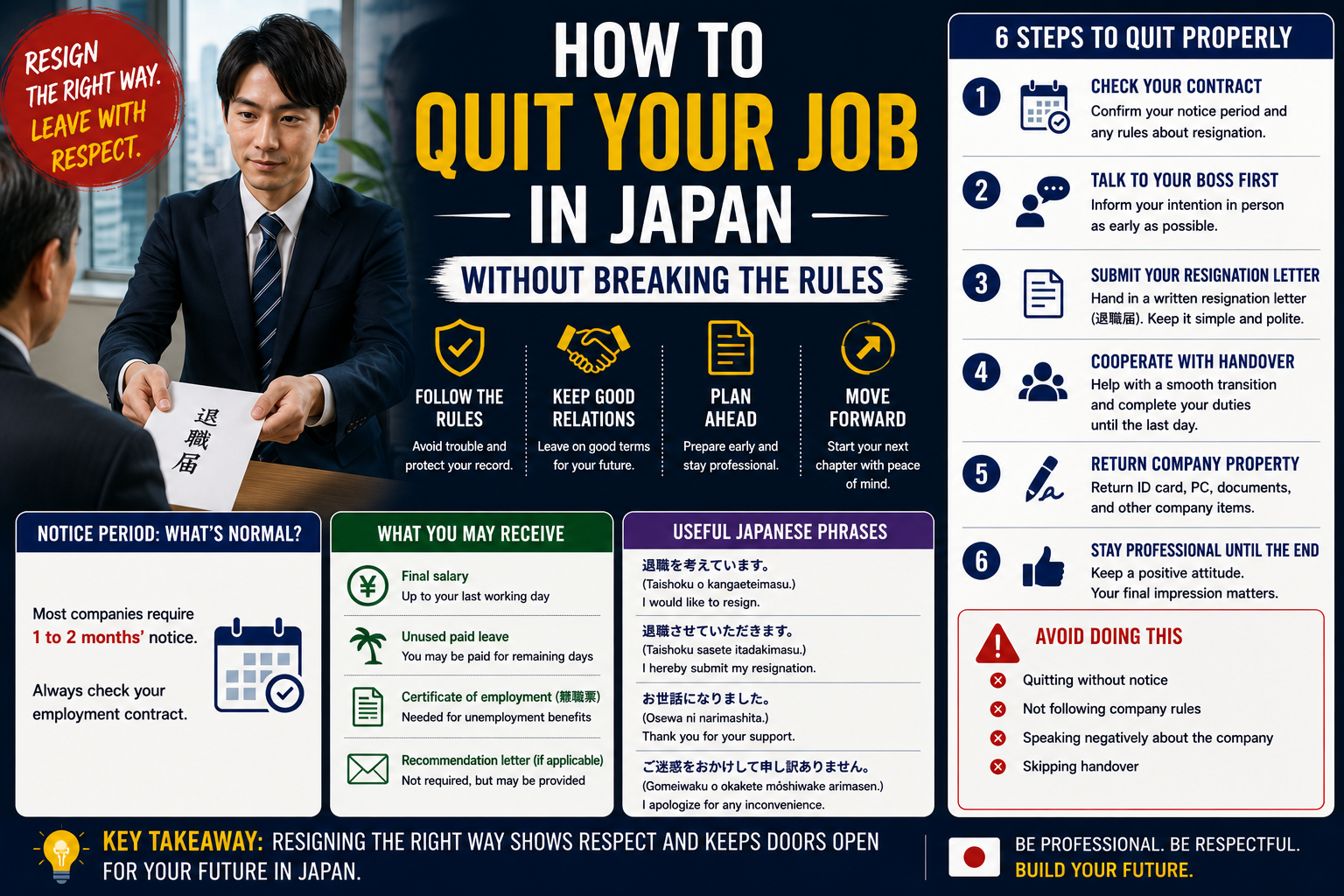
Quitting a Job in Japan: The Rules Foreign Workers Need to Check First
If you want to quit your job in Japan, the first question is not how upset your manager may be. It is what kind of contract you have and what visa status you hold.
For many workers on an open-ended contract, Japanese law allows resignation with notice. But fixed-term contracts, work visa conditions, pension and insurance changes, and immigration reporting can turn a simple resignation into a bigger problem if you ignore them.
- Open-ended employment: in general, either side can end it with notice, and the Civil Code says employment ends two weeks after the notice.
- Fixed-term employment: quitting early is harder. Different rules apply, and “I just want to leave” is not always enough by itself.
- Work visa holders: leaving a company can trigger immigration reporting within 14 days.
- After your last day: your pension, health insurance, and possible unemployment benefit steps change quickly.
Who this guide is for
This guide is for foreign workers in Japan who are thinking about resigning, changing jobs, or leaving Japan after employment ends.
It matters most if you are on a work-related status of residence such as Engineer/Specialist in Humanities/International Services, Instructor, Skilled Labor, Specified Skilled Worker, or another status tied to the kind of activity you can do in Japan.
The rule to check first: open-ended or fixed-term?
Before writing a resignation letter, read your contract.
If you have an open-ended contract
Japan’s Civil Code says that when the parties did not set a term of employment, either party may give notice of termination at any time, and the employment ends two weeks after the notice.
That does not mean every company rule disappears. Your employer may ask for a longer handover period under company practice, and many employees give more notice to avoid conflict. But the legal baseline for an open-ended contract is important because some foreign workers are incorrectly told that they “cannot quit” until the company approves it.
If you have a fixed-term contract
A fixed-term contract is more restrictive. The Civil Code allows immediate cancellation only for a compelling reason, and the Labor Contracts Act also treats fixed-term employment differently.
In practice, this means you should assume the contract term matters unless one of these applies:
- you and the employer agree to end the contract early
- you have a serious reason that makes continuation difficult
- another legal rule or specific contract clause applies
If your contract has a clear start and end date, do not assume the standard two-week rule works the same way.
ここがポイント: The biggest mistake is using the wrong rule for the wrong contract. Check the contract term first, then plan your resignation.
If you are on a work visa, quitting is not only a company matter
For many foreign workers, the labor rule is only half the story. The other half is immigration.
The Immigration Services Agency requires many mid- to long-term residents to report when they leave an affiliated organization such as a company or school. The official rule says this notification is generally required within 14 days.
Why this matters:
- your residence card may still be valid, but that does not mean any new job is automatically allowed
- your next job must fit the activities permitted by your current status of residence
- if the job type changes, you may need a change of status instead of simply changing employers
A common example is Engineer/Specialist in Humanities/International Services. Changing employers is often possible, but your new duties still need to fit that status.
Specified Skilled Worker cases are stricter in some ways. The official support site says that if you change to a different company, you must change your status before starting work there, and changing to a different field is not permitted.
If you are unsure whether the new role matches your status, checking before you start is safer than explaining it later at renewal time.
What to do in order
Start with the basic sequence below.
1. Check your contract and company rules
Confirm these points first:
- whether your contract is open-ended or fixed-term
- your contract end date, if any
- any written notice procedure
- whether you still have paid leave to use
- whether you need to return company property, housing keys, ID cards, or equipment
2. Give notice in writing
A short written notice is easier to prove than a verbal conversation.
Keep copies of:
- your resignation notice
- your contract
- payslips
- work rules or handbook pages related to resignation
- any email or chat records if the company disputes your notice
3. Confirm what happens on and after your last day
Ask clearly about:
- your final salary date
- unused paid leave handling
- your separation documents
- your tax and social insurance paperwork
Do not leave this vague. Many later problems start because the employee assumes the company will “send everything later.”
4. If you will stay in Japan, check immigration immediately
If you are changing jobs and staying in Japan:
- submit the required notification to Immigration within 14 days if your status requires it
- confirm whether the new job matches your current status
- if needed, prepare a change of status application before starting the new work
5. If you will be unemployed, check pension and job-hunting support
The Japan Pension Service says that when you leave a job, your Employees’ Pension Insurance and Employees’ Health Insurance coverage ends. If you are age 20 to 59 and not immediately re-employed, you generally need to move into National Pension coverage.
If you paid employment insurance and meet the conditions, Hello Work is the office that handles unemployment benefit procedures.
6. If you will leave Japan, check your pension refund option
If you are not Japanese and leave Japan after a relatively short coverage period, you may be able to apply for a lump-sum withdrawal payment from the pension system. The Japan Pension Service says the application must be filed within two years after leaving Japan and only after you are no longer covered by the pension system.
Common mistakes foreign workers make
These are the errors that cause the most trouble.
Believing your boss must “approve” your resignation
Company approval and legal effect are not the same thing. For an open-ended contract, the legal rule is not simply “you can leave only if the company agrees.”
Ignoring your visa category because the residence card is still valid
Your expiry date is not the whole rule. Immigration looks at the activity you are permitted to do, not only the card’s printed end date.
Waiting too long to report a job change or resignation to Immigration
The 14-day reporting rule is short. Missing it can create problems later, especially at renewal.
Assuming insurance and pension continue automatically
They do not. Once employment ends, your enrollment path may change right away.
Leaving Japan without checking pension refund timing
Some workers learn too late that the lump-sum withdrawal payment has a deadline after departure.
What if the company will not cooperate?
If your employer refuses to discuss resignation properly, withholds documents, or you suspect illegal treatment, use an official consultation channel early.
The Ministry of Health, Labour and Welfare provides:
- a multilingual Telephone Consultation Service for Foreign Workers
- the Labour Standards Advice Hotline
- labor standards information pages and consultation offices
These services matter because many disputes are not really about “quitting.” They are about unpaid wages, pressure tactics, forced signatures, or confusion over what the contract actually says.
Current practical point as of May 8, 2026
The core rules foreign workers need are still the same: contract type first, immigration reporting second, and pension or unemployment paperwork third.
What has become easier is access to official support. Immigration’s living and working guidebook was updated in 2026, and Hello Work’s internet service was renewed in March 2026. That does not change the legal deadlines, but it does make it easier to check the process before a small mistake becomes a visa or income problem.
Final checklist before you quit
- Read your contract and identify whether it is open-ended or fixed-term.
- Give written notice and keep proof.
- Check whether your status of residence requires a 14-day notification.
- Confirm whether your next job matches your current visa category.
- Arrange pension, health insurance, and Hello Work steps right after your last day.
- If you plan to leave Japan, check whether you qualify for the pension lump-sum withdrawal payment.
If you do only one thing today, do this: do not resign first and research later. In Japan, the difference between a smooth exit and a damaging one is often just a few documents and a missed deadline.
参照リンク
- Japanese Law Translation: Civil Code
- Japanese Law Translation: Labor Contracts Act
- Ministry of Health, Labour and Welfare: Labour Standards
- MHLW: Counseling Services and Hotlines in Foreign Languages for Foreign Workers
- MHLW: Labour Standards Advice Hotline
- Immigration Services Agency: Notification Concerning the Affiliated Organization
- Immigration Services Agency: Procedures by Type
- Immigration Services Agency: Steps to Working in Japan for Specified Skilled Worker
- Immigration Services Agency: Living and Working Guidebook Portal
- Japan Pension Service: Employment / Job Change / Retirement
- Japan Pension Service: Enrollment in National Pension
- Japan Pension Service: Lump-sum Withdrawal Payments
- Ministry of Health, Labour and Welfare: Employment Insurance System for Foreigners
- Hello Work Internet Service