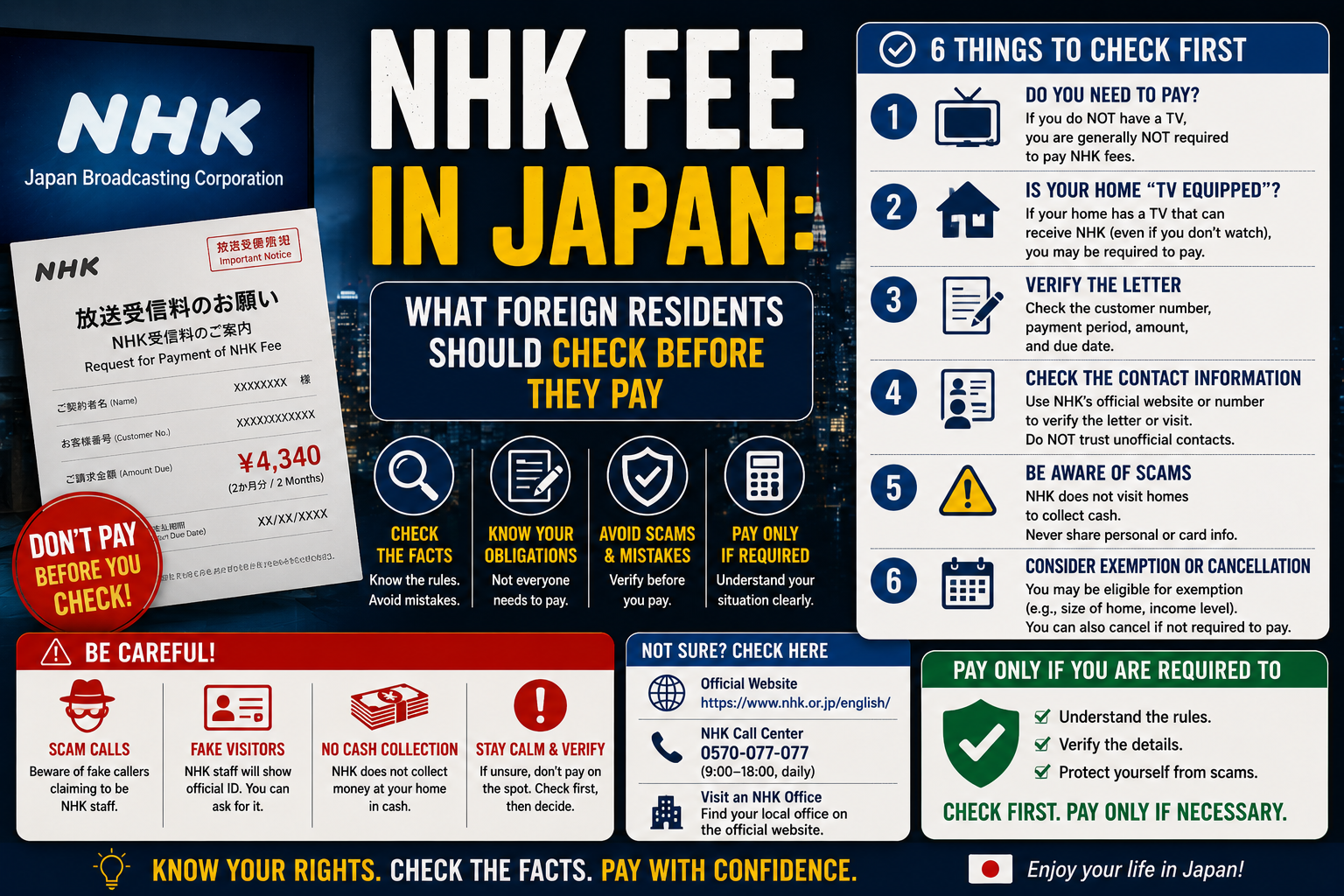
NHK Fee in Japan: What Foreign Residents Should Check Before They Pay
If you live in Japan and have a TV or another device that can receive NHK broadcasts, you usually need an NHK receiving contract. As of May 8, 2026, this can also apply if you start using NHK ONE without owning a TV. But owning a normal smartphone or laptop by itself does not create a fee.
This matters most for new residents, students moving into their first apartment, and workers who just signed a lease and are being asked about NHK at the door or by mail.
- You need to check the device first. A TV, TV tuner PC, One-Seg phone, or car navigation system with a TV tuner can trigger the contract.
- Internet-only rules changed the practical answer. If you start using NHK ONE, that can require a terrestrial contract even without a TV.
- The rule is national, not local. The main regional difference is price in Okinawa.
- Do not panic at the door. You can verify the visitor, use the official NHK site, and avoid paying anyone you cannot confirm.
Who this guide is for
This guide is for:
- foreign students in dorms or private apartments
- workers moving into company housing or furnished rentals
- long-term residents who received an NHK letter or visit
- beginners who are not sure whether their phone, TV, or streaming use counts
If you are only visiting Japan short term and staying in hotels, this usually is not your issue. It matters when you set up a home, keep a TV-capable device, or start a covered NHK online service yourself.
When an NHK contract is required
The basic rule comes from Article 64 of Japan’s Broadcasting Act. NHK and the law now treat two situations as the trigger:
- installing equipment that can receive NHK broadcasts
- starting to receive NHK’s covered online distribution service
In plain English, that means you should check whether you have any of these:
- a TV
- a PC with a TV tuner
- a smartphone with One-Seg or similar TV reception
- a car navigation system with a TV tuner
- use of NHK ONE in a way that starts covered reception
A few points are easy to miss.
- A radio alone does not require a contract.
- A normal smartphone or laptop alone does not require a contract. NHK says ownership by itself is not enough.
- NHK WORLD-JAPAN does not require a receiving contract.
- If your household already has an NHK contract, NHK says no separate extra contract or extra fee is needed just because you also use NHK’s domestic online service.
ここがポイント: The first question is not “Do I watch NHK?” It is “Do I have a device or service that legally counts?”
How much the NHK fee is in 2026
NHK’s current standard fees shown on its official fee site are:
- Terrestrial contract: 2,200 yen every 2 months, 6,309 yen for 6 months, or 12,276 yen for 12 months
- Satellite contract: 3,900 yen every 2 months, 11,186 yen for 6 months, or 21,765 yen for 12 months
NHK also says:
- Okinawa has different lower rates
- 6-month and 12-month payment plans include a discount compared with paying every 2 months
- if you use only the covered online service and do not own a TV, the contract is treated as a terrestrial contract
That last point is the part many older guides miss.
Terrestrial or satellite?
A terrestrial contract is for people who:
- have a TV that receives terrestrial broadcasts only
- start using the covered NHK online service without a TV
A satellite contract is for people who:
- have a TV or device that can receive NHK satellite broadcasts
This matters in practice because some furnished apartments, family homes, and buildings with built-in BS reception push you into the higher category. If your TV can receive satellite service, NHK treats that differently from a basic terrestrial-only setup.
What to do if an NHK representative visits your home
NHK says it still uses in-person visits, in addition to mail and phone, to explain contracts and request payment where needed. It also says its visiting staff carry identification.
If someone comes to your door, the practical steps are simple:
- ask to see identification
- do not hand over cash or personal information just because someone says “NHK”
- check your device situation before you answer
- use the official NHK reception fee site for any application, address change, or payment
- if you need English guidance, use NHK’s multilingual page or call the toll-free number listed there
As of May 8, 2026, NHK’s reception fee portal is also displaying a warning about fake visits, calls, emails, SNS messages, and videos using NHK’s name. That matters because a real question about NHK fees and a scam can look similar at first.
Common real-life situations
You moved into a furnished apartment with a TV
Check the TV, not just the rent contract. If the apartment includes a working TV or another covered device, you may need a contract unless someone in the same household already covers it under the applicable rules.
You only have a phone and laptop
Usually there is no contract just because you own those devices. The exception is when the phone has One-Seg reception or when you start using the covered NHK online service. Many people hear “smartphone” and assume the fee always applies. NHK’s own English page says that is not true.
You are a student living away from your family
This is where the family discount matters. NHK says the second contract can be reduced by half in cases such as students living separately but still in the same household budget. It is not automatic for every student, so check the eligibility rules instead of assuming you are fully exempt.
You already pay at another home
The law and NHK’s contract rules are based on household and residence rules, not simply on your name appearing once somewhere. If you are keeping two homes, supporting a student household, or sharing costs with family, check whether the family discount applies rather than ignoring the second address.
You are leaving Japan or getting rid of the device
Do not just stop paying. NHK says you should contact it to cancel the contract if you leave Japan or stop owning the relevant device, and it says the fee stops from the month after cancellation.
Common mistakes to avoid
A lot of NHK problems come from small assumptions.
- thinking nationality changes the rule
- thinking “I never watch NHK” is the legal test
- forgetting that a car navigation unit or One-Seg device can count
- assuming a BS-capable TV is charged at the lower terrestrial level
- ignoring letters after moving house instead of updating the address
- assuming student life always means free or exempt
- cancelling your apartment lease but forgetting to cancel NHK separately if needed
The latest change that matters most
The biggest practical change for foreign residents is that internet-only use is now part of the NHK contract system. Older advice often focused only on TVs. That is no longer enough.
Under the current law version published in the Japanese Law Translation database, Article 64 covers both:
- installing specified receiving equipment
- beginning to receive the specified compulsory online distribution
NHK’s current English guidance matches that legal change and points users to NHK ONE. So if you are reading an older blog post that says “No TV means no NHK fee,” treat it as outdated unless it also explains the NHK ONE rule.
What foreign residents should do next
If you get an NHK question this week, work in this order:
- Check whether you actually have a covered device or started a covered NHK online service.
- Check whether your home already has a contract.
- Check whether the device is terrestrial-only or satellite-capable.
- If a visitor comes, verify ID and use the official NHK site before paying or submitting details.
- If you move out, replace the device, or leave Japan, handle cancellation directly instead of assuming it ends automatically.
That sequence usually solves the confusion faster than arguing about whether you personally watch the channel. For most residents, the real risk is not the fee itself. It is misunderstanding what counts, paying the wrong person, or forgetting to update or cancel the contract when your living situation changes.