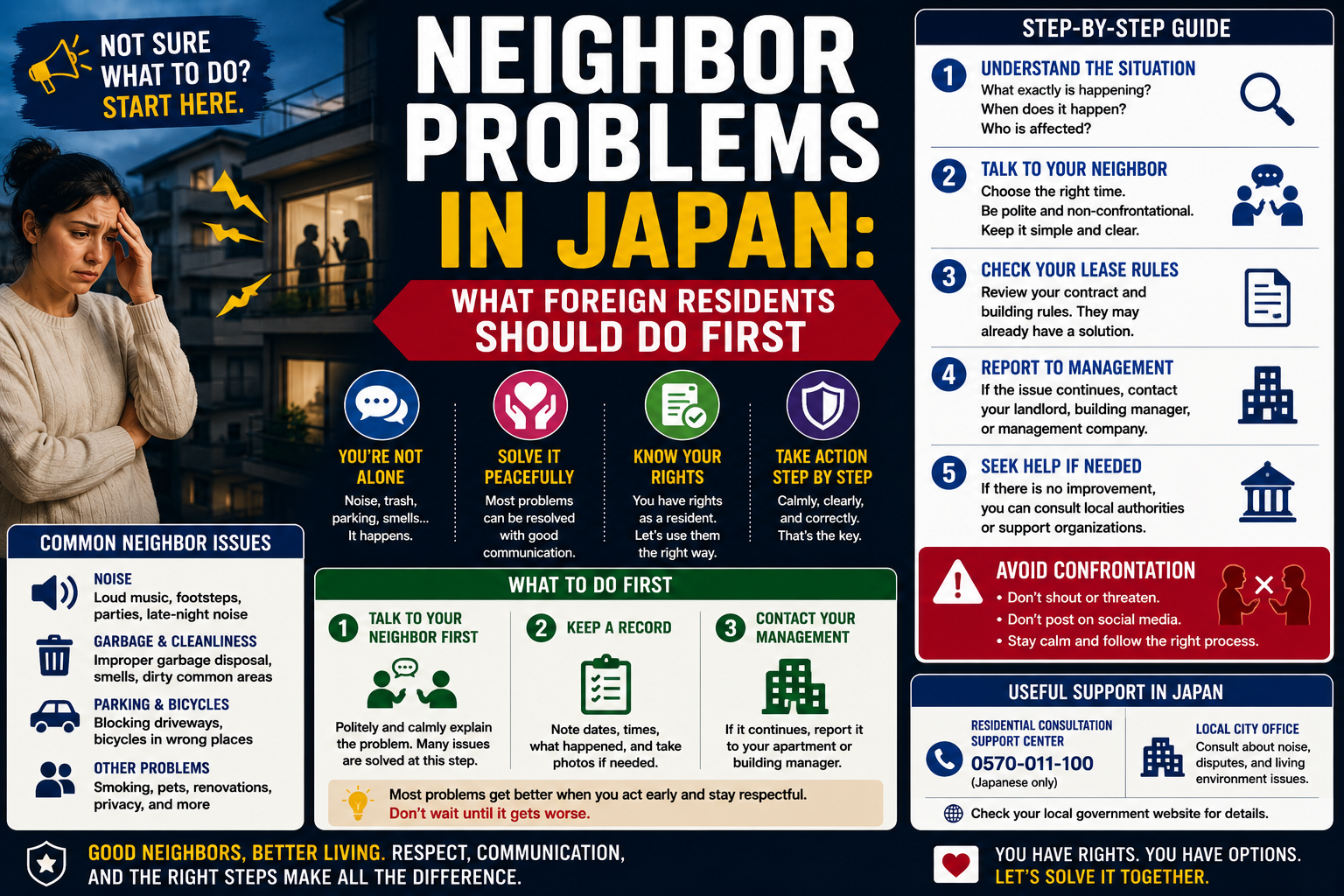
Neighbor Problems in Japan: What Foreign Residents Should Do First
If you have trouble with a neighbor in Japan, start with the safest channel, not the loudest reaction. For most cases, that means documenting the problem and contacting your landlord or building management first. If there is violence, threats, stalking, or immediate danger, call 110. If it is serious but not an emergency, use the police consultation line #9110 or your local police station.
This guide is for foreign residents, students, workers, and long-term renters who need a practical path through noise complaints, trash disputes, harassment, shared-space problems, or repeated trouble in an apartment building or neighborhood.
- Use
110for emergencies and immediate danger. - Use
#9110for non-emergency police consultation. - Use your landlord or management company first for apartment rule problems.
- Use multilingual human rights or legal support if the issue includes harassment, discrimination, or a dispute that will not settle.
Start by sorting the problem correctly
Not every neighbor problem should go to the same place. The first step is to identify what kind of trouble you are dealing with.
Usually start with landlord or building management
This is usually the best first move when the issue is about building rules or everyday living:
- loud music, TV, or repeated late-night noise
- garbage put out on the wrong day or in the wrong place
- smoking smells from shared areas or prohibited spaces
- bicycles, personal items, or trash blocking common areas
- repeated rule-breaking in apartment halls, stairs, or shared entrances
In many Japanese rentals, the management company is expected to contact residents and remind them of building rules. That matters because a direct confrontation can make a small issue more personal.
Go to police immediately when safety is involved
Call 110 if there is:
- violence or threats of violence
- stalking or following
- someone trying to enter your room or house
- property damage happening now
- a fight, emergency, or situation where you need officers to come quickly
The National Police Agency says 110 is for emergencies, while non-urgent safety concerns should go to #9110 or the nearest police station.
Use consultation channels when the issue is harassment or discrimination
If the trouble includes abuse, intimidation, or discrimination because you are a foreigner, do not treat it as only a “bad neighbor” problem. The Ministry of Justice runs a Foreign-language Human Rights Hotline: 0570-090-911 and also accepts online consultations.
That route can matter when the problem is not just noise, but repeated targeting, abusive language, or discriminatory treatment.
ここがポイント: In Japan, neighbor trouble is usually solved through the right channel for the type of problem: building management for rule issues,
110for emergencies,#9110for non-emergency police concerns, and human rights or legal support when the issue becomes harassment or discrimination.
What to do first in practice
A calm first response usually works better than an emotional one.
1. Record the facts
Write down:
- date and time
- what happened
- how long it lasted
- where it happened
- whether you have photos, audio, or messages
- whether anyone else saw or heard it
Keep the notes simple. A management company or consultation desk can act faster when you give a clean timeline instead of a general complaint like “my neighbor is always noisy.”
2. Check your lease, house rules, or posted building notices
Some disputes are really rule disputes. Garbage collection rules, quiet-hour expectations, smoking rules, pet rules, and use of common areas can vary by building, condominium association, or municipality.
That local difference matters. A problem that is treated as a building-rule issue in one place may be handled more strictly in another.
3. Contact management in writing
Email is often better than a phone call because it leaves a record. Ask for a neutral action such as:
- a warning notice to residents
- a reminder about garbage or noise rules
- a check of building camera footage if relevant
- guidance on the next step if the issue continues
If you only call once and leave no record, it becomes harder to show that the problem is ongoing.
4. Escalate if the problem continues
Move to the next channel when:
- the behavior repeats after warnings
- the problem becomes threatening
- management refuses to respond at all
- the issue shifts from inconvenience to harassment or safety
At that point, #9110, a human rights consultation desk, or legal guidance may be more useful than another informal complaint.
When to use #9110 instead of 110
Many foreign residents know 110, but fewer know #9110. That matters because neighbor trouble often falls into the non-emergency category.
The police consultation line is for cases where a crime or accident is not happening right now, but you still need advice about safety, harassment, or trouble in your immediate environment.
In Tokyo, the Metropolitan Police Department says #9110 connects to the General Advisory Center. It also publishes 03-3501-0110 and states that support is available in Japanese, English, Chinese, and Korean.
Use this route when, for example:
- a neighbor is repeatedly banging on your door but has left
- someone is harassing you in shared spaces
- you feel unsafe and want advice before the situation gets worse
- you are not sure whether the conduct is serious enough for
110
If the issue is tied to being a foreigner
Some neighbor disputes are really about noise or garbage. Others are not.
If a neighbor repeatedly insults you because of your nationality, pressures you to leave because you are a foreigner, or targets your family or children, that moves beyond ordinary apartment friction.
The Ministry of Justice says its human rights counseling for foreigners is available in multiple languages. As of the currently available public guidance, the hotline supports languages including English, Chinese, Korean, Filipino, Portuguese, Vietnamese, Nepali, Spanish, Indonesian, and Thai on weekdays.
You can also file an online consultation through the ministry’s human rights counseling service.
If you need legal guidance
When the problem turns into a legal dispute, Japan’s public legal support system can at least point you in the right direction.
Houterasu offers a Multilingual Information Service at 0570-078377. It provides general information on the Japanese legal system and can refer people to relevant consultation services. For people with financial difficulty, it also explains civil legal aid options.
This can be useful when:
- management is ignoring a serious ongoing problem
- the dispute now includes damage claims or repeated harassment
- you are being pushed into signing documents you do not understand
- you think the issue may affect your tenancy or legal position
Rental housing issues: Tokyo has extra guidance
If your problem is connected to a rental contract, repairs, restoration, or management responsibility, Tokyo has an English version of its Guidelines for Preventing Tenant-Landlord Disputes.
That guide is Tokyo-specific, not a national rulebook. Still, it is useful because it shows how Japanese housing disputes are often separated into:
- tenant responsibilities
- landlord responsibilities
- repairs during tenancy
- contract explanations and dispute prevention
If you live outside Tokyo, the exact office and rules may differ, but the basic lesson still helps: check whether the issue is really a neighbor problem, a management problem, or a lease problem.
Common mistakes that make neighbor trouble worse
Direct confrontation at the wrong time
Knocking on a neighbor’s door late at night after you are already angry can escalate the situation fast. If you do speak directly, keep it short, calm, and safe. If you feel uneasy, skip the direct approach and use management instead.
Complaining without records
A vague complaint is easy to ignore. A dated log is harder to dismiss.
Assuming police will solve every noise issue
Police can respond to safety concerns, threats, and some disruptive conduct. But they do not replace your landlord, building manager, or civil legal process.
Stopping rent on your own
Do not withhold rent just because management handled your complaint badly unless you have received proper legal advice. That can create a second problem for you.
Posting the dispute online
Public accusations on social media can backfire, especially if you identify the other person or building.
Regional differences to expect
There is no single national “neighbor dispute procedure” for daily-life problems.
What changes by area or building:
- garbage sorting and collection rules
- condominium or apartment house rules
- local foreign-resident consultation services
- police language support by prefecture
- how active the management company is
Tokyo is easier than many areas for multilingual consultation because the Tokyo Metropolitan Government runs the Foreign Residents’ Advisory Center. Other prefectures may route foreign residents to international associations, municipal consultation counters, or local one-stop support centers listed by the National Consumer Affairs Center of Japan.
Current support channels worth knowing
As of May 8, 2026, the most useful public channels for this issue are still straightforward:
- 110 for emergencies
- #9110 for non-emergency police consultation
- 0570-090-911 for foreign-language human rights counseling
- 0570-078377 for Houterasu multilingual legal information
- your landlord or management company for ordinary apartment-rule issues
If you live in Tokyo, the Foreign Residents’ Advisory Center can also help with everyday consultation in English and some other languages.
Final takeaway
The biggest mistake is treating every neighbor problem the same way. In Japan, the fastest solution usually comes from choosing the right lane early.
For noise, garbage, and shared-space trouble, start with records and management. For fear, threats, or immediate danger, use 110. For ongoing safety concerns, use #9110. If the problem includes discrimination or serious harassment, move quickly to a human rights or legal consultation desk instead of waiting for it to calm down by itself.
Before the next incident happens, save the right numbers in your phone and keep one written timeline. That small step often makes the difference between a complaint that goes nowhere and one that gets handled.
参照リンク
- National Police Agency: Opinions, consultation, and information contact page
- Tokyo Metropolitan Police Department: Help hotline information
- Tokyo Metropolitan Police Department: Police consultation dial #9110
- Ministry of Justice: Human Rights Counseling for Foreigners
- Ministry of Justice: Human Rights Counseling on the Internet
- Ministry of Justice: Human Rights Counseling for Foreign Nationals
- Houterasu: Multilingual Information Service
- Tokyo Metropolitan Government: Foreign Residents’ Advisory Center
- Tokyo Metropolitan Government: Guidelines for Preventing Tenant-Landlord Disputes
- National Consumer Affairs Center of Japan: Consultation Services