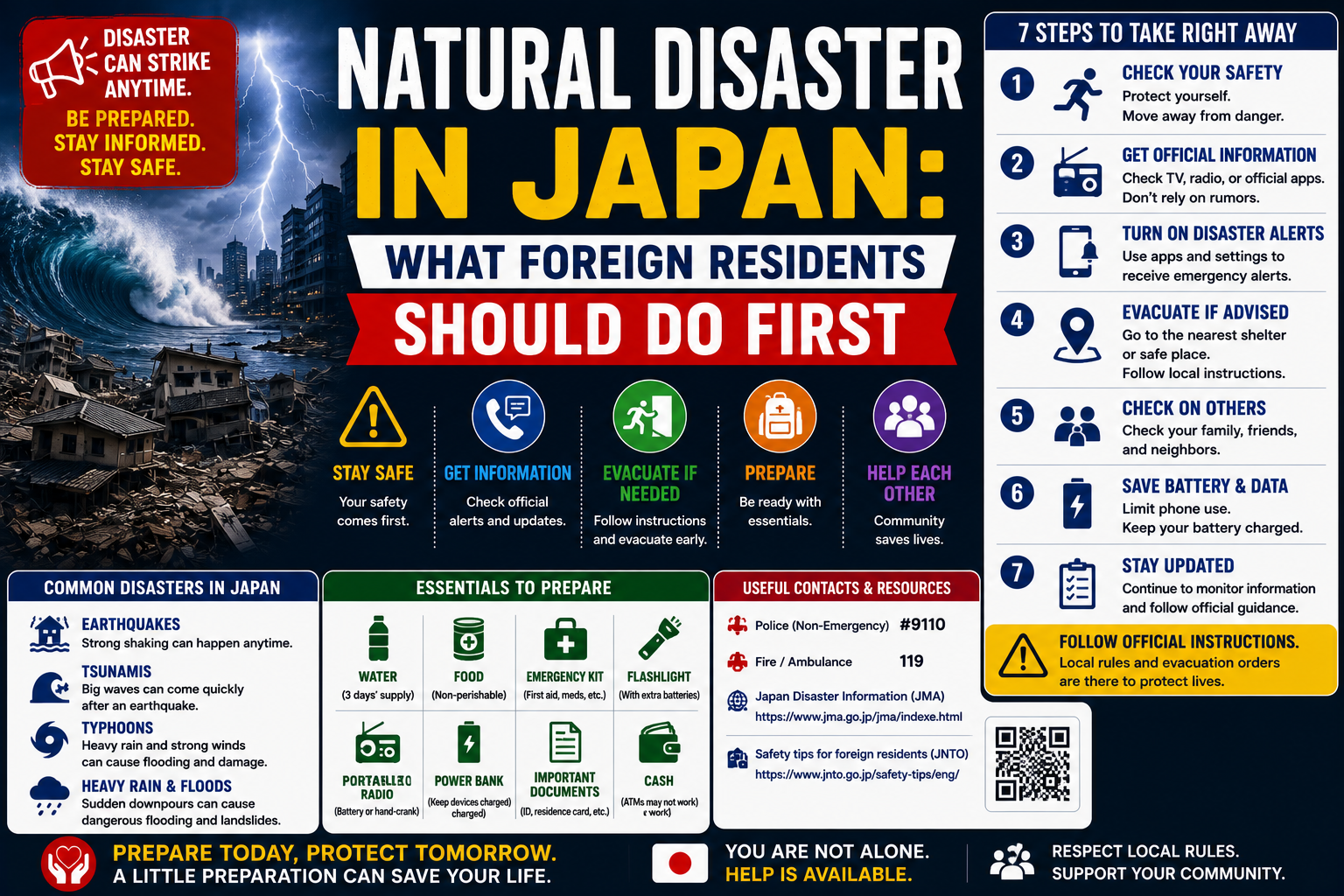
Natural Disaster in Japan: What Foreign Residents Should Do First
If a natural disaster hits while you are living in Japan, your first job is not to understand every alert perfectly. It is to protect your body, move away from the immediate danger, and then follow official local information.
In practice, that means three things. During an earthquake, protect your head and stay away from falling glass. During a tsunami or flood risk, leave dangerous low areas early. During a major weather alert or municipal evacuation order, do not wait for conditions to become obvious outside your window.
- Earthquake: Drop low, protect your head, and stay clear of shelves, windows, and hanging objects.
- Tsunami or coastal risk: Go to high ground or a designated tsunami evacuation building immediately.
- Heavy rain, flood, landslide, typhoon: Check your city’s evacuation information and leave risky areas early.
- If phone lines are congested: Use disaster message services such as
171or web-based safety tools instead of repeatedly calling.
Who This Guide Is For
This guide is for foreign residents in Japan, especially students, workers, and people in their first years here.
It matters most if you live in an apartment, dorm, share house, or company housing and you are not yet used to Japanese hazard maps, evacuation wording, or local alerts.
The First 30 Minutes: What To Do Right Away
The correct first move depends on the kind of disaster. Japan uses one alert system, but the danger is not the same in every case.
If an earthquake starts
Do this first:
- Protect your head with your arms, a bag, or a cushion.
- Move away from windows, tall furniture, mirrors, and kitchen shelves.
- Do not run outside immediately while things are still shaking.
- If you are using a stove or heater and it is safe to do so, turn it off after the shaking eases.
- Open a door only if you can do it safely, so you do not get trapped.
If you are outside, stay away from walls, signs, power lines, and glass.
If you are on a train, follow staff instructions. Trains may stop suddenly because Japan’s earthquake warning system is also used to slow trains and control other infrastructure.
If there is a tsunami risk
This is the most important rule: do not go to the coast to check the sea.
The Japan Meteorological Agency says to evacuate immediately to high ground or a tall building designated as an evacuation site when a tsunami warning is issued. River mouths and riverside areas can also be dangerous, not only beaches.
Stay there until the warning is lifted. Tsunami waves can come more than once.
If heavy rain, flood, or landslide risk is rising
This is where many foreign residents lose time. They wait until the street is already flooded or until the rain looks severe enough.
That is too late.
If your ward, city, or town starts issuing evacuation information for your area, check whether your home is in a flood, landslide, or storm-surge risk zone on the local hazard map. If it is, prepare to leave before roads become hard to use.
People on the ground floor, near small rivers, near steep slopes, or in low coastal zones need to move earlier than people on higher, safer ground.
ここがポイント: In Japan, the dangerous moment often arrives before the situation looks dramatic from inside your room.
How Disaster Alerts Work in Japan
You do not need to memorize every term, but you should know who issues what.
National alerts: weather, earthquake, tsunami, volcano
The Japan Meteorological Agency, or JMA, issues earthquake early warnings, tsunami warnings, weather warnings, and emergency warnings.
JMA’s Emergency Warning is for extraordinary danger. It is not the normal starting point for action. JMA explicitly says people should not relax just because an Emergency Warning has not been issued. Ordinary warnings and advisories can still mean real danger.
That matters because some residents wait for the strongest possible wording. The safer habit is to react to risk early, not to the most dramatic label.
Municipal alerts: when your city tells you to evacuate
Your city, ward, town, or village issues evacuation information. That is the instruction most directly tied to your neighborhood.
Current official guidance is built around this simple idea:
- Alert Level 4: Evacuation Instruction means people in dangerous places should evacuate.
- Alert Level 5: Emergency Safety Measures means the danger is already extreme, and you may need to take the best possible action immediately where you are.
Do not wait for Level 5. Official guidance is clear on this point. In many disasters, moving at Level 4 is the safer choice because roads, elevators, and stairs may become dangerous later.
The Tools To Set Up Before You Need Them
A disaster plan in Japan is much easier if you prepare the information side first.
1. Install one official multilingual alert tool
As of April 2, 2026, the Japan Tourism Agency still lists Safety tips as an official disaster-information app supervised for foreign users. It can send push alerts for earthquake early warnings, tsunami warnings, and special weather warnings, and it supports 15 languages.
Even if you are not a tourist, it is useful because it reduces the language gap during the first minutes of a disaster.
2. Save one live information page
The JNTO Japan Safe Travel Information page shows current earthquake, tsunami, volcanic, emergency warning, and large-scale fire information in English.
That page is especially helpful when you want one screen that combines alerts and location-based information instead of checking several Japanese sites separately.
3. Check your municipality’s hazard map now
Hazard maps are not just for homeowners. They matter if you rent, live in a dorm, or plan to move.
Use the national hazard map portal and then confirm your municipality’s own map. This tells you whether your building sits in a flood zone, landslide zone, tsunami zone, or storm-surge risk area.
Regional differences matter here. A safe fifth-floor apartment in inland Saitama faces a different risk pattern from a ground-floor room near a river in Osaka or a coastal apartment in Shizuoka.
4. Decide where you would go
Know these places before anything happens:
- your nearest designated shelter or evacuation site
- one backup location if the first site is full or unreachable
- one safe contact point outside your immediate area
- the nearest convenience store or public building you can use as a temporary stop
5. Prepare for communication failure
After a large quake, mobile networks may be crowded.
Japan’s disaster message service 171 exists for that situation. Instead of repeatedly trying voice calls, you can record or play back a short safety message linked to a phone number in the affected area. NTT also provides web171 information online.
This matters for foreign residents because family, school staff, and employers often need one simple safety confirmation more than a long call.
What To Keep Ready at Home
You do not need an expensive survival setup. You need a small kit that helps for the first hours and first move.
Keep these together where you can grab them fast:
- phone charger and power bank
- passport or residence card copies
- health insurance card copy and regular medicines
- cash in small bills and coins
- drinking water and easy food
- flashlight
- basic mask, tissues, and wet wipes
- simple note with your address, building name, and emergency contacts
If you live with children, older relatives, or pets, your kit needs to reflect that. Municipal shelters and apartment rules can vary, so check local guidance in advance.
Common Mistakes Foreign Residents Make
Waiting because Japanese neighbors have not moved yet
Do not use other residents as your only signal. Some people know the area well. Others may be taking a different route, helping family, or simply making a bad decision.
Assuming every shelter works the same way
Shelter rules, opening times, pet handling, and available support can differ by municipality and facility.
Thinking earthquakes and typhoons require the same response
They do not.
- In an earthquake, the first seconds are about immediate physical protection.
- In a flood or landslide threat, the main decision is often whether to leave earlier than feels necessary.
- In a tsunami risk, speed and elevation matter most.
Calling repeatedly instead of leaving one safety message
After a major event, voice networks can be overloaded. A short recorded message or text-based update can work better.
Current Status and What Changed Matters Now
For foreign readers, the important current point is not a brand-new law. It is that Japan’s official multilingual disaster tools are now easier to use together than before.
As of May 8, 2026, these are the most practical official layers to rely on:
- JMA for the core warning itself
- your municipality for evacuation decisions in your exact area
- Safety tips and JNTO’s live English pages for multilingual access
- the national hazard map and local hazard maps for advance planning
The other point worth remembering is the evacuation wording. Japan’s current system centers on Level 4 evacuation instruction as the point to leave dangerous places, not on waiting for the most extreme level.
Final Takeaway
If a disaster hits while you are living in Japan, do the simple things first and do them early.
Protect yourself during shaking. Leave coastal or flood-risk areas before movement becomes dangerous. Follow your municipality’s evacuation information, not rumors or guesswork. Then check whether the tools on your phone are ready before the next alert arrives.
Before the next typhoon season or the next strong quake, check three things tonight:
- whether your address is in a hazard zone
- whether you have one multilingual alert source set up
- whether you already know where you would go on foot
References / 参照リンク
- Japan Meteorological Agency: Emergency Warning System
- Japan Meteorological Agency: Earthquake Early Warning System
- Japan Meteorological Agency: What is an Earthquake Early Warning?
- Japan Meteorological Agency: Examples of Response to an Earthquake Early Warning
- Japan Meteorological Agency: Limitations of the Earthquake Early Warning
- Cabinet Office Japan: Evacuation Information (Revised Version)
- Cabinet Office Japan: Disaster Mitigation Points for Foreigners
- Cabinet Office Japan: Helpful Apps and Websites in the Event of Disaster
- Japan Tourism Agency: Helpful Tools for Foreign Travelers in Disasters
- JNTO: Japan Safe Travel Information
- JNTO: Emergency Warning Information
- JNTO: Emergency Contact Information
- MLIT Disaster Prevention Portal
- MLIT Disaster Prevention Portal: Damage Status
- NTT East: Disaster Emergency Message Dial (171)
- NTT East: How to Record Messages on 171
- NTT East: How to Play Back Messages on 171