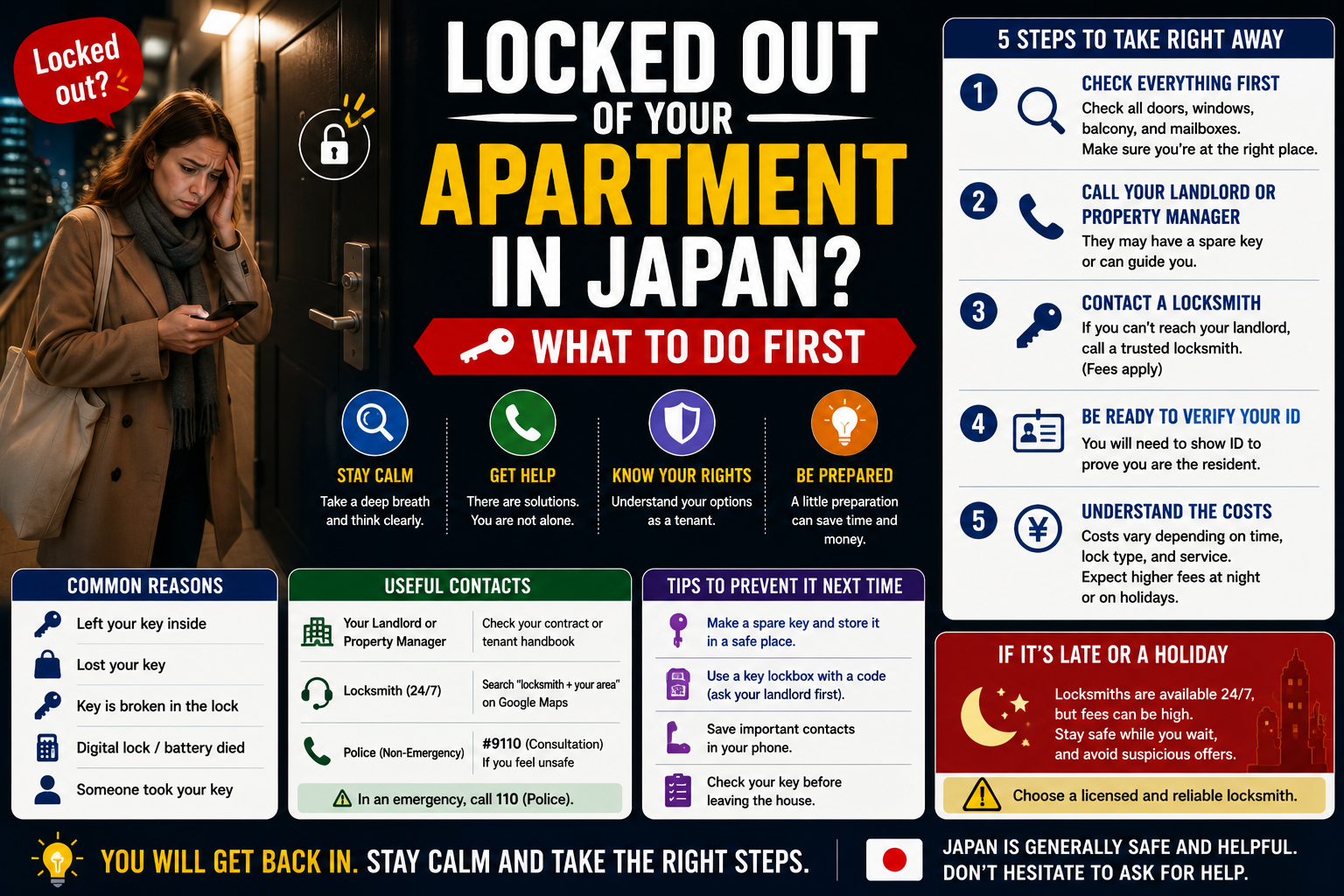
Locked Out of Your Apartment in Japan? What to Do First
Short answer: if you are locked out in Japan, contact your landlord, management company, or building support service first. Use a locksmith only after you confirm the price and who is allowed to approve the work. If your key was lost outside, file a lost property report quickly and treat it as a security issue, not just an inconvenience.
This guide is for renters, students in private housing, share-house residents, company-housing tenants, and long-term visitors staying in ordinary apartments. It matters most at night, on weekends, or when you are still learning how Japanese rental support works.
- Contact your landlord or management company before calling a locksmith.
- Use
110only for a real emergency such as danger, injury, theft, or a break-in. For non-emergency police consultation, use#9110. - If the key was lost outdoors, file a lost property report as soon as possible.
- Be careful with cheap locksmith ads. Official consumer warnings in Japan describe cases that started with low advertised prices and ended with bills above 70,000 yen.
Who should handle a lockout first?
In most rentals in Japan, the first call should be the management company, landlord, or the 24-hour support desk listed in your contract.
That matters for two reasons.
First, some buildings already have a process for lockouts. A manager may have a spare key procedure, a partner locksmith, or an after-hours line. Second, if you call an outside locksmith on your own, you may create a dispute about who approved the work, who pays, and whether a lock cylinder or card key system can be changed without permission.
If you live in a student dorm, company apartment, UR-style housing, or a share house, the rule can be even stricter. The building operator may require staff approval before any lock work starts.
What to do immediately
Start simple. Do the following in order.
1. Check whether this is a lockout, a lost key, or a danger situation
Ask yourself three questions:
- Is someone inside who may be in danger, such as a child, elderly person, or person who is ill?
- Do you think the key was stolen, not just lost?
- Did you leave gas, a stove, or another immediate hazard running?
If there is real danger, call 110 for police or 119 for fire/ambulance as appropriate.
If it is only a normal lockout with no crime or emergency, do not expect police or firefighters to open the door just because you forgot your key. In Japan, 110 is for crimes and accidents, and #9110 is for non-emergency police consultation.
ここがポイント: A normal apartment lockout is usually a building-management problem first, not a police problem first.
2. Call your management company or landlord
Check these places:
- your lease contract
- move-in guide or welcome booklet
- support sticker inside the mailbox area or entrance
- rental app or tenant portal
- fire insurance or home-assistance documents
When you call, be ready to say:
- your full name
- apartment name and room number
- whether you are locked out or the key is lost
- whether the key may have been stolen
- whether you need English support
Ask these questions clearly:
- Can your staff unlock the door?
- Do you have a partner locksmith?
- Is there a nighttime or holiday fee?
- If the key is lost, do I need a lock or cylinder change?
- Who approves the work and who pays?
If the key is lost outside, report it fast
If the key may have been dropped on the street, on a train, in a taxi, or at a shop, file a lost property report as soon as you can.
The National Police Agency says a lost property report helps police match your report with found items, and found property reported to police is stored for three months. The same guidance also makes clear that the report itself does not prove the loss and does not start a search operation. Its main value is that it helps cross-reference found items and contact you.
Practical next steps:
- Visit a police box (
koban) or police station. - Also contact the railway, bus, taxi company, store, or facility where you may have lost it.
- If the key was attached to your name, address, residence card case, wallet, or anything that identifies your home, tell your management company immediately.
If your wallet, phone, bank card, or residence-related ID was lost together with the key, handle those separately right away. Police lost-and-found guidance in Japan also tells people to contact the card issuer or phone carrier immediately when those items are involved.
When you need a locksmith
Sometimes management is closed, the building has no after-hours support, or the management company tells you to arrange a locksmith yourself. If that happens, slow down for two minutes before you approve the job.
Japan’s Consumer Affairs Agency and National Consumer Affairs Center have both warned about lock-opening services that advertise very low prices online but charge far more on site.
What to confirm before anyone starts work
Ask for these items before the technician touches the lock:
- call-out or travel fee
- nighttime or holiday surcharge
- basic unlocking fee
- extra fee if the lock is a special type
- fee if drilling is required
- full replacement cost if the cylinder must be changed
- cancellation fee
- total estimated price including tax
If the answer is vague, or if the technician says the real price can only be explained after arrival, be careful. Official consumer examples include cases where an ad showed a price starting from a few thousand yen but the final bill exceeded 70,000 yen.
Do not approve replacement too quickly
A simple unlock and a full lock replacement are very different jobs.
Replacement may be reasonable if:
- the key was stolen
- the key was lost with identifying documents
- the cylinder is damaged
- management requires replacement for security
Replacement may be questionable if:
- you are only locked out and the key is probably still inside
- the explanation is rushed
- the technician refuses to give a written estimate first
If the amount suddenly jumps far beyond what you were told, you can refuse the work before the contract is made.
What if you already face a high bill?
Do not panic and do not let the situation become a cash-pressure decision.
The National Consumer Affairs Center says that if you do not agree with the charge, you should clearly refuse on-the-spot payment while showing that you are willing to pay an amount you accept later. It also notes that cooling-off may still be possible in some cases, including when the price shown in advertising and the actual charge are very different.
If you feel unsafe because of the operator’s behavior, contact the police.
For contract trouble or suspicious billing, call the Consumer Hotline at 188. It connects you to a local consumer affairs consultation desk in Japan.
Costs: what foreigners often underestimate
The biggest mistake is focusing only on the advertised unlocking price.
Your final cost may include:
- dispatch fee
- late-night surcharge
- holiday surcharge
- special lock surcharge
- drilling fee
- cylinder replacement
- temporary hotel cost if you choose to wait until morning
In practice, the cheapest safe option is often:
- building support or management company
- insurer or tenant support service already included in your contract
- a locksmith approved by management
That order reduces both cost risk and contract risk.
Common mistakes to avoid
Calling police for a normal lockout
Police can help when there is crime, danger, or another urgent reason. They are not your default apartment unlocking service.
Calling the first search ad
This is where many expensive cases begin. Low headline prices do not tell you the full job cost.
Forgetting the security side of the problem
If the key was lost with anything that points to your address, this is not just a lockout anymore. It may require a lock change.
Approving work without building permission
In many rentals, the lock is part of the landlord’s property. Even if you pay, management may still need to approve the work method or the replacement hardware.
Waiting too long to file a lost property report
If someone finds your key and turns it in, a quick report makes matching easier.
Cases that vary by building or region
The basic approach is similar across Japan, but the details can change.
- In large cities, management companies are more likely to have 24-hour outsourced support.
- In rural areas, after-hours response may be slower, so keeping your contract contact sheet matters more.
- Smart locks, card keys, and auto-lock buildings may require system resets or re-registration, not just physical unlocking.
- Company housing, university-arranged housing, and share houses often have their own internal rules.
This is why the first phone call should usually go to the party managing the building, not the internet search result with the cheapest banner.
Current status in 2026
As of May 8, 2026, the public contact points that matter here are unchanged:
110for crimes and emergencies#9110for non-emergency police consultation188for consumer contract trouble
There is no special national “apartment lockout” system in Japan. In real life, outcomes depend on your lease, your building operator, and whether the issue is a simple lockout, a lost key, or a security incident.
Final takeaway
If you are locked out of your apartment in Japan, the fastest safe move is usually not forcing a quick unlock. It is calling the right party first.
Keep three things saved in your phone now:
- your management company or landlord number
- your contract or tenant support contact
- the consumer hotline
188
That small step can save you hours outside your door and tens of thousands of yen on the wrong night.
参照リンク
- Tokyo Metropolitan Police: How do I contact the police?
- Tokyo Metropolitan Police: Police Consultation Dial #9110
- National Police Agency: What is a Lost Property Report?
- National Police Agency: If you have lost your belongings, please immediately file a Lost Property Report!
- Consumer Affairs Agency: Consumer Hotline 188
- Consumer Affairs Agency: Administrative action and warning on locksmith door-opening services
- National Consumer Affairs Center of Japan: “I was overcharged for unlocking a key”
- University of Tokyo Housing Office: Contracting and Living in Your New Home