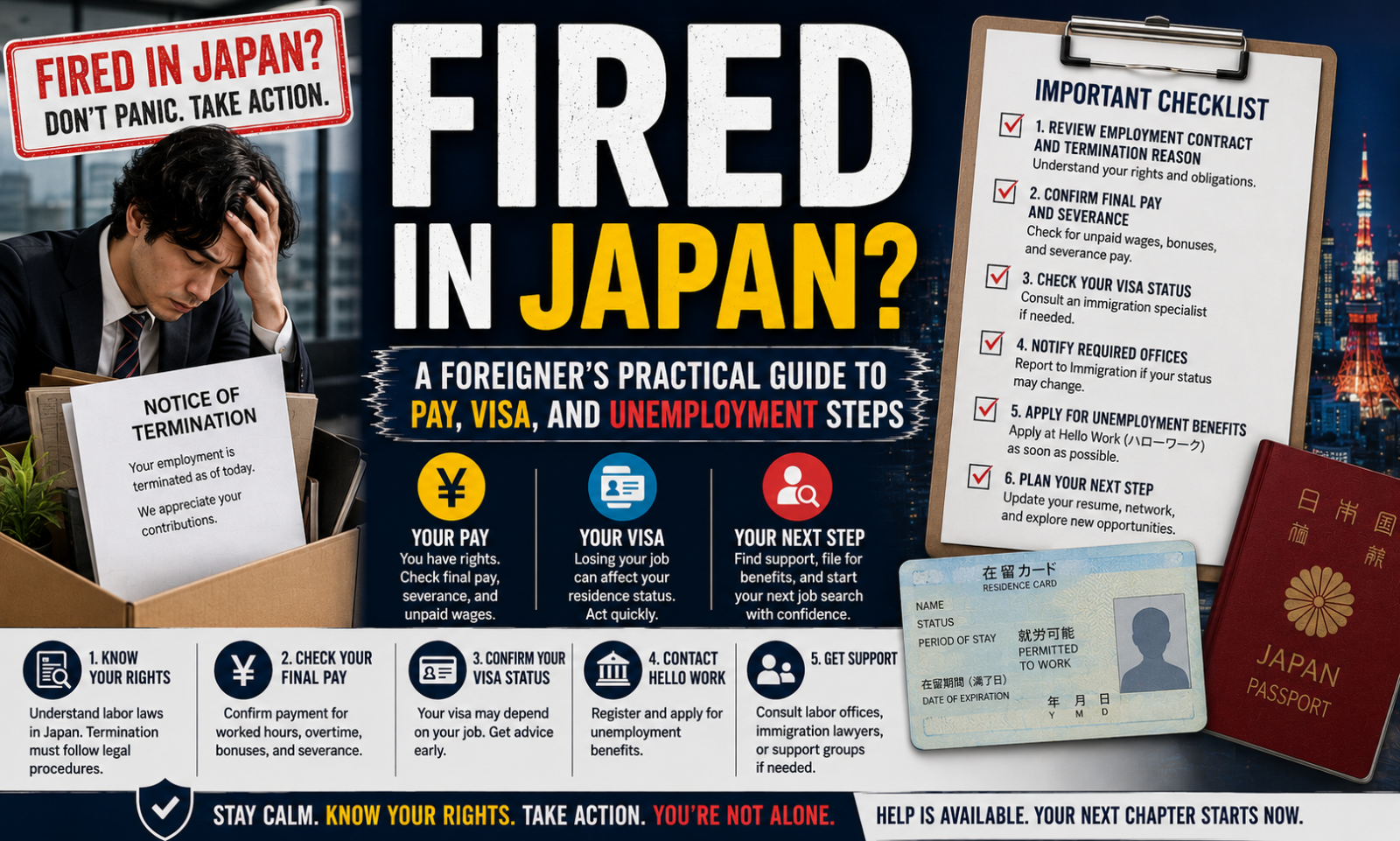
Fired in Japan? A Foreigner’s Practical Guide to Pay, Visa, and Unemployment Steps
If your employer fires you in Japan, do not treat it as only a workplace problem. It can affect your pay, your unemployment benefits, and, for many work visa holders, your immigration paperwork.
The first move is simple: get the dismissal date and reason in writing, keep your payslips and contract, check whether you received 30 days’ notice or dismissal allowance, and start both your Hello Work and immigration steps quickly.
- Get written proof of the dismissal and keep copies of your contract, payslips, work rules, and company messages.
- Check whether the company gave 30 days’ notice or paid the required dismissal allowance instead.
- If your residence status is tied to your employer, file the required Immigration Services Agency notification within 14 days.
- Go to Hello Work early. A dismissal is usually treated differently from a voluntary resignation.
Who this guide is for
This guide is for foreign residents in Japan who work under employer-linked statuses such as Engineer/Specialist in Humanities/International Services, Instructor, Skilled Labor, and similar work categories.
It also helps contract workers and part-time workers who were dismissed and now need to sort out labor documents and unemployment procedures.
If you are a permanent resident, spouse of a Japanese national, spouse of a permanent resident, or long-term resident, the labor and unemployment parts still matter, but the immigration risk is different because your stay is not tied to one employer in the same way.
What to do in the first 24 hours
Start by fixing the facts on paper.
Ask for these documents
- A written notice showing the dismissal date
- A written explanation of the reason for dismissal
- Your employment contract and any renewal notices
- Recent payslips and attendance records
- Company work rules if you can access them
- Separation documents for Hello Work, including the
rishokuhyoif applicable
Under MHLW guidance, a worker who receives dismissal notice can request a certificate stating the reason for dismissal. That matters because the recorded reason can affect both a labor dispute and unemployment processing.
ここがポイント: If the company fired you, do not casually sign a paper that says you resigned voluntarily. The classification of your departure can change benefit timing and weaken your position in a dispute.
Check whether the dismissal procedure looks wrong
A firing in Japan is not automatically valid just because the company says so.
1. Notice or dismissal allowance
As a general rule, an employer must give at least 30 days’ advance notice of dismissal, or pay dismissal allowance equal to at least 30 days of average wages. If the company gives fewer than 30 days of notice, it generally needs to pay for the missing days.
This is a procedure rule. It does not mean the dismissal becomes fair just because the company paid the allowance.
2. The reason still has to be reasonable
MHLW states that a dismissal is invalid if it lacks objectively reasonable grounds and is not considered socially acceptable. In plain terms, the employer needs more than a vague statement like “performance issue” or “not a good fit”.
3. Fixed-term contracts need extra attention
If you were on a fixed-term contract and the company ended it before the contract term finished, the bar is higher. Official guidance says the employer generally needs unavoidable reasons to dismiss a worker in the middle of a fixed-term contract.
Your residence status: what changes and what does not
Many foreign workers panic here. The key point is this: being fired does not automatically cancel your residence status on the same day.
But you still have immigration obligations.
If your status is linked to your employer
If you hold a work-related status and you leave your company, the Immigration Services Agency says you must file a notification about your affiliated organization within 14 days of the change. The same 14-day rule applies when you join a new company.
If you change employers but continue work that matches your current status, you may be able to stay in Japan until your present period of stay expires. But your next renewal or change application will be judged based on your real situation, so do not ignore the paperwork.
The longer-term risk
ISA also explains that status revocation can become an issue if a person with a work-type status does not continue the activity tied to that status for three months or more without a justifiable reason.
That does not mean every unemployed worker loses status after three months. It means you should not go silent, ignore notifications, or stop job-hunting while assuming nothing matters.
If your status is not employer-linked
If you are a permanent resident or spouse-status holder, losing a job does not create the same employer-notification problem. You still need to deal with income, insurance, and unemployment procedures, but the visa side is usually less urgent.
Hello Work and unemployment benefits
Go to Hello Work early, even if you think your next job may come quickly.
Why the departure reason matters
Official MHLW and Hello Work guidance treats dismissal and company-caused separation differently from a normal voluntary resignation.
That difference can affect:
- How soon benefits start
- Whether a benefit restriction applies
- How many days of basic allowance you may receive
This is one reason not to let a dismissal be rewritten as a self-quit if that is not what happened.
Current rule you should know
MHLW says that for people who voluntarily resigned without justified reason, the benefit restriction changed on April 1, 2025. For separations on or after that date, the restriction is generally 1 month after the 7-day waiting period, instead of the older longer rule in many cases.
That update is about self-quits, but it matters here because some workers are pushed to sign resignation papers. If your case is actually a dismissal, that distinction can change your benefit treatment.
How long can benefits last?
Hello Work says the number of benefit days depends on:
- Your age
- How long you were covered by employment insurance
- Why you left the job
For dismissed workers and some other protected categories, the official schedule can be more generous than for ordinary voluntary resignation cases.
Current status of official rate information
As of May 8, 2026, MHLW’s current official page for basic allowance amounts still points readers to the rates applied from August 1, 2025. Check the latest page when you apply, because these amounts are updated periodically.
MHLW also provides unemployment benefit guidance videos in English and several other languages, which can help if the paper process feels heavy.
Money and paperwork people often forget
After a dismissal, foreigners often focus only on the visa side and miss the everyday systems that move immediately.
Check these next
- Final salary, unused allowances, and any unpaid overtime records
- Hello Work separation paperwork from the employer
- Health insurance and pension handling after employment ends
- Your bank account details for any benefit payments
- Your registered address, because Hello Work and immigration notices depend on it being current
Health insurance and pension steps can vary depending on whether you were on employer social insurance, whether you will start a new job soon, and which municipality you live in. Ask your employer, city office, and pension or insurance desk quickly instead of waiting until the next billing cycle.
Where to get help in English or other languages
If your employer refuses documents, avoids pay issues, or pressures you to sign something you do not understand, use the public consultation system.
Labor consultation
MHLW’s Telephone Consultation Service for Foreign Workers offers support in multiple languages. As of the official page updated in April 2026, English service is available Monday to Friday, 10:00 a.m. to 3:00 p.m. at 0570-001-701.
MHLW’s Comprehensive Labor Consultation Corners also handle dismissal, pay cuts, harassment, and other workplace disputes. The ministry says the service is free and reservation is not required.
Immigration consultation
For status-of-residence procedures, the Immigration Services Agency’s information center is listed at 0570-013904 in Japan, with an IP phone and overseas number also shown on the official procedures page.
Common mistakes after being fired in Japan
- Signing a resignation letter just to “finish things quickly”
- Missing the 14-day immigration notification deadline
- Waiting for the employer to start Hello Work procedures without following up
- Throwing away chat logs, schedules, payslips, or attendance data
- Assuming a 30-day allowance makes any dismissal lawful
- Assuming your residence status ended immediately, or making the opposite mistake and ignoring it for months
Current watchpoints for foreign residents
As of May 8, 2026, these are the practical points worth checking first:
- The unemployment benefit rule for self-quits changed on April 1, 2025, so the recorded separation reason matters even more.
- MHLW’s current basic allowance amount page still refers to the rates effective from August 1, 2025.
- MHLW’s foreign-worker consultation pages were updated in April 2026, so contact hours and charges should be checked on the latest page before calling.
If you were fired in Japan, the safest pattern is simple: preserve documents, protect the dismissal record, notify immigration on time, and start Hello Work fast. The worst mistake is waiting two or three weeks and then trying to rebuild the facts after the paperwork has already moved.
参照リンク
- MHLW: Suddenly told you are dismissed? Q&A on dismissal notice and allowance
- MHLW: Can you request a certificate of the reason for dismissal?
- MHLW: Unreasonable dismissal can be invalid under the Labor Contract Act
- MHLW: Rules on ending a labor contract
- Immigration Services Agency: Notification about your affiliated organization
- Immigration Services Agency: Status of residence revocation overview
- MHLW: Basic unemployment allowance overview
- Hello Work: Number of basic allowance benefit days
- MHLW: Benefit restriction change from April 2025 for some self-quits
- MHLW: Current official page for basic allowance amounts effective from August 1, 2025
- MHLW: Unemployment benefit guidance videos in English and other languages
- MHLW: Telephone Consultation Service for Foreign Workers
- MHLW: Comprehensive Labor Consultation Corners
- Immigration Services Agency: Procedure index and information center