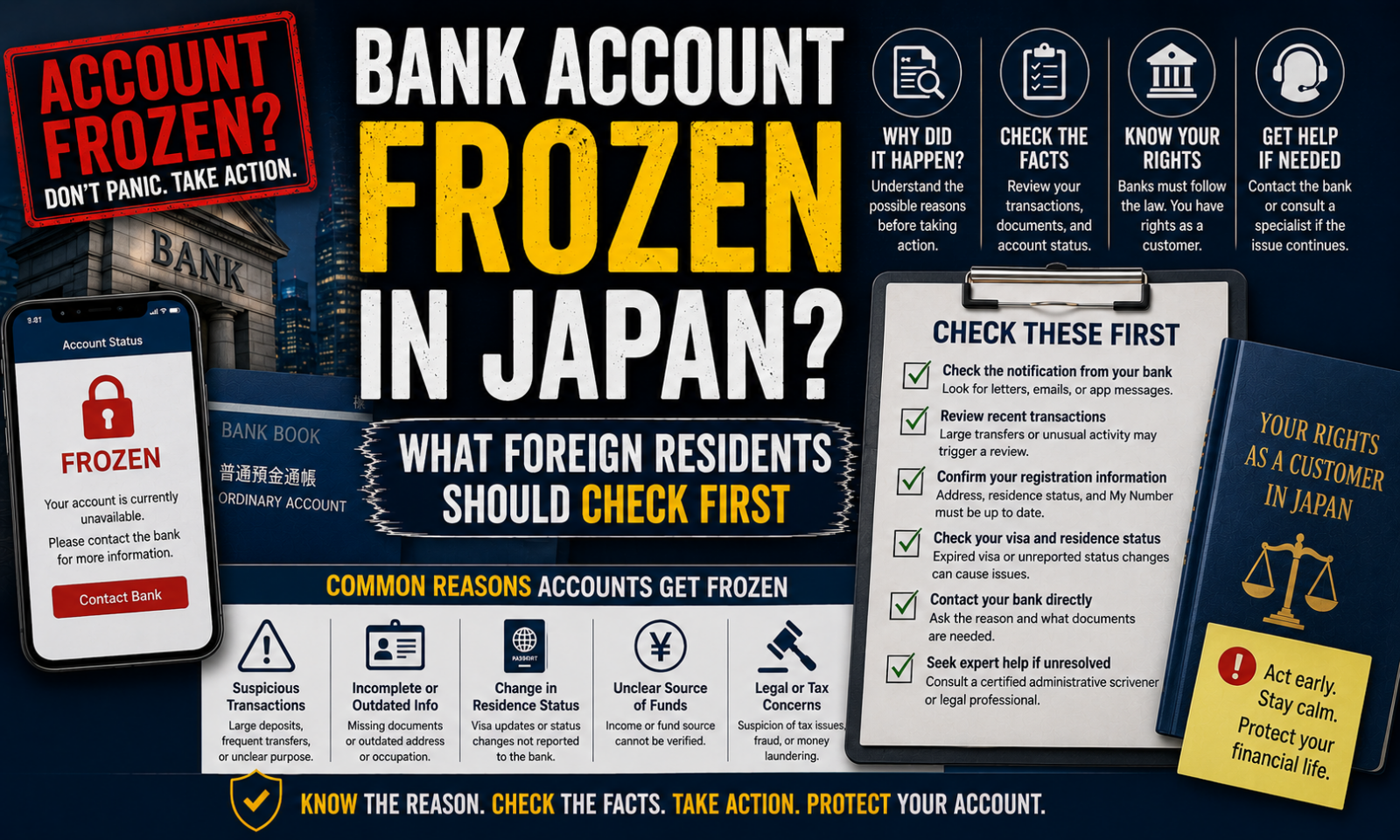
Bank Account Frozen in Japan? What Foreign Residents Should Check First
If your bank account is frozen in Japan, contact the bank first and ask the exact reason for the restriction. In many real cases, the problem is not a permanent closure. It is a temporary block caused by missing residence card updates, old address details, or a fraud check on a transfer.
The important part is speed. Some restrictions can be lifted quickly after you submit updated information. Others take days because the bank has to review the account manually.
- Check whether the block affects cash withdrawals, transfers, online banking, or everything
- Prepare your residence card, bank card or bankbook, and recent transaction details
- Update your residence card or address information immediately if anything changed
- If you see unauthorized transactions, contact the bank and the police without waiting
Who this guide is for
This guide is for foreign residents in Japan, including students, workers, and long-term residents. It matters most if you recently renewed your residence card, moved, changed your name, sent an unusual transfer, or got a warning message from your bank app, ATM, or online banking screen.
The first thing to understand
Japan does not have one nationwide “unfreeze” process for bank accounts. The background rules are national, especially anti-money-laundering checks and identity verification, but the actual procedure depends on your bank.
That is why two people with the same problem can get different answers. One bank may unlock the account through an app. Another may require a branch visit or mailed documents.
ここがポイント: A frozen account in Japan is often a compliance or security restriction, not an automatic accusation of wrongdoing. The fastest path is to learn the bank’s exact reason, then submit exactly what that bank asks for.
Common reasons a bank account gets frozen in Japan
1. Your residence card or period of stay is out of date in the bank’s records
This is one of the most common problems for foreign residents.
Banks in Japan are expected to keep customer information current as part of ongoing anti-money-laundering controls. Japan Post Bank says that if the bank’s registered period of stay has passed and you did not update the bank after renewing your residence card, you may be unable to withdraw or transfer money.
Why this matters in daily life:
- Your salary may still be sent to the account, but you may not be able to move or use the money normally
- ATM withdrawals and online transfers can stop at the worst possible time, such as rent day
- A renewed residence status at immigration does not automatically update your bank records
2. Your address, name, phone number, or other customer details do not match
If you moved and updated city hall but did not update the bank, that mismatch can trigger a review. The same applies after a name change or if your registered phone number no longer works for security checks.
This is especially important in Japan because many banks use registered mail, SMS verification, or app-based identity checks.
3. A transfer or login looked suspicious
Banks have become stricter about detecting fraud. The Financial Services Agency and National Police Agency asked financial institutions in Japan to strengthen detection, customer confirmation, and rapid suspension measures in August 2024 and again in September 2025.
That means a sudden large transfer, a new device login, or unusual remittance behavior can trigger a temporary stop even if the money is yours.
4. Unauthorized access or scam activity is suspected
If someone used your account without permission, the bank may restrict it to prevent more damage. The National Police Agency says victims of unauthorized withdrawals should contact both the bank and the police.
This matters because a security freeze and a compliance freeze are handled differently. A security case often needs fraud review, identity checks, and sometimes a police report.
5. The bank suspects unlawful use by a third party
Japan has been warning residents, including foreign residents, not to sell, give away, or let someone else use a bank account, bankbook, or cash card. The police have said clearly that transferring an account to another person is a crime.
If a bank sees signs that an account may have been used by someone else, the response can be much more serious than a simple document update.
What to do in the first 24 hours
Start with the simplest question: what exactly is blocked?
Step 1: Contact the bank through an official channel
Use the number on the bank’s website, app, cash card, or paper notice. Do not trust a number sent by SMS or told to you in a phone call.
Ask these questions plainly:
- Is the restriction on withdrawals, transfers, online banking, or the whole account?
- What triggered it: residence card update, address mismatch, suspicious transfer, or fraud review?
- What documents do I need?
- Can I fix this in the app, online, by mail, by phone, or only at a branch?
- How long does review usually take?
Step 2: Prepare the documents before you call back or visit
In many cases, you will need some or all of these:
- Residence card
- Passport
- Cash card or bankbook
- Registered phone number
- Proof of current address if the bank asks for it
- Details of the blocked transfer or transaction
- Police report number if you are reporting fraud
Step 3: If you renewed your residence card, update the bank immediately
This is the highest-priority fix for many foreign residents.
Japan Post Bank says that if your account was restricted because residence card information was not updated, the restriction is lifted immediately after the app procedure is completed for that specific issue. But its FAQ also says that if you are still waiting for the renewed card, you need to wait until the new card is issued before using that update procedure.
That detail matters. If your immigration renewal is still in process, do not assume the bank can always clear the block from the application receipt alone.
Step 4: If the issue is suspicious activity, do not keep retrying transfers
Repeated failed attempts can make the review worse, not better.
Instead:
- Save screenshots of errors
- Write down the date, amount, and destination of the blocked transfer
- Be ready to explain where the funds came from and why you made the transfer
- Follow the bank’s fraud or security instructions exactly
Step 5: If money is missing, contact the police as well
If you see a transaction you did not authorize, treat it as a fraud case, not just a banking inconvenience.
The National Police Agency advises victims of unauthorized withdrawals or banking misuse to contact the bank and the police or a cybercrime consultation desk.
How long does it take to unlock the account?
There is no single answer.
A few examples show why timing varies:
- Japan Post Bank says a restriction caused only by missing residence card information can be lifted immediately after the update is completed in its app
- SMBC Trust Bank PRESTIA says an online update of status of residence and period of stay takes about one week to complete
- Fraud reviews can take longer because the bank may need internal investigation before restoring transfers
So if a bank employee says “it depends on the reason,” that is not a brush-off. It is often true.
A special case: your visa renewal is still pending
Under Japan’s immigration rules, if you filed an extension or change application before your period of stay expired, you may remain in Japan during the special period until the decision is made or until two months after the original expiry date, whichever comes first.
But do not assume the bank will treat that the same way automatically.
In practice:
- Immigration status and bank system status are not the same thing
- The bank may still want the updated residence card or additional review
- If your rent or salary depends on that account, contact the bank before the old date passes
Common mistakes that make the problem worse
- Ignoring ATM or app messages asking you to update residence card information
- Updating immigration or city hall records but not updating the bank
- Waiting until payday, rent day, or bill day to test whether the account still works
- Using a friend’s account while your own account is restricted
- Giving, lending, or selling your bankbook or cash card before leaving Japan
- Trusting a caller who says your account is under investigation and asks for your PIN or card
That last point matters because Japanese police keep warning about scams where callers pretend to be police or bank staff and claim your account is being misused.
Current watchpoints as of May 8, 2026
Two current trends matter here.
- Japanese banks are still under pressure to tighten fraud controls, so temporary restrictions are unlikely to become looser soon
- From June 14, 2026, Japan will introduce a new residence card format. If your bank app or upload flow has not caught up yet, newly issued cards may need manual checking at first
That second point is a practical watchpoint, not a confirmed disruption. If you receive a new-format card after June 14, 2026 and your bank’s app rejects it, contact the bank and ask for the branch or manual submission route.
What to do next if you need money urgently
If the account cannot be restored the same day, ask the bank these concrete questions:
- Can incoming salary still be received?
- Can the bank release only ATM withdrawals?
- Is there a branch-based emergency identity check?
- Should your employer, school, or landlord be told that your transfer may be delayed?
A frozen account becomes more serious when it affects rent, utilities, tuition, or visa-related living costs. In that situation, the best move is not guessing. It is getting the bank’s written or verbal explanation early and planning around the actual restriction.
参照リンク
- Japan Post Bank: To All Customers Who Have Received a Notice Regarding Updating Their Residence Card Information
- Japan Post Bank FAQ: Can I update residence information while my new residence card is still being processed?
- Japan Post Bank FAQ: Will account restrictions be lifted immediately after updating residence information in the app?
- Japan Post Bank: Yucho Tetsuzuki App for Foreign Nationals
- SMBC Trust Bank PRESTIA: Register/Update Status of Residence and Period of Stay
- SMBC Trust Bank PRESTIA: Confirmation of Your Status of Residence and Period of Stay
- Immigration Services Agency: What Is the Special Period?
- Immigration Services Agency: What Is a Residence Card?
- National Police Agency: Unauthorized withdrawals through cashless payment services
- National Police Agency: Selling or giving away a bankbook or cash card is a crime
- National Police Agency: Fraud calls claiming your bank account is being misused
- Financial Services Agency: FAQ on AML/CFT Guidelines
- National Police Agency: Stronger measures against misuse of deposit accounts announced on August 23, 2024
- Financial Services Agency: Stronger measures against misuse of deposit accounts announced on September 12, 2025