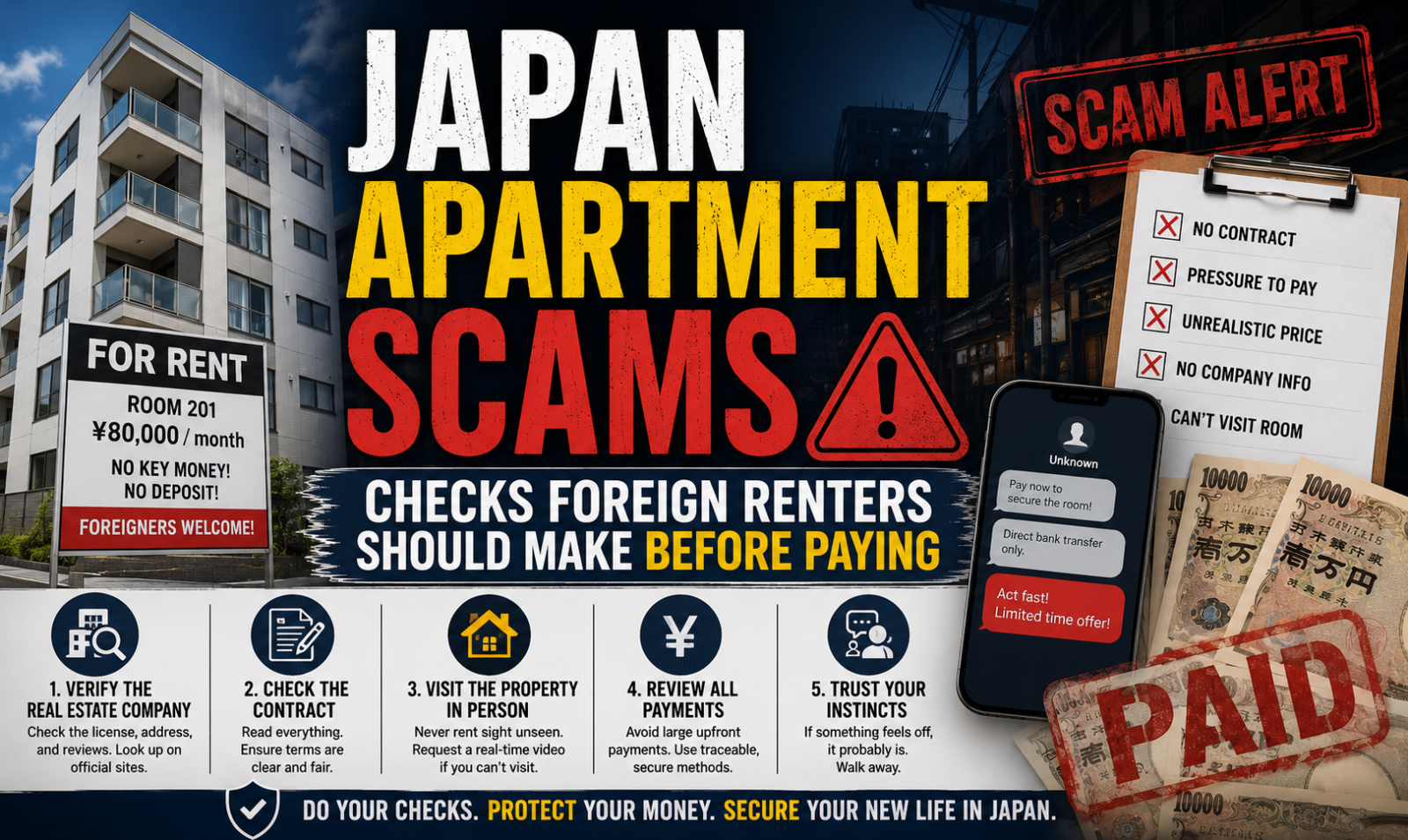
Japan Apartment Scams: Checks Foreign Renters Should Make Before Paying
If you are renting in Japan, the safest rule is simple: do not send money until you have verified the real estate company, the property, the fee breakdown, and the contract type in writing.
A rental scam in Japan does not always look dramatic. Sometimes it is a fake listing. Sometimes it is a real room wrapped in vague fees, a fixed-term contract you did not notice, or a repair clause that shifts too much risk onto the tenant.
- Verify the agent first, not just the listing.
- Treat any rushed bank transfer as a warning sign.
- Read the contract type and move-out clauses before you sign.
- Keep screenshots, emails, and room photos from day one.
Who this guide is for
This guide is for students, workers, and first-time long-term residents looking for a private rental in Japan.
It matters most when you are searching from overseas, using social media or messaging apps, or trying to secure a room quickly before school or work starts.
The first 4 checks before any payment
Start here. These checks catch a large share of avoidable trouble.
1. Check that the company is a licensed real estate broker
In Japan, a business that brokers rentals as a real estate transaction business needs a license from the national government or a prefectural governor. MLIT also provides a public search system for licensed brokers.
What to check:
- The full company name in Japanese and English
- Its license number
- Whether the office address on the listing matches the address in the license search
- Whether the company says it is licensed in one prefecture only or in multiple prefectures
Why this matters: a polished website or social account is not proof. A real license is a much stronger filter.
2. Make sure the room itself is traceable
Ask for the exact building name, full address, floor plan, and the name of the management company.
Be careful if:
- The advertiser refuses to disclose the full address until after payment
- Photos appear inconsistent with the floor plan or area description
- The same room appears at very different prices on different sites
- You are told the room is available only if you transfer a “holding fee” immediately
Some legitimate landlords do move fast, especially in March and April. The issue is not speed alone. The issue is whether the room, the company, and the payment purpose are all clearly documented.
3. Ask for a written fee breakdown
Japan rentals often include several upfront costs, such as deposit, key money, advance rent, common service fees, guarantor company fees, insurance, lock exchange fees, and brokerage fees.
That does not make a fee fake. What matters is whether every item is named, explained, and tied to the contract.
At minimum, ask for:
- Monthly rent
- Management or common area fee
- Deposit and whether it is refundable
- Key money and whether it is non-refundable
- Brokerage fee
- Guarantor company fee
- Fire insurance fee
- Cleaning or restoration-related fees charged at move-out or in advance
- Any “support,” “sanitation,” or “document” fee
If the agent cannot explain a charge in plain language, stop there.
4. Confirm who will explain the contract
Before a lease is signed, important contract details should be explained. MLIT provides model documents for foreign nationals in multiple languages, including a standard lease form and an important points explanation form.
If the explanation is online, that is not automatically suspicious. Japan allows online explanations and electronic contracting in some housing transactions. But the agent should still identify themselves properly, and for online important-matters explanations the licensed real estate transaction specialist should show their qualification card on screen.
ここがポイント: Online renting is normal in Japan now. Unverifiable people, unclear fees, and rushed payments are the real red flags.
Where foreign renters get trapped most often
The biggest problems usually start in the paperwork, not at the front door.
Brokerage fees
MLIT says brokerage fees for rental mediation are capped by law. For an ordinary residential lease, the combined brokerage fee from landlord and tenant is capped at 1.1 months of rent including tax.
What to do:
- Ask who is paying the brokerage fee
- Ask whether your side agreed to pay more than 0.55 months including tax
- Ask for the amount to appear clearly on the written estimate
If someone asks for a large “agent fee” outside the normal brokerage explanation, make them define it in writing.
Fixed-term leases
A fixed-term lease in Japan ends when the contract period ends unless both sides agree to sign again. It does not renew automatically like an ordinary lease.
Why this matters: a room that looks cheap may be cheap because the contract type is different.
Check these points:
- Is it a standard lease or a fixed-term lease?
- What is the contract length?
- Is renewal possible, or only re-contracting?
- Are there extra re-contracting fees?
Move-out charges and restoration clauses
Japan’s MLIT restoration guideline exists because move-out disputes are common. The key point is that contracts should disclose restoration conditions, and blanket clauses shifting every repair cost to the tenant deserve close review.
This matters because many foreign renters focus on move-in cost and ignore move-out risk.
Read carefully if the contract says:
- All wallpaper replacement is the tenant’s burden
- All floor repair is the tenant’s burden
- Cleaning is mandatory regardless of condition
- The deposit can be deducted broadly without a clear calculation method
In February 2026, the National Consumer Affairs Center of Japan again warned about restoration-cost disputes, including a case where a contract stated that cross and flooring replacement would be charged 100% to the tenant regardless of fault. That is exactly the kind of clause you should question before signing.
Red flags that should make you pause
You do not need proof of fraud to stop a deal. One strong warning sign is enough to slow down.
- You are asked to transfer money before seeing a contract summary or fee breakdown.
- The bank account name does not match the company you are dealing with.
- The company will not give a license number.
- The listing exists only on social media, chat, or a copied-looking website.
- You are told not to contact the management company or building directly.
- The contract is sent only as image files with no readable text.
- The room is described as “guaranteed” before screening, but details stay vague.
- The agent pressures you to sign immediately because “many foreigners are waiting.”
- A very low rent is paired with unusually high side fees.
- Special clauses are added late, after you already paid.
A safer rental process you can actually use
Use this order. It is slow enough to protect you, but still realistic for Japan’s fast rental market.
Before you apply
- Save the original listing page as screenshots or PDF.
- Ask for the company name in Japanese, license number, and office address.
- Verify the company in MLIT’s licensed broker search.
- Ask for a written estimate of all upfront and move-out related charges.
Before you pay
- Ask whether the lease is ordinary or fixed-term.
- Ask for the important points explanation and draft contract in advance if possible.
- Confirm the name on the receiving bank account.
- Confirm whether the payment is refundable and under what condition.
At move-in
- Photograph walls, floors, appliances, and existing scratches on day one.
- Keep the check-in sheet, emails, and chat records.
- Report visible damage immediately to the landlord or management company.
That last step matters. If you do not document the room at the start, a later dispute becomes much harder to win.
What to do if something feels wrong
Stop the payment first. Then move the conversation to writing.
Use this sequence:
- Ask the company to explain the disputed fee or clause by email.
- Save the listing, estimate, contract draft, bank details, and chat logs.
- If you are already in trouble, contact your local consumer affairs center through 188. The Consumer Affairs Agency says 188 connects you to a nearby consultation point, but it is available in Japanese only.
- If you are a short-term visitor rather than a resident, the CAA also lists a tourist consumer hotline in several languages.
For contract disputes, fast record-keeping matters more than arguing by phone.
Current status to know as of May 8, 2026
A few current points matter for foreign renters.
- Online procedures are now standard enough that “online only” is not, by itself, proof of a scam.
- MLIT notes that changes effective on May 18, 2022 removed the old stamp requirement on certain contract documents and allowed electronic handling for fixed-term rental contract procedures.
- MLIT added further notes to standard rental contract guidance in December 2024.
- The practical risk in 2026 is not digital paperwork itself. It is digital paperwork that you cannot verify.
So the question to ask is not “Why is this online?” It is “Can I verify the company, the agent, the property, the fees, and the contract type before money leaves my account?”
Final takeaways
If you remember only a few things, make them these:
- Verify the broker license before you trust the listing.
- Never pay from pressure alone.
- Read fixed-term and move-out clauses line by line.
- Keep evidence from the listing stage through move-in day.
A cheap room can still be expensive if the contract hides the real cost. The next thing to check is not the wallpaper or the station distance. It is the fee sheet and the contract type.
参照リンク
- MLIT: Support for Foreign Nationals in Looking for Rental Housing
- MLIT: Search system for licensed real estate brokers
- MLIT: Real estate broker licensing overview
- MLIT: Information for consumers about real estate brokerage fees
- MLIT: Standard fixed-term rental housing contract
- MLIT: Troubles and guidelines on restoration at move-out
- Consumer Affairs Agency: Local Cooperation / Consumer Hotline 188
- Consumer Affairs Agency: Key points before signing new-life contracts
- National Consumer Affairs Center: Rental housing restoration-cost FAQ
- National Consumer Affairs Center: Warning on restoration-cost disputes in rental housing