Delayed Home Internet in Japan: What to Do First and How to Stay Online Cheaply
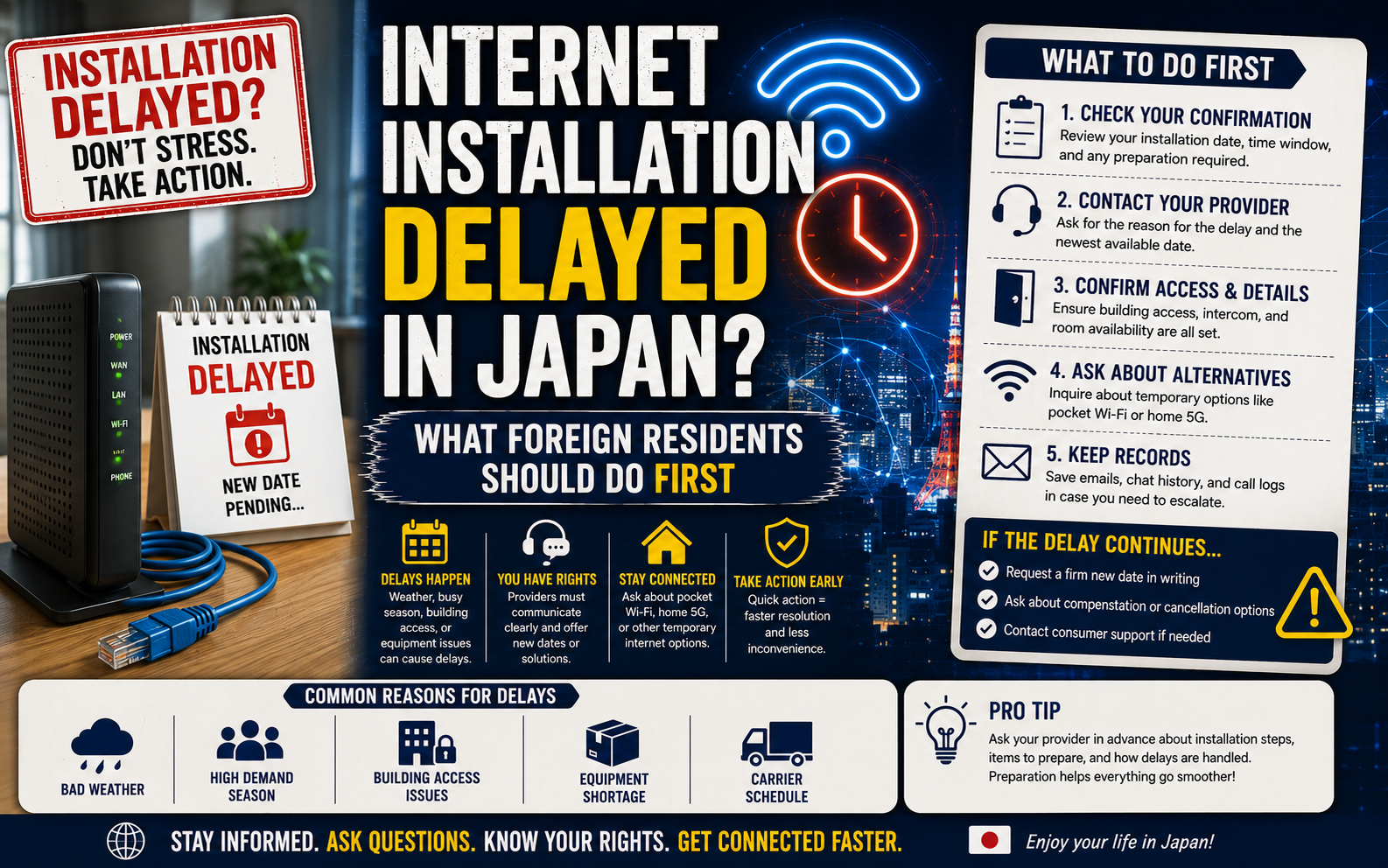
If your internet installation in Japan is delayed, do not cancel your old connection yet and do not wait passively for the next message. First, confirm what kind of delay you have, then secure a temporary connection that matches your budget: tethering for a few days, a home router if you need Wi-Fi at home right away, or a pocket Wi-Fi or coworking space if you need stable service for work or study.
This guide is for new residents, students, workers, and long-term renters in Japan who are waiting for fiber internet at a home or apartment. It matters most when you are moving in, changing providers, or starting work or school and cannot afford to be offline.
- Most delays are not the same problem. The cause may be building equipment, a missing appointment slot, landlord approval, or provider-side processing.
- The fastest workaround is usually mobile-based internet. In Japan, home routers such as SoftBank Air or docomo home 5G can start without in-home construction.
- Costs can rise if you reapply carelessly. Installation fees, missed appointments, and duplicate contracts can all add up.
- If you want to cancel, check the 8-day rule. In many telecom contracts, the line contract can be cancelled within 8 days of receiving the contract document, but devices are not always included.
Start by identifying the type of delay
A delayed installation message does not always mean the same thing.
NTT West says the time from application to service start depends on the plan and the building or equipment situation. In practice, that means your wait can change based on whether your building already has the right line, whether inside wiring is needed, and whether the provider can assign a work slot.
1. Your work date is still not fixed
This is common after a new application or a move.
For example, SoftBank says the construction date may be fixed later depending on your usage environment and application method, and the confirmed date is then sent by SMS. If you are in this stage, the main job is not troubleshooting your router. It is getting a firm status update from the provider.
Check these points first:
- Is your application still under review, or has the provider already passed it to the line company?
- Is the delay about the line itself, the in-home visit, or just the hardware shipment?
- Does your apartment already have a fiber outlet or shared building equipment?
- Is landlord or management approval still pending?
2. You had a date, but it moved
This usually means the work slot changed, the engineer could not complete the job, or access to the building was not ready.
Ask your provider one direct question: what exactly is blocking completion now? Do not accept only “it is delayed.” You need a concrete reason such as building permission, outside line work, indoor wiring, or rebooking after a missed visit.
3. The building is the real bottleneck
Many renters assume the provider is slow when the actual problem is the property.
If your apartment does not already have usable fiber equipment, the provider may need access to common areas or may need approval for wiring work. This is where delays can stretch out. If you are renting, contact the landlord or management company yourself and ask three simple questions:
- Does the building already support the line you ordered?
- Is additional wiring approval needed for your room?
- If work is needed, who must be present or approve it?
What to do today
Take these steps in order.
Confirm the exact status in writing
Use the provider portal, app, or support channel and get the status in a form you can save.
If you are using SoftBank Hikari, SoftBank says you can check or change the construction date in My SoftBank after the date is set. If the date is not set yet, that itself tells you you are still in the earlier processing stage.
What to ask support:
- What is the current stage of my order?
- Is the delay caused by building equipment, engineering capacity, or my application details?
- Do you need anything from me or my landlord?
- What is the earliest realistic completion window, not just my requested date?
Keep your old line or mobile plan alive if possible
This is the most common money-saving move.
If you are moving within Japan and still have a working old connection, keep it active until the new line is confirmed usable. People often cancel too early because they think the requested installation date is final. It often is not.
Prepare a temporary connection before you run out of time
If you work from home, attend online classes, or need internet for visa or banking procedures, arrange a backup immediately.
Your practical choices are:
- Smartphone tethering if you only need a few days and your plan allows enough data
- A pocket Wi-Fi rental if you need portable internet for one to four weeks
- A plug-in home router if you need home Wi-Fi fast without construction
- Coworking spaces, libraries, or cafe Wi-Fi for short periods and large uploads
The fastest no-construction options in Japan
If waiting for fiber is hurting your daily life, a home router is often the most practical backup.
SoftBank Air
SoftBank advertises SoftBank Air as a service that can be activated on the day it arrives. That makes it one of the clearest official fallback options when you cannot wait for a fiber visit.
This option fits people who:
- Just moved in and need Wi-Fi immediately
- Cannot get landlord approval quickly
- Expect the fiber delay to last more than a few days
Watch the cost carefully, though. Fast setup is convenient, but it may not be the cheapest solution if you only need a very short bridge.
docomo home 5G
docomo says home 5G does not require on-site installation. You plug the router into an outlet and use the mobile network at home. On the English page checked on May 8, 2026, docomo lists the monthly charge at 5,500 yen?
Need to correct: hold. We must not invent or include uncertainty. Let’s instead use the official listed figure directly and cleanly.
According to docomo’s English page checked on May 8, 2026, home 5G is 4,950 yen per month, with the device charged separately. If you apply in a shop, an administrative fee is charged; the online shop lists that fee as free.
This is useful when fiber construction is delayed, but there is an important limit: docomo says the service cannot be used at addresses other than the registered installation location. That matters if you were hoping to move the router freely between homes.
ここがポイント: If your fiber line is delayed in Japan, the fastest safe fallback is usually not “wait harder.” It is to lock in a temporary connection you can actually use this week, then keep pushing the fixed-line provider for a dated update.
How much a delay can cost you
The cost problem is not only the monthly fee. Delays often create extra costs because people double-pay, miss appointments, or cancel and reapply without checking fees.
Fiber installation fees can already be high
On the NTT West English pricing page checked on May 8, 2026, new FLET’S Hikari Next applications made via the official website show these initial charges:
- Single-family example: 22,880 yen total including an 880 yen contract fee and a 22,000 yen installation fee
- Mansion example: 12,540 yen total including an 880 yen contract fee and an 11,660 yen installation fee
These are NTT West examples, not a national flat rate. East Japan areas and other providers can differ. The point for readers is practical: if you cancel impulsively and start over with another fixed-line contract, the restart may not be cheap.
A missed visit can also cost money
SoftBank says that if work cannot be done on the day because nobody is present, a dispatch fee of 7,150 yen may be charged. That is a preventable cost.
Before the appointment day, confirm:
- Whether attendance is required
- Who can be there if you cannot
- Whether the building entrance, management desk, or parcel locker area needs separate access
Temporary internet can still be cheaper than a bad reapplication
If your delay is one or two weeks, paying for a short backup is often cheaper than:
- cancelling the line and paying new setup fees elsewhere
- losing work hours
- using expensive international roaming
- missing a visit and paying a dispatch charge
When cancellation makes sense
Sometimes waiting no longer makes sense. If the provider cannot give a realistic installation window, or if your building situation makes completion unlikely, cancellation may be the better move.
Japan has a telecom-specific cancellation rule that many foreign residents do not know.
The National Consumer Affairs Center of Japan explains that under the initial contract cancellation system, you can unilaterally cancel a telecom service contract within 8 days of receiving the contract document. But the same FAQ also says this applies only to the line contract, not to the device itself.
That distinction matters if you accepted a bundled router, modem, or terminal purchase.
Before cancelling, check:
- When you received the contract document
- Whether your service is covered by the 8-day initial contract cancellation system
- Whether you also bought a device separately
- Whether cancellation fees, return shipping, or equipment handling still apply
If the explanation you received was unclear, you can also contact Japan’s consumer hotline at 188 for guidance.
Common mistakes foreigners make
A delayed internet setup in Japan becomes much harder when the wrong assumption is made early.
Assuming the requested date is the confirmed date
It is not. SoftBank states clearly that the date may be fixed later depending on the case.
Cancelling the old line too early
Do this only after the new line is actually working.
Treating all apartments as equivalent
A building with shared equipment, an existing fiber outlet, or a different provider relationship can move much faster than a building that needs fresh work.
Forgetting that “no construction” services still have rules
A home router can solve the timing problem, but not every location rule disappears. docomo home 5G is tied to the registered installation address.
Chasing speed instead of the real deadline
If you need stable internet for work next Monday, the best answer may be a simple temporary setup now, not the fastest possible long-term fiber plan later.
Current updates worth checking
As of May 8, 2026, these points matter if you are deciding whether to wait, switch, or reapply:
- NTT West says basic installation fees for new FLET’S Hikari Next applications made through channels other than the official website will be revised from July 1, 2026
- On the same pricing page, NTT West also notes that customer-requested on-site disconnection work at cancellation may incur a fee from April 1, 2026
- SoftBank’s support page says a missed construction visit may lead to a 7,150 yen dispatch charge
If you live in western Japan and are thinking about giving up on one application and starting again, that July 1, 2026 timing matters.
What to check before you choose your next step
If your installation is delayed in Japan, make your next decision based on the delay length.
- Delay of a few days: use tethering or short-term Wi-Fi and wait for the confirmed date
- Delay of one to three weeks: consider a pocket Wi-Fi or no-construction home router
- Delay with no firm date: escalate with the provider, contact the landlord or management company directly, and compare whether cancellation is cheaper than waiting
- Delay caused by property limits: stop assuming another fiber provider will be faster unless the building setup is clearly different
The practical goal is simple: stay online now, avoid paying twice, and get a written timeline before you make a bigger contract decision.
参照リンク
- SoftBank Internet and Fixed-line Services
- SoftBank FAQ: Can I specify, check, or change the installation date for a new SoftBank Hikari line?
- NTT DOCOMO home 5G English page
- NTT West FAQ: How long does it take from applying for FLET’S Hikari to service start?
- NTT West FLET’S Hikari Next service charges
- National Consumer Affairs Center of Japan FAQ: What is the initial contract cancellation system for optical lines?