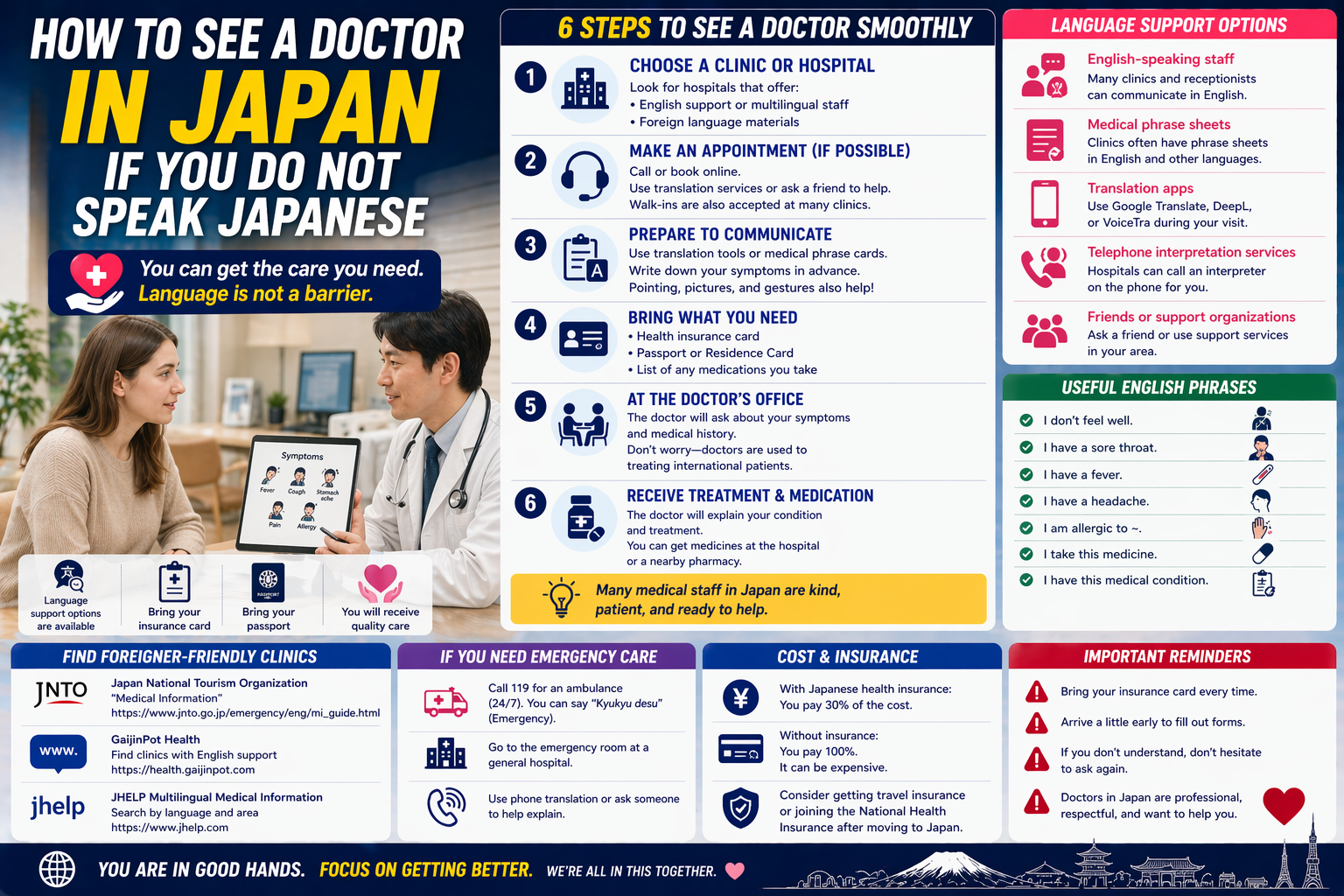
How to See a Doctor in Japan If You Do Not Speak Japanese
Yes, you can still get medical care in Japan even if you do not speak Japanese. The practical answer is to look for a clinic or hospital before you go, use a multilingual search or hotline, and bring your insurance details and basic medical information with you.
The hard part is usually not the treatment itself. It is choosing the right place, explaining symptoms, and handling payment at reception. If you prepare those three points, the visit gets much easier.
- Best first step: use JNTO’s multilingual medical institution search or your prefecture’s hospital search page.
- If language is the main problem: call AMDA Medical Information Center for multilingual guidance during its business hours.
- If it is serious or urgent: call
119for an ambulance. - If you live in Japan and are enrolled in public health insurance: you usually pay only part of the cost at the counter, not the full billed amount.
Who this guide is for
This guide is for:
- tourists who suddenly need a clinic or hospital
- students and workers who can manage daily life in Japan but not a medical conversation
- new long-term residents who have health insurance but do not know how the system works
- family members helping a child, spouse, or parent get care
It matters most when you have a fever, stomach pain, a rash, an injury, or any problem that is uncomfortable but not clearly an ambulance case.
The key rule: choose the right type of medical care first
Before worrying about language, decide what kind of care you need.
Go to a clinic or general hospital during regular hours for ordinary problems
For many everyday issues, a local clinic is the normal first stop in Japan.
Examples:
- fever, sore throat, cough: internal medicine
- rash or hives: dermatology
- eye pain: ophthalmology
- ear, nose, throat problems: ENT
- tooth pain: dental clinic
- child illness: pediatrics
JNTO’s official guide also lists common symptoms and the department that usually handles them. That matters because many Japanese clinics are specialized. Going to the wrong department can waste time when you already have a language barrier.
Call 119 if it is an emergency
Use an ambulance for serious injury, breathing trouble, severe chest pain, heavy bleeding, or another urgent emergency. In Japan, ambulances are requested through 119.
One important limit: you cannot choose the hospital yourself when you go by ambulance. The receiving hospital is decided based on your condition and availability.
ここがポイント: If the problem is not an emergency, finding the right clinic in advance is usually better than walking into the nearest large hospital.
How to find a doctor when you do not speak Japanese
This is the step that saves the most stress.
1. Use JNTO’s multilingual medical search
JNTO’s official medical guide lets you search by:
- prefecture
- language
- medical department
- card payment availability
- whether the institution is a base medical institution for foreign patients
This is useful because “English support” in Japan can mean different things. One clinic may have an English-speaking doctor. Another may only have English signs at reception. Another may depend on phone interpretation on certain days only. JNTO itself warns readers to check directly with each institution before visiting.
2. Check your prefecture’s hospital or clinic database
The Ministry of Health, Labour and Welfare says every prefecture provides hospital and clinic information, including specialty, hours, and foreign-language services. Some prefectures offer English pages, but many pages are mainly in Japanese.
That means the national rule is simple, but the search experience is regional. Tokyo, Osaka, Fukuoka, and other large areas may be easier to search online than smaller municipalities.
3. Use AMDA if you need multilingual guidance
AMDA Medical Information Center provides multilingual telephone guidance for foreign residents and visitors. Its official page says it can guide people to medical institutions where foreign languages are available and explain parts of Japan’s medical and welfare system.
As of April 23, 2026, the AMDA page lists:
- phone:
0120-339-266 - hours: Monday to Friday,
10:00to16:00 - closed: holidays and
December 29toJanuary 3
This is especially useful if you are not sure which clinic to choose or you need help before you leave home.
4. Look for JMIP-certified hospitals when possible
JMIP is an accreditation system for medical institutions that are set up to accept international patients. JNTO explains that JMIP-certified institutions are evaluated on items such as multilingual guidance and support for different cultural or religious needs.
This does not mean every consultation will be easy in English. It does mean the hospital has a clearer structure for receiving foreign patients than a random small clinic.
What to prepare before you go
Do not wait until you are standing at reception.
Bring these if you have them:
- health insurance card, or a My Number Card linked for health insurance use
- passport or residence card
- cash and, if possible, a credit card
- a written list of your medicines
- allergy information
- your symptoms written in simple English or Japanese
- your address and phone number in Japan
JNTO also provides a one-page medical information sheet and a symptom pointing sheet. Those are practical because they let you show staff your age, allergies, current medication, pregnancy status, and preferred language without building a full Japanese sentence on the spot.
What happens at the clinic or hospital
The basic flow is usually straightforward.
Reception comes first
At reception, staff will usually ask for identification, insurance details, and a short explanation of the problem. In many places, you will fill out a form by hand.
If you do not speak Japanese, keep your first sentence simple:
- “I do not speak Japanese well.”
- “Do you have English support?”
- “I have a fever since last night.”
A translation app can help here, but typed information is often better than trying to speak fast.
You may wait longer than you expect
Japanese clinics often separate first-time patients from returning patients, and waiting time varies a lot by specialty and time of day. A smaller clinic may still be faster than a major hospital.
Payment and the pharmacy are often separate
After the consultation, you may:
- pay at the clinic or hospital
- take a prescription to a separate pharmacy
- pay again for the medicine
JNTO notes that medicine charges may be billed separately at the pharmacy. Some medical institutions dispense medicine in-house, but many do not.
How much it usually costs
For long-term residents, insurance status matters more than language.
The Ministry of Health, Labour and Welfare’s English overview updated in July 2025 says eligible people in Japan’s public health insurance system can receive care by paying a partial copayment, and that foreign residents who meet the requirements, such as living in Japan for more than three months, are included.
The same overview says patients can usually receive medical services by paying 10% to 30% of the total medical expense at medical institutions and pharmacies when insurance is properly verified.
In practice, that means:
- workers on employee health insurance usually pay only their share at the counter
- many residents on National Health Insurance also pay only their insured share at the counter
- if you cannot show valid insurance information, you may be asked to pay more upfront and sort it out later
- short-term visitors without suitable insurance can face a much higher bill
JNTO also warns that credit cards are mainly accepted at major hospitals, while clinics often accept cash only. That point matters more than many newcomers expect.
Common problems for non-Japanese speakers
Going to a hospital that does not actually support your language
A listing may show some foreign-language support, but not necessarily for every shift, every department, or every day. Call first if possible.
Arriving without insurance proof
If you live in Japan, bring your insurance card or your My Number Card linked for health insurance. This can change what you pay at the counter.
Expecting one building to do everything
In Japan, the consultation and the medicine are often handled in separate places. Do not assume the pharmacy is inside the clinic.
Using the ER for a non-emergency problem
This can mean long waits, referral elsewhere, or higher stress with no real advantage. For ordinary illness during daytime hours, a clinic is usually the better move.
Explaining symptoms too vaguely
“I feel bad” is not enough. Write down:
- where it hurts
- when it started
- whether you have fever, cough, vomiting, diarrhea, bleeding, or rash
- what medicine you already took
- allergies and chronic conditions
Regional differences to expect
The medical system is national, but access is not identical everywhere.
- prefectures run their own hospital information systems
- English search tools are better in some places than others
- tourist-heavy cities may have more multilingual support
- rural areas may have fewer choices, especially at night or on weekends
- after-hours care systems vary by region
So the rule is national, but the real-life experience is local. If you live outside a major city, it is worth saving one nearby clinic, one larger hospital, and one taxi app or number before you get sick.
Current status to know in 2026
As of April 23, 2026:
- JNTO’s multilingual medical guide is active and searchable by area, language, and department.
- MHLW continues to direct users to prefectural hospital and clinic databases.
- AMDA’s multilingual consultation line is active on weekdays.
- MHLW’s English health insurance overview available online is marked as of July 2025, and it confirms that eligible foreign residents can use Japan’s public health insurance system.
These tools already exist, but they work best when you use them before you are too sick to compare clinics.
Practical takeaway
If you do not speak Japanese, the safest routine is simple:
- save JNTO’s medical search page now
- save AMDA’s phone number now
- keep your insurance card or linked My Number Card accessible
- write your allergies, medicines, and medical history in your phone
- identify one nearby clinic before you need it
That small preparation does more than memorizing medical Japanese. When you get sick in Japan, the biggest advantage is not fluency. It is having the right information ready before reception asks for it.
参照リンク
- JNTO: Guide for when you are feeling ill
- JNTO: Personal information concerning medical care to write down (PDF)
- JNTO: Sheet for pointing to symptoms and their descriptions (PDF)
- MHLW: Information on Hospitals/Clinics
- MHLW: Overview of health insurance policy in Japan, English version as of July 2025 (PDF)
- AMDA Medical Information Center: Telephone medical consultation
- JMIP: Japan Medical Service Accreditation for International Patients search
- Ministry of Foreign Affairs: Foreign Missions in Japan