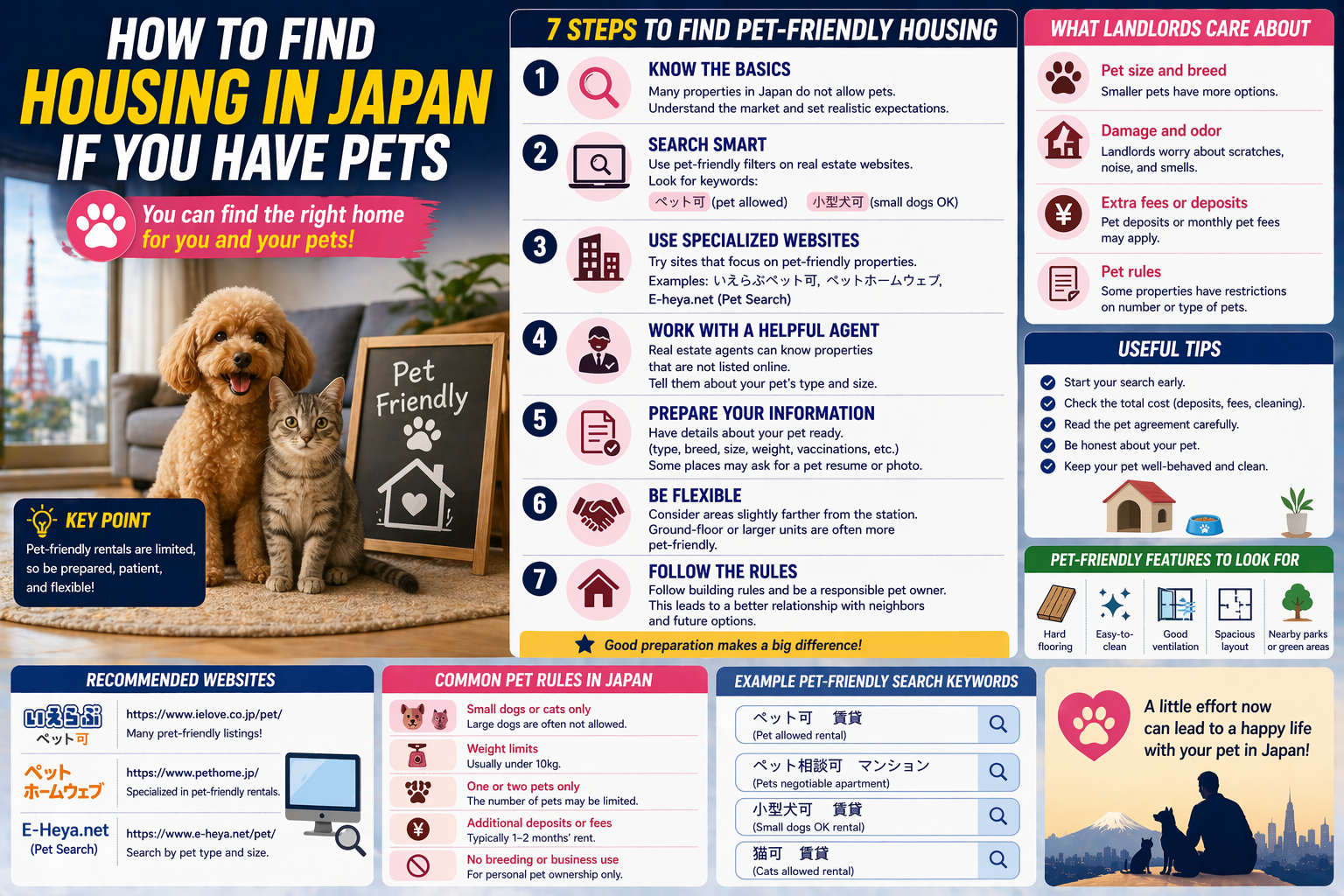
How to Find Housing in Japan If You Have Pets
Short answer: yes, you can find housing in Japan with a pet, but it is usually slower, more expensive, and more rule-heavy than a standard rental search. The biggest difference is not one national law. It is the lease, the building rules, and the landlord’s approval.
If you start with that in mind, you can avoid the most common problem: finding a good apartment first and only then discovering that your dog, cat, or second pet is not allowed.
- Expect fewer listings than the general rental market.
- Expect higher upfront costs in many cases, often through extra deposit or pet-related conditions.
- Check the exact rule for species, size, number of pets, and common-area use before you apply.
- If you have a dog, plan for municipal registration and annual rabies vaccination after you move.
Who This Guide Is For
This guide is for foreign residents, students, workers, and long-term newcomers in Japan who already have a pet or plan to get one soon.
It matters most when you are:
- moving to Japan with a dog or cat
- changing apartments inside Japan
- choosing between a private rental and a public-style option such as UR
- trying to estimate the real cost of a pet-friendly move, not just the advertised rent
Why Pet-Friendly Housing Feels Harder to Find
The basic issue is supply. In a 2025 LIFULL HOME’S survey based on listing data, pet-friendly rentals were still under 20% of listings in March 2025. That helps explain why searches take longer and why good units disappear quickly.
LIFULL also found that pet-friendly listings had a higher average listed rent than non-pet listings. That does not mean every pet-friendly apartment is expensive, but it does mean you should budget beyond the base rent you first see.
ここがポイント: In Japan, a “pet-friendly” search is really a contract search. You are checking not only the room, but also the building rules, the landlord’s tolerance, and the move-out risk.
What “Pet-Friendly” Usually Means in Japan
A lot of confusion comes from labels.
Pet allowed is not the same as any pet is fine
In practice, many listings mean one of these:
Pet allowed: a pet is permitted, but only within stated conditionsPet negotiableorpets upon consultation: the landlord decides case by caseNo pets: do not assume you can persuade the owner later
Common restrictions include:
- dog or cat only
- small dogs only
- one pet only
- weight limits such as around 10 kg
- indoor keeping only
- extra cleaning or restoration charges at move-out
UR’s pet co-living housing shows how detailed these rules can be. In those units, dogs and cats are limited, dogs must meet rabies-related requirements, pets must be kept indoors, and residents must control pets in shared areas. That is one provider’s rule set, not a national standard, but it is a good reminder that “pet-friendly” still comes with precise conditions.
A rented condo may have two layers of rules
If you rent a unit in a condominium building, you may need both:
- the owner’s approval in the lease
- the building management association’s approval under building bylaws
That double check matters. A listing can look pet-friendly at first glance but still block your pet because of the building’s own rules.
Costs You Should Budget For First
This is where many renters get surprised.
Upfront costs are often higher
A common market pattern is:
- deposit increased by one to two months’ rent
- a separate pet deposit in some cases
- higher base rent than a similar non-pet unit
- cleaning or deodorizing charges written into the contract
SUUMO notes that pet-friendly rentals often ask for one to two extra months of deposit, and sometimes more repair costs if the actual damage exceeds the deposit.
Move-out risk matters as much as move-in cost
Japan’s Ministry of Land, Infrastructure, Transport and Tourism says ordinary wear is generally not the tenant’s burden, but damage caused by the tenant’s negligence or use beyond normal living can be charged to the tenant.
For pet owners, that matters because the most disputed items are usually not normal aging. They are things like:
- scratches on walls, doors, or flooring
- urine or other odor that remains after cleaning
- chewed fittings or damaged screens
So when you compare apartments, do not ask only, “Is my pet allowed?” Ask, “What exactly happens to my deposit if odor or scratches remain?”
A Practical Search Process That Works Better
The fastest way to waste time is to search by station, budget, and layout first, then ask about the pet at the end.
A better order is this.
1. Fix the pet conditions before you contact agents
Prepare one simple profile:
- species and breed
- age
- weight
- number of pets
- whether the pet is neutered or spayed
- whether vaccinations are current
- whether the pet is indoor-only
If you have a cat, say so clearly from the start. In Japan, some owners accept small dogs but refuse cats because of scratching or odor concerns.
2. Search with the hard filters first
Use these as your first screen:
- pet allowed or pet negotiable
- building type
- floor material if possible
- distance from park or walking area if you have a dog
- ground-floor or elevator access if carrying a pet is realistic concern
LIFULL HOME’S added more detailed pet condition tags in 2025, including filters such as cat-friendly, dog-friendly, and multi-pet options. That is useful because many listings still hide the real rule behind a broad pet label.
3. Ask five contract questions before you book a viewing
Ask the agent or landlord:
- Which pets are allowed exactly?
- Is there a size or weight limit?
- Is one pet the maximum?
- Are there extra deposits, rent add-ons, or cleaning fees?
- Are there common-area rules for carrying, leashing, or elevator use?
If the answer is vague, treat that as a warning sign.
4. Read the special clauses, not just the headline rent
MLIT’s standard lease is only a model form, and rental terms are based on agreement between landlord and tenant. In practice, the pet rule is often buried in a special clause.
Check for clauses about:
- deodorizing at move-out
- replacing wallpaper or flooring
- keeping pets on balconies
- noise complaints
- unauthorized extra pets
- duty to report a pet after signing
Rules After You Move In
National rules and local rules are different here.
National and building-level points
There is no general nationwide rule that gives tenants a free-standing right to keep pets in ordinary rentals. Whether you can keep one is mainly a matter of the contract and building rules.
That is why moving in with an undeclared pet is risky. It is not just bad manners. It can become a lease problem.
If you have a dog, local procedure matters
For dogs, Japan has public rules beyond the lease.
The Ministry of Health, Labour and Welfare states that dog owners must:
- register the dog with the municipality where they live
- get a rabies vaccination every year
- attach the registration and vaccination tags, unless the municipality uses the microchip special system
Local procedure and fees can vary. For example, Inagi City’s English page shows a 3,000 yen dog registration fee for a new tag when the microchip route does not apply. Your city may use different counters, forms, or notices, so check your municipality after you move.
Microchip rules also matter now
The Environment Ministry says that since June 1, 2022, dogs and cats sold by breeders and pet shops must be microchipped and registered. If you buy or receive a microchipped pet, you need to update the ownership information.
This matters for housing because landlords or managers may ask for proof that your animal is properly identified and managed, especially in stricter buildings.
Regional Differences to Expect
The national contract framework is one thing. The actual search conditions change by area.
In practice:
- central Tokyo and Osaka often have tighter supply and higher rent premiums
- suburban areas may offer more space and easier dog access
- some public or semi-public options such as specific UR properties have their own clearly published pet systems
- condo rentals can be stricter than ordinary apartment buildings because of management bylaws
So do not assume that a rule you saw in Tokyo applies the same way in Sapporo, Fukuoka, or a smaller city.
Common Mistakes Foreign Renters Make
Waiting too long to mention the pet
Tell the agent at the first contact. Hiding it usually wastes everyone’s time.
Treating pet negotiable as approval
It only means the landlord may consider it.
Looking only at rent, not restoration terms
A cheaper unit can become more expensive if the contract shifts cleaning, odor removal, or wall replacement to you.
Forgetting local dog procedures after moving
Even if the building allows your dog, municipal registration and rabies rules still apply.
Assuming one pet rule means two small pets are fine
Many leases are strict on head count, not only size.
Current Points to Watch in 2026
A few recent practical changes matter more than general headlines:
- Detailed pet search filters on major portals have improved, which helps renters narrow by cats, dogs, or multi-pet cases faster.
- Pet-friendly supply has increased in recent years, but it is still a minority segment of the rental market.
- Microchip registration remains part of the compliance picture for many owners, especially after transfer of ownership.
The market is getting a little easier to search, but not necessarily easier to afford.
Final Takeaway
If you have pets, the best housing strategy in Japan is to treat the pet issue as a first filter, not a last-minute question.
Start with the exact animal, the exact building rule, and the exact cost clause. Then compare rent.
That one change in order will save you the most time, the most rejected applications, and the biggest move-out surprises.
Before you sign, check these three things one more time:
- the pet clause in the lease
- the extra deposit or restoration condition
- your municipality’s dog procedures if you are moving with a dog
参照リンク
- MLIT: Standard Rental Housing Contract
- MLIT: Guidelines on Restoration at Move-Out
- MLIT: Download page for the restoration guideline
- UR Rental Housing: Pet Co-Living Housing
- LIFULL: 2025 survey on pet-friendly rentals
- LIFULL: detailed pet search tags update
- MHLW: Rabies information and owner obligations
- MHLW: Dog registration tags and vaccination tags
- Environment Ministry: Dog and cat microchip registration system
- Inagi City: Dog Registration and Rabies Vaccination
- SUUMO: Basic guide to pet-friendly rentals