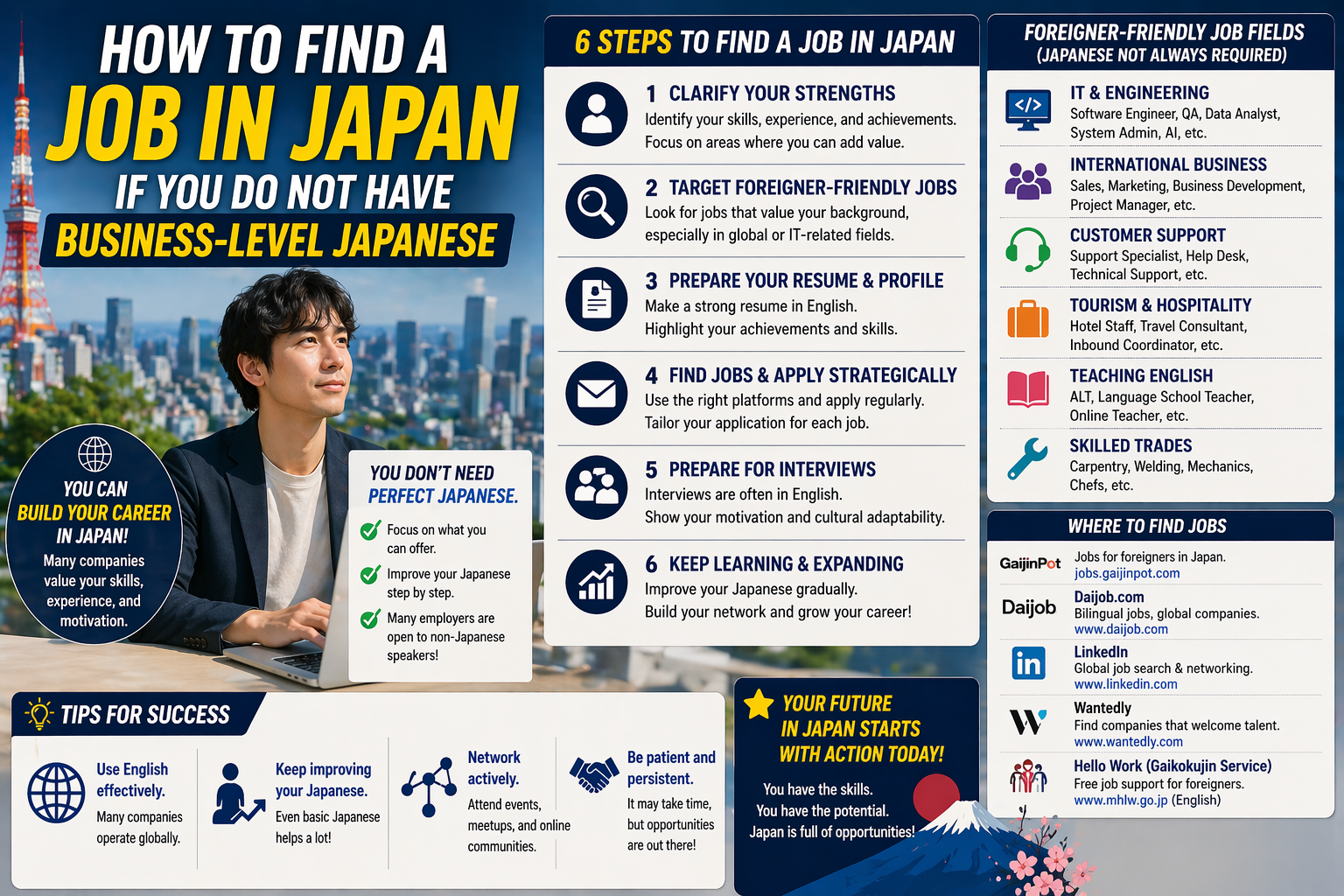
How to Find a Job in Japan If You Do Not Have Business-Level Japanese
Yes, it is possible to find work in Japan without business-level Japanese. The practical route is to target jobs where language is not the main screening tool and to check your visa path before you apply.
That usually means four things: use official foreigner job support, apply to roles that clearly say English or basic Japanese is enough, avoid jobs that need advanced customer-facing Japanese, and make sure the work matches the status of residence you can actually hold.
- You do not need business Japanese for every job in Japan.
- You do need to match the job to your visa and the employer’s real language expectation.
- Students and recent graduates have extra deadlines and status-change steps.
- As of 2026, official support in multiple languages is available through Hello Work and labour hotlines.
Who This Guide Is For
This guide is for foreign job seekers in Japan, international students who want to stay after graduation, and overseas applicants looking at Japan from abroad.
It matters most if your Japanese is around beginner to intermediate level, or if you can manage daily life in Japanese but cannot yet handle meetings, sales calls, or contract discussions at work.
Start With the Two Filters That Matter Most
Before you polish your CV, check these two points first.
1. What status of residence can you use?
Japan does not treat “can I do this job?” and “can I get hired?” as the same question.
Official guidance for international students says some statuses allow broad work rights, while others only allow work in certain fields. For example:
Permanent Resident,Spouse of a Japanese Citizen,Spouse of a Permanent Resident, andLong-term Residentcan work regardless of occupation.Engineer/Specialist in Humanities/International Servicesand similar work statuses only allow certain kinds of jobs.Specified Skilled Workeris its own route with its own tests and field limits.
If you are on a student status, you cannot simply start working because you found a job. You need the right permission for part-time work, and you need a status change for full-time work after graduation.
ここがポイント: If a job looks possible but the visa path does not fit, it is not a real option yet. Check the residence status first, then the job description.
2. What Japanese level does the job actually require?
Many applicants lose time because they read “English-friendly” and assume “no Japanese needed.” That is not the same thing.
Use this rough split when you search:
No Japanese required: realistic for some teaching, tech, research, and international roles.Basic to daily Japanese: possible in some hospitality, food service, manufacturing, and support roles, depending on visa and employer training.N2 or business Japanese: common for office work, domestic sales, back-office coordination, and jobs with heavy internal communication.N1 or near-native: common for legal, HR, public-facing admin, translation-heavy, and advanced client work.
Job Paths That Can Work Without Business-Level Japanese
The best route depends on whether your strength is native-language ability, technical skill, or hands-on work.
Public employment support first
Japan’s public job support is more useful than many first-time applicants expect.
The Ministry of Health, Labour and Welfare says Hello Work provides job consultation and job introductions. A current MHLW flyer also shows foreign-language contact numbers for some offices, with weekday and Saturday hours. If you already live in Japan, that can be the fastest way to ask which office near you can handle foreign-language support.
You should also look at the Tokyo, Nagoya, and Osaka Employment Service Centers for Foreigners if you are a student or a specialist job seeker. The Tokyo center says it supports non-Japanese students and foreign specialists already living in Japan who are seeking work.
Use these offices for:
- checking whether a vacancy fits your current status of residence
- getting help with Japanese-style resumes and application timing
- finding interview events and job fairs
- asking where English or other language support is available
ALT and other language-teaching routes
This is still one of the clearest paths if your Japanese is limited.
The JET Programme FAQ states that you can apply for the ALT role even if you do not speak Japanese. That does not mean Japanese never matters after arrival, but it means business-level Japanese is not the entry requirement.
Important limit:
- JET ALT roles do not require previous Japanese ability.
- JET CIR roles do require a functional command of Japanese at about JLPT N1 or N2 level.
So if you are looking at public or school-based language roles, read the position type carefully. “Teaching in Japan” is not one category.
Specified Skilled Worker routes
For people who want practical work outside the office track, the Specified Skilled Worker route matters.
The Immigration Services Agency’s support site says Specified Skilled Worker (i) generally requires a skills test plus either JFT-Basic or JLPT N4 or higher. That is far below business-level Japanese. But there are field differences:
- taxi and bus driving, and railway operation work, require JLPT N3 or higher
- nursing care has an extra Japanese-language requirement on top of JLPT N4
- changing to a different field is not freely allowed
This route can make sense if you are aiming at sectors with labour shortages, such as accommodation, food service, agriculture, manufacturing-related fields, or other listed sectors.
Tech and international-company roles
This is the strongest non-teaching route for many applicants with solid technical skills.
The rule here is not “Japan does not need Japanese.” The rule is narrower: some employers in tech hire for output first and domestic Japanese communication second. Current tech-focused job boards such as TokyoDev and Japan Dev still list sizable numbers of roles marked “No Japanese required” or “Apply from abroad” as of April 23, 2026.
That does not make tech easy. It means the screening logic is different. If you are a software engineer, data engineer, designer, product specialist, or security engineer, your portfolio, GitHub, shipped work, and interview performance may matter more than JLPT.
If You Are a Student in Japan Now
This is where timing matters more than many students expect.
Official Study in Japan guidance says job hunting for new graduates starts on March 1 of the year before the final grade, and the main recruiting season runs to the middle of June. The same page also notes that some companies still recruit after October, but missing the main cycle makes the search harder.
If you are still on a student status:
- part-time work needs permission to engage in activity outside your status
- full-time work after graduation needs a change of status
- if you do not get a job by graduation, you may be able to continue job hunting under
Designated Activities
Study in Japan says this Designated Activities route is generally granted for six months, with one six-month extension in principle. That gives many graduates a legal way to keep searching inside Japan, but it is not open-ended.
Common Mistakes That Slow People Down
Applying before checking visa fit
A good vacancy is useless if the company cannot sponsor the right status or if the role does not match the status you can change into.
Using only general job boards
If your Japanese is limited, start with places that make the language threshold visible:
- Hello Work and foreigner employment centers
- university career centers
- specialist boards for English-speaking roles
- official support sites for Specified Skilled Worker
Assuming all service work is easier to enter
Some hands-on roles are possible with lower Japanese. Others are not. Customer complaints, safety rules, shift coordination, and local paperwork can push the real language bar much higher than the ad suggests.
Missing the new-graduate calendar
For students, this is a major problem. Japan’s hiring cycle is early and structured. If you begin after graduation without a plan, your options narrow quickly.
Starting work before your status change is complete
Official guidance for students is clear: student status is for study, not unrestricted work. Full-time work needs the correct status. Do not rely on verbal assurances from a recruiter.
Current Status and What Changed Recently
A few current points matter in 2026.
- On January 30, 2026, MHLW said the number of foreign workers reported in Japan had reached 2,571,037, the highest since reporting became mandatory.
- In the same release, the largest residence-status group was the professional and technical category. That matters because it shows the market is not only about factory or trainee roles.
- MHLW’s foreign-worker consultation page says multilingual labour consultations are available in 13 languages, based on information current as of April 2026.
- A current Hello Work multilingual contact flyer lists language-specific phone lines and Saturday calling hours for some offices.
These updates do not mean employers lowered their standards across the board. They do mean the support system for foreign applicants is active, and the number of foreign workers in Japan is still growing.
What To Do This Week
If you want the fastest practical start, do this in order:
- Write down your current or target residence status.
- Pick one job lane: teaching, tech, Specified Skilled Worker, or general local job search.
- Set a hard language filter for your search:
no Japanese,basic Japanese,N3, orN2+. - Register with Hello Work or the nearest foreigner employment support office.
- Prepare one English CV and, if possible, one Japanese-style resume.
- Apply only to roles where your language level and visa path both make sense.
If you are in Japan already, the biggest advantage is not just location. It is your ability to use the public support system, attend interviews quickly, and fix mistakes before your status deadline arrives.
参照リンク
- Study in Japan: Employment in Japan
- Study in Japan: Job Hunting Schedule
- Study in Japan: Status of Residence
- Study in Japan: Status of Residence While Residing in Japan
- Tokyo Employment Service Center for Foreigners
- MHLW: Employment Policy for Foreign Workers
- MHLW: Hello Work foreign-language contact flyer (PDF)
- MHLW: Counseling Services and Hotlines in Foreign Languages
- MHLW: Summary of Foreign Employment Notification Status as of October 31, 2025
- Immigration Services Agency: Steps to Working in Japan under Specified Skilled Worker
- JET Programme: Eligibility
- JET Programme: FAQ
- TokyoDev: No Japanese Required Jobs
- Japan Dev