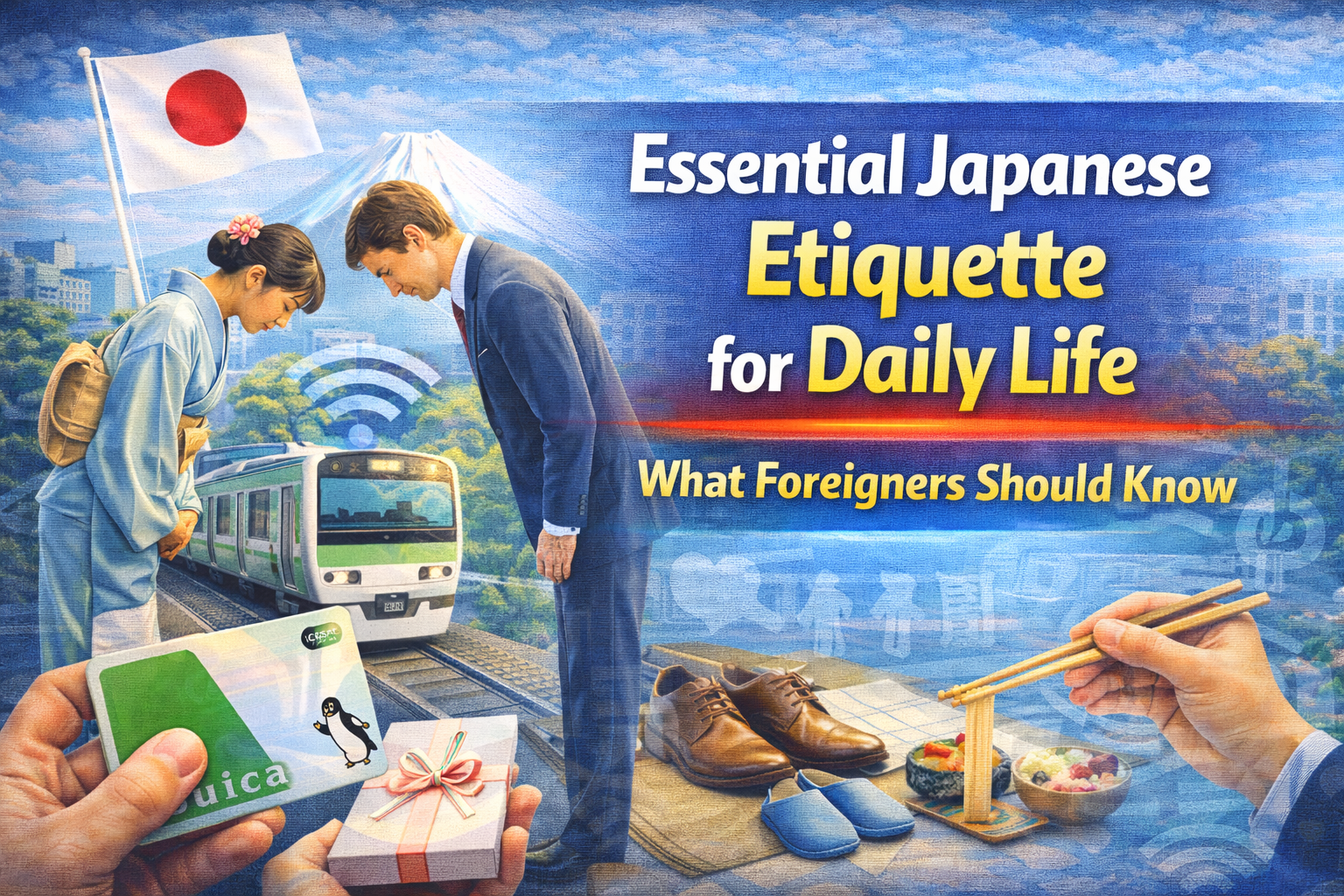
Essential Japanese Etiquette for Daily Life: What Foreigners Should Know
The short answer: in Japan, good everyday etiquette usually means not making other people adjust to you. Keep shared spaces calm, follow posted rules, sort your trash, avoid phone calls on trains, smoke only where allowed, and check local rules in crowded districts.
This guide is for tourists, students, workers, and new residents who want to avoid the mistakes that cause real friction in daily life. Some manners are customs, not laws. Others, such as smoking rules and bicycle traffic rules, can involve local ordinances or fines.
Quick essentials
- On trains and buses, keep your phone silent and avoid calls.
- In homes, some restaurants, temples, clinics, fitting rooms, and ryokan, take off your shoes when asked.
- Do not assume you can smoke, drink, park a bicycle, or leave trash anywhere; signs and local rules matter.
- From April 1, 2026, Japan’s bicycle traffic infraction system applies to cyclists, so bike manners are also a legal issue.
The Basic Idea: Shared Space Comes First
Japanese daily etiquette is less about memorizing formal rules and more about reading the space around you.
In a station, that means lining up where the platform markings tell you to stand. In a restaurant, it means keeping your group from blocking the entrance. In a residential area, it means not treating a quiet street like a nightlife zone.
A useful rule is simple: if your action creates noise, smoke, trash, delay, or confusion for others, pause and check what locals are doing.
The Japan Tourism Agency’s responsible travel guidance also points visitors toward the same idea: learn the local setting, avoid crowding, do not litter, respect private property, and be careful with photography. That advice is not only for sightseeing. It also helps in daily life around stations, shopping streets, apartment buildings, parks, and schools.
Public Transport: Quiet, Orderly, and Fast-Moving
Trains and buses are where many newcomers notice Japanese etiquette first. The rules are practical: huge numbers of people need to move through narrow spaces without arguments.
Phones and Conversation
On trains and buses, set your phone to silent mode and avoid voice calls. Talking quietly with a friend is usually fine, but loud calls, speakerphone use, and video calls stand out quickly.
Tokyo Metro’s passenger manners guidance also asks riders to be careful with smartphones, luggage, boarding, door areas, and priority seats. These are not abstract politeness points. They keep crowded cars moving.
Do this:
- Put your phone on silent mode.
- Use headphones at a low volume.
- Step off or wait until after the ride if you need to make a call.
- Avoid blocking doors while looking at your phone.
Boarding and Luggage
Let people get off before you board. Stand in the marked queue lines when they exist. If you are near the door and the train is crowded, step out briefly to let others pass, then get back on.
Large backpacks and suitcases are a common source of irritation in busy cities. Hold a backpack in front of you, place it on a rack if possible, or keep it low by your feet. In rush hour, a suitcase can block people from leaving the train, so avoid peak commuting times when you can.
Priority Seats
Priority seats are for people who need them, including older passengers, pregnant passengers, injured passengers, disabled passengers, and adults with small children. If you are sitting there and someone nearby may need the seat, offer it or move before being asked.
Streets, Smoking, Trash, and Drinking
Street etiquette changes a lot by city and district. What feels casual in one country may be restricted in parts of Japan, especially near stations and tourist areas.
Smoking Is Often Restricted
Japan has national rules against unwanted exposure to secondhand smoke, and local governments add their own rules for outdoor areas. In Tokyo, the metropolitan government’s English smoking guide says smoking is not allowed in many outdoor areas such as sightseeing spots, streets around stations, and crowded areas under local ordinances. Indoors, many public spaces, stations, trains, buses, taxis, hospitals, universities, stores, and buildings are no-smoking areas, with smoking allowed only in designated rooms or permitted hotel rooms.
For daily life, the practical rule is clear: do not smoke while walking. Use a marked smoking area.
This matters because smoking rules can change from ward to ward. A street near a station in Tokyo may be covered by a local ordinance even if another street elsewhere is not. If you smoke, look for official signs, smoking rooms, or public smoking areas.
Trash: Carry It Until You Find the Right Bin
Japan has few public trash bins compared with many countries. That does not mean you can leave bottles, wrappers, or coffee cups on benches, station ledges, or vending machine corners.
Carry a small bag for trash. Dispose of cans, plastic bottles, burnable waste, and other items in the correct bins when available. Rules for household trash are even more local: your city or ward decides collection days, bag types, and sorting details.
For residents, ask your apartment manager, city office, or ward website for the local trash guide. Putting the wrong trash out on the wrong day is one of the fastest ways to create trouble in an apartment building.
Street Drinking Can Be Locally Restricted
Public drinking is not nationally banned in every public space, but local restrictions matter. In Shibuya, Tokyo, an official English notice says drinking alcohol is banned from 6 p.m. to 5 a.m. daily in public spaces such as streets, parks, and areas around Shibuya Station, effective October 1, 2024.
That does not mean every city has the same rule. It means crowded nightlife and tourist districts may set stricter rules when litter, noise, and blocked streets become a problem.
Before drinking outside, check:
- Are there signs banning alcohol in the area?
- Is this a station square, shopping street, park, or tourist spot?
- Are police, ward staff, or security patrols giving instructions?
- Is there a bar, izakaya, or event space where drinking is clearly allowed?
Shoes, Homes, Restaurants, and Indoor Spaces
Taking off shoes is one of the most visible daily manners in Japan. The rule is not limited to private homes.
You may need to remove shoes at:
- Homes and some share houses
- Ryokan and some guesthouses
- Some temples and shrines
- Some clinics, schools, and childcare facilities
- Japanese-style restaurants with tatami seating
- Fitting rooms in clothing stores
Look for a step up at the entrance, shoe shelves, slippers, or signs. If slippers are provided, use them indoors. In many places, toilet slippers are only for the toilet area, so do not walk back into the room wearing them.
When visiting someone’s home, keep socks clean and avoid stepping on the indoor floor with outdoor shoes. If you are unsure, ask: “Should I take off my shoes here?”
Restaurants and Shops: Small Signals Matter
Restaurant etiquette in Japan is usually simple, but a few habits help.
Before eating, many people say “itadakimasu.” After the meal, they may say “gochisosama desu.” You do not have to perform these phrases perfectly, but using them politely is welcome.
Dining Basics
In casual restaurants, staff may guide you to a seat, or you may need to buy a meal ticket from a machine. At izakaya, small shared dishes are common. At nicer restaurants, wait for everyone at the table to receive food before starting unless the group tells you to begin.
Avoid these common mistakes:
- Sticking chopsticks upright in rice
- Passing food directly from chopsticks to chopsticks
- Pouring soy sauce over everything before tasting
- Leaving a table messy when trays or return counters are clearly provided
- Assuming leftovers can always be taken home
JNTO notes that taking home leftovers is generally not accepted in many Japanese dining settings, although practices vary by restaurant. If you need to ask, ask politely before ordering too much.
Convenience Stores and Counters
At convenience stores, place your basket on the counter, wait for the staff to scan, and pay using the tray or payment terminal when provided. If a line forms, join it instead of standing beside the register.
In small shops, do not open sealed products before paying. In markets or food halls, check whether eating on the spot is allowed before walking away with open food.
Bicycles: Etiquette Is Now More Than Etiquette
Cycling is a daily tool for students, workers, parents, and tourists using rentals. It is also an area where foreign residents can get into trouble because local habits may look relaxed while the law is stricter.
Japan treats bicycles as vehicles under traffic rules. The basic rule is that bicycles use the roadway, keep left, and use sidewalks only in allowed cases. Aichi Prefecture’s English traffic guidance, for example, explains that riding on the road is the norm, sidewalks are the exception, pedestrians have right-of-way on sidewalks, and cyclists should not ride while using a phone or holding an umbrella.
The April 2026 Update
As of April 1, 2026, Japan’s National Police Agency says the traffic infraction notification system, often called the “blue ticket” system, applies to bicycles. Tokyo Metropolitan Police also provides English information on cyclists being issued tickets for traffic offences.
For foreign residents and visitors using bikes, this makes several everyday habits riskier:
- Looking at a smartphone while riding
- Ignoring red lights or stop signs
- Riding the wrong way on the road
- Riding too fast or carelessly on sidewalks
- Riding after drinking alcohol
- Riding with an umbrella in one hand
- Parking in no-parking areas near stations
Key point: If you use a bicycle in Japan, treat it like a vehicle, not a toy. Slow down near pedestrians, keep left on roads, obey signals, and check local bicycle parking rules before leaving the bike.
Rental bike users should be especially careful because they may not know the area. A short ride from a station to a hotel can still pass through one-way streets, busy sidewalks, and no-parking zones.
Photos, Private Property, and Crowded Places
Photography is another area where manners and rules overlap. In tourist areas, shops, museums, temples, shrines, schools, and residential streets, signs may limit photos or videos.
Do not photograph people at close range without permission. Do not enter private alleys, gardens, farms, stairways, or apartment grounds for a better picture. The Japan Tourism Agency’s responsible travel guidance specifically tells travelers to be considerate with photos and to stay off private property.
This matters for long-term residents too. A quiet neighborhood is not a stage set. If you live near a famous street, shrine, school route, or old shopping arcade, your daily behavior affects people who are not part of your trip or social media post.
Regional Differences: Check the Local Rule, Not Only the National Habit
Some etiquette is common across Japan, but many rules are local. This is where visitors and new residents often make wrong assumptions.
Examples:
- Trash sorting differs by municipality. One city may require clear bags; another may require designated paid bags.
- Smoking areas differ by ward, city, building, and facility.
- Street drinking restrictions may apply in specific entertainment districts or event periods.
- Bicycle parking rules are often strict near stations, and illegally parked bicycles may be removed.
- Public transport manners can differ slightly by operator, route, and crowding level.
If a sign, staff member, station announcement, police officer, or local patrol gives instructions, follow that instruction even if you saw different behavior elsewhere.
Common Mistakes Foreigners Can Avoid
Most problems come from assuming that “everyone does it” means “it is allowed.” In Japan, local enforcement may be light in one place and strict in another.
Watch for these mistakes:
- Taking phone calls on trains because the car is not full
- Walking while smoking because there is no obvious smoking booth nearby
- Leaving trash beside a vending machine or convenience store bin
- Standing in front of train doors after boarding
- Wearing outdoor shoes past the entrance step
- Drinking on the street in districts with local bans
- Riding a bicycle on the wrong side of the road
- Parking a bike outside a station without checking signs
- Taking photos into homes, schools, shops, or private property
A safe habit is to slow down and look for three things: signs, queues, and what staff are asking people to do.
FAQ
Do I need to bow all the time?
No. A small nod or polite greeting is enough in most daily situations. Deep formal bows are not needed for normal shopping, train travel, or restaurant visits.
Is it rude to eat while walking?
It depends on the place. Around festivals, markets, and food stalls, there may be designated spots or an expected area for eating. On ordinary streets, trains, and crowded shopping areas, walking while eating can be seen as messy or inconsiderate. Check the area and avoid leaving trash behind.
Can I use English if I do not speak Japanese?
Yes, but keep it simple and polite. “Sumimasen” for excuse me, “arigato gozaimasu” for thank you, and pointing to written information can help. In official procedures, transport problems, medical settings, and contracts, use official multilingual support when available.
Are these etiquette rules the same for tourists and residents?
The basic manners are the same, but residents have extra responsibilities. If you live in Japan, trash sorting, bicycle parking, apartment noise, neighborhood rules, and local notices affect your daily life more directly.
Practical Takeaway
Japanese etiquette is not about acting perfectly Japanese. It is about making shared spaces work: quiet trains, clean streets, safe bicycles, clear queues, and fewer problems for people who live and work there.
Before you act in public, check the setting:
- Is this a quiet shared space?
- Is there a sign or marked area?
- Could this create noise, smoke, trash, delay, or danger?
- Is the rule national, local, operator-specific, or just common practice?
That habit will prevent more mistakes than memorizing a long list of manners.
参照リンク
- Japan National Tourism Organization: Japanese Manners Do’s and Don’ts
- Japan National Tourism Organization: Understanding and Mastering Japanese Manners and Etiquette
- Japan Tourism Agency: Travel Etiquette for the Future
- JNTO: Responsible Travel Guide
- Tokyo Metro: Good Manners When Using Subways
- GO TOKYO: Customs & Manners
- Tokyo Metropolitan Government: Know Tokyo’s Smoking Rules
- Japanese Law Translation: Health Promotion Act
- Shibuya City: Street Drinking Ban Notice
- Aichi Prefectural Government: Traffic Rules
- National Police Agency: New Bicycle System
- Tokyo Metropolitan Police Department: Cyclists Will Be Issued With Tickets for Traffic Offences