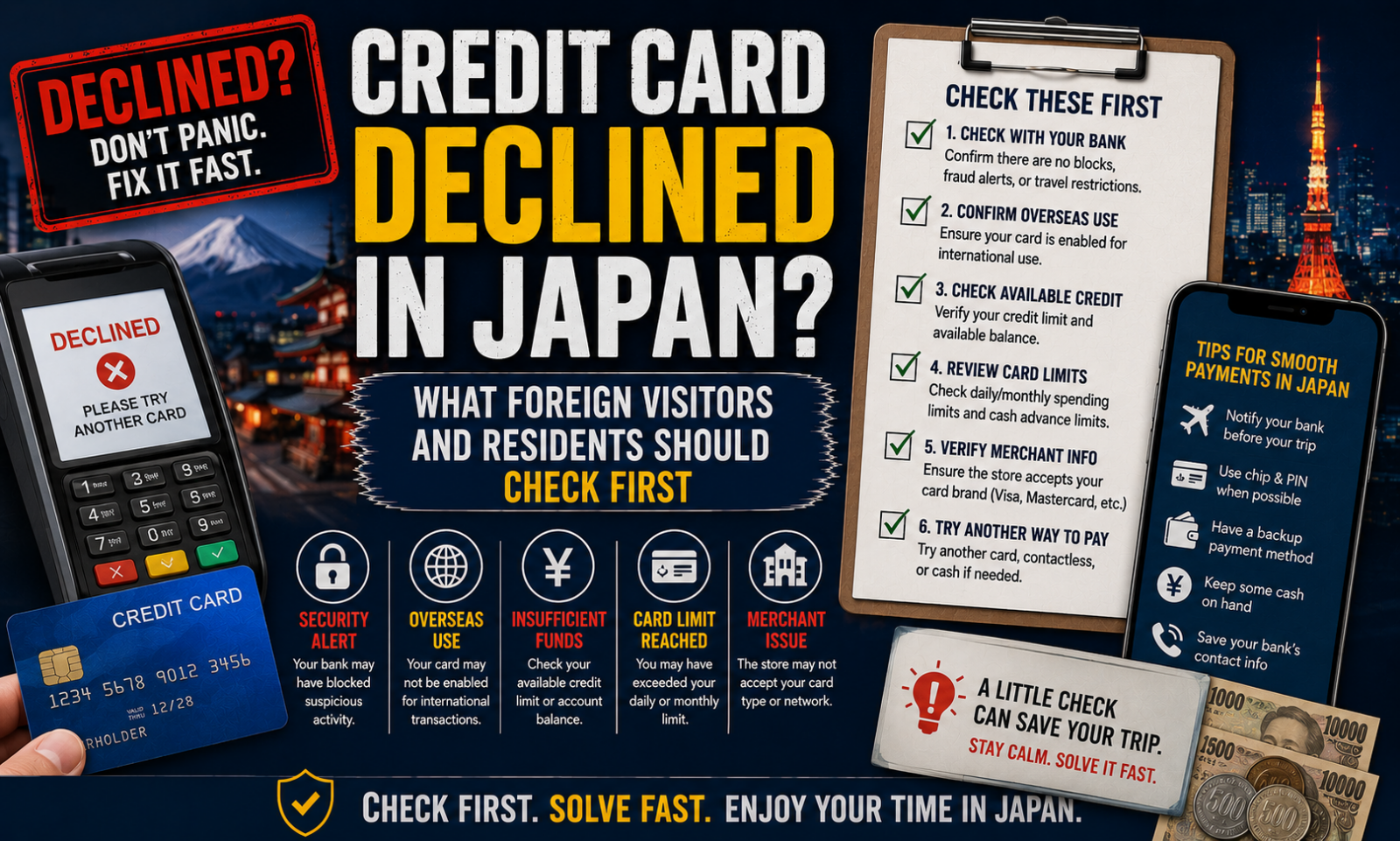
Credit Card Declined in Japan? What Foreign Visitors and Residents Should Check First
If your credit card is being rejected across Japan, treat it first as an issuer or authentication problem, not as a Japan-wide mystery. In practice, the fastest fixes are to check whether your bank has blocked overseas use, confirm that your online authentication settings work, and make sure you still have a cash fallback.
Japan is much more cashless than it used to be, but it is not fully card-friendly in every situation. That matters for travelers, students, and long-term residents alike, because a card can fail for very different reasons at a hotel desk, a train website, a small restaurant, or an ATM.
- If the card fails at many unrelated places, contact the card issuer first.
- If it fails mainly on websites or apps, check 3-D Secure / issuer authentication right away.
- If you need money today, try an ATM that accepts overseas cards, such as Seven Bank or Japan Post Bank, if your card allows it.
- Keep some cash, especially outside large city centers or when you rely on small shops and rural transport.
Who This Guide Is For
This guide is for foreign tourists, students, workers, and residents in Japan who suddenly cannot use a credit card in stores, online checkouts, or both.
It matters most when you are trying to pay for practical daily needs such as hotels, transport, food, online bookings, or emergency purchases.
First, Check Whether It Is Really “Everywhere”
Before you panic, separate a single-store problem from a full card problem.
It may be a local merchant issue if:
- The card works at a convenience store but not at one restaurant or one ticket machine.
- One brand is accepted, but your card brand is not.
- Contactless payment fails, but the merchant may still accept chip insertion or another payment method.
It is more likely an issuer-side problem if:
- The card fails at several unrelated stores.
- The same card also fails online.
- Your banking app shows a fraud alert, verification request, or temporary block.
It is more likely an online authentication problem if:
- In-store payments still work.
- Website or app payments fail during the final verification step.
- You never receive the one-time code, app approval, or other identity check.
The Fastest Recovery Steps
Start with the steps that can get you paying again within minutes.
1. Stop repeating the same failed payment
Multiple retries can make a fraud system more suspicious. One retry is reasonable. Ten retries are not.
2. Open your issuer app or online account
Look for:
- A travel or overseas-use block
- A card lock you turned on earlier
- A fraud alert asking you to confirm a purchase
- Expired card details or a replaced card number stored in an app
Visa says the issuer or bank is the best place to ask for the exact decline reason. That is usually true in Japan too, because the store often cannot see more than a generic failure message.
3. Call the number on the back of the card
Ask a very direct question: “Why is this card being declined in Japan right now?”
Then ask which of these applies:
- Overseas transactions blocked
- Card-not-present or e-commerce blocked
- 3-D Secure authentication failed
- Cash advance disabled
- Suspicious activity hold
- Merchant category blocked
That saves time. A vague “it does not work” call often gets vague answers back.
4. Move to a cash fallback immediately if you need essentials
If your card allows cash withdrawal or cash advance, you may still be able to get yen from an ATM even when a shop purchase fails.
Useful backup options include:
- Seven Bank ATMs at 7-Eleven and other locations
- Japan Post Bank ATMs
- A second card from a different issuer or network
- Cash to charge transport or pay for short-term basics
Seven Bank and Japan Post Bank both publish support for major overseas card networks, but they also note that some cards may still not be accepted. So this is a strong fallback, not a guarantee.
Why Cards Get Rejected in Japan
The reason matters, because the fix is different in each case.
Online payments now fail more often when authentication is not ready
This is one of the biggest current changes.
Japan’s Ministry of Economy, Trade and Industry has been pushing stronger credit card security measures, and official guidance has required almost all e-commerce merchants to move toward EMV 3-D Secure by the end of March 2025. METI also warned card users that a card without identity-verification setup may become unusable on some online shopping sites.
In plain terms, that means your card may be fine, but the checkout still fails because:
- You are not enrolled in your issuer’s authentication service
- Your SMS or email code never arrives
- Your banking app cannot approve the purchase
- Your issuer sees the transaction as risky and stops it
This especially matters for foreign readers who use overseas phone numbers, old email addresses, or an app they cannot log into while abroad.
Japan is more cashless now, but not universally card-friendly
METI said Japan’s cashless payment ratio reached 58.0% in 2025, with credit cards taking the largest share. That shows card use is mainstream.
But mainstream is not the same as universal. The Japan National Tourism Organization still warns that many places, especially in rural areas, may require cash. It also notes that some overseas smartphone payment methods may not work in Japan.
That is why a card can fail for two completely different reasons on the same day:
- One merchant does not really support your payment method
- Another merchant supports it, but your issuer rejects the transaction
Fraud systems may pause a card after unusual overseas use
Card issuers monitor transactions for suspicious patterns. JCB, for example, says it watches for abnormal use around the clock and may temporarily stop use while confirming the transaction.
Even if your own card was not issued by JCB, the practical lesson is the same: a burst of unfamiliar activity in Japan can trigger a protective block.
Typical triggers include:
- First use in Japan after no travel history
- Several transactions in a short time
- Online purchases immediately after arrival
- Large hotel, electronics, or ticket charges
Common Mistakes That Make the Problem Worse
A rejected card often turns into a bigger problem because of simple setup gaps.
- Traveling or moving to Japan with only one card
- Forgetting the card PIN and relying only on contactless payment
- Using an old phone number or email for one-time codes
- Assuming Apple Pay, Google Pay, or another overseas wallet will work everywhere
- Going to rural areas without enough cash
- Saving one card in multiple apps and never updating it after replacement
What Has Changed Recently
ここがポイント: Online card payments in Japan are now more likely to require issuer-side identity checks than they were a few years ago, so a card that “works physically” may still fail on Japanese websites and apps.
The practical change for foreigners is clear:
- A card problem in Japan is no longer only about card brand acceptance.
- It is also about whether your issuer can verify you in real time.
- If your phone, email, banking app, or 3-D Secure setup is weak, online payments are more likely to break.
If You Live in Japan Long Term
Short-term workarounds help, but residents should harden their setup.
Build a safer payment backup
- Keep at least two payment methods from different issuers or networks.
- Keep enough cash for transport, food, and one night of urgent expenses.
- Do not rely only on a foreign mobile wallet.
Make authentication easier
- Update your current phone number and email with your issuer.
- Make sure you can receive SMS or app approval while in Japan.
- Test one online transaction before you urgently need it.
Plan for transport and daily life
If a card issue happens on a travel day, cash still solves many problems quickly. JNTO notes that IC travel cards are commonly used, but charging them at ticket machines is often cash-only. That makes a small yen reserve more useful than many people expect.
Bottom Line
If your credit card is being rejected across Japan, the most likely answer is not that Japan has suddenly stopped accepting cards. The real issue is usually one of three things: issuer fraud controls, missing online authentication, or a merchant that does not support your payment method well.
Check the issuer first. Secure a cash fallback second. Then fix your authentication setup before the next urgent payment.
Watch these points in particular:
- Whether your card fails only online or also in stores
- Whether your issuer can reach you by app, SMS, or email
- Whether you still have access to cash in yen today
- Whether your backup payment method is on a different network or issuer
If you solve those four points, most “my card is rejected everywhere in Japan” cases become manageable very quickly.
参照リンク
- METI: 2025 cashless payment ratio in Japan
- METI: Set up 3-D Secure for safer credit card use
- METI: Credit Card Security Guidelines revised in March 2025
- METI: 2024 revision note on EMV 3-D Secure rollout by end of March 2025
- JNTO: Cashless Payments in Japan
- Visa Consumer Support: Why was my card declined?
- Visa Travel Support
- Seven Bank: Overseas Cards Usable at ATMs
- Japan Post Bank: International ATM Service
- JCB: 3D Secure and temporary stops for suspicious use