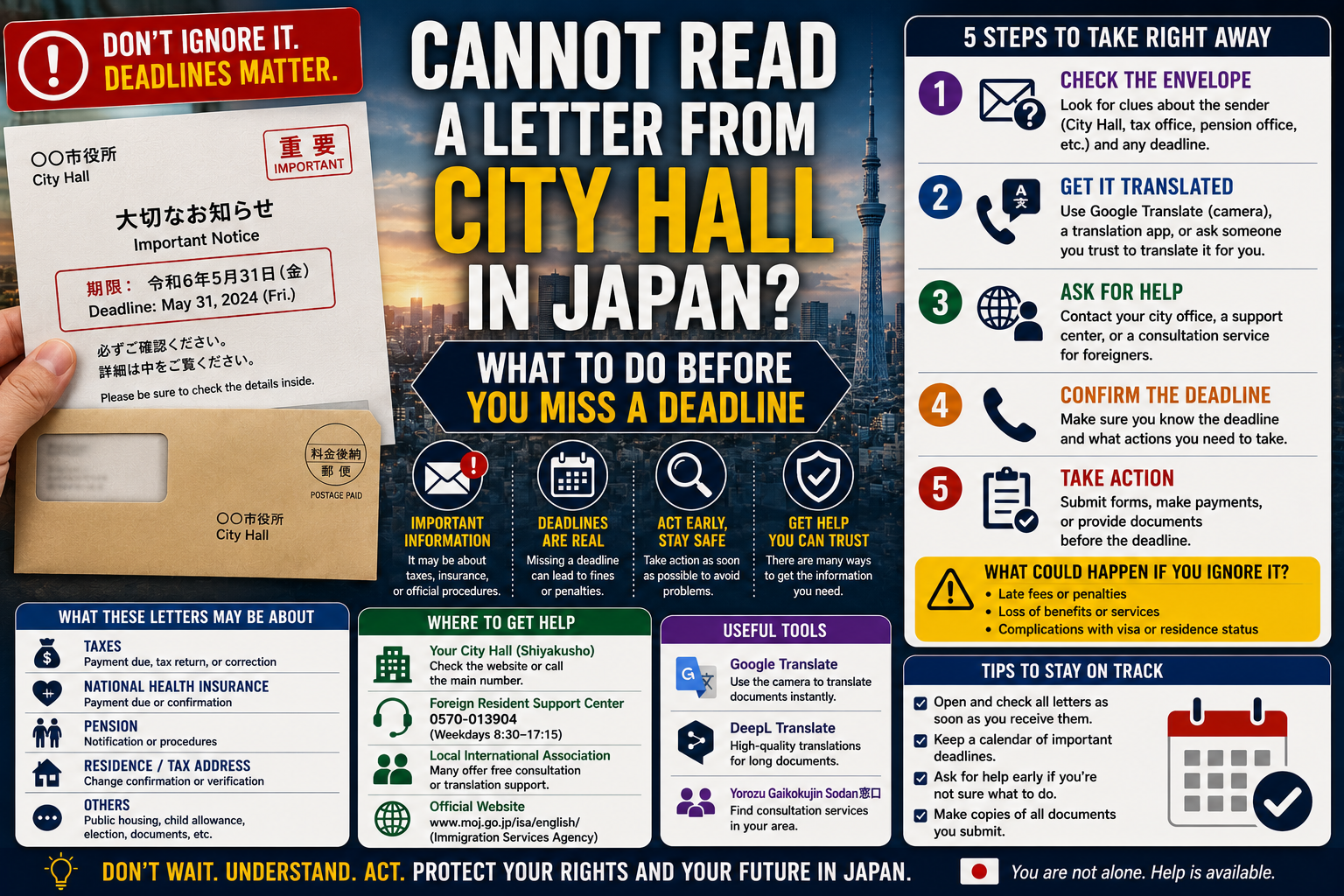
Cannot Read a Letter From City Hall in Japan? What to Do Before You Miss a Deadline
If you get a letter from city hall and cannot understand it, do not ignore it and do not pay blindly. First, check who sent it, find the deadline, and take the letter to the right office or consultation service as soon as possible.
Many city-hall letters in Japan are routine, but some are time-sensitive. A notice may be about resident tax, National Health Insurance, pension, moving procedures, childcare, or a request for missing documents. The risk is usually not the Japanese itself. The risk is missing the date.
This guide is for foreign residents, students, workers, and beginners who receive mail from a city, ward, or town office and are not sure what it means.
- Check the sender, deadline, and enclosed payment slips first.
- Do not throw away the envelope. It often shows the department name and contact details.
- Ask the city office or a foreign-resident consultation desk before the due date.
- If the letter is about tax, insurance, or pension, late action can create bigger problems later.
Start here: the fastest safe response
You do not need to understand every sentence before you act. You need to identify the type of letter.
1. Look for these items first
- Sender name: city hall, ward office, tax division, insurance division, pension office, school division
- Deadline words:
納期限,期限,至急,回答,提出 - Money words:
納付書,請求,督促,未納 - Topic words:
住民税or市民税・県民税= resident tax国民健康保険= National Health Insurance国民年金= National Pensionマイナンバー= My Number資格確認書= eligibility confirmation document
2. Keep everything together
Bring or save:
- The envelope
- Every page inside
- Any payment slip or barcode sheet
- Any reply form
- A photo or scan on your phone
The envelope matters because the back or front often shows the exact department and phone number.
3. Do one quick translation pass
Use your phone camera or browser translation to get the rough topic. That is enough for the first step. Do not rely on machine translation alone if the letter asks for payment, documents, or a visit to the office.
ここがポイント: If the letter includes a date, an amount of money, or a reply form, treat it as urgent until a real person confirms otherwise.
Which letters matter most
Some city-hall mail is informational. Some mail creates a deadline or a legal duty.
Resident tax notices
A very common letter is a resident tax notice.
Official local guidance explains why this surprises many foreign residents:
- Resident tax is based on the previous year’s income.
- It is generally charged by the municipality where you lived on January 1.
- If you move out later in the year, that usually does not cancel that year’s bill from that municipality.
- Some cities send tax notices around early June.
This is why a letter can arrive after you moved, changed jobs, or thought your tax was already handled.
National Health Insurance letters
Health-insurance mail also needs attention.
National rules say that if you live in Japan with an address and are not covered by another public health insurance plan, you may need to join National Health Insurance. The Ministry of Health, Labour and Welfare also says enrollment or withdrawal procedures often must be filed within 14 days with your municipality.
A city-hall letter may therefore be about:
- Enrollment
- Premium payment
- A missed procedure after moving in or leaving a job
- A qualification document or card-related notice
Pension notices
Pension letters are easy to postpone because they look administrative. That can be a mistake.
The Japan Pension Service provides multilingual consultation, and one of its 2026 foreign-resident notice leaflets says that if unpaid National Pension contributions are left without action, it may affect your status of residence. That is exactly the kind of letter you should not leave in a drawer.
Other municipal letters
Depending on your city, you may also get notices about:
- My Number card procedures
- Childcare or school enrollment
- Vaccination or health checkups
- Garbage sorting schedules or local-rule changes
- Certificate issuance or missing resident-record documents
These are usually local, not national. The rules and forms can vary by municipality.
Who to ask, in the right order
You do not always need a lawyer. In most cases, start with the office that sent the letter.
1. The department named on the letter
This is usually the fastest option. If the letter says Tax Division, Insurance and Pension Division, or Resident Affairs Division, contact that office directly.
Say something simple:
- “I received this letter and I do not understand Japanese well.”
- “Can you explain the deadline and what I need to bring?”
- “Is English support available?”
2. Your city or ward’s foreign resident consultation service
Many municipalities or local international associations have multilingual consultation desks. Services differ by city, but some can explain daily-life procedures, interpret by phone, or connect you to city offices.
A clear example is Yokohama’s Foreign Residents Information Center. As of April 1, 2026, it says consultations are free, available in 12 languages, and it can also connect callers to ward offices.
That matters because it shows what to search for in your own area:
[your city name] foreign resident consultation[your ward name] multilingual consultation[your city name] international association
3. National support services for foreign residents
If you are not sure where to start, Japan’s Immigration Services Agency runs national consultation services.
Its official consultation page says foreign residents can use:
- The Foreign Residents Information Center
- One-Stop Consultation Centers linked with local governments
- FRESC, the Foreign Residents Support Center
These are useful when your problem crosses several topics, such as residence status, work, and local procedures.
4. Pension or legal specialists when needed
Use a specialist line if the letter is clearly about a specialist issue.
- Pension letter: contact the Japan Pension Service multilingual consultation service.
- Legal dispute, debt collection, or rights issue: contact Houterasu’s Multilingual Information Service.
Houterasu does not replace city hall, but it helps when the problem is no longer just “What does this form say?” and becomes “What are my options under Japanese law?”
What to bring when you go to city hall
Do not arrive empty-handed and hope the staff can guess.
Bring:
- The full letter set and envelope
- Your residence card
- Your My Number card, if you have one and the letter seems related
- Your health insurance card or qualification document, if the topic is insurance
- Proof of income or employment, if the topic is tax or insurance
- A phone with translation support
- A Japanese-speaking friend or school/work staff member, if available
If you cannot visit in person, call first and ask whether they can handle the issue by phone, email, or online form.
Common mistakes to avoid
These mistakes create bigger problems than the letter itself.
- Ignoring the notice because it looks official and difficult
- Paying immediately without knowing what the bill is for
- Throwing away the envelope or attached payment slip
- Assuming a move to another city canceled the tax bill
- Assuming your employer handles everything automatically
- Missing a letter about pension or insurance because the amount looks small
- Waiting until after the deadline to ask for language help
National rules and local differences
This is the part many readers need to keep straight.
National rules
These usually come from national systems, even if the letter arrives through a local office:
- National Health Insurance basic eligibility framework
- National Pension obligations and consultation channels
- Immigration-related support services for foreign residents
Local rules or local operations
These often vary by municipality:
- How notices are formatted
- Which languages are available
- Whether interpretation is offered by phone or in person
- Garbage, child services, school notices, and some certificate procedures
- Exact office names and opening hours
So the right habit is not just “translate the letter.” It is identify whether the issue is national or local, then ask the correct office.
Current update to know in 2026
As of May 8, 2026, the Immigration Services Agency’s Foreign Residents Support Portal is active and shows recent updates, including the publication of the 8th edition of its living and work guidebook on February 26, 2026. That guidebook and portal are useful starting points when a city-hall letter touches broader life procedures in Japan.
This does not mean your municipality uses the same forms or languages. It means there is now a current national reference point you can compare against before or after you speak to your local office.
The practical takeaway
If you cannot read a letter from city hall in Japan, the correct first move is simple: do not ignore it, do not panic, and do not guess.
Check the sender, find the deadline, keep the envelope, and ask the sending office or a multilingual consultation desk while there is still time. That is especially important for resident tax, National Health Insurance, and pension notices, because those are the letters most likely to keep causing trouble after you stop looking at them.
Before the next letter arrives, it is worth saving one thing in your phone now: the consultation page for your municipality or the nearest foreign resident support center.
参照リンク
- Immigration Services Agency: Consultation Services for Foreign Residents
- Immigration Services Agency: Consultation Desk Overview
- Immigration Services Agency: Foreign Residents Support Portal
- Immigration Services Agency: Foreign Residents Support Center (FRESC)
- Yokohama City: Foreign Residents Information Center
- Yokohama City: Taxes
- Toshima City: Taxation for Foreign Residents
- Ministry of Health, Labour and Welfare: National Health Insurance System
- Ministry of Health, Labour and Welfare: Enrollment and Withdrawal for National Health Insurance
- Japan Pension Service: Consultations in Multiple Languages
- Japan Pension Service: Notice for Foreign Residents About Pension Exemption and Action on Unpaid Contributions
- Japan Pension Service: National Pension Information for Foreign Residents
- Houterasu: Multilingual Information Service
- Government of Japan: Consultation Contacts for Foreign Residents and Multilingual Legal Support