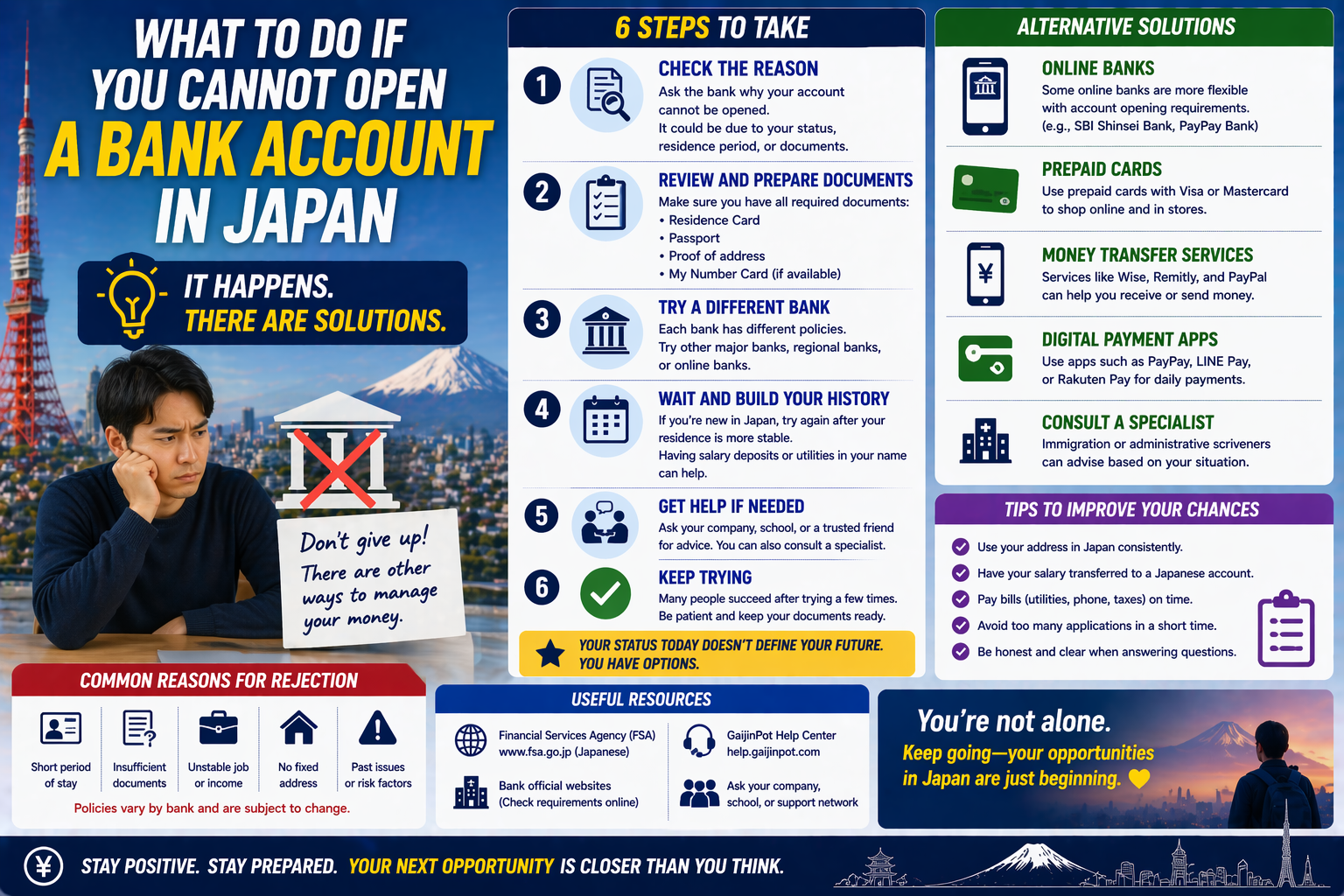
What to Do If You Cannot Open a Bank Account in Japan
If a bank in Japan will not open an account for you, do not keep applying blindly. First, ask which requirement failed, then fix that specific issue and apply again at a bank that matches your situation.
In many cases, the problem is not that you are a foreign resident. The problem is one of these: your residence card is close to expiry, your address does not match your ID, the bank cannot confirm your work or school status, or you do not meet that bank’s residency rules.
This guide is for students, workers, and new residents who need a Japanese account for salary, rent, utilities, or daily payments.
- Ask the bank for the exact reason for rejection.
- Check your residence card expiry date, registered address, and supporting documents.
- If you need money urgently, speak to your employer or school right away about temporary payment options.
- Try a bank whose published rules fit your case instead of repeating the same application everywhere.
Why banks refuse some applications
Japanese banks must verify customer identity and watch for money laundering and misuse. The Financial Services Agency says banks check items such as your name, address, period of stay, status of residence, and employment status when you open an account, and sometimes after opening it too.
That matters in real life because a missing document or a short remaining stay can stop the process even if you live in Japan legally.
Common reasons
- Your residence card expires soon. Japan Post Bank and PRESTIA both state that they cannot accept account opening applications when the remaining period of stay is less than three months.
- Your address on the ID does not match your current address. PRESTIA says online applications cannot proceed if the address on your ID is different.
- The bank cannot confirm your work or school connection. The FSA guide says some applicants should go with someone from their company or school if they do not have an employee ID or student card.
- You do not meet that bank’s residency rule. PRESTIA states that foreign nationals must either have stayed in Japan for six months or longer, or be employed at an office in Japan.
- You selected a branch with no clear connection to where you live or work. Mizuho says the branch should be near your home, workplace, or school, and applications may be rejected if the chosen branch is far from those places.
- You are treated as a non-resident for that product. Some banks do not offer ordinary integrated accounts to non-residents.
- You already hold the same type of account at that bank, or you are trying to use a personal account for business. Some banks clearly exclude those cases.
ここがポイント: Most failed applications can be traced to one concrete mismatch: stay period, address, status verification, or bank-specific eligibility. Find that mismatch first.
What to do immediately after a rejection
Do these steps in order. They save time.
1. Ask for the specific reason
A bank may not give a long explanation, but ask simple questions:
- Is the issue my period of stay?
- Is the issue my address or ID?
- Do you need proof from my employer or school?
- Should I apply at a branch instead of online?
- Can I reapply after renewal or address update?
If the problem is document-based, the next step is usually clear.
2. Check the three documents that cause the most trouble
Look at these first:
- Residence card
- Proof of current address
- Employee ID, student ID, or another document that shows why you live in Japan
If your residence card will expire within three months, renewal may be the real bottleneck. Japan Post Bank says applicants in that situation should apply after completing the extension procedure.
3. Fix your address mismatch
This is one of the most common practical problems. If your residence card or other accepted ID still shows an old address, update it before applying again.
For online applications, this point is strict. A bank may reject the application without giving you another route inside the same form.
4. Switch channels, not just banks
If an app-based application fails, a branch may work better because staff can check supporting documents on the spot.
That is especially useful if:
- you recently started a job
- you are a student and need to show enrollment
- you need to explain a long name, multiple middle names, or document differences
- your case is normal but not simple enough for automated review
If you need salary or money access before the account is ready
This part matters most if you just arrived and need to get paid.
Under Japan’s Labour Standards Act, wages must in principle be paid in currency, directly to the worker, unless another permitted payment method is used with the worker’s consent. That means a bank transfer is common, but it is not the only legal starting point.
Talk to your employer early
Ask these questions before payroll closes:
- Can my first salary be paid in cash or by another permitted method until my account is ready?
- What deadline do you need for my bank details?
- Can HR provide an employment certificate for my bank application?
This matters because payroll teams often need account details several weeks before payday. If you wait until the last minute, the banking problem turns into a salary problem.
If you are a student
Ask your school:
- whether they can issue a certificate of enrollment quickly
- whether a campus-recommended bank is easier for international students
- whether scholarship payments can wait until your account is active
The FSA guide specifically suggests asking someone at your company or school for help if you are confused about opening an account or sending money.
Which banks may fit different situations
There is no single best answer for everyone, and branch practice can vary. National AML rules are the baseline, but each bank also has its own product rules, channels, and document standards.
If you need a simple everyday account
Japan Post Bank is often one of the easiest places to start because it has nationwide branches and a multilingual app for some procedures. But it still checks residence card details and says applications can be refused depending on screening.
If you want published English requirements
PRESTIA publishes clear English eligibility rules online. That is useful because you can compare your case with the bank’s stated conditions before you apply.
If a local branch is more practical
Use the Japanese Bankers Association’s prefecture search to find banks near your area. In practice, a branch close to your home, school, or workplace can make the explanation easier, especially if you need face-to-face help.
Cases where waiting is actually the correct move
Sometimes the fastest solution is to stop applying and wait for one official update.
Your residence card is being renewed
If your remaining stay is under three months, some banks will not open the account yet. Reapplying before the new card arrives may only create more failed applications.
You just moved and your address is not updated yet
If the registered address still shows your old residence, fix that first.
You do not yet have proof of work or school
If you started work very recently, ask HR for a certificate or letter. If you are a student, get your enrollment documents first.
Mistakes that make the problem worse
These are common and avoidable.
- Applying repeatedly without changing the missing document or condition
- Choosing a branch far from your home, workplace, or school for no clear reason
- Waiting until the week before payday to tell your employer
- Using a friend’s account or accepting an offer to “borrow” an account
- Forgetting to update the bank after extending your period of stay
That fourth point is serious. The FSA, National Police Agency, and Immigration Services Agency warn that account misuse is illegal, and giving your account to someone else can create immigration and criminal problems.
Latest update that foreign residents should know
As of April 25, 2025, the FSA’s “Living in Japan: How to Open a Bank Account and Send Money” page links to a new joint leaflet from the FSA, NPA, and ISA about transaction limits.
The key practical point is this:
- if you extend your period of stay, tell your bank
- if you are applying for an extension, tell your bank before the current stay expires
- if you do not update the bank, transactions may be limited from the next day after expiry
This update is about existing accounts, but it also explains why banks are strict at the opening stage. They are checking whether they can keep your account information current after the account is opened.
When to ask for outside help
If the problem is not just banking, get help from the right place.
- Ask your employer or school if the issue is proof of status, payroll timing, or enrollment documents.
- Contact the bank again if you need to confirm which document was missing.
- Use FRESC if your problem is tied to residence procedures or you need multilingual support on the immigration side.
- Use the FSA information materials if you need a plain explanation of how bank accounts and remittances work in Japan.
Practical takeaway
If you cannot open a bank account in Japan, the usual fix is not “try harder.” It is match your documents and your timing to the bank’s published rules.
Check your remaining stay, address, and proof of work or school first. Then talk to your employer or school before payroll or scholarship deadlines pass. If your stay renewal is the blocker, wait for the new residence card and reapply with a cleaner file.
The next thing to watch is not only whether the account opens, but whether your bank record stays updated after it opens. In 2025, that became even more important.
参照リンク
- Financial Services Agency: Living in Japan – How to Open a Bank Account and Send Money
- Financial Services Agency PDF: Living in Japan – How to Open a Bank Account and Send Money
- Financial Services Agency / National Police Agency / Immigration Services Agency leaflet: How to Stop Transactions Being Limited
- Japan Post Bank: For foreign nationals opening an account
- Japan Post Bank: Yucho Tetsuzuki App
- Japan Post Bank FAQ: Can foreign nationals open an account?
- SMBC Trust Bank PRESTIA: Open an Account
- SMBC Trust Bank PRESTIA: Requirements for Internet account opening
- Mizuho Bank: I am a foreign national. How can I open an account at Mizuho Bank?
- Mizuho Bank: Account opening guide
- Japanese Bankers Association: Bank Search by Prefecture
- Ministry of Health, Labour and Welfare: Labour-related laws you need to be aware of
- Ministry of Health, Labour and Welfare: Labour Standards Act materials
- Immigration Services Agency: Foreign Residents Support Center (FRESC)
- Immigration Services Agency: FRESC consultation counters