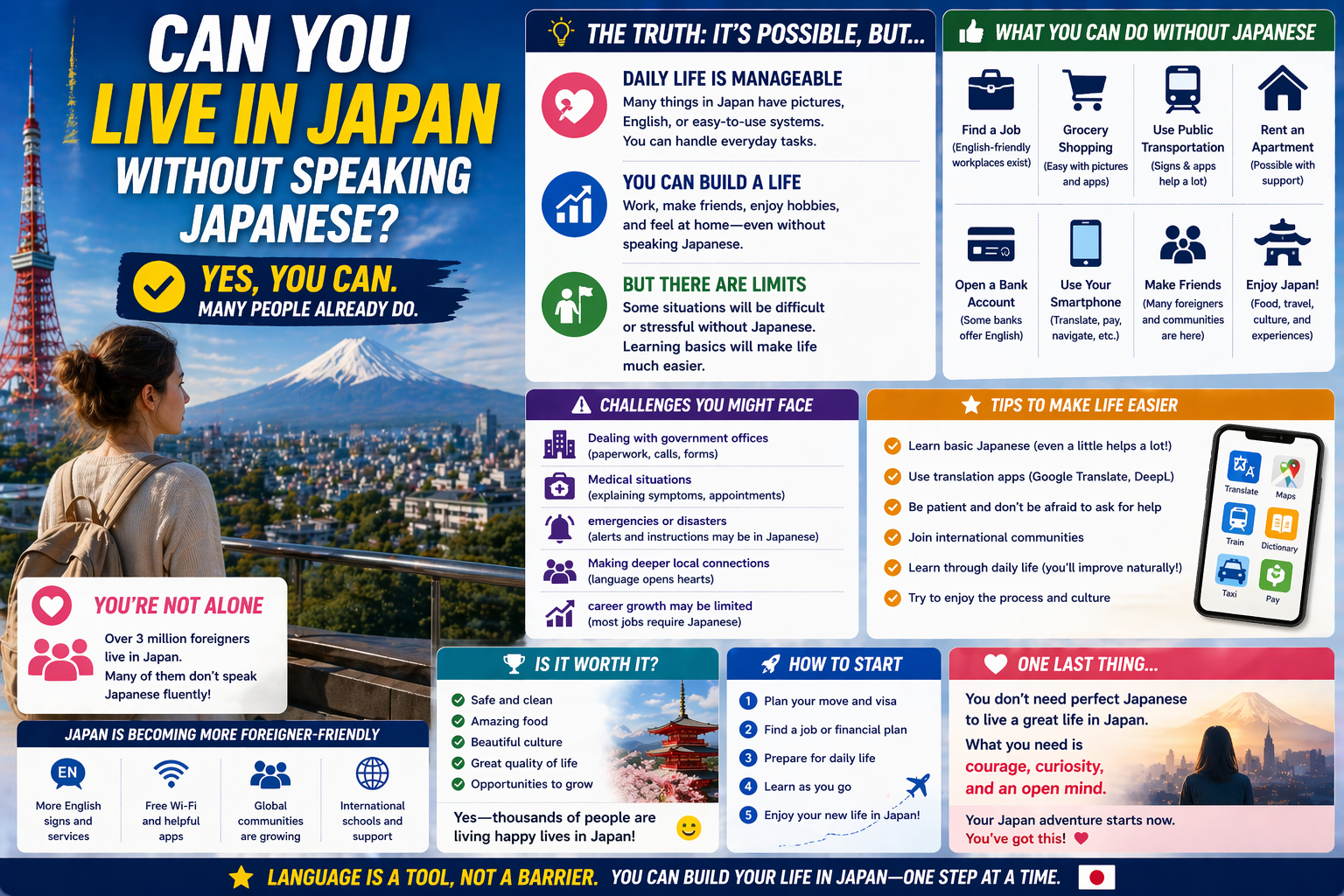
Can You Live in Japan Without Speaking Japanese?
Yes, but only up to a point. You can live in Japan without speaking much Japanese if you stay in a big city, use translation tools well, and choose services that already support foreign residents. But the longer you stay, the more basic Japanese starts to matter for housing, work, clinics, school notices, trash rules, and city-hall paperwork.
For a short stay or a first year in Tokyo, Osaka, Nagoya, or another large city, daily life is often manageable. For long-term life anywhere in Japan, basic Japanese is less about culture and more about friction: fewer mistakes, fewer missed notices, and fewer situations where you must rely on someone else.
- Short answer: Yes for many people, especially in major cities; much harder in smaller cities and rural areas.
- Biggest pain points: apartment contracts, job hunting, medical visits, official notices, and local garbage rules.
- Where support exists: immigration and resident support desks, multilingual living guides, some rail operators, and medical interpretation services.
- Best strategy: do not wait for fluency; learn survival Japanese for housing, hospitals, transport, and work.
Who This Guide Is For
This guide is for beginners, students, workers, and long-term residents who want a realistic answer before moving or while settling in Japan.
It matters most if you are in one of these situations:
- You are choosing between Japan and another country for study or work.
- You already live in Japan and feel stuck at city hall, the clinic, or when reading mail.
- You want to know whether English support in Japan is enough for daily life.
- You plan to live outside central Tokyo or outside the biggest cities.
Where You Can Get By Without Japanese
In major urban areas, you can often manage the basics with English, simple Japanese, and your phone.
Transport is the easiest part
Public transport is usually the least language-dependent part of daily life.
JR East provides English station maps, route maps, and in-station information centers with English assistance at many major stations. Tokyo Metro says delay notices near ticket gates are shown in English, Chinese, and Korean, and temporary service suspensions are also announced in English.
That matters because transport is the one part of life you will use every day. If your route, exits, and transfer information are already readable, you can move around even before your Japanese improves.
Immigration and basic public information are easier than before
Japan now has more centralized multilingual support than many new residents expect.
The Immigration Services Agency’s support portal for foreign residents collects information on city procedures, work, taxes, transport, housing, daily rules, and emergencies in multiple languages. The same agency also runs consultation services and lists phone support for residence-related questions in many languages on weekdays.
ここがポイント: Japan is not fully English-friendly, but it is much more support-rich than it looks if you use the official foreign-resident channels early.
Large-city life has more fallback options
In big cities, it is easier to find:
- real estate agencies used to foreign tenants
- clinics that can work with interpreters
- stations with English support
- employers used to international staff
- city or NGO consultation desks for residents
That does not remove the language barrier. It just lowers the number of times it becomes a crisis.
Where Not Speaking Japanese Becomes a Real Problem
This is where many people underestimate the gap.
Housing is still a major barrier
You may find listings in English, but the hard part is often after that: explaining contract terms, move-in rules, guarantor issues, garbage schedules, noise rules, and building notices.
CLAIR’s multilingual living information makes this plain by organizing guidance around moving in, garbage disposal, noise, shared spaces, bicycle parking, and utility setup. In other words, the difficult part is not only “finding a room.” It is understanding the rules that start the day you get the keys.
If you do not read Japanese, common trouble points include:
- missing required move-in or move-out notices
- putting out garbage on the wrong day or in the wrong category
- misunderstanding building rules about noise or common areas
- not understanding renewal fees, insurance, or emergency contact instructions
Medical care is manageable, but not automatically easy
Hospitals and clinics are one of the clearest examples of the difference between “possible” and “comfortable.”
AMDA International Medical Information Center provides multilingual medical information and free remote medical interpretation support. That is useful, but it also shows the basic reality: many patients still need outside language support to navigate reception, consultation, pharmacy, and payment.
If you have no Japanese, medical visits are easier when you prepare:
- bring your residence card, insurance card, and medication list
- write symptoms in simple English and simple Japanese if possible
- check in advance whether the clinic can use interpretation support
- avoid assuming reception staff can explain treatment details in English
Work depends heavily on the job type
You can absolutely work in Japan with limited Japanese in some fields, especially international companies, IT roles, some hospitality jobs, and certain factory or specialized labor roles. But the ceiling changes fast if your Japanese stays near zero.
The Ministry of Health, Labour and Welfare runs Employment Service Centers for Foreigners and also publishes information for foreign job seekers. That matters because it shows two things at once:
- there is real public infrastructure for foreign job seekers
- many job searches still need structured support, not just online applications
In practice, low Japanese ability tends to limit:
- the range of jobs you can apply for
- the number of employers willing to interview you
- promotion chances after hiring
- your ability to read work rules, safety notices, and internal messages
The Biggest Difference Is City Size
Japan is not one English environment. Your experience changes sharply by location.
In major cities
You can often survive with little Japanese because:
- stations and route information are easier to read
- more staff are used to foreign customers
- more websites have English pages
- more employers and schools already have foreign residents in their system
In smaller cities and rural areas
Life gets harder because:
- official forms may exist only in Japanese
- local clinics may have little or no English support
- landlords and agents may prefer Japanese communication
- buses, local notices, and school papers may not be translated
- neighbors and service counters may rely on simple spoken Japanese, not English
This is why two foreigners can give completely different answers to the same question. One lives near major stations with English-capable services. Another lives where even utility calls need Japanese.
What You Should Learn First
You do not need to become fluent quickly. You do need the right small set of Japanese.
The Japan Foundation’s Irodori: Japanese for Life in Japan is built around everyday situations for people living and working in Japan. That practical focus is the right model.
Start with Japanese for these tasks first:
- introducing yourself and confirming your address
- reading dates, times, floors, and station names
- booking or checking appointments
- explaining simple symptoms at a clinic
- asking about rent, bills, and contract renewal
- understanding trash categories and collection days
- reading short notices from school, work, or the building manager
This kind of Japanese gives a faster return than studying only grammar textbooks at the beginning.
Common Mistakes
Expecting Tokyo-level support everywhere
A train line in central Tokyo and a municipal office in a regional city are not the same environment. Do not assume one smooth English experience means Japan as a whole works that way.
Confusing “possible” with “easy”
Many tasks are possible through apps, friends, or support desks. That does not mean they are low-stress. A life that is technically possible can still be tiring if every letter, phone call, and clinic visit becomes a puzzle.
Ignoring local rules
National immigration rules are one thing. Daily life rules are often local.
Garbage sorting, collection schedules, bicycle parking rules, and neighborhood notices can vary by municipality and building. That is one reason official living guides and municipal instructions matter so much.
Waiting too long to build a support base
Do this early instead:
- save the official foreign-resident support portal
- learn where your city office or ward office offers consultation help
- identify one clinic you can use
- learn your building’s trash and noise rules in detail
- prepare a small Japanese phrase set for emergencies and appointments
Current Status as of April 23, 2026
The overall direction is clear: official multilingual support for foreign residents exists and is broader than before, but it is still uneven in real life.
As of April 23, 2026:
- the Immigration Services Agency’s foreign-resident support portal shows recent updates in 2026 and continues to collect multilingual information on taxes, housing, transport, labor, and daily life
- consultation channels for residence and daily-life support remain available through Immigration Services Agency and FRESC-linked guidance
- public and nonprofit support for multilingual medical access is still important, which tells you that language gaps at care sites have not disappeared
- major transport operators continue to provide strong English support in big-city networks, but this does not guarantee the same level outside those networks
So, can you live in Japan without speaking Japanese?
Yes, if you build your life carefully. No, if you expect the system to meet you in English everywhere. The practical target is not perfect Japanese. It is enough Japanese to handle the moments that matter most when something goes wrong.
Before you sign a lease, change cities, or accept a job outside a major urban area, that is the point to check again.
参照リンク
- Immigration Services Agency: Support Portal for Foreign Residents
- Immigration Services Agency: Consultation Services
- CLAIR: Multilingual Living Information
- CLAIR: Other Consultation Services
- JR East: Information Centers
- JR East: Station Maps
- Tokyo Metro FAQ: Train Service and Delay Information
- AMDA International Medical Information Center
- AMDA: Telephone Medical Consultation
- AMDA: Remote Medical Interpretation
- Ministry of Health, Labour and Welfare: Information for Foreigners Seeking Jobs in Japan
- Ministry of Health, Labour and Welfare: Employment Service for Foreigners
- Japan Foundation: IRODORI Japanese for Life in Japan
- JNTO: For Safe Travels in Japan – Guide for When You Are Feeling Ill