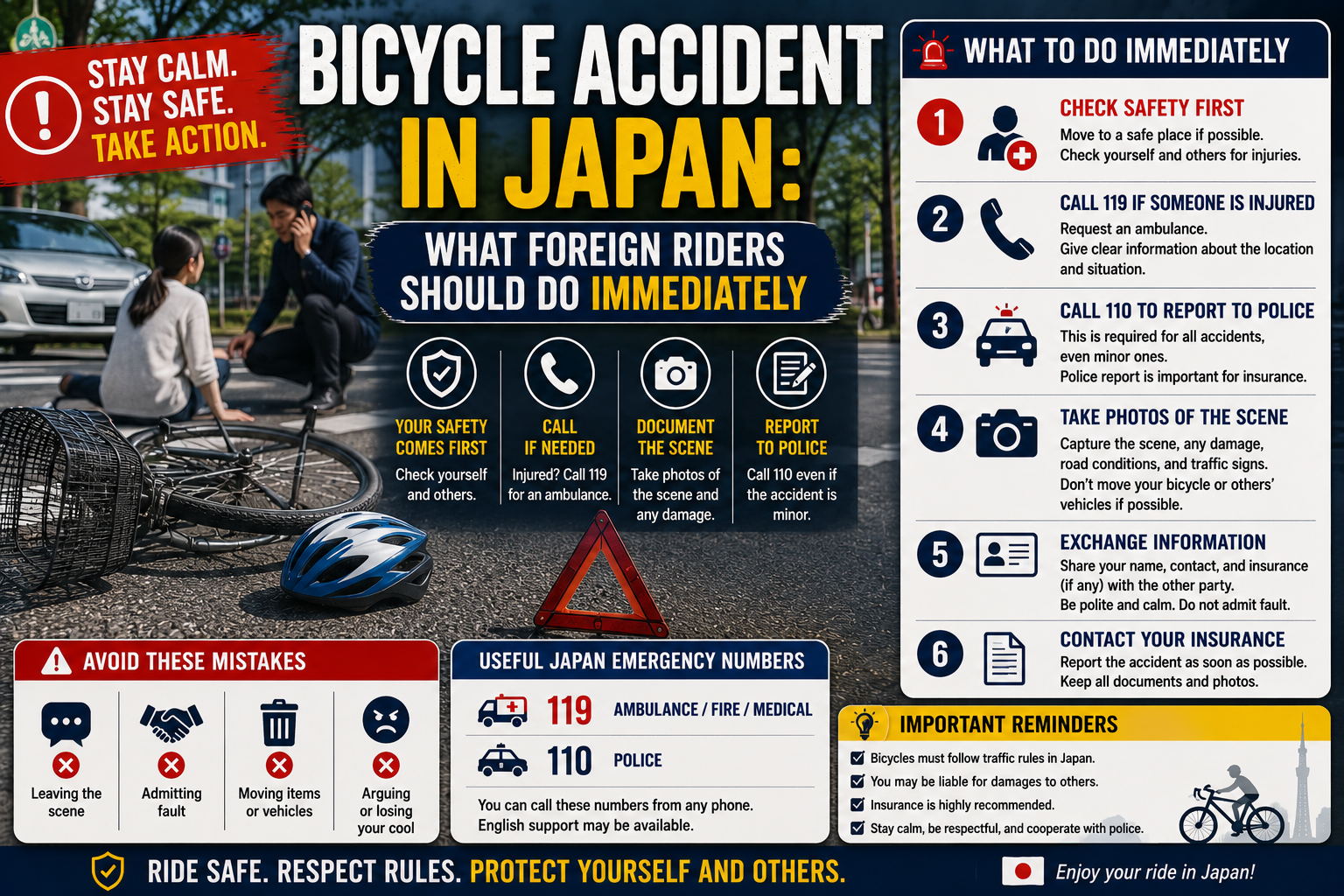
Bicycle Accident in Japan: What Foreign Riders Should Do Immediately
If you get into a bicycle accident in Japan, the short answer is simple: help the injured person, call 119 if anyone is hurt, call 110 to report the accident, and do not leave without making a police report.
That matters whether you live in Japan, study here, commute by bike, or use a rental or share bicycle for a short trip. Even a small crash can turn into a medical or insurance problem later, and police paperwork is often important for claims.
- Call
119for an ambulance if there is any injury or you are not sure. - Call
110to report the traffic accident to the police. - Exchange names, addresses, phone numbers, and vehicle details.
- Take photos and keep the time, place, and witness information.
- See a doctor as soon as possible, even if the pain feels minor at first.
Who this guide is for
This guide is for foreign residents, students, workers, and visitors who ride bicycles in Japan.
It is most useful if your accident involves:
- another bicycle
- a car, taxi, bus, or motorcycle
- a pedestrian
- a rental or share bicycle
- an injury that may lead to an insurance claim
First: what to do at the scene
Start with safety. Move out of immediate danger if you can do so without making the situation worse.
1. Check injuries and call for help
If anyone is bleeding, hit their head, cannot stand, or says they feel unwell, call 119. In Tokyo, the fire department says 119 support is available in multiple languages including English, but language support can vary by area.
2. Report the accident to police
In Japan, a bicycle crash on the road is still a traffic accident. If you leave without reporting it, you may create problems for yourself later, especially if the other person files a report first or an insurer asks for proof.
ここがポイント: If you may need insurance, compensation, or official proof later, a police report is one of the first things that matters.
3. Do not argue about fault on the street
Do not rush into a private settlement at the scene. Get the facts first. A quick apology is common in Japan, but do not let that turn into an on-the-spot agreement about money before you understand the injury, damage, and insurance situation.
What information to collect before you leave
Once the emergency steps are done, gather evidence while details are still clear.
Basic details
Get or record:
- full name
- address
- phone number
- bicycle type and color
- car plate number if a motor vehicle is involved
- insurance company and policy number if the other side knows it
Useful evidence
Take photos of:
- the bicycles, car, or damaged property
- the road, crossing, traffic signal, and lane position
- injuries, torn clothes, and broken items
- weather or visibility conditions if relevant
Also note:
- exact time and place
- direction each person was moving
- witness names and phone numbers
- whether the crash involved a share cycle or company bicycle
If police come to the scene, ask how the case was recorded and where you can later confirm the report details.
Medical treatment and paperwork
A crash that looks small can still lead to neck pain, wrist problems, or a delayed concussion.
See a doctor early
Go to a clinic or hospital the same day if possible. This is important for your health, but it also helps create a clear medical record if you need reimbursement or compensation later.
If somebody else caused the injury, your public health insurance situation may also need extra paperwork. Japan’s health insurance system allows treatment for injuries caused by another person, but the insurer may ask for a third-party injury report.
Get a Traffic Accident Certificate if needed
The Japan Safe Driving Center issues a Traffic Accident Certificate based on the police report. Many insurers or employers ask for it.
As of May 8, 2026, the standard application fee shown by the Center is 800 yen. You can apply at a post office, through the Center, or online in eligible cases.
This is one reason not to skip the police report. No report usually means no certificate.
Insurance: what foreigners in Japan should check
Insurance is where many riders get surprised.
Liability insurance may be required locally
Japan does not run bicycle liability insurance under one single nationwide rule. In practice, local ordinances vary.
For example:
- Tokyo says bicycle users must enroll in insurance that can cover liability for accidents.
- Chiba Prefecture also requires bicycle users to have insurance, and city guidance such as Matsudo’s explains this clearly in English.
That means your next step after an accident is not only “Do I have insurance?” but also “Which insurance applies here?”
Your coverage may come from somewhere unexpected
Possible sources include:
- a bicycle insurance policy
- a personal liability rider attached to home or fire insurance
- school insurance
- employer-related coverage for commuting or work use
- insurance included with a share bicycle service
- a TS mark safety inspection plan attached to the bicycle
Do not assume a private policy covers business use, or that a share cycle plan covers every injury and every item of property damage. Check the contract.
If you borrowed the bicycle
Tell the owner quickly. If it was a share cycle, follow the operator’s accident procedure immediately. If it was a company bicycle, report it to your employer as well as the police.
Common mistakes that cause trouble later
These are the most common avoidable problems:
- leaving the scene because the crash looked minor
- failing to call police because both sides seemed calm
- waiting too long to see a doctor
- forgetting to photograph the road position and traffic signal
- assuming your insurance automatically covers liability
- talking only by message app and not keeping formal records
- not checking whether a rental or share cycle operator must be notified the same day
Current rule changes that matter to cyclists
If your accident happened during a traffic violation, recent rule changes can affect how police and insurers view the case.
Since November 1, 2024
Japan strengthened penalties for two bicycle behaviors in particular:
- using a smartphone while riding in a dangerous way
- riding under the influence of alcohol
These are not small etiquette issues. They are treated as serious safety violations.
Since April 1, 2026
Police began using a blue-ticket traffic violation system for cyclists aged 16 and over for certain violations. The National Police Agency’s bicycle portal explains that this system now applies to minor traffic violations by older teen and adult cyclists.
For foreign riders, the practical point is clear: if an accident happens while you were ignoring a signal, using your phone, riding the wrong way, or breaking another traffic rule, your position becomes weaker very quickly.
If the other side later contacts you about money
Stay calm and keep everything in writing.
Do this next:
- ask for the claim details in writing
- send the case to your insurer if you have one
- keep medical receipts, repair estimates, and police-related documents
- use
#9110for non-emergency police consultation if you need guidance after the scene has cleared
If the injury is serious, fault is disputed, or the amount is large, get professional advice. Do not rely on casual translations or verbal promises.
Final takeaway
The practical rule in Japan is straightforward: report first, document everything, and check insurance early.
If you ride regularly, the best time to review your coverage is before the next accident, not after it. Check whether your prefecture or city requires bicycle liability insurance, whether your current policy covers everyday riding, and whether your share cycle or employer has its own reporting rules.
参照リンク
- MLIT: First Thing to Do in the Event of a Traffic Accident
- MLIT: What to Do in the Event of a Traffic Accident
- National Police Agency: What to Do in the Event of a Traffic Accident
- National Police Agency Bicycle Portal
- National Police Agency: Bicycle Blue-Ticket System
- National Police Agency: Police Consultation Dial #9110
- Tokyo Metropolitan Police: Bicycle Insurance
- Matsudo City: Bicycle Insurance and TS Mark (English)
- Japan Safe Driving Center: Traffic Accident Certificate
- Japan Safe Driving Center: Application Method for Traffic Accident Certificate
- Shibuya City: If You Need to Call 110 or 119