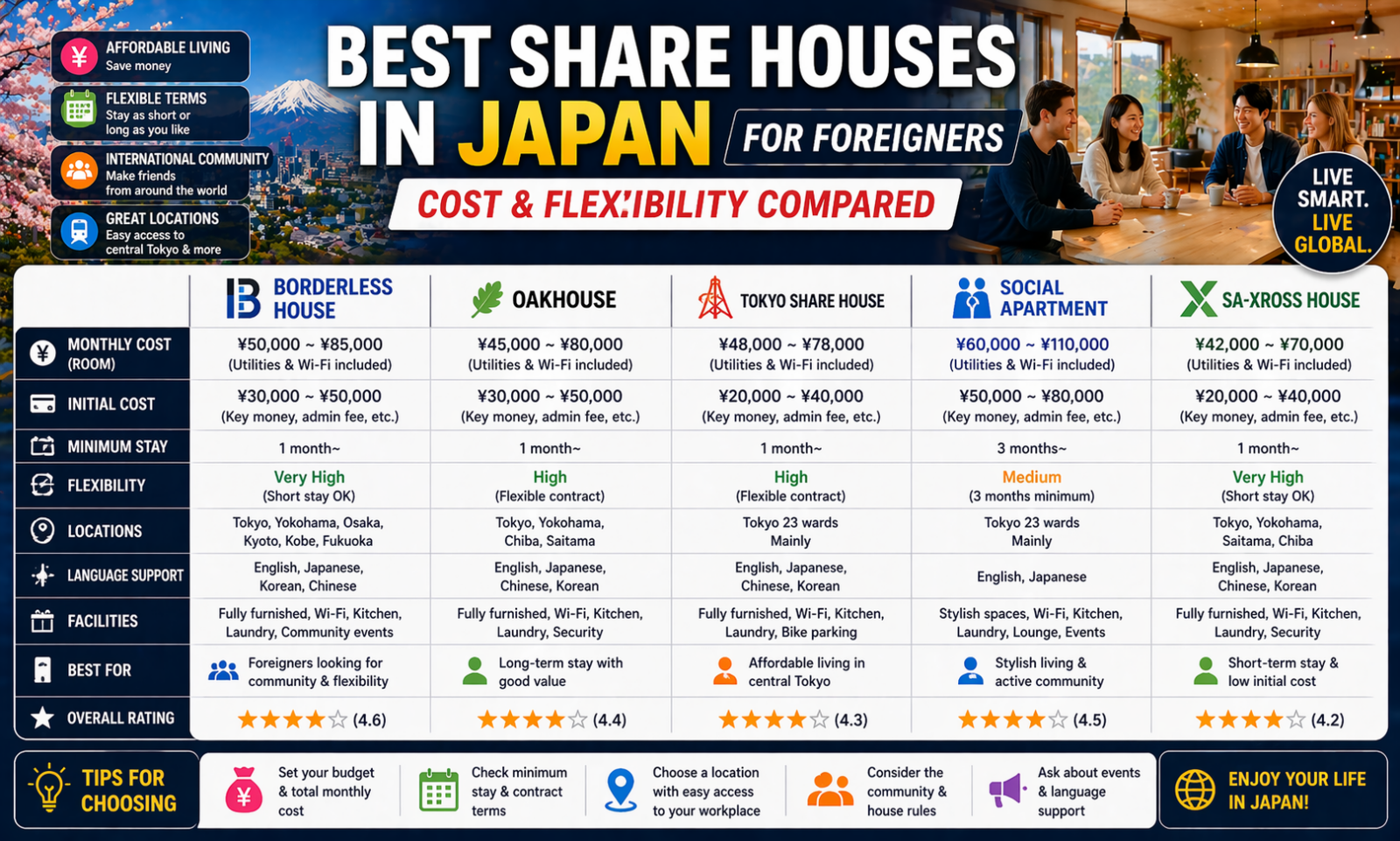
Best Share Houses in Japan for Foreigners: Cost and Flexibility Compared
If you want the shortest path to a room in Japan without paying regular-apartment startup costs, share houses are usually the better first move. Based on official pricing and contract terms checked on April 21, 2026, XROSS HOUSE is the strongest pick for low upfront cost, BORDERLESS HOUSE is the best fit if you want an international community, Oakhouse is the most flexible for broad choice and one-month stays, and Sakura House works well if you want simple all-in monthly pricing in Tokyo or Kyoto.
This guide is for students, working holiday users, new employees, and long-term residents who need a furnished room fast, want English support, or are not ready for a standard two-year apartment lease.
- Best for lowest upfront cost: XROSS HOUSE
- Best for international community: BORDERLESS HOUSE
- Best for wide inventory and one-month flexibility: Oakhouse
- Best for simple monthly stays in Tokyo or Kyoto: Sakura House
What matters most when comparing share houses
A cheap monthly rent is not enough. For foreigners in Japan, the real decision usually comes down to four points:
- How much cash you need before move-in
- Whether utilities and Wi-Fi are already bundled in
- How soon you can leave or change rooms
- Whether the operator can handle English support and overseas booking
A regular apartment can still be better if you want full privacy for years. But if you are arriving in Japan, changing jobs, waiting for a longer lease, or testing a new city, share houses often save both money and paperwork.
ここがポイント: The best share house is not the one with the lowest rent on the listing page. It is the one with the lowest total friction: move-in cost, contract length, notice rules, and daily living fit.
Quick comparison
| Operator | Best for | Typical costs from official pages | Flexibility | Main tradeoff |
|---|---|---|---|---|
| XROSS HOUSE | Lowest upfront cost | Initial cost 30,000 yen; rent from 24,800 yen for dormitory, 34,800 yen for semi-private, 40,000 yen for private room; common fee 15,000 yen | Minimum stay 1 month; online contract from abroad; free internal moves | Lowest prices often mean less privacy or smaller rooms |
| BORDERLESS HOUSE | International community | Initial fees include 30,000 yen key money and 15,000 yen cleaning fee, plus prorated rent and utilities; Tokyo private rooms roughly 58,000 to 81,000 yen, Kansai private rooms 43,000 to 64,000 yen | Minimum stay 1 month; contracts can be tailored; 30-day move-out notice | Entry cost is higher than XROSS HOUSE |
| Oakhouse | Wide selection and short stays | No security deposit or key money; contract fee varies by room type, such as 50,000 yen for single rooms and apartments, 20,000 to 40,000 yen for share or semi-private rooms, 10,000 to 30,000 yen for dorms | Stays from 1 month; maintenance fee includes utilities; internet free | Total contract fee depends on the house and room type |
| Sakura House | Simple monthly budgeting in Tokyo and Kyoto | Share house rooms start from 75,000 yen per month; no deposit, key money, or agency commission; utilities and Wi-Fi included in monthly rent | Monthly stays; strong multilingual support; easy for short and medium stays | Usually not the cheapest option |
Which share house is best for you?
XROSS HOUSE: best if your budget is tight
XROSS HOUSE is the most aggressive on entry cost. Its official English pages say share houses start from 24,800 yen for dormitory rooms, 34,800 yen for semi-private rooms, and 40,000 yen for private rooms, with a flat 30,000 yen initial cost and a 15,000 yen common service fee that covers utilities and shared equipment.
That matters if you have just landed in Japan and need to preserve cash for your residence setup, commuting pass, food, and phone plan. The operator also allows online contracts from overseas and says you can stay from one month.
XROSS HOUSE is a strong fit for:
- Working holiday users
- Students arriving before a school dorm opens
- People who need Tokyo-area access without standard apartment fees
- Anyone who may need to move between properties later
The catch is simple: the cheapest listings are often semi-private or dorm-style. If you work from home, take many calls, or need quiet, paying more for a real private room may save you frustration.
BORDERLESS HOUSE: best if you want community, not just a bed
BORDERLESS HOUSE is not the cheapest, but it is the clearest option if you want a house built around interaction between Japanese and international residents. That is more than branding. It changes the value of the place if you are new to Japan and want faster language practice, a social base, or help settling into daily life.
Its official Japan pages show these rough monthly ranges:
- Tokyo shared rooms: 40,000 to 55,000 yen
- Tokyo private rooms: 58,000 to 81,000 yen
- Kansai shared rooms: 35,000 to 50,000 yen
- Kansai private rooms: 43,000 to 64,000 yen
- Utilities: 9,000 to 13,000 yen depending on region and room type
For new contracts, official fee information shows 30,000 yen key money, 15,000 yen cleaning fee, prorated first-month rent and utilities, and optional bedding rental. BORDERLESS HOUSE also announced a pricing update effective March 2026, so this is one operator where checking the latest fee page before payment really matters.
Choose BORDERLESS HOUSE if:
- You want a private room but still want daily contact with other residents
- You are choosing between Tokyo and Kansai and want a clearer regional price gap
- You care about English support and a move-in process that works from overseas
Oakhouse: best if you want the broadest practical flexibility
Oakhouse is the operator to look at when you do not yet know exactly how long you will stay or where you will end up. Its official pages emphasize no security deposit, no key money, no guarantor requirement, multilingual support, and contracts from one month.
The numbers are less tidy than XROSS HOUSE because Oakhouse uses room-type-based contract fees. Official move-in guidance shows:
- Apartment or single room contract fee: 50,000 yen
- Share room, compartment, or semi-private: 20,000 to 40,000 yen
- Dormitory: 10,000 to 30,000 yen
Oakhouse also states that the maintenance fee includes electricity, gas, and water, and that internet is free. For foreigners who do not want separate utility setup, that is a real advantage. Its site also shows a large spread in available stock, from lower-cost suburban rooms to more central options.
Oakhouse is the best fit if you:
- Need more listing volume to compare areas
- Want one-month entry without a normal apartment contract
- May need a private apartment later under the same operator
- Want multilingual customer support
Sakura House: best if you want simple, all-in monthly living
Sakura House is less of a bargain hunter’s choice and more of a convenience choice. Its official pages say share house rooms start from 75,000 yen per month, with no deposit, key money, or agency commission, and monthly rent includes utilities and Wi-Fi.
That pricing structure is easy to understand. If you are coming to Japan for a semester, a project assignment, language school, or a first few months before a longer lease, the simplicity has value.
Sakura House is especially useful for:
- People who want Tokyo or Kyoto rather than a nationwide search
- Residents who prefer bundled monthly costs over low headline rent plus extra fees
- First-time arrivals who want strong multilingual support
It is usually not the cheapest room-per-yen option. It is one of the easiest to budget.
Cost vs flexibility: where the real difference shows up
The biggest mistake is comparing only the monthly rent line.
For example:
- A 40,000 yen room with a 30,000 yen initial fee and one-month minimum stay can be easier on your cash flow than a 58,000 yen room with extra move-in charges, even if the higher-rent room is nicer.
- A 75,000 yen all-in room can be cheaper in practice than a lower-rent room if you would otherwise need to buy bedding, set up utilities, or pay extra contract-related costs.
- A house with easy transfer options can save money if your workplace, school, or commute changes after arrival.
If your stay is under six months, upfront cost and exit rules usually matter more than a small monthly rent difference.
Rules and exceptions foreigners should check before signing
Share houses are easier than normal rentals, but they are still contracts. Before you pay, confirm these points in writing:
Address registration
If you are a mid- to long-term resident in Japan, your address registration matters. Immigration Services Agency procedures state that a change of residence must be reported within 14 days. BORDERLESS HOUSE says you can register the house address as your official address, but you should still confirm this with any operator before signing, especially if you need bank paperwork, a My Number notice, or residence card updates.
Move-out notice and exit fees
This is where “flexible” can mean different things.
- XROSS HOUSE requires move-out application at least one month in advance and charges a 16,500 yen cancellation fee for share houses
- BORDERLESS HOUSE says less than 30 days’ notice means at least 30 days of rent and utilities will be charged from the date of notice
- Oakhouse also expects advance payment timing and house-specific contract details to be checked carefully
A one-month minimum stay does not mean you can leave tomorrow without cost.
Room type and privacy
Do not assume every listing is a fully private room.
- XROSS HOUSE separates private, semi-private, and dormitory types
- BORDERLESS HOUSE pricing differs clearly between shared and private rooms
- Sakura House share houses use private bedrooms with shared common space
If you work night shifts, study seriously, or take online meetings, pay attention to the room type first and the rent second.
Common mistakes when choosing a share house in Japan
- Choosing by rent alone and ignoring common fees, bedding, cleaning, or move-out charges
- Assuming all operators cover the same regions; Sakura House is much more Tokyo and Kyoto focused than XROSS HOUSE or BORDERLESS HOUSE
- Forgetting that Kansai prices are often meaningfully lower than Tokyo on the same operator
- Assuming “furnished” means every daily item is included; check bedding and small appliances
- Paying before confirming whether the address can be used for official registration and mail
Latest update worth watching
The clearest recent pricing change in the sources checked for this article is BORDERLESS HOUSE’s March 2026 update, which revised bedding rental pricing and restated the current initial fee structure for new contracts. More broadly, share house pricing changes faster than many foreigners expect because these operators price by vacancy, room type, and city.
That means the best strategy is practical, not theoretical:
- Shortlist by contract style first
- Compare total move-in cash second
- Then compare room quality and commute
If you need the cheapest possible landing spot, start with XROSS HOUSE. If you want a shared life that can help you build a social base in Japan, start with BORDERLESS HOUSE. If you want the broadest search and one-month flexibility, start with Oakhouse. If you want simple monthly budgeting in Tokyo or Kyoto, Sakura House is the safer pick.
Before paying, check the current fee page one more time and confirm your notice period. That final step is what separates a flexible move from an expensive surprise.
参照リンク
- XROSS HOUSE official site
- XROSS HOUSE price and move-in process
- XROSS HOUSE FAQ: contract period
- XROSS HOUSE FAQ: move-out procedures
- XROSS HOUSE FAQ: moving out fees
- BORDERLESS HOUSE reservation process and required fees
- BORDERLESS HOUSE Japan monthly rent and utility guide
- BORDERLESS HOUSE contract and move-out FAQ
- BORDERLESS HOUSE pricing update effective March 2026
- BORDERLESS HOUSE moving-in and facilities FAQ
- Oakhouse official English site
- Oakhouse move-in and contracting process
- Oakhouse what is a share house
- Oakhouse maintenance fee FAQ
- Oakhouse contract length FAQ
- Sakura House official site
- Sakura House share house overview
- Sakura House about and rate structure
- Immigration Services Agency: change of residence notification for mid- to long-term residents