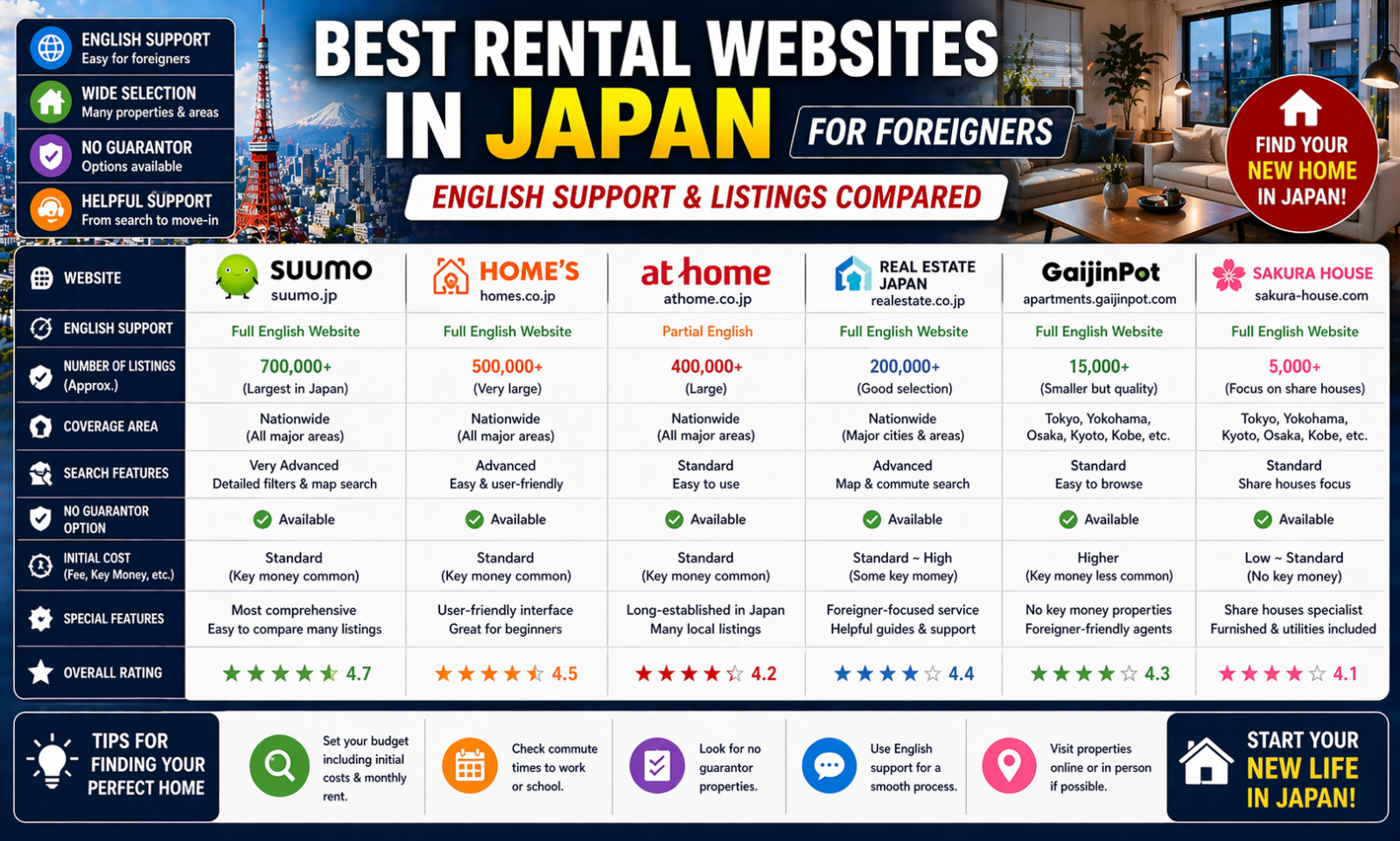
Best Rental Websites in Japan for Foreigners: English Support and Listings Compared
If you need an apartment in Japan and want to search in English, there is no single best website for every case.
For most foreigners, the practical answer is this: use an English-first site for communication and filters, then check a large Japanese portal for wider inventory before you apply. If you want the widest choice, SUUMO, LIFULL HOME’S, and At Home still matter. If you want easier communication, GaijinPot Apartments, Real Estate Japan, wagaya Japan, and Village House are usually easier starting points.
- Best for English-first searching: Real Estate Japan, GaijinPot Apartments, wagaya Japan
- Best for the biggest pool of listings: SUUMO, LIFULL HOME’S, At Home
- Best for low upfront fees: Village House, UR Rental Housing
- Best when language support matters more than raw listing count: LIFULL HOME’S Friendly Door
This guide is for students, workers, couples, and long-term residents who need a normal rental in Japan, not just a share house or short tourist stay. It matters most when you are comparing listings across cities, trying to avoid wasted inquiries, or checking whether “English support” really means help with the contract.
What actually makes a rental website useful in Japan?
A rental site in Japan is not just a search tool. It affects whether you can:
- understand the listing details before you contact anyone
- confirm upfront fees such as deposit, key money, agency fee, and guarantor company costs
- find an agent who will actually handle a foreign tenant application
- compare regional inventory outside central Tokyo
- move fast when a listing disappears after one or two days
ここがポイント: In Japan, a website being available in English does not mean the contract, screening, or move-in process will be in English.
That one point explains why many renters get stuck. The site feels foreigner-friendly, but the actual agency, guarantor company, or landlord may still require Japanese communication or extra documents.
Best websites by use case
1. Real Estate Japan
Best for: long-term renters who want an English interface and city-focused listings.
Real Estate Japan runs a full English portal with rental search, short-term options, bilingual-agent search, and filters such as furnished apartments and no key money. That makes it one of the easiest places to begin if you want a standard apartment search without reading Japanese from day one.
Why it stands out:
- English interface from search to inquiry
- useful filters for foreigners, including furnished and no-key-money options
- strong coverage in Tokyo and other major urban markets
- bilingual agent directory is useful when you need help beyond the listing page
Watch for this:
- stock is still narrower than the biggest Japanese portals
- regional inventory can thin out fast outside major cities
- an English portal does not guarantee every landlord is equally foreigner-friendly
This is a good first tab to keep open if you are balancing ease of use against realistic long-term housing choices.
2. GaijinPot Apartments
Best for: beginners, first-time movers, and renters who care about low-initial-cost or short-term filters.
GaijinPot Apartments is built for foreigners living in Japan. Its rental search includes filters that many newcomers care about immediately, such as no guarantor, no key money, no deposit, furnished, short term, internet, and credit-card payment.
That matters because newcomers often fail at the first screening stage, not the browsing stage. A site that lets you narrow for those pain points saves time.
Why it works well:
- clear English search flow
- practical filters for first-time foreign renters
- useful for people who are still deciding between short-term and standard leases
- less intimidating than Japanese-only portals
Limits:
- inventory is not as broad as SUUMO or At Home
- some listings skew toward foreigner-oriented stock rather than the full local market
- in smaller cities, choices may be limited
If you have just arrived in Japan and want a smoother start, this is one of the easiest places to search without getting buried in Japanese real-estate terms.
3. wagaya Japan
Best for: foreigners who want a site aimed directly at non-Japanese renters and buyers.
wagaya Japan positions itself as a property site for foreigners and offers rental, share house, short-term serviced apartment, and property-search request options in English. That makes it useful when you want one portal that is clearly designed around overseas and foreign-resident users.
Why people use it:
- English-first design
- foreigner-focused search categories
- straightforward way to send search requests if you cannot find a good match yourself
Limits:
- like other English-first portals, it does not match the raw volume of Japanese-language giants
- quality varies by area and partner agency
It is a solid second or third site to compare against Real Estate Japan and GaijinPot rather than a complete replacement for Japanese portals.
4. SUUMO
Best for: renters who want the widest market view and can handle Japanese or browser translation.
SUUMO is still the portal many renters check because it is huge, fast-moving, and deeply tied to the mainstream Japanese market. If your priority is choice, SUUMO belongs in your search even if your Japanese is limited.
Why it matters:
- massive inventory across Japan
- strong coverage beyond the most foreigner-focused neighborhoods
- useful for checking what the broader market is charging in the same area
But there is a tradeoff:
- the site is Japanese-first
- inquiry handling depends on each agency
- a listing appearing on SUUMO does not mean the agency will work smoothly in English
Use SUUMO as a market-check tool. Even if you do not apply through it, it helps you learn whether the apartment you saw on an English site is overpriced or unusually restrictive.
5. LIFULL HOME’S and Friendly Door
Best for: renters who need help finding agencies that can work in English or other languages.
LIFULL HOME’S is one of Japan’s largest property portals. On its own, it is mainly a mainstream portal. The more important foreigner-facing change is Friendly Door, which LIFULL launched a multilingual real-estate-agent listing page for on September 9, 2024. The English page says users can contact agents who offer support in English, Chinese, Korean, Vietnamese, Portuguese, and other languages.
That does not magically turn every listing into a foreigner-friendly rental. What it does do is solve a more practical problem: finding an agency that can explain procedures in a language you understand.
Why this matters in 2026:
- language support is now easier to find than before on the LIFULL side
- this is useful if your issue is communication, not just inventory
- it can help outside the narrow set of classic “expat apartment” listings
Limits:
- support quality still varies by office
- listing access and language support are not the same thing
- some areas will still have far fewer multilingual agencies than Tokyo or Osaka
For renters who do not need a luxury expat apartment but do need a human who can explain the process, Friendly Door is one of the more meaningful recent changes.
6. At Home
Best for: cross-checking agencies and listings in the broader Japanese market.
At Home is not the easiest portal for non-Japanese speakers, but it is too important to ignore. The company says its real-estate information network had 63,278 member offices across Japan as of April 2026. That scale matters because some properties show up through agency networks more consistently here than on smaller English portals.
Why to use it:
- very large agency network
- helpful for finding local-market listings outside the usual foreigner-focused pool
- useful as a second opinion when the same area looks thin elsewhere
Main downside:
- not an English-first renter experience
- you may still need translation tools and direct agency confirmation
At Home is less about comfort and more about coverage.
7. Village House and UR Rental Housing
Best for: renters whose top priority is lowering upfront costs.
These are not classic listing portals in the same way as SUUMO or Real Estate Japan, but they deserve space in the comparison because they solve a real budgeting problem.
Village House offers an English site and promotes low initial costs, including no deposit, no brokerage fee, no renewal fee, and no key money, though some conditions and exceptions apply. It also says it has properties in over 1,000 locations in all 47 prefectures.
UR Rental Housing is another major low-fee option. UR says it does not charge key money, brokerage fees, renewal fees, or require a guarantor, and its rental stock is large. The catch is that UR coverage is limited to its own housing stock and available areas, so it is not a general market portal.
These two options matter when your problem is simple: you can pay monthly rent, but Japan’s usual move-in costs are too high.
Which site should you start with?
The fastest workable approach is:
- Start with GaijinPot Apartments or Real Estate Japan if you want English filters and easier first contact.
- Add SUUMO or At Home to check whether the area has more options than the English portals show.
- Add LIFULL HOME’S Friendly Door if communication support is the main issue.
- Check Village House or UR if upfront fees are stopping you from moving.
For most renters, the best stack is not one site. It is one English-first site plus one big Japanese portal.
Common mistakes foreigners make
Assuming “English support” means the whole deal is in English
Often it only means the first contact or some staff can communicate in English. Screening, guarantor paperwork, house rules, and the lease itself may still be mainly Japanese.
Searching only on English portals
That is convenient, but it can hide the real market. In Tokyo, you may still find enough choices. In regional cities, it can make the market look much smaller than it really is.
Ignoring area differences
Tokyo, Yokohama, Osaka, Kyoto, and Fukuoka usually have more English-friendly inventory and agencies. Smaller cities may require a Japanese portal, a local agency, or both.
Not checking the fee structure early
Before you book a viewing, confirm:
- deposit
- key money
- agency fee
- guarantor company fee
- lock change fee
- cleaning fee
- short-stay or early-cancellation penalties
A cheap monthly rent can still be expensive on move-in day.
Current changes that matter as of April 21, 2026
A few practical shifts stand out right now:
- LIFULL HOME’S Friendly Door has made multilingual agency search easier since its September 2024 launch.
- At Home’s agency network remains extremely large, which matters if you need broader local inventory in 2026.
- Low-initial-cost options are easier to compare online than before, especially through services like Village House and UR.
- English search is improving faster than English contracting. That gap is still the main friction point for foreign renters.
That last point is the one to remember. Website usability has improved, but the actual rental process in Japan still depends on the agency, landlord, guarantor company, and region.
Bottom line
If you want the simplest answer, start with Real Estate Japan or GaijinPot Apartments, then verify the area on SUUMO or At Home.
If you need a multilingual agency more than a huge listing pool, check LIFULL HOME’S Friendly Door.
If move-in fees are your biggest problem, compare Village House and UR Rental Housing before you assume a normal private-market apartment is your only option.
The next thing to check is not the homepage. It is the actual fee sheet, language support at the agency, and whether the landlord will accept your application.
参照リンク
- Real Estate Japan
- GaijinPot Apartments
- GaijinPot About
- wagaya Japan
- SUUMO
- LIFULL HOME’S Friendly Door English page
- LIFULL announcement on Friendly Door multilingual agent listings
- At Home corporate overview
- At Home real estate information network
- Village House English site
- Village House FAQs
- UR Rental Housing
- UR Rental Housing portal
- UR guide for residents in English