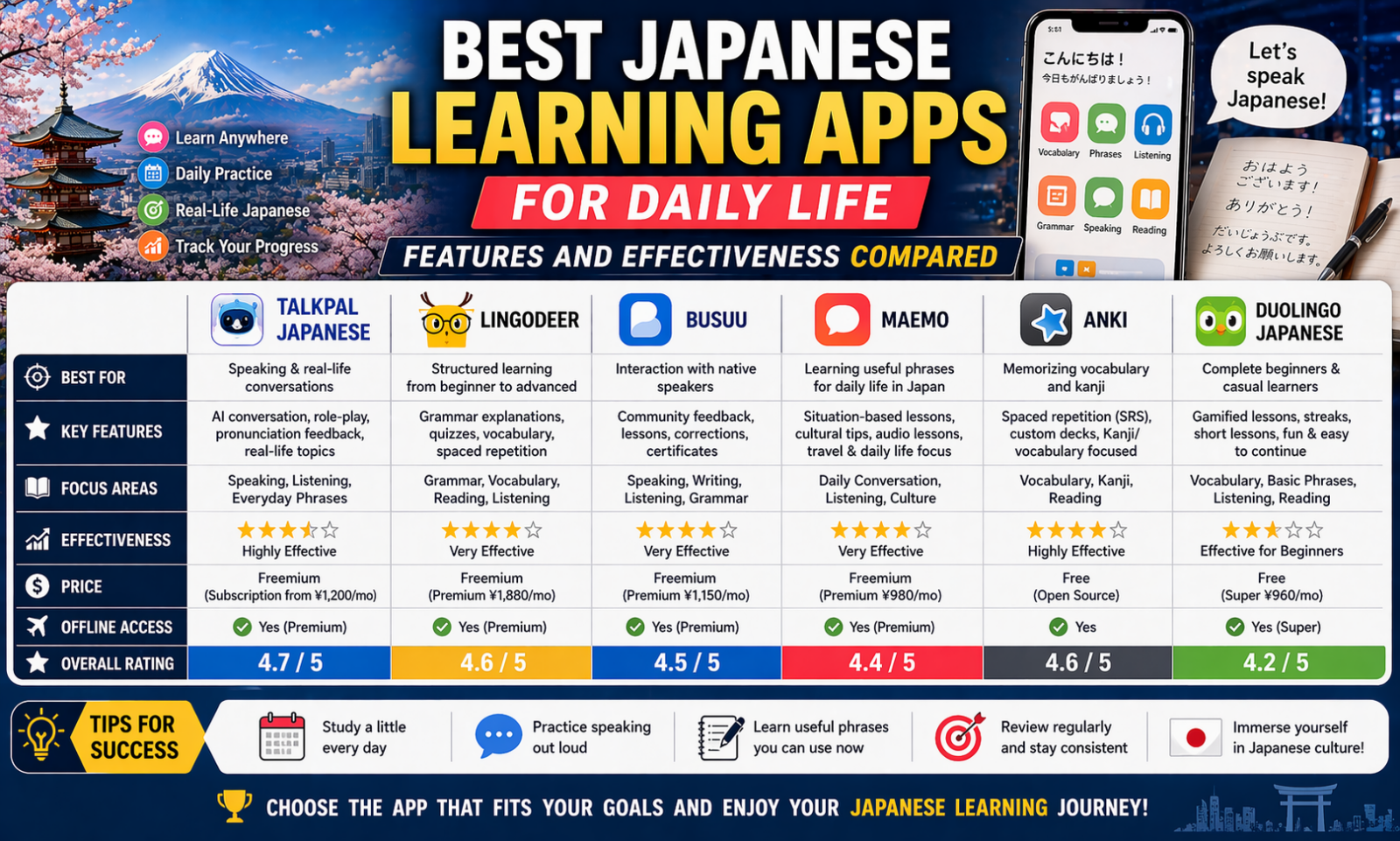
Best Japanese Learning Apps for Daily Life: Features and Effectiveness Compared
If you want one short answer, LingoDeer is the best single app for most beginners who need Japanese for daily life in Japan. It is the most balanced option for building core sentence patterns, kana, listening, and travel-use phrases from zero.
But one app is usually not enough. The most effective setup for daily life is a pair: one structured study app plus one practice app. For most people, that means LingoDeer or Duolingo for routine study, then HelloTalk for real conversation. If reading is your biggest pain point, add WaniKani. If grammar keeps breaking your sentences, add Bunpro.
This guide is for travelers, new residents, students, and workers who need practical Japanese for shops, stations, housing, school, and basic paperwork. Prices and features below were checked on April 21, 2026, using official sites and app listings. App prices can vary by country and platform.
- Best all-around app for daily life: LingoDeer
- Best free habit builder: Duolingo
- Best for grammar accuracy: Bunpro
- Best for kanji and reading signs: WaniKani
- Best for real conversation practice: HelloTalk
How I judged these apps for daily life in Japan
For daily life, the question is not just “Can this app teach Japanese?” It is more specific: can it help you handle the language you actually meet outside your room?
I compared the apps on these points:
- How well they build survival skills such as greetings, requests, numbers, time, directions, and simple service interactions
- Whether they help with reading, especially kana, common kanji, menus, labels, station signs, and app interfaces
- Whether they support listening and speaking, not only passive recognition
- Whether the app is still useful after the first few weeks in Japan
- Cost, free access, and whether the paid tier looks reasonable for regular use
ここがポイント: The best app for daily life is not the app with the most content. It is the app that gets you from memorizing words to handling small real situations quickly.
The best choices, depending on what you need
1. LingoDeer: best overall for daily life beginners
LingoDeer is the strongest one-app option if you are starting from zero and want practical Japanese, not just streaks.
Why it stands out:
- It teaches Japanese from the alphabet stage and is built for languages with non-Latin writing systems.
- Its official support pages say its courses are designed to take a complete beginner to an intermediate level around A1 to B1, depending on pace and learning style.
- The premium plan includes the main course, Fluent, Story, Travel Phrasebook, review tools, offline learning, and cross-device sync.
- The US App Store listing says subscriptions start at $14.99 per month, with annual and lifetime options also shown.
What that means in real life:
- If you need to read a restaurant tablet, answer a delivery call, or understand simple questions at city hall, LingoDeer gives you a better base than most gamified apps.
- Its grammar tips matter because daily-life Japanese breaks down fast if you only know isolated words.
- The Travel Phrasebook is especially useful before you can produce your own sentences comfortably.
Where it is less strong:
- It is still an app course, not a real social environment.
- Once you reach lower-intermediate level, you will still need live input, native content, or conversation.
Best for: beginners, new arrivals, students, and workers who need balanced basics fast.
2. Duolingo: best free option for building a study habit
Duolingo remains the easiest app to start and the easiest app to keep opening.
Officially, Duolingo says its lessons cover speaking, reading, listening, and writing in quick sessions. Its Japanese tools also include dedicated character study for hiragana, katakana, and kanji. The company expanded course access in April 2025 and said beginner-level content included features such as Stories and DuoRadio in many new courses.
Why it works:
- The barrier to entry is almost zero.
- The Japanese course includes character practice, which helps absolute beginners stop depending on romaji.
- It is effective for short daily repetition, especially if your main problem is consistency.
Why it is not the best single choice for life in Japan:
- It is better at keeping you engaged than at explaining why Japanese sentences work.
- You can finish many quick lessons and still feel shaky when you need to ask for help in a pharmacy or explain a problem to your landlord.
- Paid tiers remove ads and other limits, but the app is still not the strongest tool for detailed grammar control.
The US App Store listing shows free access and several Super Duolingo price points, including $12.99 monthly and annual options such as $83.99 and $95.99. Prices can vary.
Best for: beginners who need a free start, commuters who study in short bursts, and learners who quit more serious apps too early.
3. Bunpro: best for fixing grammar that blocks real communication
Bunpro is not the prettiest first app for a total beginner, but it is one of the most useful once you already know basic kana and want your Japanese to stop falling apart.
Bunpro says it offers:
- 900+ grammar points
- 10,000+ example sentences with native audio
- 120+ graded reading passages
- vocabulary study and deck tools
- 25 JLPT practice tests across N5 to N1
Its pricing page lists:
- Free plan: $0
- Premium: $5 per month
- Lifetime: $150 one time
Why it matters for daily life:
- Grammar mistakes matter when you need to ask for permission, explain a delay, describe symptoms, or understand written instructions.
- Bunpro is especially useful for learners who already know words but cannot connect them naturally.
- At $5 per month, it is also one of the cheaper focused tools in this comparison.
Where it is weaker:
- It is not the best first app if you are still learning basic survival phrases.
- It helps you study grammar efficiently, but it does not replace speaking practice with real people.
Best for: learners around late beginner to lower intermediate, JLPT learners who also want practical grammar control, and residents who already know some Japanese but need cleaner output.
4. WaniKani: best for reading-heavy daily life
WaniKani is a specialized tool. It is built around kanji and vocabulary, not full language coverage.
According to WaniKani’s official knowledge base:
- the system teaches around 2,000 kanji and 6,000+ vocabulary words
- it uses mnemonics and spaced repetition
- it is free through Levels 1 to 3, then premium starts from Level 4
- premium pricing is $9 per month, $89 per year, or $299 lifetime
Why it is effective:
- Life in Japan becomes much easier when you can read station names, notices, trash instructions, medicine labels, and online account menus.
- WaniKani focuses on long-term kanji retention instead of broad beginner conversation.
- If reading is your weak point, this app can remove a major daily stress source.
Why it should not be your only app:
- WaniKani itself says it does not teach grammar.
- You can become much better at recognizing words and still struggle to speak or understand a fast shop interaction.
Best for: long-term residents, self-learners serious about literacy, and anyone tired of feeling locked out by kanji.
5. HelloTalk: best for turning study into actual conversation
HelloTalk is different from the others because it is not mainly a course app. It is a language exchange platform.
Official pages describe it as a service for learning and practicing languages by connecting with other users. The app listing says it offers:
- matching with native speakers
- text, audio, voice, and video exchange
- translation and transliteration tools
- Voicerooms and live sessions
The US App Store listing shows free access, with VIP prices including $12.99 monthly and $79.99 yearly.
Why it matters for daily life:
- It is the closest thing in this list to the messiness of real communication.
- You learn what happens when the other person does not speak textbook Japanese.
- It is especially useful once you want practice with introductions, plans, errands, and casual chat.
The caution:
- It is not structured enough to be your first and only learning system.
- Language exchange works only if you can already produce something.
- As with any social app, partner quality varies.
Best for: learners who already know basics and need real interaction, especially residents who feel stuck between study mode and real-world use.
Which app is most effective for specific daily-life goals?
If you need Japanese for your first month in Japan
Choose LingoDeer first.
It gives you the clearest route from zero to useful sentence patterns, and it includes travel-use materials that map well to everyday errands.
If you keep quitting study apps
Choose Duolingo first.
Its strength is not depth. Its strength is that many people actually keep using it.
If you can speak a little but your sentences are broken
Choose Bunpro.
It is the most practical grammar repair tool in this group.
If signs, labels, and notices are your biggest problem
Choose WaniKani.
That problem will not be fixed by speaking drills alone.
If you freeze in real conversation
Choose HelloTalk, but only after building a basic foundation.
The best moment to add it is when you can already introduce yourself, ask simple questions, and respond slowly.
The combinations that work better than a single app
For most readers, these combinations make more sense than paying for one premium app and expecting everything from it.
- LingoDeer + HelloTalk: best practical mix for beginners who want both structure and real conversation
- Duolingo + Bunpro: good low-friction mix if you need habit plus grammar repair
- WaniKani + Bunpro: strong reading-and-grammar combo for serious long-term learners
- LingoDeer + WaniKani: best if your daily life includes lots of reading and forms, but your spoken Japanese is still basic
Common mistakes when choosing a Japanese app
Paying for conversation before you can form basic sentences
A live exchange app sounds efficient, but many beginners waste the first month because they cannot sustain even a simple chat.
Picking a kanji app as your only tool
You will read more, but you may still fail at simple spoken tasks like confirming an appointment or asking staff to repeat something.
Staying inside one app for too long
No app in this list fully covers grammar, speaking, listening, literacy, and natural conversation at the same level.
Judging progress only by streaks
A 100-day streak is not the same as being able to ask, “Can I pay by card?” or “Which platform is for Kyoto?”
Current changes worth knowing
A few recent updates matter if you are choosing now rather than from an old review.
- LingoDeer highlighted a Japanese update in 2025 that added high-quality native-speaker videos in lessons, practice, and reviews. That makes it more attractive for listening than older comparisons suggest.
- Duolingo announced a major course expansion on April 30, 2025, with more beginner content and broader access across interface languages.
- Bunpro continues to position itself as a broader Japanese platform, not only a grammar drill tool, with vocabulary tools and JLPT practice tests alongside grammar.
Final recommendation
If you want the simplest recommendation, start with LingoDeer.
If you want the most efficient real-world setup, use LingoDeer or Duolingo for daily study, then add HelloTalk once you can handle simple exchanges. Add WaniKani if reading is slowing your life in Japan, and add Bunpro if grammar errors keep blocking you.
The real test is not whether the app feels smart. It is whether, two weeks later, you can handle one more small thing in Japanese without switching to English.
参照リンク
- Duolingo App Store listing
- Duolingo investor release on new course expansion (April 30, 2025)
- Duolingo blog: How to learn to read Japanese
- LingoDeer App Store listing
- LingoDeer support: Is LingoDeer free? How much is it?
- LingoDeer support: What level will I be at after I finish the course?
- LingoDeer support: What’s included in premium membership?
- Bunpro pricing
- Bunpro App Store listing
- Bunpro JLPT practice tests
- WaniKani knowledge guide: What is WaniKani?
- WaniKani knowledge guide: What will WaniKani teach me?
- WaniKani knowledge guide: Is WaniKani Free?
- WaniKani knowledge guide: Premium membership
- HelloTalk official site
- HelloTalk App Store listing
- HelloTalk terms of service