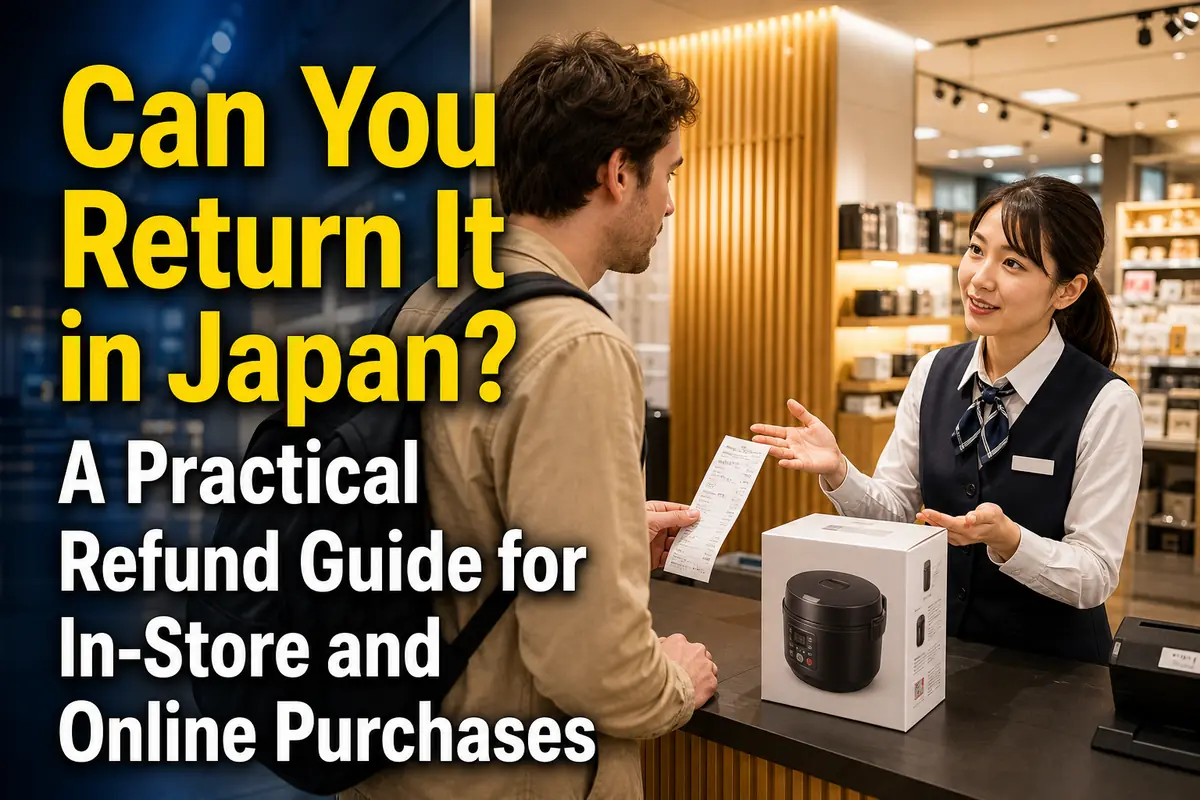
Can You Return It in Japan? A Practical Refund Guide for In-Store and Online Purchases
The short answer: a change of mind does not normally give you an automatic right to return something bought in a Japanese store. The shop may accept the return under its own policy, but it can set conditions such as a short deadline, an unopened package, and proof of purchase.
Online shopping works differently. Japan has no general cooling-off right for mail-order purchases, including ordinary internet orders. The seller’s displayed return terms usually control. If the seller did not display special return terms, a statutory rule may allow eligible goods to be returned within eight days after delivery, with the buyer paying the return shipping.
This guide is for foreign residents, students, workers, and families buying from Japanese stores or websites. The rules below reflect public guidance available as of August 1, 2026.
At a glance:
- In-store change-of-mind return: usually depends on the shop’s policy
- Faulty item or false product explanation: contact the seller promptly and ask for a suitable remedy
- Online order: read the seller’s return terms before paying
- Door-to-door or telephone solicitation: statutory cooling-off may apply, often for eight days
- Consumer trouble: residents can call Japan’s Consumer Hotline at 188, which operates in Japanese
Start by identifying how and why you bought the item
Your next step depends on both the sales method and the reason for returning the purchase. “I no longer want it” and “the product does not work” are not the same type of claim.
You changed your mind after buying in a store
Perhaps the size is wrong, you found a lower price elsewhere, or the color looks different at home. For an ordinary purchase completed inside a shop, there is generally no automatic cooling-off period simply because you reconsidered.
A retailer may still offer exchanges, refunds, or store credit as customer service. Check the receipt, signs near the register, the retailer’s website, and any membership-app conditions.
Possible store requirements include:
- The original receipt or another accepted proof of purchase
- An unused item in resalable condition
- Original packaging, labels, manuals, cables, and accessories
- A return request within the retailer’s stated period
- Return to the original branch or designated counter
- The payment card and, sometimes, the cardholder
These are retailer conditions, not one nationwide return standard. A chain’s policy may also differ for outlet goods, sale items, food, cosmetics, underwear, customized products, digital codes, or opened electronics.
The item is faulty, damaged, or not what was promised
This is more than buyer’s remorse. If the item arrived broken, does not function as described, is different from the order, or was sold after a false explanation, contact the seller quickly.
State the problem clearly and ask what remedy the seller offers. Depending on the facts, that might be:
- Repair
- Replacement
- Delivery of the correct item
- A price adjustment
- Cancellation and a refund
Do not discard the packaging or attempt a repair before contacting the seller if doing so could make the condition harder to verify. Take photographs or a short video, note when the defect appeared, and save your messages.
A manufacturer’s warranty can help with repairs, but it is not the same as a shop’s return policy. Check whether the seller wants you to use its service counter or contact the manufacturer directly.
You ordered online, through an app, or from a catalog
Internet and other mail-order purchases are not covered by Japan’s statutory cooling-off system. Instead, first read the seller’s displayed return provisions, often labeled 返品・交換, 返品特約, キャンセル, or 特定商取引法に基づく表記.
The terms should explain matters such as:
- Whether returns are permitted
- The deadline for requesting one
- The required condition of the item
- Who pays return shipping
- Whether original delivery charges are refunded
- How to obtain authorization or a return address
Under the Act on Specified Commercial Transactions, an online seller must display its special return provisions, including whether a return is possible, the applicable period, and responsibility for return costs. For internet orders, relevant conditions must also appear on the final confirmation screen.
If no special return provision was displayed, official guidance says a consumer may be able to withdraw from the mail-order contract and return the goods within eight days after delivery. The consumer normally bears the return shipping cost. This rule is not a general eight-day cooling-off period, and the exact facts still matter.
ここがポイント: Do not assume that every purchase in Japan has an eight-day return window. Eight days can refer to different legal rules, and ordinary in-store purchases do not gain a return right merely because the buyer changed their mind.
Check the return policy before you pay
The best time to solve a refund problem is before the transaction is completed. A few checks at the register or checkout screen can prevent a difficult discussion later.
In a physical shop
Ask a specific question rather than only saying “Return OK?” Useful phrases include:
返品できますか?— Can I return this?返品期限はいつまでですか?— What is the return deadline?開封後も返品できますか?— Can I return it after opening it?レシートは必要ですか?— Is the receipt required?返金ですか、交換ですか?— Is it a refund or an exchange?この店舗以外でも返品できますか?— Can I return it at another branch?
If the answer is important, ask the employee to show you the written policy. Spoken explanations can be difficult to prove later, especially across languages.
Before leaving, confirm that the model, size, color, quantity, and included accessories match what you intended to buy. For used, display, or clearance goods, ask whether the marked condition affects return eligibility.
On a Japanese website
Before tapping the final order button:
- Open the return-and-cancellation page.
- Save or screenshot the terms that apply on that date.
- Check the seller’s legal-information page for its business name, address, and contact details.
- Confirm the final price, delivery charge, recurring-payment terms, quantity, and delivery date.
- Review any non-returnable-item list.
- Save the order-confirmation email and order number.
Marketplace purchases require one extra check: determine whether the seller is the platform itself, a business using the platform, or an individual. Platform protection and seller-specific terms may be separate.
What to prepare for a return request
A concise request supported by evidence is more effective than a general complaint. Gather everything before contacting the seller.
Prepare:
- Receipt, invoice, order confirmation, or payment record
- Product name, model number, size, and serial number if relevant
- Purchase and delivery dates
- Original packaging, tags, manuals, accessories, and gifts included with the order
- Photographs or video showing damage, incorrect contents, or an error message
- A copy of the displayed return policy
- Previous emails, chat logs, and the name or department of anyone you spoke with
- The payment card or account information needed for the seller’s refund process
A receipt is particularly valuable because it proves where and when the item was purchased. The National Consumer Affairs Center advises consumers to request and retain one; without it, a retailer may be unable to confirm the transaction.
How to request a return or refund
Contact the seller quickly, use its stated process, and keep a record of every step. Do not send an item back without checking the return address and authorization requirements.
Step 1: Describe the transaction
Give the order number, purchase date, product, amount, and payment method. If you bought at a branch, include its location.
Step 2: Give one clear reason
Distinguish among:
- Change of mind
- Wrong size or color selected by the buyer
- Wrong item sent by the seller
- Damage during delivery
- Product defect
- Description or explanation that did not match the product
This distinction affects whether the request relies on shop policy or concerns a problem with the goods or sales explanation.
Step 3: Ask for a specific result
For example:
I received order 12345 on July 30. The appliance does not switch on, although I followed the included instructions. I have attached a video and photographs. Please tell me whether you will replace the item or cancel the order and issue a refund, and provide the return instructions.
Avoid returning only part of a set unless the seller agrees. Include free gifts or bundled accessories if the policy requires them.
Step 4: Use trackable shipping when appropriate
Keep the shipping receipt and tracking number. Photograph the item and package before dispatch. If the seller is responsible for a wrong or defective item, ask for a prepaid label or written confirmation about shipping costs before paying them yourself.
Step 5: Monitor the refund
A retailer may not complete a card refund at the same moment it accepts the return. The timing can depend on the merchant’s process, the card issuer, and the billing cycle.
Keep the return receipt until the credit appears. If a card statement closes before the refund is processed, the purchase and refund may appear in different billing periods. Contact the merchant first, then ask the card issuer how an accepted refund will appear on your account.
Cooling-off applies only to certain sales methods
Cooling-off is a legal cancellation system for specified transactions, not a universal returns policy. It can apply when the way a contract was solicited creates particular consumer risks.
The National Consumer Affairs Center lists these common periods:
- Door-to-door sales, certain appointment or street-solicitation sales: 8 days
- Telemarketing sales: 8 days
- Specified continuous services, including qualifying language schools, tutoring, cram schools, computer schools, matchmaking, and certain beauty or cosmetic services: 8 days
- Multilevel marketing transactions: 20 days
- Certain business-opportunity sales: 20 days
- Door-to-door purchases, where a business visits to buy a consumer’s belongings: 8 days
Conditions and exclusions can apply. The period generally starts when the consumer receives the required written application or contract document, whichever comes first. Inadequate documents or interference by the business can affect the deadline.
Since June 2022, cooling-off notification can also be made electronically, including by email or a seller’s online form. Preserve evidence of what you sent and when. If a related credit agreement exists, official guidance recommends notifying both the seller and the credit company.
Do not wait for the business to answer before protecting a deadline. If you are unsure whether cooling-off applies, contact a consumer affairs center immediately.
Important exceptions and confusing situations
Product type, seller location, payment method, and tax status can change the practical process. Do not assume that a rule from one purchase carries over to another.
Opened, perishable, hygienic, or customized goods
Retailers often restrict returns for goods that cannot easily be resold. The exact exclusions come from the relevant policy and circumstances, so check before opening or using:
- Food and other perishable products
- Cosmetics and personal-care goods
- Underwear or hygiene-related products
- Customized, engraved, or made-to-order goods
- Software, digital codes, tickets, and downloadable content
- Clearance, outlet, or “final sale” merchandise
A “no returns” term for a change of mind does not automatically settle a separate complaint that the item was faulty or materially different from its description. Explain the problem rather than presenting it as an unwanted purchase.
Gifts
A gift recipient may lack the original receipt, payment card, or purchaser account. Before buying, ask whether the retailer provides a gift receipt and whether it offers a refund, exchange, or only store credit.
Purchases from individual sellers
Consumer-protection rules aimed at business-to-consumer transactions may not apply in the same way to a private sale. Review the marketplace’s buyer-protection process and report a problem within its deadline. Keep the listing, photographs, seller messages, and payment record.
Overseas sellers
A Japanese-language site does not necessarily mean that the seller is located in Japan. Overseas returns can involve international postage, customs procedures, different laws, and limited enforcement options. Check the legal seller name and address before paying.
Tax-free purchases by eligible visitors
A tax-free transaction has tax and export conditions in addition to the retailer’s commercial return policy. Ask the original tax-free counter how a return will be handled before taking the goods elsewhere or leaving Japan. Japan’s tax-free shopping system is scheduled to move to a refund-based model on November 1, 2026, so visitors purchasing after that date should confirm the current procedure with the retailer and official tax-free shopping information.
Common mistakes that weaken a refund request
Most avoidable problems come from missing deadlines or losing evidence. Watch for these errors:
- Assuming the return culture of another country applies in Japan
- Opening or using an item before reading the exclusions
- Throwing away the receipt, packaging, tags, or delivery label
- Calling an online order “cooling-off” without checking whether that system applies
- Sending a parcel to the address printed on the package without obtaining return instructions
- Paying return postage without first confirming who is responsible
- Waiting for a manufacturer when the seller’s return deadline is about to expire
- Relying only on a telephone conversation
- Filing a payment dispute before giving a legitimate seller a reasonable chance to investigate
- Missing a marketplace or payment-provider claim deadline while negotiating informally
When the seller refuses
Ask for the refusal and the policy behind it in writing, then escalate according to the type of problem. A firm “no” at a counter does not tell you whether the employee understood the defect, the online terms, or a possible cooling-off claim.
Take these steps:
- Ask the seller to identify the applicable return or warranty term.
- Restate whether the issue is a defect, wrong item, false explanation, or change of mind.
- Request review by the retailer’s customer-service department or marketplace support.
- Preserve the item, evidence, policy screenshots, and all correspondence.
- Contact an official consumer consultation service before a legal deadline passes.
Residents can dial 188 to reach a nearby municipal consumer affairs center or consultation desk. The 188 service is in Japanese, so ask a trusted Japanese speaker or local international association whether language support is available in your area.
The Consumer Affairs Agency also lists a multilingual Consumer Hotline for Tourists at 03-5449-0906, available to overseas visitors for consumer problems during a trip. Its published hours are Monday to Friday, 10:00 a.m. to 4:00 p.m., excluding national holidays and December 29 to January 3. Confirm current availability before relying on it.
For expensive goods, suspected fraud, safety problems, or a dispute involving unclear contract terms, seek advice early. A consumer affairs center can explain relevant rules and may help communicate with the business, but the correct route depends on the facts.
A five-point check before your next purchase
In Japan, the written terms and your evidence often decide how smoothly a return proceeds. Make these checks before paying:
- Is this item returnable if I simply change my mind?
- What is the deadline, and must the package remain unopened?
- Do I need the receipt, original branch, or payment card?
- For an online order, who pays return shipping and where are the special return provisions?
- If something is wrong, how quickly must I report it and what evidence should I keep?
The most important practical habit is simple: save the receipt and read the return conditions before opening the product. If the issue involves solicitation, a defective item, or a fast-approaching deadline, document it and contact the seller or Consumer Hotline 188 without delay.
参照リンク
- Consumer Affairs Agency: Guide for the Act on Specified Commercial Transactions
- Consumer Affairs Agency: Mail Order Sales
- National Consumer Affairs Center of Japan: Cooling-off System
- National Consumer Affairs Center of Japan: Shopping Advice and Return/Refund Guidance
- National Consumer Affairs Center of Japan: Why Receipts Matter
- Consumer Affairs Agency: Local Cooperation and Consumer Hotlines
- Japan Tourism Agency: Tax-Free Shopping