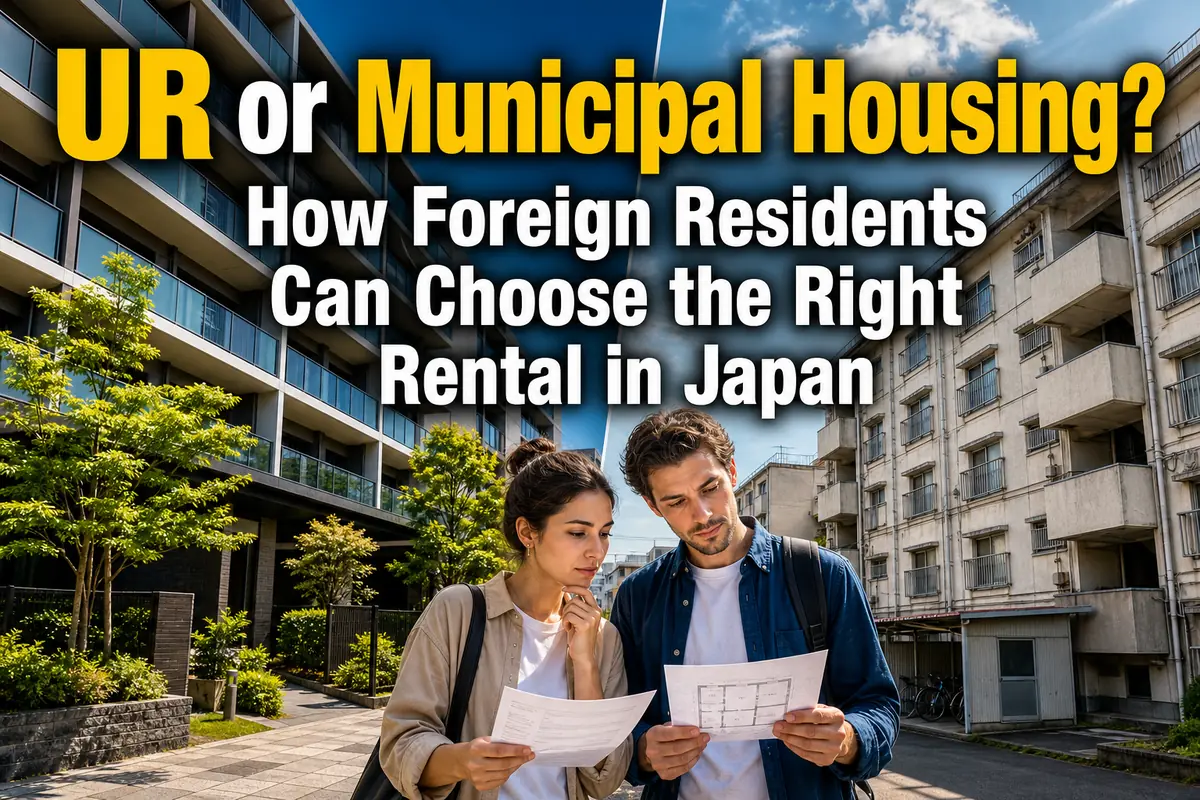
UR or Municipal Housing? How Foreign Residents Can Choose the Right Rental in Japan
Choose UR rental housing if you need a home soon, can meet its income or savings test, and want to avoid a guarantor, key money, and agency fees. Choose municipal housing if your household has a low income, meets local residence and family rules, and can wait for an application period, screening, and possibly a lottery.
The important difference is purpose. UR is public-sector rental housing offered under standard eligibility rules. Municipal housing—called shiei jūtaku (市営住宅, city housing), kuei jūtaku (区営住宅, ward housing), or similar names—is social housing for people who have difficulty securing an affordable home.
This guide is for workers, families, students with sufficient income or savings, and long-term residents comparing these two options. Rules and availability are current as checked on August 22, 2026, but municipal requirements vary substantially.
At a glance
- UR: easier to search at any time, no guarantor, but rent is not generally based on low-income status.
- Municipal housing: lower-income households are the main target, but applications are restricted by local rules and available vacancies.
- Foreign nationality does not automatically exclude you, but your residence status and local residency record may matter.
- Neither option guarantees an apartment in your preferred area, size, or move-in month.
The central difference is eligibility, not building ownership
UR and municipal housing may both look like large public apartment complexes, but they serve different groups.
UR rental housing is closer to a regular rental product with simplified contract costs. The Urban Renaissance Agency, an independent administrative agency, manages about 700,000 rental units. Applicants choose an advertised vacancy and must pass UR’s eligibility checks.
Municipal housing is different. A prefecture, city, or ward provides it mainly to households with limited income and a genuine housing need. Rent and eligibility are tied to local public-housing rules. Demand can exceed supply, so meeting every condition may only give you the right to enter a selection process.
ここがポイント: UR asks whether you can reliably pay for a particular home. Municipal housing asks whether your household falls within a locally defined group that needs subsidized housing.
That distinction should guide your search before you compare floor plans.
UR works better when timing and predictable contract costs matter
UR is usually the more practical first search for someone who has recently started work, lacks a Japanese guarantor, or needs to choose a vacant unit without waiting for a municipal campaign.
What you pay when moving in
UR’s standard initial payment consists of:
- Shikikin (敷金, security deposit): normally two months’ rent
- Prorated rent for the move-in month
- Prorated kyōekihi (共益費, common-area fee)
UR does not charge reikin (礼金, key money), a brokerage fee, or a renewal fee. A personal guarantor is not required. Its official FAQ also states that it does not collect fire-insurance, lock-change, or cleaning fees at move-in, although charges may arise at departure depending on the condition of the unit.
For a hypothetical apartment with ¥80,000 rent and a ¥5,000 common-area fee, the deposit alone would normally be ¥160,000. Prorated rent and the common-area fee would then be added according to the contract date. This is only an illustration; it is not a quoted price for a particular property.
Lower initial fees do not mean low monthly rent. Compare the actual rent, common-area charge, transport costs, heating or cooling needs, and parking fee with private rentals in the same neighborhood.
Who can apply
UR’s published conditions require an applicant to meet all applicable requirements, including its income standard. Applicants must need the home for their own continuing residence, and everyone in the household must be able to move in within the period specified by UR.
Eligible foreign nationals include:
- Permanent residents
- Special permanent residents
- People with diplomatic or official status
- Mid- to long-term residents
The applicant must also be able to understand the rental agreement. A short-term visitor is not within UR’s listed foreign-resident categories.
UR normally checks whether average monthly income reaches the required level for the selected rent. Alternative arrangements based on savings, advance rent, or family support may apply in specified cases, so do not assume that a new job or irregular monthly income automatically disqualifies you. Ask a UR office which test and documents apply to your situation.
Documents to prepare
The exact list depends on the household and the method used to prove payment ability. Common items include:
- Residence records for the household
- Proof of income, such as a withholding slip or official income certificate
- Photo identification
- Residence card and documents confirming residence status when applicable
- The deposit and prorated charges before the contract
- A registered seal certificate, signature certificate, or other identity procedure required for the contract
UR states that a contract holder who appears in person with accepted photo identification may not need to submit a seal certificate in some cases. Confirm this before obtaining paid documents.
Municipal housing can reduce rent, but access is narrower
Municipal housing is the stronger option when ordinary market rent is difficult for a low-income household to sustain. The trade-off is a more restrictive application process.
There is no single nationwide application form. Local governments decide when to accept applications, which homes are offered, how applicants are selected, and which priority categories apply within the national framework.
Typical eligibility checks
A local application commonly examines whether:
- Your household income is within the prescribed limit
- You live or work in the relevant municipality, sometimes for a minimum period
- You have a qualifying residence status and a registered address
- You are genuinely having difficulty securing housing
- You do not own suitable housing
- Your household composition fits the advertised unit
- The applicant and household members are not members of an organized crime group
Some campaigns accept single applicants; others are limited to families, older people, people with disabilities, young couples, or households raising children. Never rely on the building name alone. Read the qualification sheet for that specific recruitment round.
Tokyo shows why local verification matters
Tokyo metropolitan housing, or toei jūtaku (都営住宅), provides a useful example, not a national rule.
For a Tokyo category aimed at young couples and child-raising households, rules published in April 2026 require the applicant to live in Tokyo and prove this through the residence record. A foreign applicant must be a mid- to long-term resident. Certain statuses are accepted directly, while applicants with other statuses must generally show at least one year of continuous residence history by the application date.
The same program also applies an income ceiling, household-composition rules, and a test of housing need. Another city or prefecture may use different residence periods, income calculations, and foreign-resident conditions.
Shibuya City, for example, tells readers that its municipal-housing qualifications may include years of residence in the ward, age, and income. A person eligible for Tokyo metropolitan housing is therefore not automatically eligible for every ward-operated program.
Selection may take time
Municipal homes are often offered through scheduled recruitment. Depending on the program, selection may use:
- A lottery
- Extra lottery weighting for priority households
- A reserved number of units for particular groups
- A point system measuring the severity of housing need
- Screening followed by selection from eligible applicants
Japan’s Ministry of Land, Infrastructure, Transport and Tourism notes that local governments may give priority to groups such as very low-income households, older people, people with disabilities, child-raising households, young married couples, and domestic-violence survivors. Priority treatment varies locally and does not always mean immediate placement.
Keep a backup housing plan if your current lease is ending. An application receipt is not proof that you will receive a unit.
UR and municipal housing compared
The best choice becomes clearer when the practical differences are placed side by side.
| Question | UR rental housing | Municipal housing |
|---|---|---|
| Main purpose | Public-sector rental housing for applicants who meet payment and residence conditions | Affordable housing for lower-income households in housing need |
| How to find a home | Search currently advertised vacancies | Check scheduled or ongoing local recruitment notices |
| Rent | Set for the property; not generally calculated as a low-income subsidy | Usually determined under public-housing rules and may reflect household income |
| Income rule | Usually a minimum income or another approved payment test | Usually a maximum household-income limit |
| Initial costs | Normally two months’ deposit plus prorated rent and common-area fees | Varies by local government and program |
| Guarantor | Personal guarantor not required | Local rules and contract procedures apply |
| Selection | Application for an available unit after eligibility checks | May involve screening, a lottery, priority weighting, or a point system |
| Local residence history | UR’s national eligibility framework applies | A city, ward, or prefecture may require local residence or employment history |
| Best fit | People who can pay the listed rent and value speed or simpler fees | Eligible low-income households able to follow local application timing |
The table describes the usual structure. The recruitment guide and contract for the actual property remain controlling.
A practical decision path
Start with your deadline, then test eligibility. This avoids spending days collecting documents for a program that cannot house you in time.
1. Decide how soon you must move
If you need a signed lease within weeks, search UR and private rentals first. You can still monitor municipal recruitment, but do not plan around an uncertain lottery result.
If your present housing is stable and the cost is becoming difficult, municipal housing may be worth a longer application process.
2. Calculate household income in the required format
Do not compare only your bank deposit or monthly take-home pay.
UR may ask for average monthly income and specified evidence. A municipality may calculate annual household income after particular deductions. The local form may include income from a spouse or another household member even when that person is not the main applicant.
Ask the office which Japanese document it needs:
- Gensen chōshūhyō (源泉徴収票): withholding tax slip from an employer
- Kazei shōmeisho (課税証明書): taxation certificate
- Shotoku shōmeisho (所得証明書): income certificate
- Jūminhyō (住民票): residence record
These documents are not interchangeable in every application.
3. Check residence status and address history
Look at the wording in the current notice rather than assuming that “foreign residents accepted” settles the issue.
Confirm:
- Which residence statuses qualify
- Whether every household member must be a mid- to long-term resident
- Whether a minimum period in Japan or the municipality applies
- Whether your address history is visible on the required residence record
- Whether your current period of stay must extend beyond a specified date
Housing staff can explain their program rules, but immigration questions should be confirmed with the Immigration Services Agency or a qualified adviser.
4. Search by operator, not only by the word “public”
A listing described casually as kōteki jūtaku (公的住宅, public-sector housing) could refer to UR, municipal housing, a prefectural housing corporation, or another supported-rental scheme. Those programs do not share one eligibility system.
Write down the operator’s full name and ask:
- Who is the landlord?
- Is the unit UR, municipal public housing, or housing-corporation rental housing?
- Is the rent subsidized or income-linked?
- Is this a regular vacancy or a limited recruitment campaign?
5. Inspect the home and total monthly cost
A lower rent can be offset by a long commute or extra expenses. Before accepting a unit, check:
- Common-area charges
- Parking and bicycle-storage fees
- Heating, cooling, and hot-water systems
- Distance to work, school, childcare, and medical services
- Internet availability
- Elevator access and barrier-free features
- Rules on pets, instruments, guests, and business use
Older public housing may have different equipment from a newer private apartment. Inspect the actual unit when the program permits it; do not infer its condition from another building in the same complex.
Common mistakes that delay or invalidate applications
Most avoidable problems come from treating a public-housing application like an ordinary apartment inquiry.
Applying under the wrong household structure
Municipal programs can define who must apply together. Leaving a spouse or family member off the form, or adding someone after applying, may invalidate the application. Tokyo’s published rules for the example program generally do not allow applicants or co-residents to be changed after submission, except in limited events such as birth or death.
Using gross salary when the form asks for calculated income
An income ceiling may use a statutory calculation rather than the number printed as annual salary on an employment offer. Follow the worksheet in the current guide or ask the housing office to check your calculation.
Assuming eligibility guarantees a home
Passing the first conditions may only admit you to a lottery. Do not cancel your current lease until you receive formal selection, complete the qualification review, and know the permitted move-in date.
Paying an unofficial UR application agent
UR warns that businesses charging fees to submit UR applications are not connected with the agency. Use UR’s official website or an official UR shop, and verify the recipient before paying anything.
Ignoring language requirements after moving in
Translated guides are useful, but local notices, repair procedures, resident meetings, and emergency information may still arrive in Japanese. JKK Tokyo’s English guide for metropolitan-housing residents says that inquiries and visits may require help from someone who understands Japanese.
Before signing, identify a reliable translation method and save the management office’s contact details.
Exceptions and alternatives worth checking
A rejection from one program does not mean that every public or supported rental option is closed.
Housing-corporation rentals are a separate category
Prefectural or municipal housing corporations may offer rentals that are neither UR nor low-income municipal housing. Their rents, income tests, deposits, and recruitment methods can differ. JKK Tokyo rentals, for example, must not be confused with the Tokyo metropolitan housing that JKK manages on behalf of the metropolitan government.
Safety-net housing may help some renters
Japan’s revised Housing Safety Net Act took effect on October 1, 2025. The system includes registered housing and support for people who face difficulty securing a rental home. Foreign nationals are among the groups that may require housing support under the framework.
Financial assistance is not automatic nationwide. Rent-reduction, guarantee-fee, relocation, and residential-support measures depend on the property, household, and participating local government. Ask your municipality whether it operates a relevant subsidy or can refer you to a kyojū shien hōjin (居住支援法人, residential support corporation).
Urgent housing problems need a different route
A normal UR search or municipal lottery may be unsuitable if you face homelessness, domestic violence, disaster displacement, or another immediate safety problem. Contact the municipality’s welfare or housing consultation desk and explain the urgency. Priority categories and temporary support are handled under separate conditions.
Current status in August 2026
The basic choice remains stable: UR offers available rentals under its payment and residence requirements, while municipal housing is locally administered, income-restricted housing for households in need.
The details that can change are the ones most likely to affect an application:
- Recruitment dates and available buildings
- Income limits and deduction formulas
- Priority categories and lottery methods
- Required local residence period
- Accepted documents and validity periods
- Residence-status conditions for foreign applicants
- Rent, common-area fees, and move-in dates
Download the newest application guide on the day you apply. A saved guide from a previous year—or even an earlier recruitment round—may contain an obsolete deadline or income table.
Final checklist before choosing
UR is likely the better starting point if you can meet its payment test, need housing on a practical timetable, and want to avoid a guarantor and several standard rental fees.
Municipal housing deserves serious attention if your household income is within the local ceiling, you can prove the required local connection and housing need, and you have enough time for recruitment and selection.
Before submitting either application:
- Confirm the operator and program name.
- Obtain the current eligibility guide.
- Check every household member’s residence record and status.
- Calculate income using the program’s method.
- List the complete move-in and monthly costs.
- Keep alternative housing until formal approval and a move-in date are secured.
The next practical step is not to choose “public housing” in the abstract. It is to check one real UR vacancy and one current municipal recruitment notice against your income, address history, household members, and moving deadline.
参照リンク
- UR Rental Housing: How to Rent—English brochure
- UR Rental Housing application requirements
- UR Rental Housing required contract documents
- UR Rental Housing FAQ
- Tokyo Metropolitan Government: Eligibility for housing for young couples and child-raising households
- Tokyo Metropolitan Government: Metropolitan housing recruitment portal
- Shibuya City: Housing information
- Ministry of Land, Infrastructure, Transport and Tourism: Priority admission to public housing
- Ministry of Land, Infrastructure, Transport and Tourism: Housing Safety Net System
- JKK Tokyo: English guide for residents of metropolitan housing