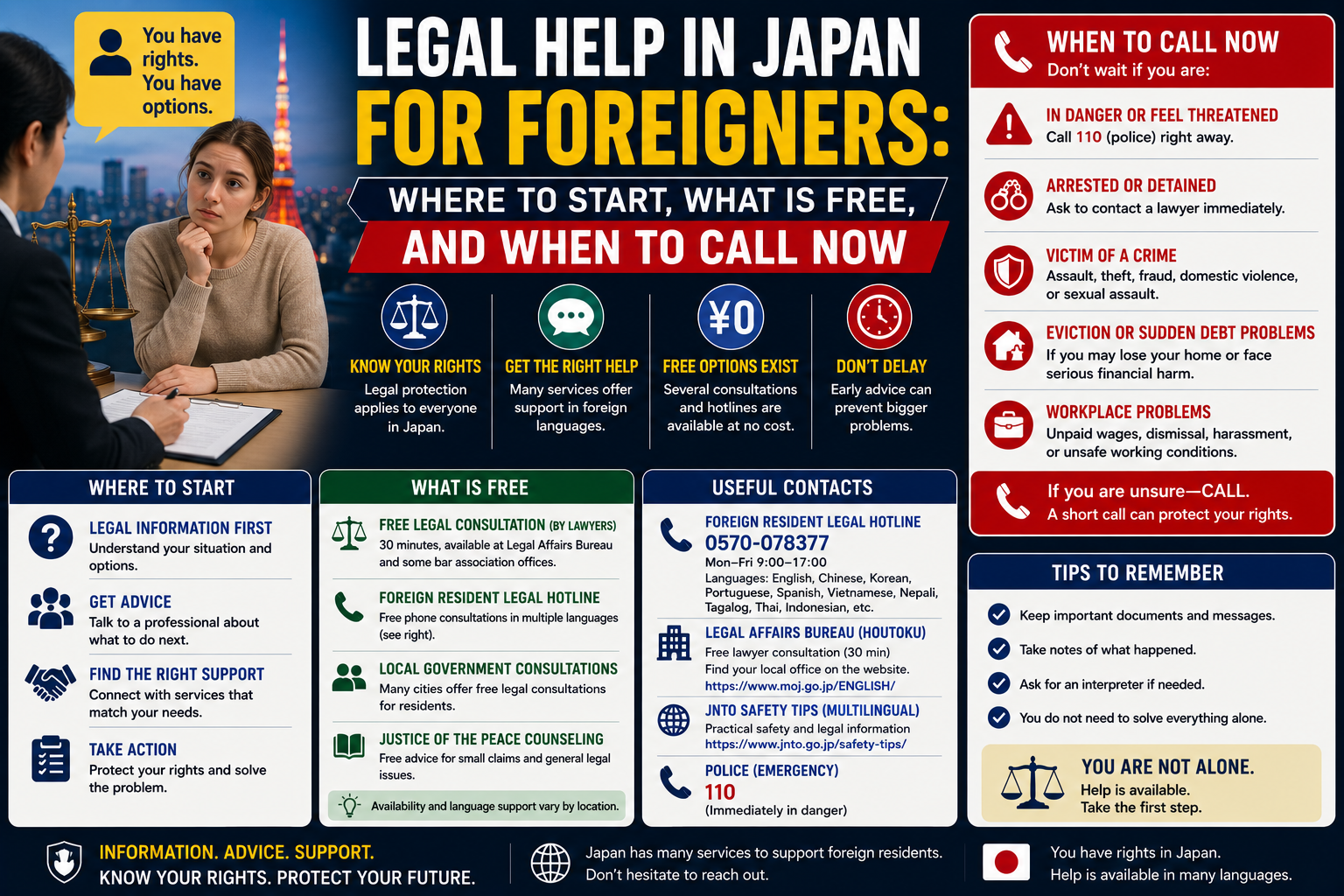
Legal Help in Japan for Foreigners: Where to Start, What Is Free, and When to Call Now
If you need legal help in Japan, the best first step is usually not to search for a private lawyer on your own. Start with the right public contact point for your problem.
If it is an emergency, call 110. If it is not urgent but you need police advice, use #9110. If you mainly need guidance on contracts, work, discrimination, or residence procedures, Japan has official hotlines and support desks that can point you to the right next step.
- Do not wait for your problem to become a court case. Many issues can be handled earlier through a hotline, mediation, a labor office, or a consumer center.
- Start with a service that matches the problem. Police, labor, consumer, immigration, and human rights desks handle different issues.
- Some support is free. Houterasu gives free legal information, and some people may qualify for civil legal aid.
- Rules and access points vary by topic and region. National hotlines exist, but local consultation centers may handle the practical next step.
This guide is for tourists, students, workers, and long-term residents who need a clear first move in Japan. It matters most when you are under time pressure, your Japanese is limited, or you are not sure whether your issue is a police matter, an immigration matter, or a civil dispute.
Start Here: Which Problem Do You Have?
A lot of confusion comes from treating every problem as “legal help.” In Japan, the first contact point depends on what actually happened.
If you are in immediate danger or a crime is happening
Call 110 right away.
Use this for situations such as:
- violence or threats
- stalking or sexual assault
- theft or fraud happening now
- a serious traffic incident
- being forced to work or move against your will
If the situation is not urgent but you need police consultation, use #9110 or contact the nearest police station. This is the better route when you need advice, want to discuss a report, or are unsure whether the matter is criminal.
If the problem is about work
Use the Ministry of Health, Labour and Welfare’s foreign worker consultation services.
These are useful for:
- unpaid wages
- sudden dismissal
- excessive overtime
- dangerous work conditions
- threats from an employer
- confusion about employment contracts
The ministry’s Telephone Consultation Service for Foreign Workers accepts multiple languages. The English line is 0570-001-701 on weekdays, and there is also an after-hours Labour Standards Advice Hotline.
If the problem is discrimination, harassment, or abuse
Use the Ministry of Justice’s Foreign-language Human Rights Hotline: 0570-090-911.
This is an important route if the issue is not only rude behavior but a rights problem, such as:
- discrimination because you are foreign
- bullying at school
- workplace harassment with a human-rights angle
- abuse inside the home
- refusal of services linked to discriminatory treatment
The Ministry of Justice also accepts online human rights counseling in foreign languages.
If the problem is a bad contract, scam, purchase, or service dispute
Use the Consumer Hotline 188.
This is the right place for problems like:
- subscription or cancellation disputes
- misleading sales tactics
- repair or moving service trouble
- travel, lodging, restaurant, or shopping disputes
- online purchase problems
One limit matters here: 188 is Japanese-only. For overseas visitors with consumer trouble in Japan, the Consumer Affairs Agency also lists a tourist hotline at 03-5449-0906 in several languages.
If the problem is about visa or residence status procedures
Use the Immigration Services Agency’s Foreign Residents Information Center.
This is the correct first contact for:
- extension or change of status of residence
- residence card procedures
- reporting changes after job or address changes
- questions about required immigration documents
The official contact number listed on the Immigration Services Agency procedure pages is 0570-013904 or 03-5796-7112 for IP phones and calls from overseas.
When Houterasu Is the Best First Step
If you are not sure where your problem fits, Houterasu is often the most practical starting point.
Houterasu is Japan’s public legal support center. Its multilingual information service explains the legal system, tells you what kind of office handles your problem, and can refer you to the next service. That matters because many foreigners do not need a lawyer first. They need the right desk first.
You can call Houterasu’s multilingual line at 0570-078377. If you use a VoIP phone or a prepaid mobile phone, the alternate number is 050-3754-5430.
What Houterasu can do:
- explain basic Japanese legal procedures
- tell you whether your problem is civil, criminal, labor, consumer, or administrative
- direct you to bar associations, local offices, or other public services
- provide multilingual support through a three-way call with an interpreter
What Houterasu does not do:
- give final case-specific legal advice on the phone
- replace emergency police help
- handle general legal consultations from people living outside Japan, except for limited Hague Convention matters
Key point: If you do not know whether your issue belongs to the police, immigration, labor, or a lawyer, start with Houterasu before paying for a private consultation.
What Is Free and What May Cost Money
This is where many people make the wrong assumption.
The first information step is often free, but full representation usually is not.
Usually free or low-cost first contacts
- Houterasu multilingual information service: free, but normal call charges apply
- Ministry hotlines for labor or human rights: consultation access is public, though phone charges may apply depending on the line
- Consumer Hotline
188: consultation is free, but call charges apply - Local multilingual consultation centers: often free for first guidance
When a lawyer may cost money
You may need to pay when:
- you want a lawyer to negotiate for you
- you need court representation
- you need a contract letter reviewed in detail
- you need ongoing advice on a dispute
Civil legal aid in Japan
Houterasu also offers civil legal aid for people with financial difficulty.
As of the Houterasu English guidance checked in May 2026, this support can apply to civil, family, and administrative matters handled in civil procedures. It does not cover criminal matters. Eligibility depends on factors such as lawful residence in Japan, income, assets, and whether the case has a realistic basis.
That distinction is important. If you were arrested, accused, or questioned in a criminal case, do not assume the civil legal aid route applies.
If You Are in Tokyo, FRESC Can Save Time
Tokyo has one especially useful option: FRESC, the Foreign Residents Support Center.
At FRESC, Houterasu works alongside other agencies, including immigration and labor-related services. That setup matters when one problem affects several areas at once, such as:
- an employer who withholds wages and also controls your residence-related paperwork
- a family issue that affects immigration status
- a contract dispute that also needs help from another public office
Houterasu at FRESC provides information in person or by phone without charge or reservation. If you call the multilingual Houterasu number, you can ask to be connected to FRESC.
Local Differences Matter More Than Many Readers Expect
Japan has national laws, but your practical route often becomes local very quickly.
For example:
- police handling is local after the first report
- consumer centers are run through local systems
- labor consultation may lead to a prefectural labor bureau or inspection office
- multilingual resident support varies a lot by prefecture and city
If you live outside Tokyo, check the CLAIR list of multilingual local consultation centers. These centers are not all law offices, but they are often the fastest way to find language support, municipal guidance, and referrals near your home.
Documents to Prepare Before You Call
A better first call usually depends on better notes, not better English.
Prepare:
- your full name and a callback number
- your address and prefecture
- residence status and expiry date if the issue is immigration-related
- names of the other person, employer, landlord, school, or company involved
- contract dates, payment dates, and key messages
- screenshots, bills, letters, notices, and photos
- a short timeline of what happened
If your Japanese is limited, write a five-line summary in simple English first. Dates, amounts, and names matter more than long explanations.
Common Mistakes to Avoid
Waiting too long
Deadlines matter in labor disputes, consumer cancellations, immigration filings, and police reports. Even if you are unsure, make the first contact early.
Going only to social media or friends
Friends can help you interpret documents, but they are not a substitute for an official desk. Start with a public hotline when the issue affects money, status, or safety.
Mixing up immigration advice and legal advice
A private immigration document helper, a labor office, and a lawyer do different jobs. Use the immigration information center for procedure questions, and use Houterasu or a lawyer when the issue is also a dispute.
Assuming every problem needs court
Many issues are solved earlier through consultation, mediation, a formal complaint, or a negotiated settlement.
Not asking about language support
Japan’s public systems often look Japanese-only at first glance, but many have interpreter support or multilingual routes. Ask directly.
Current Status to Check Before You Call
As of May 8, 2026, the official pages checked for this guide showed:
- Houterasu multilingual legal information service available on weekdays
9:00 a.m. to 5:00 p.m. - Houterasu civil legal aid guidance for eligible civil, family, and administrative matters
- Ministry of Justice foreign-language human rights hotline on weekdays
9:00 a.m. to 5:00 p.m. - Consumer Hotline
188active, with a separate multilingual tourist line - Immigration procedure pages listing the Foreign Residents Information Center contacts above
Because hotline hours and language coverage can change, confirm the latest details on the official page before you call.
Final Practical Takeaway
If you need legal help in Japan as a foreigner, do not start by asking, “Do I need a lawyer?” Start by asking, “Which public desk handles this kind of problem first?”
For many people, the fastest workable route is:
110for immediate danger#9110for non-emergency police consultation- Houterasu for legal direction and referrals
- labor, human rights, consumer, or immigration hotlines for topic-specific help
- a local multilingual consultation center when language is the real barrier
The next thing to watch is not only your legal issue itself, but your deadline. In Japan, the difference between a manageable problem and an expensive one is often just a few days.
参照リンク
- Houterasu Multilingual Information Service
- Houterasu Civil Legal Aid
- Houterasu Services in Foreign Residents Support Center (FRESC)
- Ministry of Justice: Human Rights Counseling for Foreigners
- Ministry of Justice: Human Rights Counseling on the Internet
- Ministry of Health, Labour and Welfare: Counseling Services and Hotlines in Foreign Languages for Workers
- Consumer Affairs Agency: Consumer Hotline and Tourist Hotline
- Immigration Services Agency: Residence Procedures and Information Center Contacts
- Immigration Services Agency: Contact Information for the Online Notification System
- National Police Agency: Opinions, Consultations, and Information
- National Police Agency: Measures to Combat Trafficking in Persons
- CLAIR Multilingual Local Consultation Centers